The Boulevard Monster, page 4


That’s why I smiled when he called me dumbass. It took me back to Mom and Lummoxes, and the very special, real place we called Lurth.
“What kind of duck was it?” I asked as Dad continued rifling through the papers on the table.
He grumbled and shook his head, as though my question were ridiculous. “My duck,” he mumbled. “My duck.”
Dad had been diagnosed with dementia two years earlier. At first I thought he was just becoming forgetful like most seventy-year-olds. He’d put his car keys in the freezer, forget to take clothes out of the dryer, not lock the front door, things like that. But when he got lost on his way to United, a grocery store he’d shopped at for fifty years, and had to call me for directions home, I knew something was wrong. Something more than regular aging.
He fought going to the doctor for a while, becoming angry and agitated if I brought it up. But one day after he was filling out some paper work and couldn’t remember his own birthday, he called me and agreed to see Dr. Hale.
Along with putting Dad on several medications, Dr. Hale advised him to hire a home assistant, or to move into a retirement community where he could have daily supervision, but he couldn’t afford either. Other than his short stint in the army, he’d worked manual labor jobs his entire life, and his retirement plan was to work until he dropped dead. Shortly after diagnosis, he’d quit his job at Master Men Landscaping due to Dr. Hale’s safety concerns, forcing Brianne and me to help pay for his utilities, taxes on the house, and supplemental insurance coverage.
I made my way down the lit hall to his bedroom. His bed was covered in junk he’d dumped out of plastic totes. As I refilled the totes, Dad opened a closet door in my old bedroom across the hall and started rummaging.
After stacking the totes in his closet, I sat on the edge of his bed and buried my face in my hands. They still carried the scent of Brianne’s soap, her skin. “Duck, duck, duck,” I whispered. “What does he mean? He’s never been duck hunting. Maybe it was a postcard from an old army buddy or something. Did he ever…” Then it struck me like a bolt of lightning out of the clear blue sky. An image. A black and white photo of my dad and his mom and his beagle named Duck—the only dog he owned as a child.
I went across the hall and peeked into my old room. Mom had turned it into a sewing and craft room after I’d moved out. But now it looked more like an outdoor storage shed. There was a weed eater, a snow shovel, a trash bag full of crushed cans, and many unmarked cardboard boxes. “I’m going to the attic for a minute. I’ll be right back.”
“The ladder’s broke.” He replied without slowing in his closet search.
“All right. I’ll see what I can do.”
In the garage, I pulled down the attic door using the rope hanging from the handle, and a blob of July-hot air fell from the opening, carrying the smell of dust and wood. The ladder was supposed to unfold into a straight line, but the right side had snapped in two, making the lower half unable to support weight.
I found a flashlight on the shelf above the dryer, managed to bypass the lower rungs, and climbed into the attic. The last time I’d been up there was when I’d helped Dad and Brenda box up Mom’s clothes and craft supplies a month after we buried her at Harrington Memorial Cemetery. I crawled on a slim plank passed the boxes with her name on them and shined the flashlight beam on what I was looking for. A white box labeled PHOTO ALBUMS.
Mom could fill a photo album quicker than most people could fill a glass with tap water. There were probably fifteen or twenty in the living room closet, and five or six more in the white box. They weren’t all photos of the family. Some were of her garden from different years, or the sunset, or falling snow, or a blooming snowball tree she saw on her way to work. Holding the flashlight in my mouth, I balanced on the cross beams and hefted the box over to the plank. By the time I slithered back to the opening, dropped the box onto the garage floor, and jumped down, my shirt was soaked with sweat.
I carried the box inside the house and pulled out the grey photo album with a cowboy hat on front. On the second page behind a thin clear film was the picture. Dad, his mom (who died before I was born), and Duck were standing on a curb. Dad wore cut-off jean shorts and a white T-shirt and his hair was crudely cropped. His mom was wearing a lengthy dress, had shoulder length hair, and piercing eyes. Neither of them was smiling. Dad had his hand on Duck’s head. They’d named the beagle Duck because his head was solid black, and the rest of his body was white save a dark patch on one side that resembled a tiny wing.
I found Dad in his bedroom dumping out the totes I’d just put away. I held the picture up for him to see. “Is this what you’re looking for?”
When he saw it, the frustration in his eyes and tension on his face instantly disappeared. He snatched the photo out of my hand and headed to the living room. I re-packed the totes, put them away, and followed him. He was sitting in his recliner looking at the picture. His legs were kicked up on the footrest, eyes brimming with emotion. I didn’t know what to say. Dad had never been good at discussing emotions, so I just let him have the moment.
I straightened up the house, turned off all the lights, heated up a meatloaf TV dinner, and headed back into the living room.
“I heated up a TV dinner for you. It’s in the kitchen.”
He briefly moved his eyes to me, nodded, then looked back at the picture. He looked lost in the past, swimming in a pool of distant memories. I turned on the TV and set the remote on the armrest of his recliner.
“I guess I’ll get then,” I said. He nodded again but didn’t look at me. “I’ll call you later.”
Outside, the setting sun colored the clouds on the horizon gold and purple. Had Mom been alive the house would’ve been lined with three-foot sunflowers. The grass would’ve been dark green and thick. The hedge running along driveway trimmed to a perfect rectangle. But the yard was more dirt than vegetation now. Nothing had been trimmed or mowed or watered for years. Considering the condition of the yard, I should’ve been more suspicious of why there was a blue jay in the dying oak tree. But I wasn’t. I sat on the porch, puffed my cheeks, and pushed out a loud breath. It was a relief to be out of the house.
I was checking my cell phone to make sure I hadn’t missed a call when Brenda called out my name. I met her halfway across the yard and hugged her.
“Is he all right?” she asked.
“Yeah. He was looking for a picture of a dog named Duck.”
She smiled. She had a head of white hair, and her mouth and eyes were bracketed a couple of times over, but when she smiled, I could easily see the happy little girl she once was. “That’s what it was then. I should’ve figured that out. I remember that picture of him and his mom and that dog. Your mom showed it to me once.”
“Don’t worry about it,” I said.
She bit her lip, looked down. “I can’t imagine what it must feel like to know that you’re losing everything from your past. Everything that you are and were and will be.” She glanced at the house. “I wouldn’t wish it on anyone.”
“Me either,” I said, glancing at the house as well.
Following a short silence, she smiled again and asked how Brianne and Sera were doing. I told her fine, and she said she wished we’d come visit more often and I swore we would. After exchanging appreciation for the beautiful sunset, I thanked her for helping with Dad, hugged her, and headed to my truck.
I didn’t notice the small piece of paper crammed under the windshield wiper until I fired up the engine. I rolled down the window and grabbed it. My stomach turned to cement as I read the words written in fancy cursive letters.
Meet me at West Hill. Now.
Seven
Collaborative Burial
I’d never been to the West Hill site after sunset. I dimmed my headlights as I turned off 55th and slowly made my way down the dirt road. A Howe’s cement truck, two backhoes, and a T300 Bobcat were the only vehicles in the lot where we parked on workdays. The only sign of life: a sole blue jay perched atop the Bobcat that flew toward the shed when I killed the engine and rolled down the windows.
Keeping my eyes on the dirt road, I anxiously waited. Five long minutes passed with nothing. Five more. I took the note off the dash and read it again. Now. Just before I looked up to check the road again, Luther slapped the hood of my truck, and my heart jumped up into my throat. I slammed my elbow into the horn and dropped the note.
Luther laughed loud as he approached the driver’s side window. He had a burlap sack slung over his shoulder and carried it with ease. Like Santa Claus carrying a sack of toys. His Guayabera was even red and white. But I was certain his sack didn’t have toys in it.
“Why the hell did you do that?” I asked.
“You should’ve seen your face, man.” That unbreakable smile again. My back stiffened when he reached into the cab and picked the note up off my lap. “I see you got my note.” He shoved it in his pant pocket. “You ready?”
“Ready for what?”
He narrowed his eyes to annoyed slits and opened my door. “Let’s go get this over with. I’ve got a plane to catch.”
He dropped the sack and took off toward one of the foundations we’d poured earlier that week. When he looked back over his shoulder and saw I hadn’t moved, he ordered, “Come on.”
I slid out of the truck, scooped up the sack, and held it against my chest. It was heavier than it had seemed when Luther had carried it. Seventy-five to eighty pounds I’d guess. As I hurried to catch up with him, I tried not to feel the shape of legs in my hands, a head against my chest. Tried not to think about the fact that I was carrying someone’s kid. Maybe someone’s wife or husband. But I did. I did. And I kept walking.
Luther stopped on the backside of the 5103 foundation where the ground was leveled off. I stopped beside him and set the sack on the ground. He was staring at the copse of trees in the distance where the bird bandits lived, smiling as if listening to something other than the crickets that were clipping the night’s silence. Something mesmerizing. Something specifically for him.
I nervously checked the road to make sure no one was coming, then turned back to Luther. “Why did you want to meet me? I figured you wouldn’t want to—”
He snapped his head my direction, and I broke off. “That I wouldn’t want to be here when you did your job?”
I lowered my head but made sure to keep my eyes pointed away from the sack. “I figured—”
“You figured wrong. Maybe I wanted to be here because I like you, and I know it can be hard the first time.”
To my ear he sounded sincere. Sympathetic even. I didn’t know what to say. I kept my head down. Part of me believed him. The scared part that would’ve believed anything that meant I wasn’t out there alone with whoever was in the sack. But my instinctual, survival self, the part of me that clearly remembered his threats and the power of his touch, believed he was there to make sure I didn’t get cold feet or do anything stupid. Knowing what I know now, I think both parts of me touched on the truth.
“You’re going to pour the cement for the back porch tomorrow, right?”
I looked at him. I wanted to ask him how he knew that. How he knew seemingly everything about me. Who I was. Who I loved. Where I was and would be. But I didn’t have the courage for that yet. I cleared my throat. “Yeah,” I said. “We are.”
“Then that’s where we’ll bury the trash.” He marched toward the makeshift shed where we ate lunch, and I lost sight of him. My hands and knees were shaky. I checked the road again, then looked back toward the shed. I almost glanced down at the sack, but thought better of it.
Luther materialized out of the darkness, and as he grew closer, I saw he had a shovel in each hand. He handed me one and started digging without saying a word. I watched him scoop and toss a couple of times before joining in.
We dug in silence, but I dug clumsily, constantly glancing at him and back at the dirt road, while he dug swiftly, seemingly relaxed and at peace. I’m pretty sure we dug the five-foot deep, three-foot wide hole fairly quick, but it seemed to take forever, each scoop of dirt seemingly weighing a hundred pounds. When we finally finished, I was out of breath and sweaty. Luther looked like he’d just woken up from a refreshing nap.
“Toss it in,” he said.
Without looking directly at the sack, I picked it up, dropped it in the hole, and immediately started tossing dirt on it. I didn’t want to give myself time to think about the body, or for Luther to say anything at all. I wanted to finish and leave and pretend it never happened.
We filled in the hole and smoothed and leveled it off in less than half the time it had taken to dig it. Afterward, Luther handed me his shovel. “Now that wasn’t so hard was it?”
I took off my lucky Rangers cap, then looked at him and shook my head.
“Good,” he said. “From now on, you’re on your own.”
My phone vibrated, and he glanced at my pocket. “It’s probably your girl. She probably thinks you’re out with some other hussy.” He gave me a wide grin. I couldn’t tell if he was grinning at the notion that women think that way in general, or that Brianne might think that about me.
Using the bottom of my T-shirt, I wiped my face and rubbed my eyes for a moment. When I lowered my shirt, Luther wasn’t there. I spun in a circle, searching, but didn’t hear or see any sign of him. He was gone.
I put the shovels back in the shed and hurried to my truck. I didn’t check my cell until I reached the lit Toot’n Totum parking lot on 55th. Like Luther had guessed, Brianne had called. She’d left a message saying she was worried about me. She’d talked to Brenda and knew I’d left my dad’s house hours ago.
I didn’t call her back. I drove to Wizzards and took two shots and chugged three beers before going home to tell her about Duck.
Eight
Blue Jays, Blue Jays, Everywhere
My first big purchase was Esperanza’s tombstone. Sera and I drove out to Harrington Memorial Cemetery the morning it was placed. Harrington is located ten miles north of Mercy, and in contrast to the barren prairie that surrounds the rectangular lot, old elm and cottonwoods shelter the graves from the sun, and a quilt of green fescue covers the ground, coming to an abrupt stop at the fence lines as though it had been snipped with a giant pair of scissors.
I parked about twenty yards from Esperanza’s final resting place and killed the engine. “You ready?” I asked.
Sera looked up from her new cell phone and smiled. Brianne had helped her add streaks to her bouncy hair the day before. The cream color matched her tank top. Paired with a black skirt and black shoes, she looked prepared to audition for the X-Men. She looked beautiful. “Yep.”
“All righty. Let’s go.”
Sera snapped pictures with her phone as we approached the granite, half-circle tombstone, and I handed her the bouquet of stargazers we’d bought for Esperanza when we reached it. She knelt, laid the flowers down, and ran her hand over the tribal-themed design etched across the top of the tombstone—a design that matched a tattoo Esperanza had had on her upper thigh. “So awesome,” she said. “What do you think?”
“I think your mom would love it.”
“Me, too.”
Sera traced her fingers over her mom’s name.
“You want me to take your picture?” I asked.
“Sure,” she said. She squatted, wrapped her arm around the back of the tombstone, and laid her head sideways on the arc as if it were one of her most treasured friend’s shoulders. I snapped the picture, and then she took her cell phone back and examined it. “Looks good. My first picture with her since I was what…a year and half old?”
I nodded. Eleven long years ago. A different time. A different life.
Sera loved hearing stories about her mom. The only memories she had of Esperanza were still-shot images. And she wasn’t sure if those were real memories or wishful ones based on the pictures we had. One of which—Esperanza dancing in the living room of our apartment—was in a frame on her dresser. My stories were her only link to Esperanza’s past. When I’d tell her stories like the one where Esperanza gave our groceries to a homeless woman and her children sitting on the curb outside the supermarket, or the one where she’d slapped an old man after he’d smacked her butt as she passed by his pawn shop, Sera listened with wonder-glazed eyes.
I scanned the cemetery, stopping on my mom’s grave in the distance. Before Mom had died twenty years earlier, she’d bought side-by-side plots and a double tombstone for her and Dad. I held up the dozen daisies we’d bought for her. Her favorite. “I’m going to take these over to my mom.”
Sera was sitting Indian-style on the grass. “Is it okay if I stay here?”
“Of course. I’ll be right back.”
I propped the flowers on my mom’s side of the wide tombstone, told her that I loved and missed her, and that I hoped she was having fun in Lurth.
The last time I spoke to her, the night before she died, we didn’t talk about me, or her, or dad, or work, or anything else Earth-related. We talked about Lurth and Lummorville for the first time in years. For hours. We talked about the trees and animals and smells and colors. About all the weird relatives and adventures that awaited us when we returned. We even made up two new forms of transportation Lummoxes used—underground swimming tunnels driven by warm currents, and strap-on backpack wings. Before I left that night, after I hugged her, she asked me to do the Lurth handshake I’d made up as a child. I think she knew that was the last time I’d see her alive.
When I returned to Sera, she stood and handed me her cell phone. “Check this out.” It was a picture of Esperanza’s tombstone, and perched atop the arc, seemingly staring at the camera, perhaps even smiling at it, were two blue jays. “Cool, right?”
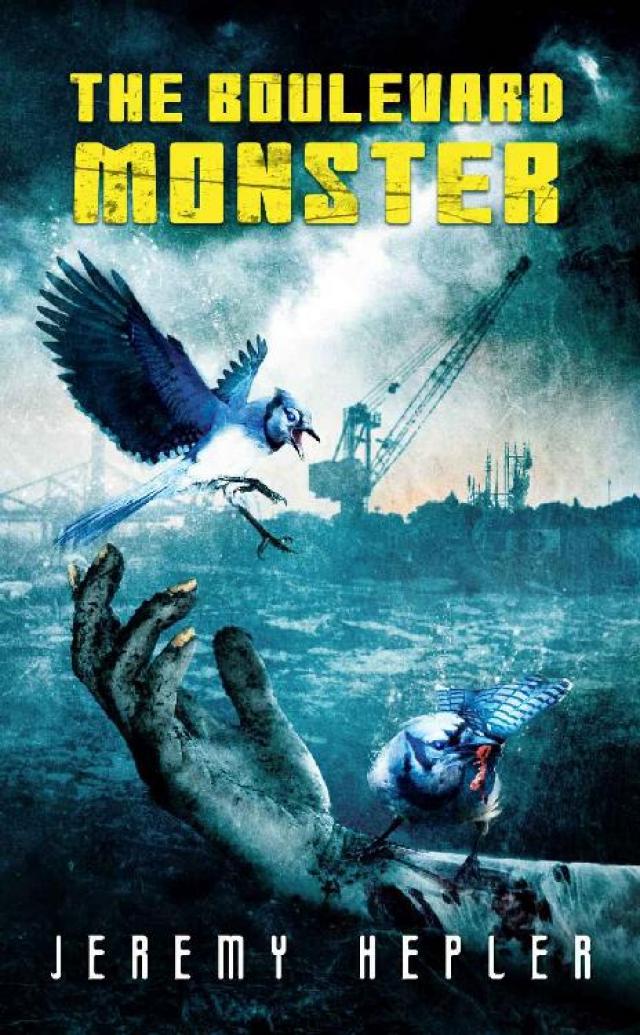
I nodded, at first not thinking much of it, but as I handed the phone back to her, I thought about the bird bandit blue jay that had stolen the note from under my lunchbox. Then the one on the Scion at the UA Cinema parking lot. The one in my dad’s dead oak tree in his front yard. The one on the Bobcat at West Hill that night with Luther. These two on the tombstone. Right then an alarm bell went off inside my head. The blue jays were linked to Luther. I could’ve kicked myself for not seeing it sooner. They were his. They had to be. But what could they…were they—