Prose & Poison, page 1
part #1 of Cafe Prose Mystery Series
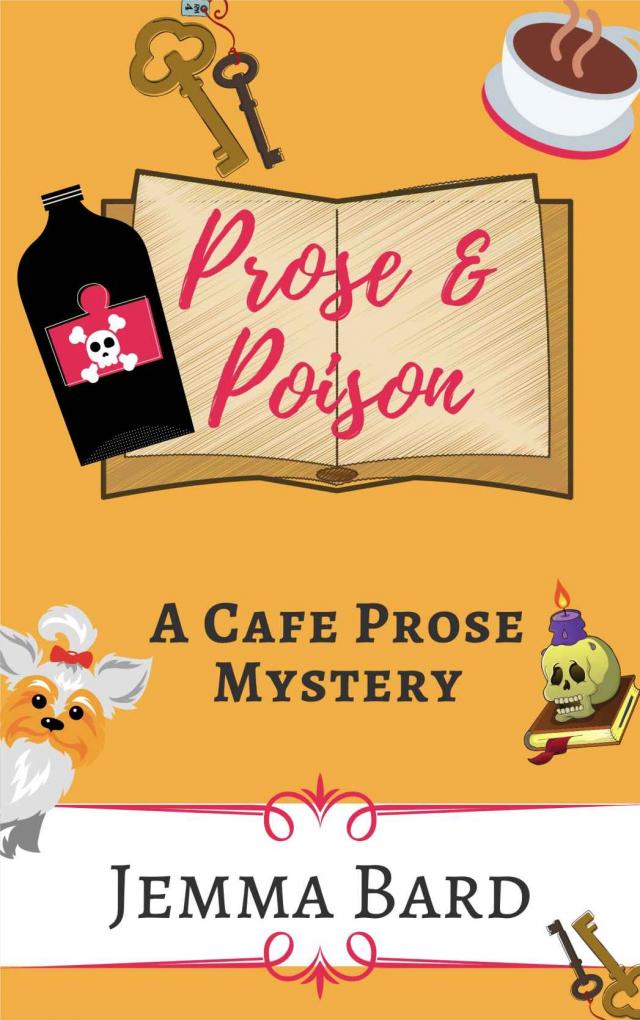


Prose & Poison
A Cafe Prose Mystery
Jemma Bard
Prose & Poison
Jemma Bard
The characters and events portrayed in this book are fictitious. Any similarity to real persons, living or dead, is coincidental and not intended by the author.
Copyright © 2019 by Jemma Bard/Jennie K. Brown
All rights reserved.
No part of this book may be reproduced in any form or by any electronic or mechanical means, including information storage and retrieval systems, without written permission from the author, except for the use of brief quotations in a book review.
http://www.jemmabardauthor.com
For new releases, give-aways, and cozy freebies, become a member of Jemma’s Reader’s Club
For my greatest inspiration — William Shakespeare
Contents
Chapter 1
Chapter 2
Chapter 3
Chapter 4
Chapter 5
Chapter 6
Chapter 7
Chapter 8
Chapter 9
Chapter 10
Chapter 11
Chapter 12
Chapter 13
Chapter 14
Chapter 15
Chapter 16
Chapter 17
Chapter 18
Chapter 19
Chapter 20
Acknowledgments
Chapter 1
“Can you go any faster?” I asked Elliot, my Uber driver.
Elliot huffed. “Sorry, lady. This is the best I can do,” he said as politely as a twenty-two-year-old with a hangover could.
I sucked some air between the tiny gap in my front teeth as the traffic slowed to a stop on Willow Tree Bridge, the main route in and out of my hometown of Willow Creek, Pennsylvania, while I sat in a boxy late-90s Ford Escape that smelled of stale cigarettes, spilled coffee, some sort of meat, and the faint remnants of one of those pine-tree car fresheners. An odd combination for sure.
I reached into the dog carrier to my right and rubbed the little patch of gray behind Romeo’s ears, his favorite spot. “Almost there, boy,” I assured my pint-sized, six and a half pound yorkie. He wagged his tail in approval.
“What was that address again?” Elliot’s tattoo-covered hand fiddled with his phone. “Lost the connection on my GPS.”
I sighed, remembering that Willow Creek is a black hole for some phone providers. “Forty-seven Maple Avenue. But I can just tell you where to go from here.” We were about a three-minute car ride to my destination. The house where I grew up. The house just a block away from my Aunt Tilly. Aunt Tilly — the reason I’m making a rare appearance in Willow Creek this morning.
“It always backs up this time of day,” Elliott said, pulling from the glove compartment the latest issue of Sports Illustrated Magazine. “Ever since they started updating the bridge.” He reclined his chair back so far, the top of his seat hit the hard luggage case where I rested my left arm, and he began reading an article on women who mountain bike in bikinis.
I rolled my eyes and then scrolled through my phone, searching for any more messages from my mother. I checked my voicemail and then my texts. Nothing new. Just the last message she sent at 6:08 a.m. I’d just gotten out of the shower, about to get ready for my job appraising rare books at the Library of Congress when the message came through.
Get home ASAP. Aunt Tilly’s had an accident.
As soon as the message binged on my phone, I’d called Mom back, but it went to voicemail, just like it did the next ten times I’d tried. Other than Mom and Romeo, my Aunt Tilly was my favorite being in the entire world. So I did what I had to do — called off work, packed an overnight bag just in case, grabbed the nine-fifteen Amtrak to Philadelphia, and then ordered an Uber for the hour and a half ride through the flat, farm country of central Pennsylvania to Willow Creek. So here I sat, wedged between my luggage (and now the dirty head of my Uber driver), and my pint-sized yorkie in the back seat of a smelly car. At least the scenery was nice. The bridge we sat on overlooked the Elm River, and trees with leaves of crimson, rusty orange, and yellow lined the banks. “Welcome home,” I murmured.
Elliot’s seat suddenly lurched forward, throwing me off balance. “We’re moving.”
I sat up straighter, catching my reflection in the rearview mirror. I cringed. This was not a good look for me. My blonde, chin-length hair flipped out on the ends because I hadn’t had the chance to put a straight iron to it. Dark circles, ones my glasses couldn’t even hide, cupped my eyes. And worst of all, a small pimple had appeared on my chin in a matter of four stress-filled hours. In the past, I’ve been told I have an “adorable, elvish kind of look about me”, with my heart-shaped face, large green eyes, and button nose. But as I looked at my reflection in Elliot’s mirror, I settled more on the “sight for sore eyes kind of look”. I frowned and then pinched my cheeks for color.
“Keep going straight,” I directed Elliot as we came off the bridge. “Follow this main road through town square, and then Maple will be the third street on your right.”
Elliot grabbed what appeared to be a cheese and Lebanon bologna sandwich from the center console and took a bite. That explained the suspicious meat smell. I gagged inside; who knows how long it’d sat there. Thank goodness the temperature inside the car hadn’t warmed it up too much on this chilly autumn day.
Elliot gestured toward the center of town, sandwich in hand, and a few crumbs fell to his lap. “Cute town, lady,” he noted.
And it was cute, even if I wanted to be anywhere but here. Willow Creek was one of those towns that seemed plucked straight out of a Hallmark movie. At the end of the bridge, two weeping willow trees framed a blue sign that read Willow Creek in swooping cursive letters. Underneath the town’s name was the updated population of 1,747. A generous twenty more people than when I’d left fifteen years ago.
Willow Tree Bridge turned into Willow Street, the main thoroughfare running through the center of town. A large green fountain sat in the middle of the square, and in its center a union soldier stood with his gun to his right and a bent left arm leaning atop a regal, brushed metal horse — a sculptured reminder of the historic “Burning of Willow Creek” that demolished the entire town during the Civil War. Every summer, villagers donned period clothing and reenacted the battle that ensued leading up to the great burning.
Elm Street, where all the town’s “official businesses” were housed, intersected Willow Street. East Elm Street boasted the Willow County Courthouse, the Law Offices of Baker and Fellows, and The Public Opinion News. Willow Creek Pharmacy, the Public Library, and the local police department ran along West Elm.
Once past the square, shops of all kinds lined each side of Willow Street — Trickling Springs Creamery, A Stick of Butter Bakery, Color Me Crafty, and my favorite of all — Cafe Prose, a coffee shop slash used bookstore inherited, owned, and operated by my childhood friend Piper Stone. I spent hours and hours, days upon days in the stacks of Cafe Prose growing up, sipping on chai tea, reading the works of Austen, Shakespeare, and the Bronte sisters. Cafe Prose was one of the reasons I got interested in the rare and antiquated books business in the first place. I shuddered to think of the other reason — my high school boyfriend’s grandfather — Harold Ellerton, and discovering a first edition of Alice in Wonderland in his extensive collection.
I sighed fondly as we passed by the cafe and remembered why it was so special to me — my childhood days reading at Cafe Prose took my mind away from my father’s murder when I was just twelve. The only true crime Willow Creek had ever seen. The only unsolved mystery.
I smiled. “It is a pretty cute town, isn’t it?” I finally answered Elliot. It had been a while since I spent real time here, so I almost forgot about Willow Creek’s charm. How it sucked you right in.
A flickering of white caught the corner of my eye as we passed the two storefronts of Alice’s Gifts Galore and Here’s Looking at You. Attached to the brushed bronze street lanterns in front of the shops hung signs for the mayoral race. “Make Willow Creek Safe Again. Vote for Harold Ellerton.” “Humph,” I muttered. First of all, if Mr. Harold Ellerton the Third thought that anyone in their right mind would vote for him, then he was delusional. I would never vote for, just as I’d never forgive, the man who used his academia ties to have my acceptance to Georgetown University revoked. And second, wasn’t he in his late seventies by now? It didn’t matter anyway. With the kind of money Harold had, he’d probably buy his way into the mayoral position.
My eyes drifted to the next lamppost and a woman wearing a familiar pink raincoat with purple leggings and bling-y boots standing in front of it. “What the? “STOP,” I yelled.
I held onto Romeo’s den as we lurched forward. “Did I miss my road?” Elliot reached for the rest of his sandwich that flew to the front of the dash.
It couldn’t be.
I squinted to get a better look at the woman whose hair sat atop her head in a messy bun with a few gray ringlets of curl falling loose. “You’ve got to be kidding me,” I muttered as she leaned a sign against the post in front of Ellie’s World of Pancakes with six words written in capital letters written on it — DON’T BE A BORE, RE-ELECT MOORE.
The woman turned. “Aunt Tilly?” I mouthed as my perfectly healthy, able-bodied, non-ailing Aunt Tilly, former off-Broadway actress, older sister to my Mom, and aunt extraordinaire to me — Talbot Juliet Meadows — stared at me with a wide grin and my same inviting emerald eyes.
Elliot dropped Aunt Tilly and me in front of my childhood home, and immediately I noticed the vibrant purple trim and shutters from the Queen Anne house had dimmed to a dirty lavender. Vines of ivy wrapped around the sullied pillars holding up an upstairs porch that tilted slightly to the left. Sure, Mom’s house could use some sprucing up, but it wasn’t as if she got paid a ton of money as a police department secretary who moonlighted as a gardener. Plus, knowing Mom, she didn’t care about the appearance of her house. “Family, flowers, and food make a home. Nothing else,” she’d say.
“Busy!” Aunt Tilly called my Mom’s name as we walked through the threshold. The house smelled the same familiar blend of dust and seasons — a mix of lavender, vanilla, pumpkin spice, and pine. The scent wasn’t the only thing that hadn’t changed though. The looming grandfather clock still ticked in the entryway, piles of books and magazines were stacked on the desk in the home office to my right, and Annabelle Lee, Mom’s pleasantly plump twenty-two-pound cat, scampered under the wing-backed chair in the living room after catching a glimpse of Romeo. Seriously, that cat was three times the size of my dog. What did she have to be afraid of?
Aunt Tilly unwrapped the flowing, striped scarf from her neck and placed it haphazardly on the antique entry table marked with scuffs and scratches. The clicking of heels on the well-worn, hardwood floors grew louder and louder until my mom poked her fluffy red hair around the corner.
“Talbot?” Mom chirped, rushing toward me. She leaned over and wrapped her boney arms around my back. “It’s so nice to have you home!”
“Hi, Ma.” I pulled away, taking in the batter splattered across her cheek and down the front of her apron. “I saw your text about Aunt Tilly and got here as soon as I could.” My eyes scanned from the top of Aunt Tilly’s head to the tips of her pointy, bedazzled boots and smirked. “Looks like she’s just fine.”
Mom wiped her hand on a dish towel with small red and yellow poppies stitched on it, and then tossed it over her shoulder. “Of course she’s fine. What would make you think otherwise?”
I scrolled to the messages on my phone. “Because of this,” I said, pushing the phone toward her face.
Her eyebrows scrunched together. “I didn’t send that.”
What? “But it came from your name. Your number.”
She flicked her wrist at me. “I misplaced that stupid phone …” Mom paused and looked toward my aunt. “What, Tilly? About five, six days ago?”
Aunt Tilly counted on her fingers. “Didn’t have it at the fall fest on the 14th or at the grand-opening of that new winery across town the night before.” She nodded adamantly. “So, yes, six days ago or so. Your mother’s turning into me, always misplacing something.”
She was right, and unfortunately, I’d inherited my aunt’s same clumsy tendencies.
I tilted my head to the side. “So you’re telling me I came here because of some fake text message sent from your lost phone?”
Aunt Tilly placed a dramatic hand to her head. “It does appear so, my dah-ling.”
“And when will you move into the twenty-first century?” I accused my aunt, the one person in the entire world who still used a rotary phone.
She flicked her hand. “Pish-posh to that technology,” she said with the cockney English dialect she had used playing the role of Eliza Doolittle in Pygmalion back in the early ‘90s.
“So who has your phone then, Mom?” I asked.
She shrugged casually. “No clue. Probably left it in someone’s garden.” She laughed and then raised an eyebrow at me. “Since you’re here however —.”
“Stay for a few days!” Aunt Tilly yelped, clenching her fists and jumping in the air.
Mom kissed the top of my head. “Yes! It’s Friday, you’re already here, so why not make a long weekend out of it?”
I bit the side of my lip. “Well … it has been a while since I stayed.”
Mom cleared her throat and gave me the eye. “Fifteen years, a while.”
“Not fair!” I protested. “I visit every Easter and Christmas.”
Mom huffed. “Always on a holiday and never for more than a few hours.”
She had me there. But Willow Creek has a magical way of sucking you in and never letting go. Fifteen years ago when I left, there were things I had wanted to let go of, to leave in Willow Creek. But it had this intangible, charming pull, and I’d done too well on my own to get sucked back in.
Mom and Aunt Tilly on the other hand would love this town to lure me in like a starved fish. All Mom ever wanted for me was to finish high school, marry my high school sweetheart Patrick Ellerton-Bluebell, take a librarian assistant position at the public library, move right down the road, and have babies. More importantly, give her lots of grand babies. Don’t get me wrong … Mom was certainly proud of me and my accomplishments — graduating top of my class from University of D.C., scoring a few book appraisal jobs in small, private bookshops around the city, and then getting my current, coveted role at the Library of Congress as an Associate Appraiser.
However, Mom didn’t forget the real reasons I never stayed longer than I had to — Dad’s death and the high school graduation incident of 2003. In fact, I was pretty sure the entire town, minus my fabulous and oftentimes oblivious Aunt Tilly, hadn’t forgotten about that incident.
So, it was easier to just pass through Willow Creek at the major holidays for a nice, just-long-enough, eight-hour visit. And the best thing about reappearing during holidays — everyone was too preoccupied with their families to worry about a visit from the town’s number one heartbreaker — me.
“Okay, Mom.” I put my hands up in surrender. “I’ll stay the night. But I have a whole room full of rare materials in D.C. waiting for me, so I’ll be leaving tomorrow.” Truth be told, the room full of rare materials waiting for me had been appraised weeks ago and work had been a bit slow lately, but she didn’t have to know that detail.
“Wonderful,” Mom clasped her hands together. “I use your old bedroom for storage now, so you can stay above the garage for the night.” A sudden look of terror showed on Mom’s face. “Oh, no!” she shrieked. “The scones.” She spun on her heels, the dish towel falling to the floor behind, clicked down the hallway, and disappeared into the kitchen.
“The garage?” I turned toward my aunt and pouted my lips. “Aunt Tilly. Can’t I just stay with you?” I begged.
She shook her head. “No, dear. The Willow Creek Players are performing A Midsummer Night’s Dream in three weeks, and my cottage is drama headquarters.” She bent over in a curtain call curtsy.
I laughed. “Of course it is.” Aunt Tilly, aka Matilda Eleanor Hepburn (not of the Audrey and Katharine Hepburns), retired from performing in off-Broadway musicals and moved back to Willow Creek after three marriages and a thirty-year acting stint in New York City. Like I said, Willow Creek has a way of bringing people back.
Aunt Tilly grabbed her scarf from the table and re-wrapped it around her neck. “Plus, your mother saved some money to have the junk room above the garage remodeled.” She grabbed my hand and winked. “I think you’ll quite like it.”
This I had to see.
* * *
The wooden steps creaked under my sneakers as I made my way to the renovated space above the detached garage. “What do you think?” Aunt Tilly pushed open the freshly painted forest green door.
“Holy moly!” I exclaimed, stepping into the new room. No, scratch that. The new studio apartment. To my right was a small living space complete with a navy and cream sofa, two cream wingback chairs with nautical rope fabric pillows, and a coffee table made from ... “Is that the wood from Dad’s old boat?” I asked.
Aunt Tilly nodded. “Your mom was going to sell it, but I talked her out of it.”