Fiend, page 1
part #3 of Voice of Blood Series


PRAISE FOR JEMIAH JEFFERSON AND
VOICE OF THE BLOOD!
“Die-hard vampire fans are going to love it!”
—Hellnotes
“Jemiah Jefferson has proven herself as an author to watch with this novel. If you let Voice of the Blood get under your skin, you’ll be hooked.”
—Horror World
“Jemiah Jefferson [is] a welcome voice in character-driven horror fiction.”
—Gothic.net
“Jemiah Jefferson draws us into an erotic, violent and tragic world of vampires. . . . Voice of the Blood delivers all the bittersweet irony and tragedy requisite of modern Gothic horror.”
—Dark Realms
THE MOMENT OF HIS CREATION
She pressed her lips against the side of my neck, and I felt a minute pinch as her teeth nipped me. I stroked the bones of her spine with my fingertips for a moment before I lost all will and ability to move, unable to do more than emit a deep sigh. I heard nothing but the sweet low throbbing of blood against my eardrums.
“What have you done,” I whispered, my voice too slight to make a question.
“I saved you,” she said. She kissed me, pushing the taste of my own blood into my mouth. How delicious it was, ripe with cognac. “You will never again be alone, my sweet boy,” she whispered with a kiss.
Of course I believed her. And she spoke truth indeed. But I did not yet know the face of the murderous desire that would become my constant companion, did not feel the velvet noose that would strangle me, nor hear the lover’s whisper of the guillotine that would sever me from my soul.
And the darkness consumed me.
Other books by Jemiah Jefferson:
WOUNDS
VOICE OF THE BLOOD
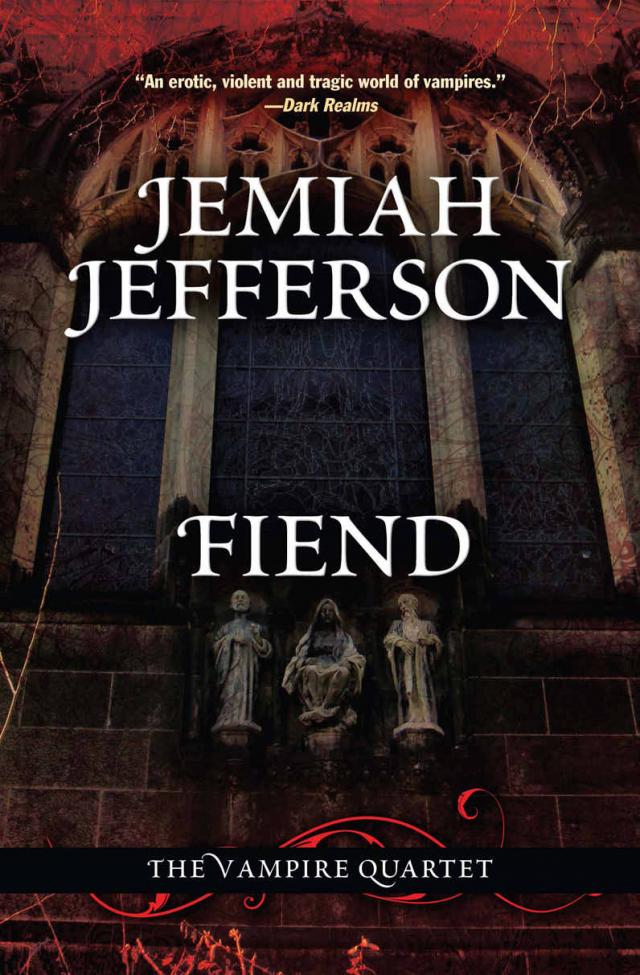
JEMIAH JEFFERSON
FIEND
The characters and events portrayed in this book are fictitious. Any similarity to real persons, living or dead, is coincidental and not intended by the author.
Text copyright © 2005 Jemiah Jefferson
All rights reserved.
No part of this book may be reproduced, or stored in a retrieval system, or transmitted in any form or by any means, electronic, mechanical, photocopying, recording, or otherwise, without express written permission of the publisher.
Published by Montlake Romance
P.O. Box 400818
Las Vegas, NV 89140
ISBN-13: 9781477807026
ISBN-10: 1477807020
To my dead homies:
Julia Margaret Harrison
Rich Will Powers
Rocio Q. Kosok
You made me greater than I ever imagined possible.
Content
Title
Copyrights
Acknowledgments
Prologue: The Coffin
Recommendation of a Departing Soul
Olive Oil
Litany
Inside
Intoxication
We Began at Midnight
Halo
La Vie Nouvelle
Chicot
Revolution
Avalanche
Revelation
Conflagration
La vie Parisienne
A Generation Come and Gone
Reintegration
Shorthand for Hamlet
Through Black Smoke
Conjoining
The Berlin Schnauze
“Can It Be Done?”
Potential and Kinetic Energy
So Much Darker Nearing Dawn
Simple Justice
Knives Out
Battle
Receive My Spirit
This title was previously published by Dorchester Publishing; this version has been reproduced from the Dorchester book archive files.
ACKNOWLEDGMENTS
Enormous thanks to the people without whom I could not have completed this book: my benefactor, Jon Lasser; my beloved readers, Cecilia, Myrlin, Blossom, and Sedona; Dr. Carol Timpone and the interns at the Pacific University Vision Center, for taking care of my eye; my editor, Don D’Auria, and the cool folks working at Leisure; Mom and Dad and Terry and Gary and Joey, for being proud to be related to me; and to all my friends and fans—thank you for sticking with me.
Ho con me l’inferno mio.
I have my own hell inside me.
—Ranieri di Calzabigi, Orfeo e Euridice
PROLOGUE
The Coffin
My God—give me light!
The coffin is smaller than I had imagined it would be. The silence screams in my ears, and only a faint whisper of air leaks through a hairline fissure in the unvarnished wood. My heart has not beat in so long, I can no longer remember how that feels. And yet I lie awake, staring at nothing. No light can reach my eyes here in the crypt; and yet I see. I do not breathe, and yet I breathe. I am neither asleep nor awake.
I am certainly not dead.
It has been a long time since I heard the faint scraping sounds of Father Christopher cleaning mortar from the last sepulchral brick, his whisper of the Final Rites, and his quiet, vanishing footsteps away. I do not hear him anymore. I do not miss him. But I could smell the track the tear made, cleansing a path down a dusty, unshaven cheek, and felt my own eyes ache in sympathy.
I was his friend, as much as he is mine.
And yet I smelled his tears, and my stomach clenched with hunger for his blood.
I imagined springing onto his neck, where the red furze of his beard grew sporadically, and before he could draw another mournful breath, ripping into his throat, spilling his life into my mouth. The taste of the sea, the scent of human terror, just barely thicker than water, indelible, infinite, the taste of God Himself—
No! No more of these thoughts! I will end this!
I am a murderer, demon-possessed, a monster, an unnatural, accursed fiend. I know that with the same certainty that I know that I am a man. But, indeed, am I even still a man? I am no longer human. My humanity was taken from me.
No, I gave it willingly. God forgive me. I remember.
That is why I am here, now, in this narrow pine box on a shelf, in the catacombs below an English cathedral. I seek to protect humanity, to protect the Father Christophers, to defend the lamb against the leopard, the vicious slinking predator inside me. I will suffocate this beast. I shall die at last.
Time for my rest, Lord. Please allow me to close my eyes and not open them again, even if it is only to be cast immediately into Hell. I have sinned too often, and too wickedly, for me to expect otherwise. But have I not made penance enough? Am I not allowed, even so, to seek forgiveness? Do mankind’s rules even still apply to me?
I am tired. I am one hundred forty years old, and I am tired. Please, Lord, I am tired; I humbly beg you to let me sleep, to know a final oblivion.
I wished that everyone I loved would live forever and never be taken from me. Please forgive me.
I wished for extraordinary mysteries to be revealed. I wanted to know everything. I wanted to be everything. Please forgive me.
I wished the devil’s inexorable powers of temptation. Please.
I wanted to be a god.
No. No longer. I want nothing, except an ending. The ultimate denial. I am finished. I am ready to leave the party; I am weary and I want to go home. I want to return to the earth from whence I came, pull up a coverlet of earth and stone, and know no more of myself or anything else.
Please, let me die.
I don’t even know if that’s possible.
My eyes remain open.
Recommendation of a Departing Soul
What is this, this disease, this mutation, this deformity, this insanity, this vampirism? What is it, truly, that has refused, for twice the age of a man, to release me? What kind of monster have I become, that my prayers to the Mother of Mercy go ignored?
I was not born this way. I was created. I was given this warped form, these desires, as an act of love, of hunger, and of power over the weak-minded. For (it is true) all mortals are weak-minded to the vampire. I offered no resistance—no, not at all! I leapt into the arms of perdition with an exceptional zeal. But I was heading there, even before. I have never been virtuous. Compassionate, perhaps. Generous, absolutely. And I have continued to observe my sacred duty, even broken and bloodstained. I take Communion, I ask liturgical counsel, I seek absolution. My beads are even now wrapped around my hands, my index finger resting on the yellowed ivory crucified body of Our Lord.
Credo in Deum Patrem omnipotentem. Amen.
But there has not ever been a catechism written for my kind. I may well be the only blood-drinker who has ever had the Rites performed for him; the rest simply perish, undoubtedly horribly, in fire and misery. Or perhaps they do not perish at all, and go on living, trapped in a cage of rotting meat and silk, as I do, praying for my thoughts to cease.
There are so many more things, now that it’s too late, that I would like to ask Father Christopher about. . . .
I felt him anointing my eyelids with oil as I lay paralyzed in the coffin, and I know by his thoughts (wavering like words written in mist on a mirror) that he wondered if the consecrated oil would burn or blister my skin. Father Christopher had to see for himself if I was the kind of monster I confessed to him that I was. (Foolish man; did he not recall seeing me take the Body and Blood every Saturday night for the last five years? Surely he could not be deceived by penny-dreadfuls and picture shows? I have a higher opinion of him than that!) When nothing happened, his relief was so palpable that I let out a faint wheeze of a sigh. And then, if I am not mistaken, Fath
Earlier, he had pushed back my lips for a closer look at my four sharp fang teeth, no longer subtle, easily concealed points, but grown long and savage with age. He wondered how he had never noticed this unmistakable sign of my true nature before. He lifted my hand and squeezed my wrist in vain, searching for a discernible pulse. He pushed back my eyelids to look closely into my unfocused eyes. I perceived a dull glow, nothing more, but I sent my thoughts into his mind, requesting that he stop. I am not certain that he knew that it was my ethereal interjection, but he let my eyelids relax, and then began daubing oil on my bare chest, over my motionless heart.
That was not the first time I frightened him, but he never pissed himself like that before. Perhaps my true nature didn’t seem real until he thought I was dead—that he had performed the Unction and offered me indulgences and prayers as I breathed my last. I had looked dead for two days—and then I moved, and showed him that I somehow still live.
He did finish the Rites, finally, though it took him almost an hour to grasp the courage to return. Good lad. Seal the box, lay the bricks. Walk away. Say nothing to anyone about the fate of that strange, sick young man who lurked around the rectory, or the new wall of fresh bricks.
I am sorry, Father Christopher, that you had to do this. But I am grateful that you did.
But perhaps you ought to have given in to that impulse that flickered across your mind, and burned me alive. . . .
Descendit ad inferna.
The Lord descended into Hell.
I don’t know how long ago I stopped having any sense of my legs, or the ability to turn my head or flex my wrists. It could be days or weeks or years. The animation has gone from me, but my thoughts race more vividly than ever. I am powerless to stop it. Once, I could have distracted myself with the concerns of the concrete; but deprived of sense and action, the mind endlessly reflects itself to itself.
How is it that, the weaker my body grows, the recollections of my past strengthen and dominate? Have I made the transition from grave to cradle? How is it that the oppressive blackness of the crypt fills my sight-starved mind with brilliant, buttery sunshine, my isolation gives birth to visions of rosy-cheeked and vexatious sisters, the priests and peasants of the village of Piedmonte, my father with a face like carved stone, my mother’s calm smile? Are my eyes truly open? Where I should see the void, I see the farm, a patchwork of olive groves, vineyards, and silky rolling hills.
How could I have forgotten what was in my blood?
I did have a childhood, once upon a time, and a happy, warm, and fortunate one, at that. Indeed, I was spoiled and insulated, and inevitably, ferociously dissatisfied! I was sick of the blanketing scent of sheep shit, yeast, and grapes, the humble limestone village church, the sun-roasted skin of the villagers employed by my father, the skim-milk complexions of my sisters. I longed, desperately, for a different life—a life of adventure, poetry, sailing on the Argo in the guise of my namesake, battling at Jason’s side. My brilliant music and angelic voice would charm the very stones themselves. Instead, I was just an ordinary boy with an unremarkable treble and clumsy fingers. As far as I am able to determine, I was not extraordinary in my level of youthful folly, yet how depraved it seems, seen through the lens of age and care.
Why do we long for that which we can never have? Had I remained a human, the one thing assured me was my death. Now? I don’t know. Perhaps this is my penitence—an eternity of remembrance, the golden thoughts of Campania just out of reach, my Tantalus heart thirsting for that sunlight, that stability, and those troublesome girls.
Four sisters had preceded me into the world: Maria Elena, Anna, Venetia, and Mirabella. My childhood was crowded with girls, and all their vexing habits and mysterious scents, their hysterias, and their inabilities. And they were all bigger than I was, as though my father’s virility had been used up by the time I was conceived!
There had once been a brother, firstborn, even before my sisters, named Vittorio, after my father. He died in infancy, before any of us were born, but he would never be forgotten; my mother and father spoke of him frequently, and made it plain that they considered Vittorio to have been the best of us. “If Vito was here, he would be grateful to his father for the opportunity to study the piano,” my father said. “He would fight to defend the honor of his family! He would have grown up to be a strong fellow, not a sissy!” To my mother, Vittorio was more precious than diamonds and as virtuous as a saint. “He was such a wonderful child, he was a pink-edged rose—eyes like the sea—as good as gold.” My sisters and I had no choice but to believe every word our parents said, as they seemed mouthpieces of God himself. We knew no other truth. Vittorio had been called back by the angels before sin could mar his perfection.
Not so, the subsequent son.
Oh, but my mother, the former second-string contralto at the Venetian Opera, possessed the same romantic temperament as myself, presented with a beautiful turn of phrase and a rich imagination. She had given me a demigod’s name and a fool’s capacity for fantasy. Her stories of “Vito,” describing him in vivid detail, adventures that he would have, things that he would say, thrilled me as I sat at her knee. Her tales recreated my lost brother so beautifully that I could see him before me as though he had never died, and an eldest brother lived among us. I wanted to see him so badly, I willed him into being. But only I could really see him. Mama spoke of him, but she did not allow herself to truly believe. I became obsessed with proving his existence to her. But how could I make him appear?
He would be tall, with dark hair, and luminous eyes the blue color of my mother’s Roman glass perfume bottle. He would be slim but vigorous, rakish and gallant: a gifted horseman, a brilliant conversationalist, skilled with the rapier, and as agile as a monkey. He loved me completely, and I him. We were inseparable companions. I cut my hands and licked at the resulting blood, shuddering with nauseous joy at the flavor, knowing that it was my brother’s blood I tasted. While at play, I lowered my voice to a manly growl when I wanted him to answer; he would always say what I most wanted to hear. How I despise the moment when we were interrupted in the middle of an adventure in the undercupboards, and the glorious Vittorio dissipated back into nothingness and idle fancy!
“Talking to yourself, rabbit? Only lunatics and idiots do that,” Mirabella said, and Anna and Venetia echoed her, their giggles rising in pitch, until I ran away, determined not to show them my frustrated, shameful tears. I knew I could never explain to those three . . . If only Vito would come and teach them a stern lesson . . . But he won’t.
He is dead and he will never grow up. But I must.
But when I grow up, no one I love will ever die. I’ll make sure of it.
Yes, I remember.
And then Elena came and met me on my miserable way back to the nursery, and gave me the bowl of goat’s milk and honey I had desired, without my ever having to speak it aloud to her, or even think of it in detail myself. Elena just knew. She kissed me on the mouth, tousled my hair, and went away. I sighed for her. Was that the moment when I began to recognize my desire for her, when we had been at innocent play for years previous?
Elena—milk and honey remade in human form! Her abundant, curling, carnelian-red hair always strayed free from any constraints, and loosed from its pins, caught and caressed the air as she departed. I ached to run after her and cling to her legs, but I turned away, my ears burning, knowing that I was too old to hide in her skirts, that I must stand on my own. But oh, I wanted to pursue. I wanted to lose myself in her.
Rather, I simply lost myself. And I lost her as well.
My Elena! What I have given to see you again, even in my memories!
If only she had been a man—as the eldest, the farm would have been hers . . . but had she been a brother, and not Elena, would she have taught me, shared with me, what she had? Would I have loved her so completely, without thought of taboo? Would I have loved Vittorio the same way?
Can I undo the memories of such passion, such splendid pleasure? If I do, will my soul be saved?