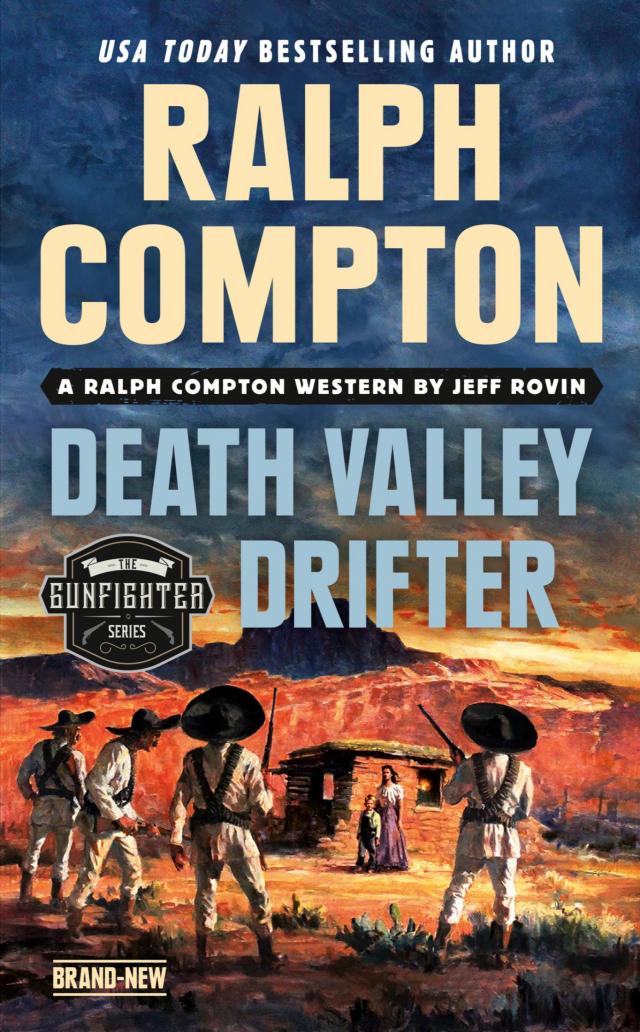
Death Valley Drifter, page 5


“Might I sit?” Hank asked. “These boots are unkind.”
“Go ahead. On the corner of that table behind you.”
“Thank you.”
Hank hobbled to the table. The man followed him with the raised shotgun. The Rebel snickered at something that seemed to amuse him. Hank was fully confused. Perching on the edge where Jane had done her nursing, he gratefully removed the boots.
“I recognize your uniform,” Hank admitted as he set the boots on the ground. “Confederate.”
“That’s right. Lots of proud veterans wear them out here. They got Mexicans and Injuns to worry about. No one bothers us much. Unless they want a fight.”
“I don’t know about any of that,” Hank said, wriggling his bare toes. “Did we meet each other at night or during the day?”
“Late twilight yesterday. There were four of us around a campfire. Your friend stayed just out of the light. But I saw you.”
“How far from here did that happen?”
“Twenty miles on the map. When it was over, you scooted into the desert, bound for where I do not know. We left one man behind to— Well, to stay behind. The rest of us three spread out after you in case you cut north or south.”
Just then Jane appeared in the doorway. Douglas was behind her, deep in shadow.
“May we come out? It’s stifling in there.”
The man in the uniform studied them quickly but with a trained eye. “Yes, you may. Let me see your hands first.”
She held them out, her palms upturned; then she encouraged her son to come around her and do the same. Hank had felt a brief surge of concern when he first saw them; he was relieved to see that Jane had left the Colts in the chest.
“Why don’t you go ahead and stand with your friend where I can watch you all. If you don’t mind.”
“I don’t mind, Mr. . . . ?”
“It’s Lieutenant Goodman Martins.” He regarded Hank. “Heard of me?”
Hank shook his head, the wound punched back, and he stopped.
“Lieutenant, I am Jane Smith, and this is Douglas.”
The boy said, “Pleased to make your acquaintance, sir.”
The lieutenant did not acknowledge them. He seemed to regard every move as a threat, every word as a potential lie.
Jane went directly to the table and pointed to the boots. “Mr. Martins, I’d like to fix these.”
“What do you mean?”
“They were my husband’s. I’m going to fill these with stones. The heat will expand them, stretch the leather.”
“Okay.”
“Thank you,” Hank said gratefully.
“So you really did arrive without much on.”
“As I’ve been saying.”
“The word of a thief.”
Hank’s eyes drifted to Douglas. Maybe the man was right. Maybe he was an outlaw and deserved his contempt. He hoped not. There was a brief look of something just short of awe in the boy’s eyes when he gazed up at the man. He had obviously heard the story about the knife.
The woman fixed her attention on the boots as the boy gathered up small stones as she indicated. Hank and the lieutenant locked eyes.
“All of this is for real, not just ’cause you’ve been caught?” the man with the shotgun asked.
“It’s real, Lieutenant Martins,” Hank said. He considered the other for a moment. “You retain your rank in peacetime.”
“It’s not peacetime everywhere.”
“Where, then?”
“South. Mexico and the French.”
None of that sounded familiar to Hank. “I guess I was involved somehow.”
“Somehow,” Martins agreed. “If you weren’t, you are now.”
The man came from around the well, brushing away flies drawn to the sweat running from his hatband. He had a noticeable limp. That was probably why the lieutenant had smirked at Hank’s hobbled walk.
“War injury?” Hank asked.
“That’s right. You sound like you could be a border country Southerner, maybe Virginia. You remember where you’re from?”
Hank shook his head once slowly. Martins lowered the shotgun but kept it tucked under his arm.
“You present me with a dilemma,” the lieutenant said, still approaching slowly. “I’m supposed to meet the others further north, at the Butterfield way station. Maybe they caught your partner. Maybe they didn’t. I’m thinking you should come with me.”
“To do what?”
“Assuming all you’ve said is true, you still got a partner out there. He betrayed you. Didn’t kill you, maybe didn’t have the heart. Maybe you two were kinda close, and he didn’t want your blood on his hands, exactly.” Martins stopped a yard distant. “Or maybe he left you where we’d find you, slowing us down. Or maybe you’re supposed to kill us—though I sorta doubt that.”
“Why?”
“I saw how fast you were back at the camp. My finger’s off the trigger. Where I’m standing, you could’ve snatched the barrel before I could fire.”
Martins backed away a few paces as Hank processed how he had been tested.
“Whatever the case,” Martins went on, “when we find him, and he sees you, you might be able to help us get back what you took.”
“Or he might shoot me. He won’t know that I can’t remember dirt.”
“What you say is certainly a chance, save that he didn’t kill you back there. Or stab you, though he took your other knife.” Martins reached around back with his free hand, drew something from his belt. “I pulled this one from the tree. I intended to use it on you, if I got the chance.”
Hank looked at the knife, the bone-carved handle. It was definitely familiar. But only the knife, nothing that might have surrounded it.
“You going to tell me anything else?” Hank asked. “Who you work for, for instance.”
“Now, how hen stupid would that be? You might suddenly remember things and pretend you didn’t. Like why you should leave me behind and meet your partner somewhere.”
“That could happen anyway.”
“True, but such a possibility don’t mean I have to help.”
Hank did not like the man or his deal. He had a swagger in his voice, in his walk, that did not sound like a man accustomed to taking orders in any kind of army.
Jane held her son to her. They had finished with the boots, had placed them on the table—in the sun where the stones would expand and stretch the leather—and were standing at the far end. Hank smiled at them, then regarded Martins.
“What if I don’t go?”
“Stay here, you mean? With them?” Martins shrugged. “I’m pretty certain I do not want you at my back. If you insisted, I’m afraid I would be forced to shoot you now and be done with it.”
“Well, put that way—”
“I thought you’d understand. Tell you what, though. I won’t bind your hands.”
“Why so tenderhearted?”
“It’s not that,” Martins said. “You gotta drink. I have to give it to you. I’m gonna keep my distance. Besides, we’ll catch your partner regardless. If you ain’t there, you may not ever find out who you are.”
That was true, Hank thought. But whoever he was, there was a strong in-the-present reality: Something about being here, with Jane and Douglas, was appealing. Not only because it was the only thing familiar to him, but because even without his memory, he had felt peace since he arrived. It was not the knife-throwing life Martins had hinted at. But given that natural fit he felt, Hank wondered again if he had a wife and a son somewhere else. What if they were waiting for his return?
“Hey, you busy remembering something, Mr. No Name?”
“No,” he replied.
Hank’s natural dislike for the man did not take to this new mockery. Perhaps, at one time, he would have answered with a knife through the man’s Adam’s apple. Now he made no comment.
Lieutenant Martins returned the knife to his belt. “I want to make sure you hear this, mister, because if you do remember who you are and what your business was, and you decide to finish what you started, you will wish you died back there in the desert. You hear?”
“It’s my memory that’s dull, not my hearing.”
“Good. Because here’s this. If, on the other hand, you decide to throw in with me and mine, that will weigh strong in your favor.”
Hank stared at the man and his greasy brow, at dark brown eyes that shined like marbles against his dark skin. “I don’t know what kind of man I was, Lieutenant Martins. But your manner makes me wonder who was the good guy and who was the bad guy when we met.”
“That kind of wondering is a road to nowhere.” He glanced up at the sun. “I have a rendezvous to keep in Oak Ridge, and I’ve taken enough time here. For all I know, your friend is already captured, and this whole conversation was for nothing. I’ll get the horses. Say your goodbyes outside where I can see you.”
Martins paused to pick up the Smiths’ rifle on his way to collect his horses.
“We need that!” Jane called after him. “To hunt.”
“You should’ve thought of that before you pointed it at me.”
“I did that, remember?” Hank said. “She has two Colts in the house, never drew them.”
The lieutenant stopped, turned, and then placed the rifle against the well before continuing on. Hank collected his boots, tied the laces together, and heaved them over his shoulders; they needed more time to stretch, and he would not be doing much walking.
He stood there a moment feeling their weight. Swung round his head and released, something like this could kill a mountain lion. Or a man.
It was a thought.
Then he went to where the Smiths were standing.
“Thank you for the rifle,” she said.
“Thank you for all you did,” Hank replied, looking down at the woman’s face. It had lost some of its initial reserve and seemed . . . pretty, now that he looked.
“You’re most welcome, Hank. I’m going to go inside, get you some food to take with you.”
When she left, Hank’s eyes went to the boy, who remained where he was. “Thanks to you, too, son. You’re quite a young man.”
The boy seemed a few inches taller and lit by a second sun at that moment.
“You’ll come back, won’t you, Hank?”
“If it’s humanly possible, I most certainly will.”
“Even if you don’t find your knife, I hope you find out who you are.”
“Son, that’s the nicest thing I can ever remember hearing.”
It took a moment, but the boy smiled like a poked baby. “Aw, you don’t remember anything except today.”
Jane returned with a canvas sack full of jerky and something she held behind her back. Hank accepted the food with gratitude.
“To be honest, ma’am, there’s a big part of me wishes I could start over here and now as Hank.”
“It’s not good to have ghosts. One day your memory will return. I live with memories—you have to make peace with them.”
The man smiled tightly as his eyes were drawn to the smoke rising from the crooked chimney.
“You better tend to your own victuals.”
“I will.” She revealed what she had been hiding: her husband’s Stetson. “You’ll need this, too.”
Hank’s smile was big and earnest as he looked from Jane and then over to Douglas. “Son? When this is done, and if I do get my knife back, it’s yours.”
“Really, sir?”
“Really. Until then, you can practice.”
“How?”
“Rub a large stick on a rock till it’s got a point. Flip it at the ground like this.” The man pinched his thumb and index finger and made a snapping motion with his hand. “And that’s not all you can do with a stick.”
The boy thought hard. “Like you seen me do with the rabbit and the arrow?”
“Saw,” Jane said.
“Sure, that,” Hank told him, “if you first stab the critter. No, I recollected something when I was watching you at the pond.”
“Really?”
“Yup. I had a stick, and I used it to dig or cut a trench or write in the dirt—”
“Maps?”
“Possibly,” Hank thought—truthfully, he could not recall.
“My pa did that sometimes to show where he’d been.”
“See? And you can use it to point, too, like a big finger. Or leave sticks on the ground to point a trail you’ve taken. Thing is, out here, you have to be clever, like I’ve seen you be. Use the things around you while you’re waiting for your knife.”
The boy smiled so broadly that his mother laughed. Hank wondered how often she got to do that, and Douglas averted his face quickly. Hank felt another strong tug that bid him to stay. But knew he had no place here. Not now, at least.
Fixing the hat gently on his head—he wore it dipped forward, to keep the band resting just above his wound—he walked away, tall and suddenly proud in a splash of brilliant day.
“Is Hank going to be okay, Ma?”
“I pray he will be.”
“Maybe—maybe we should go with him.”
“They’ll be on horseback. We wouldn’t be able to keep up.” She smiled comfortingly. “Do you remember that? When you used to run after your daddy’s horse, calling after?”
“I sure do. I fell a lot.”
“But you always got up.”
“What if we follow and only catch up instead of keep up?”
Jane laid her hand on his sandy blond hair. “You heard—Hank has some things he has to settle. And we’ve got a smoked rabbit to attend to.”
Douglas watched as Hank and Martins met. The new rider took a moment to stroke the horse.
“He’s making friends,” the boy remarked.
“He is indeed,” Jane said wistfully as she put her arm around her son and walked over to the sack where the rabbit waited patiently.
CHAPTER FOUR
IT WAS A very natural thing for Hank to sit a horse. Having done it enough, he guessed that was something you did not have to remember. The ability was just there.
With a knife, too, he thought. He wondered what he would do if he had the one Martins had shoved in his belt. He suspected he would feel better just possessing it. And it might help him to remember.
The men rode single file onto the plains, with Hank in front. He had shifted his boots so they were wrapped around the saddle horn, where they thudded dramatically and rhythmically against the sides. Sweat had quickly saturated the band inside the Stetson and droplets ran along his scalp. They stung the wound but not enough to distract him. The bandage sagged so quickly that it was not long before he tore it away. The slight breeze, warm though it was, felt soothing on the hot wound.
Hank did not try to talk to the other man. If Goodman Martins had wanted to say anything, he would have. If Goodman Martins were any kind of human being, he would have helped him just a little. Both were indicators of the kind of challenge Hank faced in the hours to come.
The farther north the men rode, the more verdant and rolling the countryside became. They were still on a mostly scrubby plain, but there were trees here and the first water he had seen since the pond: a creek where they stopped to water the horses. Hank had seen no sign of any other animals having gone this way, other than those with small padded paws. He figured that Martins was looking, too.
Hank ate a strip of the jerky and offered some to his companion.
“Got my own,” Martins said, but he did not offer to share.
They rode on with nothing but the terrain and the occasional shadow or cry of a hawk to distract them. Hank felt nothing as smaller birds and mice fell victim to their diving attacks. Was that the uncaring coldness of the old Hank or the new?
He half turned.
“There’s something I’m trying to understand,” Hank said, “and I’m wondering if you can help me.”
“Depends.”
“You said I was on horseback? I seem to recall one—had a blond mane.”
“I didn’t see it. I said you boys stayed outside the fire.”
“I thought maybe you caught a glimpse of markings, of what I was wearing—”
“I did not. First thing I knew was when you threw the knife and your friend collected what you came for. Then we heard you ride off.”
“How did we get such a big lead?”
“You cut our horses loose first. Took us a while to gather them in the dark, shouting out plans and scaring them more, holding burning brands for light with one hand, grabbing reins with the other. I wanted you dead, the two of you, but I had to admit you were good. Damn quiet.”
Hank shook his head. “It just happened a few hours ago. How can I not remember any of the—” He fell silent.
“What is it?” Martins asked.
“I can’t remember any of the plan,” Hank said—not just repeating the words but thinking about them. “A plan. A bad plan . . .”
The lieutenant kicked his horse forward until he was beside Hank. “You had a plan. What was it?”
“I don’t know. I said those words to him.”
“Said them to who?”
“Bill. Bill . . . Beaudine.”
The other man’s harsh features showed interest. “Your partner?”
“I don’t know,” Hank replied. His own brow was creased in the middle as he tried to fill in that dark hole in his memory. “Do you know the name?”
“Don’t ask. Damn it, think. Bill Beaudine. What about him?”
Hank tried to put a face on the name, a form, a horse, a place . . . anything. He saw only that empty hole and shook his head slowly. He silently repeated the words over and over. It’s a bad plan. It’s a bad plan.
Martins swore and came to a stop. Hank’s grip on the reins was loose, and his horse walked on several paces before stopping on its own. The rider was not quite present. He was hunting through his emptied mind.