Diana of the Dunes, page 12


Thursday morning with many anxious thoughts as to my blankets, piled under the cedar saplings by the roadside, I started off over the sand wash along the road through the bottom.
It really was not far to a few cottages, and then the railroad and the highway, and more or less farmlike places. But I had a hard time getting anything; no one had eggs or milk or bread to sell. Finally I got some milk and bread, and then met the traveling groceryman and got supplies—eggs, cheese, bacon, bread, butter; more than I could carry, so that I had to hurry back for a second loaf of bread.
Pain! And the Keen Edge for Living!
And when I got home—that comes natural! back-heated in my heavy clothes, I climbed the great white way again to see the sunset. Then I remembered that it had rained a little the night before, and my blankets were a little damp. So I built a fire in the iron box I had found ready at hand, which makes cooking so unexpectedly convenient, and spread out my possessions on the ground around it. I sat in this state of joy, thinking very much of L. because I had been using what Miss H. called his word so much—“wonderful”—and thinking that I was what he had called me —“Alice sit by the fire,” whatever that was supposed to mean. Feeling very happy and domestic and much pleased with myself and the world, my world, large and small—when, the fire dying down, and my towels being not quite dry, I moved the iron firebox with the idea that the sand under it would be the best means of finishing the drying, and deliberately put my hand—my right hand—caressingly on the sand to see if it was warm enough to do the towel much good, I suppose.
My God—how it hurt!
The shame of having done such a fool thing was hardly second to the pain of the burn.
At first I thought I would never tell the story. Then I reflected that human perfection of any hurt is so rare that none of it ought to be hidden under a bushel, even perfection in folly.
I contemplated walking the beach all night but soon found it very cold. Then I went lamely to make my bed.
I was thinking how much I wished I were not such a coward about physical pain. I found myself admiring Mrs. M. and N.R. and in general the women I rather despise as Philistines, who nevertheless are morally far superior to me in that respect at any rate. I was in imagination talking to L and saying that I knew I was physically too much of a coward to have children. I found myself even admiring his mother for her bravery in endurance.
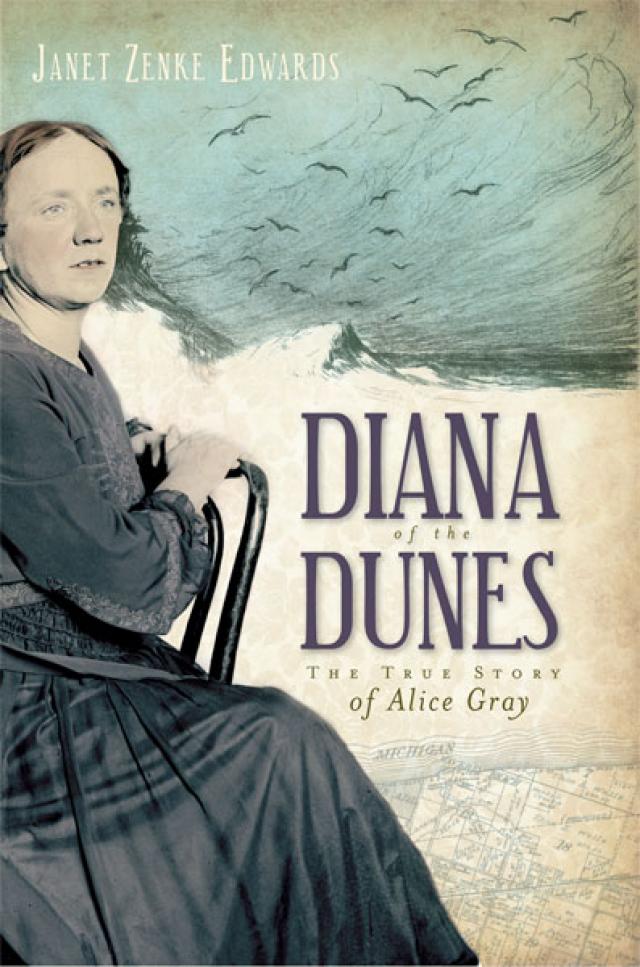
This photograph accompanied publication of Alice Gray’s diary in the Chicago Herald and Examiner on June 2, 1918. It was credited to photographer Robert Sansone and was part of Chicago Camera Club exhibit at the Art Institute in Chicago.
As to the hand, it hurt more or less all night, I think, but didn’t trouble me much. I had been afraid it might fall off, but I guess it was really nothing serious. At the worst, I reflected, I should be inclined to agree with God that one hand is enough for a perfect fool.
Yesterday, I gathered a few pine boughs for my bed, and found it a great improvement. I am afraid the oil cloth and the blankets were hardly enough over the cold sand. It seemed almost sacrilege to break the trees. I wonder if they grow up on top, and don’t mind the loss of the boughs I can reach.
I seem to run to negatives in thinking of the pine (or fir). It is the opposite of the pettily human—the anxious, the care sodden, the duty frazzled.
Duty is calming and unifying and life-giving and restful, but there is an imitation, very common among the descendants of the Puritans, which is much the reverse.
Tuesday, Nov. 16
Toward Sunset
Dear L.—I wonder why we got stricken dumb so often. Why didn’t you talk to me, as you said you wanted to, about your plans for the book? And so very often when I seemed to want affection, what I had wanted—or thought I wanted—was to get our notions cleared up.
I wrote you a letter or two before I left. One of them, as I remember, was rather enlightening. It said that my disquietude was because I had sinned, in losing the disinterestedness which is my true attribute.
I think I have regained it out here.
I’m getting fond of your word, as L.H. calls it. Those were very kind and wise words you wrote me: “The world is very big and wonderful, and you must be very sweet and patient or it will be unkind to you.” Now, I think, though; you really meant, “Be very sweet and patient with what seems its unkindness, and you will find it very kind.”
Cabbage and Sunsets to Make a Poem
Wednesday, November 17
The above might have been entitled “While the Cabbage Cooks and the Sun Sets.” I stopped to run up the hill above my bower to see how the weather promised. On coming back I ate the cabbage—which, with plenty of bacon grease, was delicious—and then had to make haste to get ready for bed as the clouds had that murky yellow cast which I thought meant snow.
This open air cookery reminds me of Lamb’s young Chinaman; it sometimes seems as if I were burning down a wood to cook an egg. Not that I build a big fire; I remembered L.’s remark of the Indian—the Indian builds a little fire and keeps warm; the white man builds a big fire and freezes. Moreover, my stove being about 12x12x20 hardly tempts to excessive size.
My stores are now reduced to three eggs, half a slice of bread, a little oatmeal, coffee and salt, a bacon rind and some grease, a cabbage and a very few apples and radishes. Money, eighty-two cents. I hope Dr. A. sent me a remittance! And that is a pre-breakfast inventory.
Now after breakfast—oatmeal in lots of bacon grease, two fried eggs and half a slice of bread, two apples, and the remains of last night’s supper’s cabbage, and a quart of coffee, evaporated down to one small glass—and a trip for water, to return to L. and the meaning of life—or shall I go for a possible letter?
I notice that when I am in a happy and satisfied mood I tend to think very well of L., but when I feel outcast and rather abused—as last night in the wind and rain—I scorn him utterly—both for business and personal relations.
Dear L.—Are you ever suspicious of me and irritated with me? Or have you really, to your own satisfaction, “my number”? Sometimes I think you don’t understand me at all—that you misinterpret me wretchedly, meanly, vilely, insultingly, and then again I think perhaps you see me as I am, in actual feebleness and possible strength, as it were well if I should see myself. And sometimes I admire you and love you, and again I despise you and—not hate you—I have hated you, I think, only for one moment, waking up for one morning just before I left Chicago and seeing you, not with vine leaves in your hair, but in a foolish paper cap, “grinning”—but think how could I ever waste a thought on you.
You said people never understood what you mean—that I never should. Then, perhaps, it is not, as I have sometimes thought of myself, that I am stupid and dull, or at least slow and uncertain, in sizing people up, that makes me uncertain as to you.
It seemed to me, however, that your real feeling was—whether you were struggling with conflicting feelings, or held back from its expression by a sort of pity for me, a feeling that I called on you for aid which you were loathe to refuse, although you felt either that it would be too costly to you, or that in reality I was hopeless—or else made uncertain in its expression by mere politeness; but it seemed to me that your real feeling was that, as to having any relations with me, the game was not worth the candle; that you were trying to detach yourself from me, to “shake me,” as the expressive slang has it.
And He Said I Was a Nice Girl, But—
I felt it that night when we had a sandwich at the Greek’s, and you said, “You really are a nice girl: I really like to have you around—but—”
But—what?
Shall I guess?
You know, you are a fearful waste of time. Not a waster of time—I like to kill time myself, sometimes, often, a lot of it. I believe in it. But you are a waste of time: futile, vain as a driving wheel without an attachment. You think you are something—that you are much, but you are nothing, just because you think so much of yourself. To be brief, you are not yourself, as a human being should be, which would demand relationships—ties—but to yourself enough, and so a mere troll, a vain imagination, nothingness-initself. And I, if I had much more to do with you—might find it contagious. In any case, you are unprofitable to me, who have a work which calls me and a place in the world—of which I am as proud in my way as any grandee of them all.
Tuesday, November 30
Sunday night going to bed in a windstorm was quite a wonderful experience, as L. would say. I felt perfectly safe and happy, and a little excited. I intoned the Lord’s Prayer over and over—and was really in the spirit of prayer and worship, wanting nothing, fearing nothing, asking nothing, but to be shown my duty and given the grace to do it filled with the beauty of the storm and with the praise and worship of God. I had thought to say to Mr. N. in a joking way that I found fasting easier than prayer, but less easy than eating; praying is a gift which is not taken by violence or by desire for it. Yet how beautiful, how satisfying it is when it comes, prayer.
L. says I have not been in the right soil. He said I should be popular to his set. Popular? Ye gods! I always think of myself as a supreme bore to the people I know. Emerson says if you are popular in your set, it is a bad sign, but if people look at you with strange looks of regret and half dislike you are probably different.
Generally—especially when I write, or walk, or sing, or read, or recite my favorite poems—I am very, very happy and contented with my lot and my course. Then once in a while I wonder if I am childish, futile, foolish, a “skulker” as some one [sic] called Thoreau—a nonentity, a shirker and deserter and coward and egoist. Yesterday was one of the days of such doubt of myself.
The highest bravery in the world is loyalty to one’s trust. It may be simply withstanding the world, refusing to stoop to court, or to compromise, letting the world and its glory pass by without a regret or a thought, willing to be thought nothing, but in reality, in one’s self possessing one’s own desire.
Yesterday I longed for society—the companionship of some big, cleareyed, single-hearted, frank soul, who would talk to me as L. says, about life and love, about God, freedom, immortality.
Is L. such a person? N.J. says L. is not simple and therefore not great. I wonder if she does not [unreadable] him from the outside—though she likes him—and if, perhaps, I was not speaking the truth when I said lightly to that foolish telephone talk with “Cousta Helen” in response to her question, “Do you believe anything he says?”: “Of course; hearing him is like listening to my own soul.”
I wonder if we might be friends, if he would like me as a friend, or if my “stimulating” effect, as he call it, spoils me for friendship, or if he finds in me no satisfaction, no promise, no interest, or attraction in that way. Perhaps I should be disappointed in him; as he said in a letter to another person: After all, our friends, like our gods, are our own creation; we it is who endow them with the qualities we love and which satisfy us.
Yes, but the test of their truth and reality, after all is just their power to be endowed with those qualities—to let us endow them and feel the endowment; to throw back to us the balls we throw against them, the rays of heat or light we sent out.
That is the only difference between a wall of solid masonry and a bank of fog for the purpose of handball, and that is the difference between a friend and a disappointing acquaintance, between the god of one’s own soul and another man’s god.
I wonder if L. really wants me to think about him, and love him as I might love, should love if I loved at all—or if he would rather say “ships that pass in the night” and let us forget one another.
The love I have always idealized primarily is a platonic love—my thoughts of sexual love have been of a lower power, and likely to end in—what shall I say?
And is not this exactly what L. felt, only he used the terms ‘love’ and ‘stimulation and desire and happiness’?
I wonder if he dreaded, or at least felt the danger, the possibility, not only of too much “coaxing” but of too much kindness and sympathy—or if I am endowing a rather elemental creature with refinement of honor of which he never dreamed?
Strong in Grammar, But His Ideas—
He said in writing his book, he wanted to avoid “ought” or “should” and all such terms. Yet he said to me, after the parting, the night of passion in the form of regret, and the note in the morning—“I felt that I ought not to have left you in that way, when I had been thinking about you as much as I had been.”
Yes, that is what interested me in him, I think, as it always has in novels and poems and their authors and all men in general—what is his philosophy, his ethics, his criterion of right and wrong, his standards of honor? What does he admire, what despise, what long for in the moral world?
I think L. and I might have had a great friendship—if—
Just think, dear. I have never had a friend, except my mother, who died thirteen years ago.
Thursday, Dec. 2
Yesterday, I walked south through the woods and struck, not as I expected, the old Chicago road, but the road which I first followed home as a variant from the Chicago road, which comes out on the beach at either the first or second sweep to the west—I am not sure which.
Miss E. was not in, but I took the [liberty] of looking in the mail box and found there the letter I was looking for—with three dollars, and a general... [text is unclear] “fatherly” tone.
I stopped in cheerily on my way back to see Mrs. B. Combing her hair, she referred to her looks, and that reminded me to look in the glass.
What a sight! I looked like a delirious Indian. Nose red from a little cold and much wiping—eyes pale and staring in the general smoky red, teeth pearly by contrast, and, oh, what a forlorn, unwashed, gaunt face!
This morning I washed in hot water and plenty of soap—I had only a rub off before since the day by the fire in the wigwam—and looked civilized except—as the glass revealed—for a grimy underchin and neck.
I wonder if this life is really so good for me as I thought. ‘As good as a sea voyage,” I said in my letter to Dr. A.
Friday, Dec. 3
Dr. A. said in his letter—I said in [unclear] I seldom make such frank statements about my circumstances, they generally do no good and are likely to be misunderstood—that I had not been too frank and only a “false friend” could find fault with such a letter; it was a relief to confide in some one, if one got the right person—as he was!
To be continued in tomorrow’s Herald and Examiner.
CHICAGO HERALD AND EXAMINER
MONDAY, JUNE 3, 1918
“DIANA OF THE DUNES DISSECTS SOUL IN DIARY:
LETTERS TO ‘L’ REVEAL ROMANTIC SIDE IN NATURE
OF THE MYSTERIOUS GIRL LIVING IN THE WILDS”
Tells of Preparing New Book
In the first installment of the diary of Alice Gray, the “mysterious nymph” of the sand dunes, she told of her first days at the wild lake shore after her flight from life in Chicago. Today the Herald and Examiner gives that portion of her remarkable diary dealing with her final work on a certain doctor’s book and gives several of her letters to “L.” Since, to change a quotation, “the most interesting study for man is woman,” you will find these letters interesting. And, living alone amid dunes, as her letters tell, the University of Chicago student found so many primitive things to interest her that she fell in love with life again. Her diary, continued from yesterday, reads:
Well, it seems the good old doctor does misunderstand me a little, though I guess it won’t do any harm. It isn’t sympathy or relief of my feelings that I want; or at least that I was looking for from him; but as I said I hate to press him for money, and have felt all along rather apologetic to him for making him wait so long; and so I wanted him to know why I was in such a state of mind, and just how I needed money now, so that he will not keep me waiting at a ruinous cost to me.
One day—it was well along in October I think, when the work was nearly done—it seemed I just could not keep my word and finish the work. I called him up and told him I was unable to go any further. He said very meekly—if I remember the words—“When do you think you can work again?” The impression was strangely deep of patience—of something old and patient—especially old and infinitely patient. I had not the heart to throw up the work and disappoint such patience.
Shrinks From His Kiss
I do not mean that I thought of Dr. A. himself as old; he has a sort of boyish buoyancy and hope, despite his sixty-seven years.
That might sound to a stranger as if I idealized the doctor. Not in the least. Personally I rather dislike him, or at least shrink from him, as he would bore me to death.
While I’m on the doctor—the last scene. He was proud of the book “and of me.” I was a good girl—he was going to kiss me good-by. (Business of doing so.) Then, at the door—oh, by the way, how much did he owe me?—I hadn’t meant to charge him much, because of the delay. (I had meant to leave all above the original $40 to him.) But how much? Say—Well, would $75 be too much? He gasped a little, but said quickly “Well, I won’t jew you down. But you won’t get it all this month. Don’t tell my sister—I’m going to kiss you again.”
I was glad the rest of my transactions were to be with the printers.
But it did at least reveal to me the distance between one person and another when it comes to kissing. There is indeed a certain temperamental suitability between L. and me.
Various and strange indeed are the sources of knowledge in this world.
Dear L.:
This is a business letter!
Is your book written, writing or to be written?
I am having a good, restful and recreative time, living outdoors on the dunes. I shall stay here [sic] until the weather drives me home. I came Oct. 31.