A Stranger in the Family, page 1


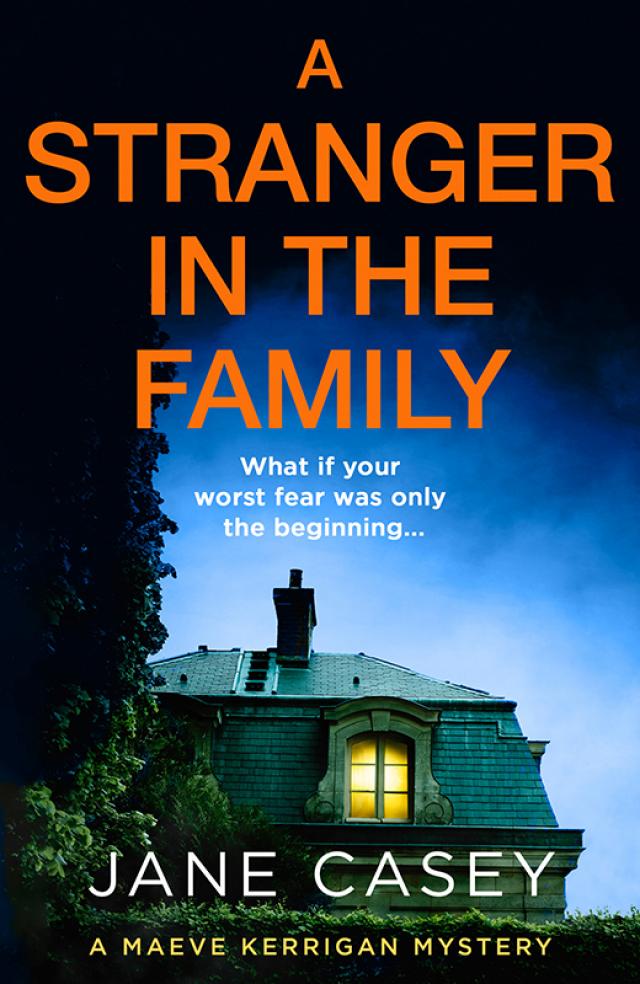
A STRANGER IN THE FAMILY
JANE CASEY
Published by Hemlock Press
An imprint of HarperCollinsPublishers Ltd
1 London Bridge Street
London SE1 9GF
www.harpercollins.co.uk
First published in Great Britain by HarperCollinsPublishers 2024
Copyright © Jane Casey 2024
Cover design by Claire Ward/HarperCollinsPublishers Ltd
Cover photographs © Ildiko Neer/Trevillion Images
Jane Casey asserts the moral right to be identified as the author of this work.
A catalogue copy of this book is available from the British Library.
This novel is entirely a work of fiction. The names, characters and incidents portrayed in it are the work of the author’s imagination. Any resemblance to actual persons, living or dead, events or localities is entirely coincidental.
All rights reserved under International and Pan-American Copyright Conventions. By payment of the required fees, you have been granted the non-exclusive, non-transferable right to access and read the text of this e-book on screen. No part of this text may be reproduced, transmitted, down-loaded, decompiled, reverse engineered, or stored in or introduced into any information storage and retrieval system, in any form or by any means, whether electronic or mechanical, now known or hereinafter invented, without the express written permission of HarperCollins.
Source ISBN: 9780008405021
Ebook Edition © March 2024 ISBN: 9780008405045
Version: 2024-02-06
For Julia Wisdom, with love
‘I have an habitual feeling of my real life having past, and that I am leading a posthumous existence.’
John Keats’ last letter
30 November 1820
CONTENTS
Cover
Title Page
Copyright
Dedication
Epigraph
1
2
3
4
5
6
7
8
9
10
11
12
13
14
15
16
17
18
19
20
21
22
23
24
25
26
27
28
29
30
31
32
33
34
35
36
37
38
39
40
41
42
43
44
45
46
47
48
49
50
51
52
53
54
55
Epilogue
Keep Reading
Acknowledgements
About the Author
Also by Jane Casey
About the Publisher
1
Did you notice anything out of the ordinary?
Afterwards, when the whole horror of it had been laid out, and their innocence – or rather, the degree to which they should feel guilty – had been debated by people who knew them, and many more who didn’t, it was the small, uneasy details that lingered in the mind.
What went missing with her, and what did not.
What happened during the holiday a month earlier.
The argument two days before.
The car with a broken number plate, and how many times it was seen near the house.
The tiny, bare bedroom with blood on the floor.
The visitors to the house that week.
The letters before.
The phone call after.
The open door.
The river.
The bruises and scrapes.
The way her brothers reacted, or did not; the things they said, or did not.
The way her father cried.
Her mother. Her mother. Her mother.
But most of all, how long it was before anyone realised she was gone.
2
For some time now, Helena Marshall had been waking up every morning in a panic. It was instant, a punch of fear that struck before she was even aware that the day had begun. Today was no different.
She peeled off her eye mask and blinked at the ceiling, at the lightshade that probably needed dusting, and a smudge that had once been a mosquito in the corner, and the crack that wandered across the plaster, and a cobweb. The house was full of spiders because August was when they started preparing for cold weather, and it was an old house, with sash windows that were loose in their frames and gaps in the floorboards and fireplaces in bedrooms, and the chimneys needed sweeping now that she came to think about it but the sweep had been so rude the last time he came.
There was a notebook by her bed, with a pen, and she could start a list of jobs to do – dust shade, remove cobweb, find new sweep – but it was so boring. And no one else noticed these things, or did anything about them. It was always her job to sort out the house, and the children, and remember to buy school shoes (school shoes! that needed to go on the list that she wasn’t making) and actually, she had better ways to spend her time. Work that needed to be done.
Beside her, her husband gave a long, quavering snore. If she was a man, no one would expect her to bother about the chimneys being swept and the gutters cleared (which they would need to be; there were thriving miniature rain forests in three or four places and August had been so wet and the brickwork would take any excuse to soak up damp and present it to her in bouquets of dull grey blooms on the wallpaper).
It was (she checked, peering in the half-light) ten minutes past six. The sun had risen, in theory, but it was a dull day and the forecast was for rain again and that didn’t help her mood.
Her age, Dr Fuller said. Her age seemed to be the answer to every question she asked the doctor these days. The aches in her joints. The skittish unreliability of her memory. The way her skin looked in the morning, and the evening, and after a glass of wine. The sense of impending doom. There was no other reason for it. Her life was busy and fulfilling. She didn’t like seeing the changes that time was making to her famously lovely face but that was what happened.
Count your blessings.
Lying there, Helena tried. She was getting things done when it came to her work, and that was good, even if it meant unpleasantness from ignorant people.
Her husband was rich, reasonably nice, supportive of her and present, unlike several of her friends’ husbands who had slid away to new lives where they could pretend to be young again. Bruce was thirteen years older than her, which made him fifty-nine (and she would have to plan a party for his sixtieth; that was another job that would take up time she didn’t have). They had met later than their contemporaries, married within six months, and he had already been fading into comfortable middle age. She had been a minor star, famous enough to have her picture in the paper, often, coming out of nightclubs or at the races. A sort of celebrity, on the guest list for parties and launches even if no one quite knew why. She had thought he was wonderful and he had thought she was beautiful and that had seemed like enough.
Then marriage, and motherhood, which was another life.
Helena was not the sort of person to run away from things, but she sometimes dreamed of packing a bag and going away for a week or a month, meeting a stranger, having a wild affair, and only coming back to the cobwebs and the draughts and the homework and muddy sports kit and maddening questions when she was good and ready. And that was why she hadn’t overreacted on holidays.
That was why Bruce still snored beside her.
Helena wriggled her shoulder blades flat against the mattress to try to relieve the ache at the base of her neck. The boys should have come first on her list of blessings, probably. Ivo was fourteen and, overnight, had gone from sweet-natured compliance to frowning silence. He only seemed happy when he was playing some sort of sport (which, at least, he was good at). Magnus was twelve and (a squirm of genuine anxiety at this) insufficiently focused on his schoolwork. He was lazy, and not bright enough to get away with it. His school report had made it impossible to ignore the issue, along with the phone call from his headteacher suggesting that if things didn’t improve he might be happier at a different school. So they were paying, at vast expense, for a tutor to come all summer.
And Rosalie, of course. They had Rosalie, who was nine. Rosalie’s room was the smallest and it needed a new carpet thanks to her experiments with making perfume out of pilfered cosmetics and household cleaning products. Helena had been thin-lipped about it and Bruce had laughed. Rosalie was a wilful child, demanding in a way that the boys had never been. Girls were different, she’d been warned.
Helena kept her preferences strictly to herself but if she had to choose – in a fire, say – she would rescue her boys first (and of them, Magnus had her heart, but that was something she thought no one else knew. Ivo was a good boy but Magnus had charm). And then she would go back for Rosalie – assuming she hadn’t started the fire in the first place. What Helena often asked herself was whether Rosalie was disturbed or just too bright for her own good. She was intelligent. Interested in everything. A sponge for facts. Prone to awkward questions, and doggedly focused about them. She had never been playful. Helena had thought it would come in time, and had been wrong.
She took several deep, slow breaths, focusing on the positives: they were as happy as most people could expect to be.
Enough wallowing.
She levered herself out of bed, braved the bathroom (chilly) and the bathroom mirror (unflattering), and pulled on a dressing gown. Now that she was upright, her anxiety had translated itself into energy. It was Friday but they were at the tail end of the summer holidays; it would be hours before anyone else woke.
On a whim, Helena went upstairs instead of down. The ceilings were lower up here but there were two large bedrooms and a bathroom that made their Bulgarian cleaning lady shake her head. The important thing was that the boys occasionally showered in it. She missed the soapy-clean smell that they’d had throughout their childhoods. Now a waft of sweat and muskiness and socks greeted her when she opened Ivo’s door, like the men’s locker room in a gym.
He was face down, his head turned to one side, his arms and legs trailing off the bed. A spasm of tenderness made Helena tweak the duvet into place to cover his (enormous! calloused!) feet so he didn’t get cold. His room was neat – Ivo was an organised child and always had been.
Magnus’s room next. It was wildly untidy. No chance of reaching the bed here, Helena registered, eyeing the floor. It was covered in clothes and miscellaneous crap that she wasn’t allowed to throw out. Her favourite child was rolled up in the duvet like a sleeping gerbil. A tuft of his silky fair hair was just visible.
Was he breathing? Could he have died in the night? Was that the reason for the feeling of doom that had been shadowing her since she woke up?
Helena stared at the ball of duvet, which didn’t move. She was a new mother again, terrified of cot death. Surely it should rise and fall; surely—
Magnus shifted and a low fart vibrated through the mattress. The porcelain-delicate newborn was long gone. She retreated, closing his door. It was a long time since she had checked on the boys while they slept and she wondered if it would ever happen again, which was depressing. What was it they said? Long days, short years.
She shivered as she hobbled down the stairs, trying to be quiet, thinking about the opinion piece she was writing for the Telegraph and whether it was too angry and might put people off. Tone was so important.
Not for a moment did she hesitate on the first floor. Not for a second did she consider going to check on Rosalie. Afterwards, she would struggle to explain that, but the last thing Helena wanted was company while she was writing, and specifically Rosalie, who would want to know what she was doing and why. No matter what Helena said, she would linger in the room like a black-eyed ghost.
Helena wandered into her study and turned her computer on, shuffling through her notes, already half absorbed. Back out of the study, into the sitting room, her nose wrinkling at the mess of squashed cushions on the sofa and a stale smell. She tidied the room briskly, shuffling papers, plumping cushions, mouthing good lines to herself as she went.
The supreme act of love, as a mother, is to give up a child to someone who can offer them more. Love isn’t about blood, but care, kindness and guidance . . .
Too early for post, which was something of a relief given the sort of messages she’d been getting since the last time she was on Woman’s Hour. But she couldn’t allow herself to be intimidated into silence. She went down the steps to the kitchen at the back of the house and filled the kettle. All of this mattered, that was the problem. Life and death, literally. Wishing things were different wouldn’t help, and in the meantime children were suffering. The best place for a child to be, Helena thought, was with a loving family. Producing a child didn’t make you a mother, and—
A thin line of pale light ran down the edge of the back door. It wasn’t properly closed. Helena had gone to bed before the boys and her husband, so one of them must have left it open, she thought, and strode across the kitchen, her slippers scuffing the floor in a way that would have the forensics officers shaking their heads a few hours later. The handle felt sticky as she shut the door. She sighed and went to the sink for bleach cleaner and a cloth. There was dirt on the paintwork – something dark – so she wiped it vigorously until it was spotless. The key wasn’t in the lock, or hanging on the hook where it lived, and Helena sighed again, and went to make her tea.
And she never, for one minute, thought that there was anything to worry about, because she had been in practically every room of the house and nothing was missing.
3
The Toyota Land Cruiser bumped up the track, the four-wheel drive barely coping with the heavy rutted mud and large stones on the only access road to Windholt House. Heavy gates topped with barbed wire blocked the track every mile or so, with signs warning that this was private property. The fields on either side of the road were muddy and straggled with unkempt grass, since the sheep no longer cropped it. Their absence had left the land without a purpose, without life.
The rain had been constant for days. The third gate sat in a giant puddle that made the driver swear as he splashed through it, dragged the gate open, drove through, stopped, got out again and swung the gate closed. Easier with a passenger, he thought, and winced at that thought too. This wasn’t a journey he made often.
Today was different.
Today was an emergency.
Tearing anxiety tightened his hands on the wheel and turned his stomach into a sea of acid. The letter was where he had flung it on the passenger seat. It had been waiting in the PO box he visited once a week, an innocent-looking white envelope with his name in familiar handwriting.
I don’t know when you will read this but you will be too late.
He stopped at the last gate. The rain seemed to gather force as he got out of the car, drumming on his head and shoulders. Now that he was nearly at the house he was afraid of what he would find, and more afraid of what he might not find.
At first glance, everything at the house looked as it should: the Land Rover was parked near the front door. A light in the hall made the windows glow softly. He hurried around the side of the house, the wind catching the breath from his body as he faced into it.
In the yard the kennel was empty, but that meant nothing. The dog, a sheepdog, had died before Christmas. He hurried forward, stepping on something that gave under his foot with unpleasant softness. It was saturated with mud, but he held it up and shook it out. A jumper, hand-knitted, the colour impossible to guess. Pearl-pink buttons at the neck.
He gave a low moan and looked ahead, to the back door.
It was standing open.
He hurried through to the hall, leaving a trail of prints from his boots, careless now as he flung open doors. Empty rooms. He ran up the stairs, praying under his breath.
How could he have left her here?
How could he have done anything else?
The brass doorknob chilled his palm as he turned it, and he swung the door open on a nightmare.
4
‘Are you sure you don’t mind?’ Ivo Marshall’s voice was barely audible. The other man had to strain to hear him over the sound of the television from the room next to them. Racing commentary echoed through the flat, rapid and toneless.
‘Of course I don’t. It’s not a burden for me to spend time with them. Not after so long.’
‘I’d have thought it would be worse, seeing them like this.’
‘Time takes its toll on us all.’ He held up his stick. ‘I’m not what I was either.’
Ivo smiled. ‘You haven’t changed, Mr Hood.’
‘Dennis, please. And I’ve slowed down a lot since Lydia died.’ He reached out and patted the younger man’s sleeve. ‘Take a weekend off, Ivo. Spend some time with your wife. I can help out with your parents, if that frighteningly effective young woman needs any assistance.’
‘Sabiha?’ Ivo looked around as if the carer was going to materialise behind him even though she wasn’t due to arrive for an hour. ‘She’s brilliant, isn’t she?’
‘I’m tempted to steal her when I go. It can’t be long now until I need someone to look after me.’
‘Please don’t lure her to Bristol. We couldn’t manage without her.’
Hood blinked. ‘I was only joking, Ivo. I can see it’s been difficult. Your mother . . .’
‘It must be a shock for you to see her how she is now.’