The Outsider, page 1
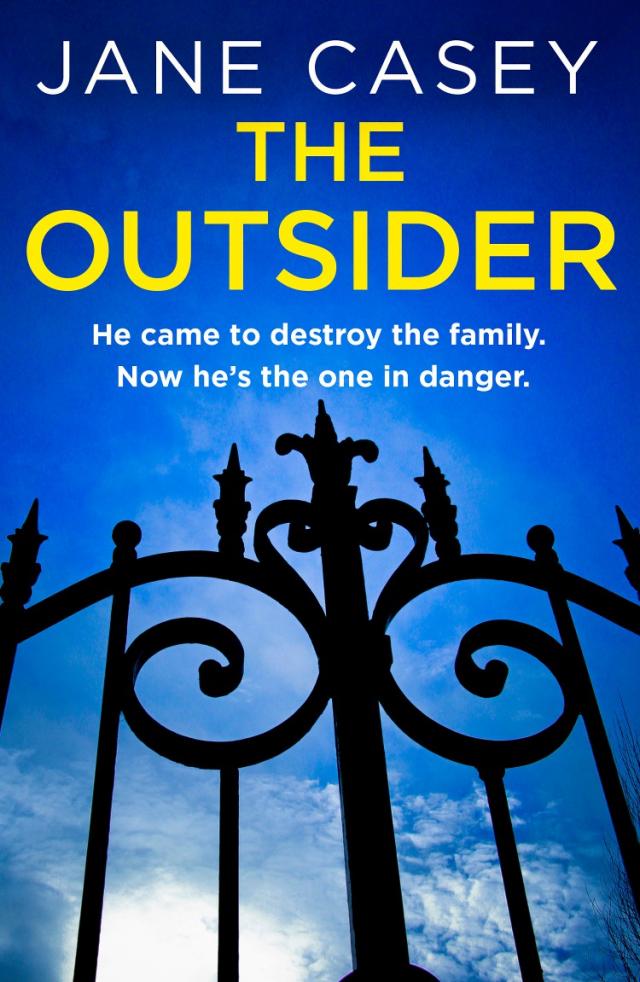


The Outsider
JANE CASEY
HarperCollinsPublishers Ltd
1 London Bridge Street,
London SE1 9GF
www.harpercollins.co.uk
First published by HarperCollinsPublishers Ltd 2023
Copyright © Jane Casey 2023
Cover image © Michel Gile/plainpicture
Jane Casey asserts the moral right to be identified as the author of this work.
A catalogue copy of this book is available from the British Library.
This novel is entirely a work of fiction. The names, characters and incidents portrayed in it are the work of the author’s imagination. Any resemblance to actual persons, living or dead, events or localities is entirely coincidental.
All rights reserved under International and Pan-American Copyright Conventions. By payment of the required fees, you have been granted the non-exclusive, non-transferable right to access and read the text of this e-book on screen. No part of this text may be reproduced, transmitted, down-loaded, decompiled, reverse engineered, or stored in or introduced into any information storage and retrieval system, in any form or by any means, whether electronic or mechanical, now known or hereinafter invented, without the express written permission of HarperCollins.
eBook Edition © November 2023 ISBN: 9780008445959
Version: 2023-11-14
Table of Contents
Cover
Title Page
Copyright
Chapter 1
Chapter 2
Chapter 3
Chapter 4
Chapter 5
Chapter 6
Chapter 7
Chapter 8
Chapter 9
Chapter 10
Chapter 11
Chapter 12
Chapter 13
Chapter 14
Chapter 15
Chapter 16
Chapter 17
Chapter 18
Chapter 19
Chapter 20
Chapter 21
Chapter 22
Chapter 23
Chapter 24
Chapter 25
Chapter 26
Chapter 27
Chapter 28
Chapter 29
Chapter 30
Chapter 31
Chapter 32
Chapter 33
Chapter 34
Keep Reading …
About the Author
Also by Jane Casey
About the Publisher
1
Trouble was the last thing on my mind as I drove down a leafy country lane on a sunny autumn morning, but trouble found me anyway. Strictly speaking, I found it as I rounded a bend to discover a low-slung Mercedes skewed across the carriageway, its bonnet crumpled against the broad trunk of an oak. I’d been deep in thought and about half of my attention was on driving; I’d expected to see the Mercedes in front of me, a safe distance ahead, as it had been for the last ten miles. Instinct took over. I slammed to a stop inches from the black, shining bodywork of the other car even as I was still realising what had happened.
I switched off my engine and listened, and the silence was too loud. No one stirred in the Mercedes. One occupant, I thought. The driver had been heavy on the accelerator and the brakes, but he hadn’t been speeding. A new car, less than six months old. The road was narrow, but the bend wasn’t sharp.
Why did you crash?
Why aren’t you getting out of the car to check the damage?
Why aren’t you on the phone, calling for help?
One thing at a time. Swearing under my breath, I started my engine again and reversed my car around the corner so it could sit in the carriageway and stop any other cars from crashing into the Mercedes, its driver and me. That was frankly all that my car was fit for: it was an ancient Golf on its sixth and final owner. I was going to take great pleasure in scrapping it one of these days. I left its hazard lights flashing and ran back with a warning triangle to block the road in the other direction. I was hoping to find the driver upright and shaken but all right, fundamentally. The Mercedes had an exemplary safety record. You couldn’t pick a better vehicle to drive into a tree. He would be fine, I assured myself, in spite of the feeling of dread that was tightening my jaw.
Nothing had changed in the minute or so since I’d come upon the crash. No one moved. Now that I was out of the car I noticed the hot stink of petrol and engine oil that hung in the air. A slick of liquid had started to pool under the car. Not a problem, I told myself, and hoped I was right about that. Cars didn’t just explode when they crashed, unless you were very unlucky. As long as no one lit a cigarette, we should be fine. I didn’t smoke, and the driver presumably had other things on his mind. Fear knotted my stomach anyway as I jogged fifty metres ahead of the crashed car to set up the triangle in the roadway. I had no reason to be afraid, and I had every reason. I approached the Mercedes as if it contained a fully-grown tiger and not a fellow motorist in need of urgent assistance.
The driver’s door was still closed, which worried me; either he’d made no attempt to get out or he was stuck in there. The white cloud of the deflated airbag hid him from view but it was another bad sign that he hadn’t moved it away from his face. I tried the door and it came open easily despite the damage the car had sustained: German engineering at its best.
‘Hello? Are you all right? Can you hear me?’
No response.
Fuck.
I shoved the airbag out of the way so I could see him: late fifties, grey hair, slumped forward over the wheel. I slid a hand between his jaw and his collar, looking for a pulse, finding nothing. My internal swearing went up a notch. Move him and I’d risk damaging his spine. Leave him where he was and he had no chance whatsoever.
No choice, really.
I reached across him to undo his seatbelt and pushed him back in his seat gently, supporting his head as best I could. Maybe I’d just missed his pulse …
His flesh was clammy under my fingers. I was still talking to him, babbling cheery nonsense, but not so much as a flicker of awareness crossed his features.
‘All right, mate. Think we need to get you out of the car. I’m on my own so this might be a bit rough, but bear with me.’
I emptied his pockets quickly, shoving his phone and wallet into my jeans so they didn’t fall onto the road when I lifted him. I slid his seat back as far as it would go, away from the twisted dashboard, then swung his legs out of the car with a silent prayer that I wasn’t doing irreparable harm. I tipped his arms over one of my shoulders and leaned into his torso before hoisting him up.
Dead weight. The words had never been more appropriate.
At least he wasn’t very tall, I told myself, my knees buckling as I stepped away from the car and along the roadside towards a flattish bit of grass on the verge. How long since I’d come across the crash? A couple of minutes, no more than that. Time was stretching, as it tended to in a crisis.
I lowered him to the grass as gently as I could and tipped his head back so I could look into his mouth. No obvious blockage to his airway. Nothing was stopping him from breathing, except that he wasn’t. I undid the buttons on his shirt and put my ear to his chest, which was completely still. Long-ago first-aid training came back to me: the instructor barking instructions. You can’t make ’em more dead, whatever you do.
I put the heel of one hand in the middle of his chest and leaned my other hand on top of that, and began chest compressions, counting under my breath, horribly aware that I was on my own and that I wouldn’t be able to keep it up indefinitely. Proper CPR breaks ribs, I’d been taught. I did my best.
The sound of a car engine broke my concentration after a couple more endless minutes. I looked up to see a small Peugeot humming to a stop just in front of the warning triangle. The driver – a slight young woman with long brown hair – got out.
‘Is everything OK?’
Not really, I thought, and didn’t waste my time saying it. ‘Can you call 999? We need police and an ambulance. Tell them one casualty, not breathing, no pulse.’ It took me ten breaths to get the words out.
Her hands were shaking as she dialled. I listened to her end of the conversation, well aware of what the operator would want to know.
‘Where are we? I – I don’t know.’
‘Sarsden Road, off the B4450,’ I said. ‘About a mile from the turn-off, heading west.’
She repeated what I’d said, word for word. ‘Yes. One casualty. He’s not breathing. Yes, there’s a man here doing that. No, he’s on his own. No! No, I couldn’t. I’m not strong enough.’
My shirt was sticking to my back. I wasn’t far off being exhausted. I stopped and put my fingers to his throat. Nothing.
Get on with it.
I heard another engine, this one throaty and deep. I glanced over my shoulder to see a large man getting out of a van behind the Peugeot. He jogged across to me.
‘Need a hand?’
I nodded and moved out of his way, sitting back on my heels. My arms felt like lead. The large man was maybe twenty-five, with colourful tattoos crawling up his arms and a full bushy beard. He was muscular rather than fat, and competent enough that I could watch him while I got my breath back and stretched out my limbs. When I noticed him starting to struggle, I took over again, and we went on like that for another three or four minutes, checking for a pulse with diminishing hope.
What a mess, I thought. What a complete and total disaster.
‘Try again?’ The big man leaned away and I pressed my fingertips against the driver’s throat.
‘Anything?’
I hesitated. Was it just that I wanted to feel a pulse? But no, there was a definite flutter under my fingers, regular and steady. I put the back of my hand over his mouth and felt warm air on my skin.
‘You beauty.’
‘Is he breathing?’ the big man asked anxiously.
‘Yeah.’ I shook my head. ‘I didn’t think that was going to work.’
‘Me neither.’
‘Is he OK?’ The young woman had come closer, her face white. She was still holding her phone to her ear.
‘No, but you can tell them we’ve got a pulse and he’s breathing on his own.’
She repeated it and listened, then relayed, ‘They’re five minutes away.’
Five minutes. He could stay alive for five minutes, I thought, until the proper professionals turned up.
It was the longest five minutes of my life.
‘You did a decent job marking the accident.’ Grudging praise from a traffic officer who was sternly inspecting the scene, but it was still praise.
‘I just wanted to make sure no one else crashed.’
‘Got any training?’
‘My driving instructor was a retired police officer.’
The officer grunted. ‘He did a good job on you.’
‘She was a good teacher.’ I couldn’t resist correcting him but I’d have been better to say nothing, as the officer took himself off for a tight-lipped tour of my car. They had ways of punishing smart-arse members of the public; I’d be lucky if I was allowed to drive it away.
The road was still covered in oil and broken glass, but a recovery vehicle was preparing to remove the crippled Mercedes. An ambulance had taken the driver away twenty minutes earlier, driving off at a respectable speed, though he was stable, and breathing, and semi-conscious. The girl had got into her Peugeot and left, still trembling, followed by the bearded man. He had continued his Good-Samaritan routine by promising to make sure she got home OK, which prompted her to stare up at him with adoring eyes. He had at least got her number out of the accident, I thought. What a way to meet. A story for the wedding reception, maybe, one day.
I had hung back so I could speak to the police officers. Judging that the one who was inspecting my car wasn’t likely to be forthcoming, I wandered over to where the other was photographing the road.
‘Any idea what caused the accident?’
‘Best guess is that he had a heart attack and crashed.’ The officer squinted at the road surface. ‘You can see he wasn’t going fast. And we have your statement that he was driving all right up to this point. Would you have seen if anyone else was involved?’
‘Yeah. I came round the bend just after it happened – a few seconds, not more than that. I wouldn’t have missed another vehicle or a bike or a pedestrian.’
‘And he was on his own in the car?’
‘As far as I could see.’
‘Single-car collision, and he wasn’t breathing when you found him.’ The officer shrugged. ‘The crash could have finished him off if he’d been going faster. If you hadn’t happened to come along, he’d have died anyway. He was lucky.’
He’d had a heart attack and written off his very expensive car, but he was still lucky. It was all a matter of perspective.
‘Do you know where the ambulance took him?’
‘The JR. It’s the closest hospital.’
The JR was the John Radcliffe Hospital on the outskirts of Oxford, and it was the best facility in the region. Lucky again.
‘I want to check up on him. See if he makes it.’
The officer nodded, not particularly curious about it. ‘You’ll need his name.’
‘I’ll find him.’
‘Fair enough.’ He’d lost interest in me, and the conversation, already.
I went back to my car, which had been judged to be just about roadworthy, and made my escape while I could.
I didn’t need his name.
I’d known who he was long before the car crashed.
2
At the hospital I didn’t quite tell the receptionist that I was a close relation of Geraint Carter, but I didn’t tell her I wasn’t either. Geraint was in A&E, where they were stabilising him and assessing him to see if he needed surgery. I could wait, she told me with a sympathetic head-tilt, with the rest of the family in the private waiting room.
I knew they kept the private waiting room for the families of patients who could go either way; Geraint wasn’t out of the woods yet. I walked along the corridor in a thoughtful frame of mind, and tapped on the waiting-room door before I stepped into the lion’s den.
At first glance the room was full of faces, all turned to me with that mingled fear and suspicion that I recognised from long nights of waiting for news from doctors myself. I raised a hand in an apologetic salute.
‘Sorry to bother you.’
‘Are you a doctor?’ The question came from a small, dark-haired man with heavy eyebrows and a handsome, sulky face who had been pacing up and down in the small room. Bruno Carter, straight from the pages of my files: Geraint’s first-born son.
‘No, I—’
‘A nurse?’
I shook my head.
‘Then what the fuck are you doing here?’
‘If you gave him a chance, maybe he could tell us.’ The rebuke was a mild one but Bruno bristled all the same, glowering at the man who’d said it. He was thirty-two but losing his hair fast, and he was a good six inches taller than Bruno. I knew his name was Den Blackwood, and that he was married to Geraint’s older daughter, Cassie. He peeled himself away from the wall where he’d been leaning and came towards me, putting himself between me and Bruno with what I guessed was habitual caution. ‘Are you in the right place?’
‘I’m looking for Geraint Carter’s family.’ I hesitated a little over the name, making sure it sounded as if I was unfamiliar with it.
‘That’s us.’ There were two women in the room, sitting down in the corner, their arms around each other. One was pale and pretty with frightened eyes: Naomi, Bruno’s wife. The other was the one who had spoken: Juliet Carter, Geraint’s younger daughter. She gazed at me with frank interest, her eyelashes spiky and far too long to be real. Her tan was deep and unnaturally even and her nails were elaborate fakes too, but there were recent tear tracks on her face: she was there because she was worried about her dad. She had won the genetic lottery with her looks, taking after her mother in having regular, neat features, but she was built on her father’s scale. I guessed Bruno really minded about his height and Juliet didn’t need to; there were definite advantages to being on the female side of the Carter family.
‘Who are you?’ She asked it confidently, but without her brother’s belligerence.
‘I’m Mark. Mark Howell.’ It came out naturally, because that was how I’d been taught to say it – drilled in my second identity until I’d almost forgotten my first. Rob Langton didn’t exist as far as these people were concerned, and I wanted to keep it that way. I looked around the room, as if I was trying to work out who everyone was. There were two other men in addition to Bruno and Den. One, bald and bull-necked, was Harry Dillon, also known as Geraint Carter’s muscle. The other was a thin, gangling twenty-year-old with acne and hair that badly needed a cut: Carl Carter, the youngest of the children, who looked as if he would rather be just about anywhere else. He was sprawling on a chair, away from everyone else.
‘Should that mean something to us?’ Bruno again.
‘I wanted to see how Mr Carter was doing. I was driving the car behind him when he crashed.’
Den’s interest in me sharpened. ‘Did you see what happened?’
‘No. I came round a bend and found him. I didn’t see the crash. He was driving fine up to then.’
‘Was anyone else there?’ Harry Dillon asked. ‘Any other car?’
‘That’s what the police asked me.’ I hoped I was looking confused enough. ‘No. No one.’
‘Sure?’
‘No one went past me and the road was straight after the bend – I’d have seen them. I’d have heard an engine.’
‘The police told us he wasn’t breathing after the crash,’ Den Blackwood said.
‘Not breathing, no pulse.’ I winced as Juliet gave a little wail. ‘Sorry – I didn’t mean to upset you.’
‘Were you the one who did CPR?’ Den, pursuing the issue to understand exactly what had happened. He liked the details, I thought.