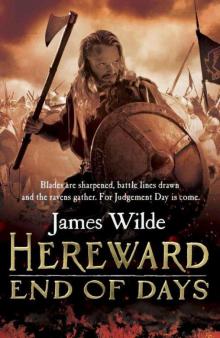
Hereward 03 - End of Days, page 1


ABOUT THE BOOK
1071. Five years have passed since the Norman’s crushing victory at Hastings. England reels under the savage rule of its new king, the one they call ‘the Bastard’. The North has been left a wasteland – villages torched, innocents put to the sword, land stolen. Rats feed upon fields of the dead.
It seems no atrocity is too great to ensure William’s iron grip upon the crown. Now his cold gaze is turning towards the last stronghold of the English resistance. After these years of struggle, he will brook no further challenge to his power. His vast army is massing; his machines of war are being made ready.
In their fortress on the Isle of Ely, the English rebels have put their faith in one man – a warrior, a leader and a master of the art of waging war. His name is Hereward, and he has planned an uprising that will sweep the hated king from the throne once and for all.
But Hereward has disappeared – and with him, it seems, England’s hopes of victory. Can this great hero really have abandoned his people? Time is running out, for King William is about to begin his final, devastating assault that will surely mark the end of days . . .
Here is a heart-pounding tale of heroism, treachery and sacrifice – and the bloodiest rebellion England has ever known . . .
Contents
Cover
About the Book
Title Page
Prologue
Chapter One
Chapter Two
Chapter Three
Chapter Four
Chapter Five
Chapter Six
Chapter Seven
Chapter Eight
Chapter Nine
Chapter Ten
Chapter Eleven
Chapter Twelve
Chapter Thirteen
Chapter Fourteen
Chapter Fifteen
Chapter Sixteen
Chapter Seventeen
Chapter Eighteen
Chapter Nineteen
Chapter Twenty
Chapter Twenty-One
Chapter Twenty-Two
Chapter Twenty-Three
Chapter Twenty-Four
Chapter Twenty-Five
Chapter Twenty-Six
Chapter Twenty-Seven
Chapter Twenty-Eight
Chapter Twenty-Nine
Chapter Thirty
Chapter Thirty-One
Chapter Thirty-Two
Chapter Thirty-Three
Chapter Thirty-Four
Chapter Thirty-Five
Chapter Thirty-Six
Chapter Thirty-Seven
Chapter Thirty-Eight
Chapter Thirty-Nine
Chapter Forty
Chapter Forty-One
Chapter Forty-Two
Chapter Forty-Three
Chapter Forty-Four
Chapter Forty-Five
Chapter Forty-Six
Chapter Forty-Seven
Chapter Forty-Eight
Chapter Forty-Nine
Chapter Fifty
Chapter Fifty-One
Chapter Fifty-Two
Chapter Fifty-Three
Chapter Fifty-Four
Chapter Fifty-Five
Chapter Fifty-Six
Chapter Fifty-Seven
Chapter Fifty-Eight
Chapter Fifty-Nine
Chapter Sixty
Chapter Sixty-One
Chapter Sixty-Two
Chapter Sixty-Three
Chapter Sixty-Four
Chapter Sixty-Five
Chapter Sixty-Six
Chapter Sixty-Seven
Chapter Sixty-Eight
Chapter Sixty-Nine
Chapter Seventy
About the Author
Also by James Wilde
Copyright
PROLOGUE
17 September 1071
SOON THE GRAVES would give up their dead.
To the west, a red gash wounded the darkening sky. The cold was starting to creep across the silent wetlands. And in the cemetery beside Ely’s great church shadows merged, the grassy mounds of the burials little more than smudges in the gloom.
Judgement Day was coming.
Wardric knew this was true, for the priest had announced it to the world that very morn while he sat, bored, at the back of the chill nave, watching the blood drain from his mother’s and father’s faces. Crouching beside the gnarled hawthorn next to the cemetery fence, the boy watched the graves with wide eyes. Soon, soon, the tumble of sod, the bony hands reaching up to the sky. And then the booming verdict of the Lord. He licked his dry lips, afraid of what he might see, but excited too.
Wardric had known eight summers, and although his kin said most of them had been hard under the grip of the cruel King William, he remembered only fishing and swimming and games and his father teaching him how to carve an angel out of deer horn. Now, though, all that was to end.
For a while he waited, his heart beating faster as the sun slipped towards the horizon. The time seemed right. The breeze smelled of endings. Ashes floated from the home-fires, and he could taste the rot drifting from Dedman’s Bog. Finally he glimpsed movement.
Wardric stiffened, but his heart slowed when he realized the graves were not yawning. It was only Oswyn, old Oswyn the potter, no doubt on his way to the saint’s shrine. Every day at dusk he trudged the same path. Back bowed, eyes never raised from the turf, white hair aglow, he clutched his offering, ready to mutter his prayers for the son he had lost in the spring floods.
The boy sagged back.
But only for a moment. He glimpsed another movement across the edge of his vision, a shadow taking on weight and form as it caught the dying rays of the sun. A man, swathed in a cloak, hood pulled high, striding with purpose. Curious, Wardric leaned forward.
A spear’s throw away from him, the cloaked figure caught up with Oswyn. Startled, the old man spun round, but his shoulders soon slumped back under their doleful weight as he muttered a greeting and turned back to his path. The blow came from nowhere, a fist hammered into the back of the potter’s head.
Wardric stifled a gasp.
Oswyn crashed across one of the graves, stunned. His attacker leaned over him, snarled his fist in the front of the man’s tunic and half hauled him up. As his senses returned to him, the old man began to splutter. His fingers clawed the air. The other man shook him and murmured, ‘Hold your tongue.’ The words drifted across the still cemetery.
Wardric felt puzzled to hear no threat there. That command almost seemed laced with a gentle humour. Careful not to make a sound, he eased back under the cover of the hawthorn.
‘What do you want of me?’ the old man moaned.
‘Only your life.’
Oswyn stared, baffled. ‘I have done you no harm.’
‘No, you have done me no harm. There is not a man or woman in Ely that you have harmed. You are well liked, old man. That is why I chose you.’
Gripped by the encounter, Wardric dug his fingers into the soft turf, squinting through the half-light to try to discern the identity of the hooded man. The attacker’s back was turned, but he seemed much younger than the potter.
Oswyn reached out a pleading hand. ‘I have no coin …’ His voice wavered. Like Wardric, he could make no sense of what was happening here.
The attacker dipped a hand inside his cloak and then pulled it back. A short blade shone in the ruddy glow of the sunset. It hung in the air for only a moment before its owner plunged it into his victim’s chest.
Wardric jerked back in horror, his hand flying to his mouth. How he prevented himself from crying out he did not know, but he was sure that if he made the slightest sound the hooded man would turn on him next.
The attacker pressed his free hand across the potter’s mouth to stifle his cries. Wardric clutched his ears to drive out those awful muffled sounds.
‘You are but the first,’ the hooded man hissed.
As the potter thrashed in his death throes, his attacker removed his hand and stepped back, watching the end of the old man’s days. Oswyn must have spoken, for the murderer said as if in reply, ‘Your protector has abandoned you.’
‘God has not abandoned us,’ the potter croaked.
The hooded man laughed. ‘Night is falling fast upon Ely, and upon the English. Be thankful you will not be here to witness it.’
And then he fell upon Oswyn like a wild beast, stabbing in a frenzy.
Rigid with terror, Wardric could not look away. Even when the savagery had ended and the old man’s shudders had stilled, even when the murderer had swept away across the cemetery, the boy remained, staring into the dark, afraid to move. He would never speak of this thing.
The Devil had come to Ely and nothing would be the same again.
CHAPTER ONE
THE WIND MOANED through the high branches and the skulls on the witch-charm rattled out a warning. Ravens, crows, gulls, oystercatchers and stonechats the two men spied as they looked up into the ash tree, all of them joined in death.
Madulf shuddered and pulled his cloak tighter around him. His unease only made his sullen face seem darker. ‘There are things abroad that I would not see,’ he murmured.
‘Are you a child, afrit of the dark?’ his brother Sighard said with a grin. His hair was red, his face pale and freckled, a rarity among the English rebels who had gathered under Hereward’s standard in Ely. And yet even as he spoke he felt his neck prickle, and he peered into the darkening woods.
‘You think the witch would have left this here for n o reason?’ the other man hissed. ‘You are the child, simple in the head.’
‘Let us not argue,’ Sighard pleaded. ‘These days it is all we seem to do. I worry that this struggle drives us apart.’
Madulf pushed past him back on to the track, allowing himself one last worried glance at the ghastly charm. Sighard followed. Like his brother, he had left his spear and his shield beneath his bed. Under his threadbare green cloak, he wore little more than rags. This night he would be no warrior, just a mud-spattered ceorl with straw behind his ears, and with luck no one would pay him much attention. There were eyes everywhere, even in these lonely woods. Nowhere was safe any more.
‘We argue because hope fades fast,’ Madulf called back, pulling up his hood as he hurried along the old straight track. ‘Outside the church this morn, one of the monks cried out that it was the harvest time for man. No one spoke out against him. And now … now we have been abandoned by the only one who can save us.’
Another witch-charm rattled overhead. They were everywhere, a last desperate attempt to ward off what all feared.
‘This night we may make things right again,’ Sighard replied, hoping his brother had not seen the charm.
‘Aye, crook your finger and wish,’ Madulf sneered. All his worries seemed to flood out of him in one deluge and he whirled, grabbing Sighard by the shoulders. ‘The End of Days has come like a midwinter gale. It howls across all England, and no man will escape its knives.’
‘You do not know this to be true.’
‘Can you not see?’ Madulf clutched his head. ‘In the far north, mortal remains clog the rivers and the streams and line the byways like markers on the road to hell. More rats than men now live in Northumbria, so say those who have fled the devastation. Hunger bloats the bellies of children and turns men and women to naught but skin upon bone. And the sickness has brought silence to whole villages, leaving black lips and black hands and feet in its passing. You know this to be true!’
‘We still have hope, brother.’
‘Not any more.’ Madulf’s shoulders sagged and he turned back to the track.
Sighard spat. It was the invaders who had brought the world to this. Those bastard Normans, with their bastard king, who had stolen the English crown. He tried to fan the flames of hatred in his heart. It had kept him warm during the bitter struggle against the enemy, but no more. These days he felt the cold touch of fear more often than not.
They paused on the edge of a black lake and looked out across the still fenlands. Wood and water, stinking bog and whispering reeds, as far as the eye could see. A treacherous landscape for any who did not know its moods, and one that changed constantly, with the tides flooding in through the saltmarshes to the north and east, and the rainfall swelling the rivers and streams to the east. Land that had been dry only a day earlier could pull a man down to his death.
Shadows were pooling under the trees. Along the western sky, a crimson band blazed as the sun slipped away. Time was short. They hurried on.
After a while, moonlight cast patches of silver among the trees. And then, through the curtain of branches, a soft golden light danced. The two brothers slowed, catching their breath. This was the place.
‘Forget your fears,’ Sighard whispered, resting one hand on Madulf’s shoulder. ‘Remember only the reason why we are here. Everyone in Ely counts on us.’
Murmuring voices drifted on the dank night air. Sighard breathed in the scent of woodsmoke. Pulling aside the hanging willow branches, he left his brother and stepped into a small clearing where some twenty folk squatted on logs around a roaring campfire. Many heads were bowed in deep reflection. Others leaned in close to whisper, as if raising their voices would bring the wrath of God upon them. He sensed a mood that was tense, almost reverent.
Through the twirl of smoke, Sighard could see a shack that had almost been swallowed by its surroundings. Yellowing grass grew waist-high on every side; the ash trees pressed so close they seemed all that stopped the bowing walls from collapsing. The roof gaped where sods of turf had fallen away. Sighard thought that it barely looked fit for pigs.
At the rear of the congregation, he dropped to his haunches and looked around the group. Worry etched deep lines into faces. They were frightened, he thought, seeking aid from whatever source they could find.
From the hut, a faint trilling rolled out. The crowd fell silent, and as the chirruping grew louder all eyes turned towards the door. Unable to look away, Sighard watched too. After a moment, he realized he was holding his breath tight in his chest.
When the door ground open, a dark shape moved in the shadows inside the shack. The trilling died away and a suffocating quiet descended on the clearing. Under his breath, Sighard muttered a prayer. These folk had heard the monks’ warnings, as he had. Lives destroyed, fortunes blighted. Sickness. Starvation. Death.
In the doorway a figure loomed. For a fleeting moment, Sighard imagined all the terrors he had heard whispered. Yet it was only a woman who stepped out into the firelight. Even then he was not comforted. Like a wolf she was, lean and strong and savage, her thin lips curling back from jagged teeth, fingers crooked to tear with broken, filthy nails. Her face had been weathered by the harsh fenland seasons, her filthy dress reduced to little more than mildew-stained rags. But though her hair was streaked with grey she glowed with the vitality of a much younger woman. Sighard found himself caught in the grip of her glittering eyes. They looked all black from rim to rim, the eyes of a devil, not a woman.
As she prowled along the front row, folk reared back as one. ‘Now you come,’ she murmured, her voice flinty. ‘In the cold of winter, you denied me food. Your children threw stones at me in the woods. You turned your faces away at the market. And your churchmen beat me with cudgels until my arms and back were blue and my blood flowed freely. Yet now you come.’
A man flushed from the heat of the fire bowed his head. He could not look at her. ‘Brigid,’ he ventured, ‘we should not have done you wrong. All of us are in agreement.’ He glanced around. Heads nodded. ‘Find it in your heart to help us and we shall be in your debt.’
Brigid looked across the group. ‘What would you have me do?’
‘Whatever is in your power,’ a wife cried. Her worries had been stifled for too long. ‘The church does not help us any more. The priests either bow their heads to King William in hope of favour, or are so fearful of his vengeance they cower like mice.’
‘Give us wards to keep the Normans at bay,’ a man shouted.
‘Make them piss blood. Make their cocks drop off with the pox,’ another yelled.
‘Hide our barns,’ a second woman pleaded, ‘so they cannot steal our food and we can live through the cold season.’
Brigid grunted. She stared into the dark beyond the circle of firelight and cocked her head as if listening to voices. When Sighard followed her gaze, he saw only gloom among the ash trees. He felt his skin crawl. Brigid prowled to the fire where a pot hung on a chain over the flames. Though the liquid bubbled in the heat, the woman dunked her fingers in and pulled out a shrivelled mushroom. ‘The flesh of the gods,’ she croaked. ‘It gives me wings to fly to the guardian of Lugh’s Spring and ask his aid, as it did for my mother, and my mother’s mother, and all the mothers before them.’ Brigid dipped a wooden cup into the brown stew. She let the contents cool, then began to sip. Once she had drained the liquid, she leaned her head back and closed her eyes in ecstasy. Slumping to her knees, she began to rock, humming to herself.
The moon slipped across the sky. No one spoke.
When the crack of a dry branch echoed from deep in the woods, everyone jerked and looked round. As they strained to listen, Sighard watched their fears play out on their faces. Wuduwasa, wuduwasa, the whispers rustled. A ceorl crossed himself, afraid he would be the next victim of the silent denizen of the wildwood who gnawed on the bones of men. They held their breaths and waited. Only when another crack echoed, this time further away, did they turn their attention back to the fireside.
Finally Brigid began to mumble. Sweat slicked her brow. ‘Speak,’ she breathed, her eyes still shut. ‘Ask what you would.’
‘Will the guardian help?’ someone at the front whispered.
The wise woman nodded.
Smiles leapt to lips. Hands clasped in hope. A white-haired woman, as bent as a wind-blasted tree, leaned forward. She swallowed and her voice cracked when she spoke. ‘Are these the last days?’