Bones of Coral, page 1


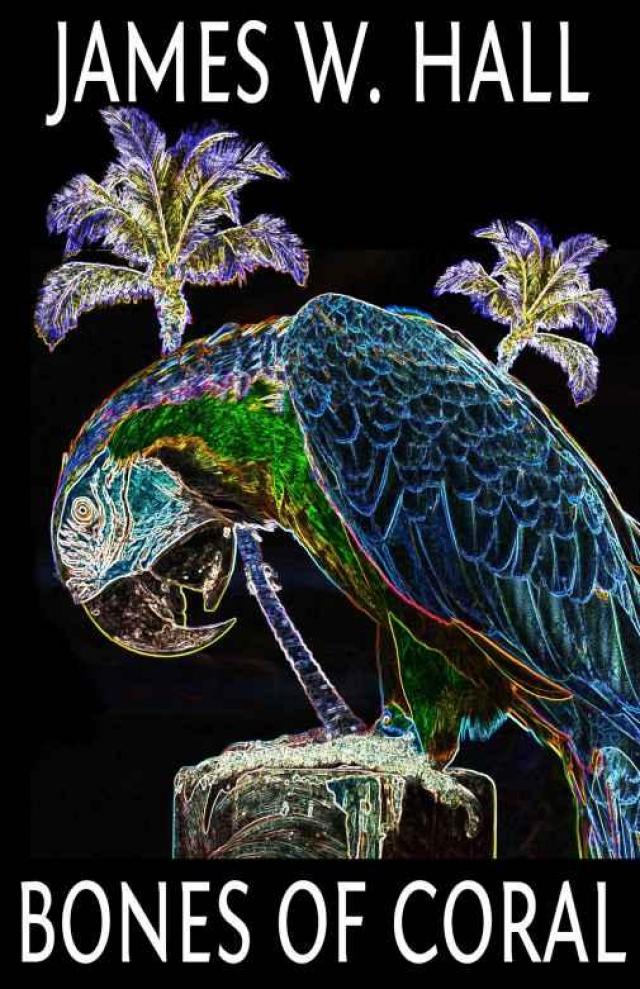
Bones of Coral
James W. Hall
Copyright © 1991 by James W. Hall
All rights reserved.
This novel is a work of fiction. Names, characters, places, and incidents are either the product of the author's imagination, or are used fictitiously. Any resemblance to actual persons, living or dead, or events is entirely coincidental.
Table of Contents
Chapter 1
Chapter 2
Chapter 3
Chapter 4
Chapter 5
Chapter 6
Chapter 7
Chapter 8
Chapter 9
Chapter 10
Chapter 11
Chapter 12
Chapter 13
Chapter 14
Chapter 15
Chapter 16
Chapter 17
Chapter 18
Chapter 19
Chapter 20
Chapter 21
Chapter 22
Chapter 23
Chapter 24
Chapter 25
Chapter 26
Chapter 27
Chapter 28
Chapter 29
Chapter 30
Chapter 31
Chapter 32
Chapter 33
Chapter 34
Chapter 35
Chapter 36
For Evelyn
Full fathom five thy father lies;
Of his bones are coral made;
Those are pearls that were his eyes;
Nothing of him that doth fade
But doth suffer a sea-change
Into something rich and strange.
SHAKESPEARE, The Tempest
1
Cassie Raintree was dying of brain cancer every afternoon at two-thirty. She had been dying all through January, and Shaw Chandler thought she was becoming more beautiful every day.
She wore a turban of bandages, and her cheekbones seemed to have risen to the surface. A halo of diffused light surrounded her hospital bed—that strange phosphorescence of the dying that Shaw had witnessed so often.
He knew it was goofy, but there it was. A thirty-eight-year-old paramedic who'd spent almost half his adult life wheeling the bloody, the broken and the dead to the ER or the morgue, and he'd let himself get involved in a soap opera.
Oh, he knew "Hidden Hours" was hokum, and that it was being written by some rich housewife in a Park Avenue apartment, all by formula: dark man sweeps woman away from cheese spread for intense romantic interlude. But he watched anyway, because Cassie Raintree was better than the worn-out story. She acted her way beyond it. She could draw in a breath as she stared down some bitchy accusation and then absolutely nail the sucker with a tilt of her head and a change of light in her eyes. It was art.
Everybody went on about the Meryl Streeps, but those Hollywood hotshots took a year to make a picture. They got takes, retakes, time to learn their lines, millions of dollars to make them glow. But hell, Shaw believed the real artists were the ones doing it every day. Out on the edge, cameras rolling, get it right the first time, or get out.
Dr. Cassie Raintree was the chief psychiatrist at Leewood Hospital in Oakbridge. In that position she'd gotten the lowdown on a lot of the citizens of Oakbridge. But she'd never abused her power. She had her standards and upheld them. Like the time she'd risked her career rather than reveal intimate details about one of her patients. Shaw was with her on that one. He'd been with her, in fact, on every problem that had come her way in the year he'd been watching "Hidden Hours."
Even during the weeks Cassie Raintree had fallen for Maiden Aimes, an undercover cop, Shaw had been on her side. Maiden was a renegade and a dark hombre. He wasn't but half a cut above the scum he was hunting. But he burned with a passion that had electrified Cassie Raintree and lured her away from her fiancé, Dr. Barton Donaldson. And though she had broken faith with Barton, Shaw believed she'd done the right thing. Barton didn't have the sizzle this woman needed. It never would have worked.
Cassie's real name was Trula Montoya. Trula Marie Montoya. She'd been two years behind Shaw at Key West High School twenty years ago. Running with a different crowd, the arty set, but he'd known her, everyone had. She was the poised daughter of a doctor at the navy base, the talented girl with the easy smile who was headed somewhere.
Shaw Chandler had noticed her, watched her walk the high school corridors, talk to her friends. This pretty, dark-haired sophomore with the large blue eyes. His buddies catching him a couple of times and making remarks. Finally, around Halloween his senior year, he'd asked her out. She was a bright, funny girl, her eyes alive.
She wasn't the least bit in awe of him like other sophomores would have been. Talked to him from the first moment like her equal, as if perhaps she didn't know that Shaw's photograph was on the sports page of the Key West Citizen almost every week. Eventually Shaw had trouble explaining her to his friends, why he'd bother with a kook like her, some airy-fairy actress who never even came to the games.
After a month of movies and dances and cheap restaurants, Shaw and Trula had begun to park beside the ocean at Smathers Beach, scoot close in his Chevy pickup and kiss for hours. Then between the kissing, gaze off at the glitter of moonlight on the Atlantic. He remembered her talking at moments like that, talking about plays, about people they knew, characters around the island or in school. She was excited by all kinds of odd things. People, the way they moved, their little mannerisms. She could mimic his friends' voices, their pigeon-toed walks, how they slouched against their lockers. She was funny and smart. He remembered her using the word nuance one night, and he had asked her what it meant.
Then one humid evening near Christmas, they had spread a towel across the sand, drunk beer from a quart bottle, and in a panic of laughter, stripped off their clothes and splashed into the water and held each other and kissed. But neither of them wanted to go farther than that. Nothing was said, but it was clear they were both embarrassed, unprepared for what came next. They toweled off and dressed, and afterward they kissed some more in the truck, but there was no heat in it anymore. And when he drove away from her father's house that night, he knew it was over. Though they dated for a few more weeks, it was never the same again. They had become, in that one night of sudden intimacy, merely friends.
After Shaw graduated and moved three hours north to Miami, he'd heard from his mother that Trula Montoya had dropped out of high school in her junior year and had gone to New York. And from time to time over the years, she'd mentioned Trula, appearing in this or that TV commercial, acting in some off-Broadway play.
Then about a year ago his mother had informed him that Trula Montoya had joined the cast of "Hidden Hours." He should watch the show, she said. See one of our own who made it.
So he'd sat down with the boob-tube addicts one afternoon last winter and started watching, not telling the guys he'd known Trula. And instantly he'd seen it. Trula Montoya was the only real thing on the silly show. A three-dimensional person ambling through a cardboard forest.
After that he'd begun watching "Hidden Hours" every afternoon he wasn't out on a call, waiting for her scenes, studying her, trying to separate the acting from the woman, prying around her mask for a glimpse of the island girl he remembered so clearly from that other life.
Then a couple of weeks ago, after only a year on the show, Cassie Raintree was diagnosed with brain cancer. And her vital signs began to grow weaker every day. It was clear that Trula Montoya was being written out of the show, and Shaw was vaguely depressed, walking around feeling heavy and slow. His one bright moment every afternoon at two-thirty was about to go dim.
***
One Wednesday afternoon, the second week in January, his partners, Jorge Benito and Buzz Sullivan, were watching the show. Buzz at a card table sipping a Diet Coke, and Jorge sunk into his recliner. Shaw was standing up, leaning against the rear wall. Three guys from the engine crew were scattered about the Spartan room—concrete block walls, glossy white linoleum—all in their identical recliners. Cassie Raintree was with her oncologist, and things looked bleak. Her doctor had suspended all treatment. He'd asked her if her business affairs were in order, if there was somebody she wanted him to call. No, she'd said, nobody.
A commercial came on, a deodorant soap that made people sing and smile when they used it. Buzz, watching the actors lathering up, said, "She's the star. They won't kill her off."
"What? They going to find a cure for brain cancer, huh, Buzz? Announce it right on this show?" Jorge looked around for approval from the other firemen.
"Maybe it was a bad diagnosis," said Buzz.
"She'll be gone by next week," Jorge said. "You don't survive shit like that. You get a tumor in there, it's fast growing, forget it, you're over with, a month tops."
"Dr. Jorge Benito," Buzz said. "Fresh in from Walter Reed to give his lecture on brain cancer."
"You heard what her doctor said. It's inoperable, man. I say just bury the bitch, let's get on to the sex scenes."
"I never liked her anyway," one of the engine guys said. "She's got a king-size corncob up her ass, you ask me."
"She's an actress," Shaw said. "She's playing a part."
"She's a dry sandwich," Jorge said. "You can tell the way she walks around, the woman has no lubrication."
Some of the engine guys laughed.
Shaw walked to the john and took a leak, and when he returned the show was back on and it had moved on to another part of the plot. But he wasn't interested in the rest of the charac ters. Without Cassie Raintree moving among these people, who gave a shit about them?
Shaw believed that Trula must have had herself written out. It'd gotten too easy for her. She wanted to test herself on some other stage, see what else she had inside her. That had to be it.
When the show was over that day, everybody standing up, stretching, Jorge said, "But I got to say it, man. Dry sandwich or not, I'm going to miss that babe. Her eyebrows, shit, they get me very hot."
"What eyebrows?" someone said.
"Man, that lady's eyebrows are so bushy, she's got to blow-dry them," Jorge said.
"You like hairy women, huh, Jorge?" Shaw said.
"So what if I do?" he said. "The thicker the eyebrows, you know, the hairier the bush. And this Cassie bitch, man, she's got to have a bush up to her navel and down to her knees."
Shaw stared at Jorge. The kid was sitting at a card table, working on his nails, digging the dirt out with the blade of his knife. A couple of the other firemen rocked up from their recliners, made some bored noises and headed back into the engine room.
"You know why you like hairy women, Jorge?" said Shaw. He felt the tightness in his throat, but wasn't sure if anyone else could hear it in his voice.
"I like hair," he said. "No reason for it. I like to get in there and smush my face in it."
Shaw said, "It's because you got homosexual tendencies."
Jorge stood up, put his knife down. Shaw moved out onto the open floor.
"Hey, hey," Buzz said. "What're you two idiots getting worked up about? It's a goddamn soap opera."
"But you're too chickenshit to admit you want to suck cock," Shaw said, going on with it, feeling the heat spreading through him. "So you get off on hairy women."
Buzz jumped up and stepped in front of Jorge, blocked him with his wide chest.
"Goddamn it, Shaw, shut up," Buzz said. He muscled Jorge back to the card table. And the boy sat down, still giving Shaw as hard a look as he could fashion.
Shaw Chandler went outside and sat down with some of the engine guys, looking out at the traffic on Bird Road, waiting for an alarm bell so they could go out and press the electric paddles to some obese, cigarette-smoking heart attack victim, resuscitate a cocaine mother, straighten up somebody's bloody mess.
***
At nine-thirty that night the three of them were in their cubicles. Shaw in his bed reading a Western, Buzz snoring, and Jorge singing along to his Walkman. When the claxon sounded, Shaw folded the corner of the page. The wall speakers came on, the female dispatcher saying, Rescue Seven respond on a Three Forty-four, a possible suicide, result of gunshot. She gave an address three blocks from the station house. Code Three, get cooking. Police were on their way.
Buzz pulled the rescue van out onto Bird, took the second left onto Seventy-fourth, a street full of warehouses and auto repair shops, and wheeled hard into the dirt driveway of a small white frame house.
A white-haired woman in a white sack dress waited for them behind the screen door. She was about sixty. Breathing hard and blinking her reddened eyes. She took a long look at Shaw, then said to follow her please, the victim was in the back bedroom. She believed he was already dead. Trying to be polite but having trouble keeping her legs under her.
She led them through a living room cramped with furniture. Big, primitive wood things, rockers and chests of drawers and tables, a secretary, a cedar coffee table, and a sofa with a jumble of bright, quilted pillows.
She walked down the narrow hallway, Jorge close behind her, rocking his head in time with her wide hips. Buzz punched him lightly on the shoulder to cut it the hell out.
In the bedroom the victim was wearing striped pajama bottoms and a white undershirt, his left arm slung over a pillow, holding it to his face. In the other hand he held a Colt .38. His heart blown out the back of his undershirt.
Buzz bent over him, checked for a pulse at his throat, while Shaw opened the equipment bag. Buzz rolled up the T-shirt, took the Life-Pak Five from Shaw and pressed the paddles to the victim's chest. Jorge and Shaw watched the tape printing out a straight line.
"I was out at the Seven-Eleven," the woman said, gazing at a blank wall. "I wasn't gone but fifteen minutes."
Buzz handed the paddles back to Shaw. He leaned over the victim and lifted the lifeless arm from his face. Shaw glanced at the man, then staggered a step backward.
"What?" Jorge peered at the guy, then back at Shaw. "What?"
"Jesus Christ," Shaw said, leaning forward for another look. He turned away, working for breath.
The man was close to sixty. A light touch of gray in his close-cropped beard. He'd gotten soft in the face and the middle. But his shoulders were still wide, his hands as thick and rough as they had been when this same man had lifted Shaw above his head to touch the ceiling of their house on Olivia Street in Key West. And his eyes, even without their shine, staring at the ceiling, they were his father's eyes. Hanson Chandler's eyes. Though it had been twenty years since Shaw had stared into them, there was no doubt. It was him. His square jaw, his heavy brow, those full, almost girlish lips. Hanson Chandler.
Shaw sat down heavily in a rocker, glanced over at the woman who was watching him quietly in the doorway.
"What's wrong, man?" said Buzz.
"It's only a gunshot," Jorge said.
"He's seen ten thousand gunshots," said Buzz.
Shaw stared at the blue rag rug. The light swam out of his eyes, the room yellowed, narrowing to a groggy slit. He lowered his head to bring some blood back to his brain.
"He looks like somebody I used to know. That's all," Shaw said, taking another slow breath. "It's okay. I'm okay."
"That'll shake you up," Buzz said.
"People look like other people," said Jorge. "What's the big deal?"
The woman was watching Shaw.
"I had it happen once," Buzz said, putting the paddles back in the plastic case. "Five, six years ago. I'm doing CPR on this lady, and it strikes me this girl looks like a girl I went out with in college. Sally something. I was actually considering marriage. Then it hits me, this girl doesn't just look like her, it is her. And there I am blowing into her mouth, trying like hell to revive her from an overdose of something. I had to stop, hand her over to my partner."
"Bunch of wimps," Jorge said.
The woman, standing in the doorway, looking at Shaw, said, "Can I talk to you? When you feel better."
Shaw lifted his head. "Yeah," he said. "Sure."
She led him into the kitchen and Shaw took the chair opposite her. The room was no wider than a hallway, painted bright white, the windowsill full of violets and herbs. Muffin tins and copper colanders and kitchen gadgets hung from the walls, a collection of porcelain pitchers on one counter. Someone had emptied a farmhouse and carted it here among the transmission shops and beer warehouses.
At one end of the room, a green parrot in a white cage hopped from its swing to a water trough, ruffling and shaking its feathers. It squawked and said, "Hey, sailor, hey, sailor."
The woman's eyes were faded green, the whites stained the color of weak whiskey. But her mouth was tight and resolved, as if perhaps she'd seen this night coming from a long way off and had hardened part of herself for it, even measured out her grief already for this moment.
A twitch had come into Shaw's heart. The tremors before a quake.
"I know it must be a shock," she said. "Finding him like this after so much time."
"Who are you?" he asked.
"Just somebody," she said. "Somebody helping your father get by."
"How do you know who I am?"
"Your father pointed you out to me. He watched you." She gave him a look at her eyes. "He watched you a lot."
There was a heavy knock and a voice at the front door. She frowned and rose wearily to let the police in. Shaw waited, staring at the swirl of grain in the oak tabletop, unable to summon a thought, a sharp clot forming in his throat.
The parrot gripped the cage door with its beak, gave it a rattle. "Who's a good boy?" it sang. "Who's being a good boy?"
When the woman came back into the kitchen, Shaw was focused on the bird, watching its frantic circuit of the cage. She took her chair, her eyes drifting to the wall above Shaw's head.