Just For You (Escape to New Zealand), page 11



“Ka nui taku aroha ki a koe,” she told him, the tenderness so strong, the longing to hold his vulnerable heart, to protect it forever, so fierce.
She saw his eyes close for a moment, and she could tell, all the way to her belly, all the way to the seat of her soul, that she was watching the fear of love unreturned leaving him, flying away on eager wings. The relief flooding his body was as real to her as if it were her own, because it was.
My love for you is limitless, she had told him.
Because it was.
October. Spring, and the first real break of the season for an international player, the gap between the end of the Southern Hemisphere Rugby Championship and the beginning of the five-week European Tour allowing for a much-needed rest, precious time with family and friends away from the pressure of the game.
A break, and he needed a break, for all sorts of reasons. Two weeks off, and he was spending them with Reka.
They’d gone to Whangarei first to visit her mum, to Russell to see the rest of her whanau, and she’d cried a little when they’d left both places.
“It’s only a few hours away,” he said when they were in the car again, across on the ferry, on their way north to Ahipara and his own family. “You can still visit heaps. It’s all good, baby.”
“Not what you said when you told me to move.” She was drying her eyes already, throwing it right back at him. Bloody hell, but he’d missed this.
He laughed. “Got me. And I didn’t tell you to move, I asked you. I only wish it were that simple.” Even though he didn’t, not really. “But yeh, living with the people you love is better. Which is why I want you to live with me.”
“Oh, smooth,” she said. “Dead smooth. Got me there, didn’t you, in the end. Got my toothbrush in your bathroom.”
“And your nightie in my closet, and I’m happy to have it there. I’ll be happier when all your things are there, though. I’ll be happier when you’re there even when I’m not.”
“I know you would, and you’re wearing me down, no worries.”
“Good.” He took a hand off the wheel to squeeze hers for a moment, then had to put it back again, because the road had too many twists and turns in it for one-handed driving, this far north.
Slowing for the drive through the minimal bustle that was Kaitaia, around another green curve, and, finally, it was there, the exhilarating tang that was salt and ozone and endless possibility, filling his lungs even before it came into view, and his heart lifted as it always did at the sight and the smell and the sound of the sea.
His sea. His beach. His place. The sweep of gold meeting blue that stretched endlessly northward, uninterrupted, all the way to Cape Reinga. The Ninety-Mile Beach.
“Home,” Reka said, as always understanding him perfectly.
“Yeh,” he said. “Home.”
After that, it was his mum running out to greet them, arms wide and welcoming, telling them about the hangi she had planned for the next day. Going out fishing with his dad, helping him rebuild the carburetor on a faulty outboard motor, eating and talking and laughing and his whanau, the neighbors, the friends, the land and the sea.
Home, and Reka fit there, the same way he fit with her family, understanding and belonging and meshing at a level, in a place that was bone-deep. Spirit-deep. Blood-deep.
“Hope you aren’t planning to get us stuck,” she told him a few days later as they drove along the beach. How many days, he’d have had to stop and count, because one day blended into the next here, slipped by so easily.
“Do me a favor,” he said with exaggerated pain, steering expertly around a soft spot, heading briefly towards the water and then back higher up the sand again. “I grew up driving this beach. Can’t tell you how many tourists I’ve dug out in my time. That’s why there’s a shovel in the boot. For them, not us.”
“You just tell yourself that.” She was laughing, and the sound, as always, made him smile too. “Luckily, I’m a dab hand with a spade.”
“You’re asking for it,” he warned, doing his best to sound menacing.
“Oh, yeh, big boy. I’m so scared. Who knows, you may push me down the stairs again.”
“I thought we’d agreed to forget that,” he complained. “You’re going to be bringing that up for years, aren’t you?”
“Probably.” Her smile was a bit smug now. “Nah. Definitely.”
“Just you remember,” he warned her, “I’m good at discipline. For myself, and for…others.”
“And again,” she said, “not exactly quaking in my boots. Going to have to do better than that.”
He had to laugh. “I’ll think of something, then, shall I?”
“You do that,” she said. “Something to impress me. Thrill me a little, too. Later.”
They stopped along the way to toboggan down the sand dunes of Te Paki, and Reka loved it as much as he’d known she would, charged up the steep slope without any trouble at all, again and again, making easy work of the heavy going through the deep sand. And slid down every bit as fast as he did, laughing with the exhilaration of speed, hitting a bump once, accidentally or on purpose he couldn’t tell, rising in the air, coming down to one side of her sled and rolling, over and over, down to the bottom of the huge hill.
She got up laughing, too, grabbed her toboggan and jumped out of the path of a shrieking pair of young girls, and ran down the slope to join him at the bottom, her hair and clothes a sandy mess.
“If anybody has to dig anybody out,” he told her, his own smile broad, “it’ll be me. I think you took half the dune with you.” He brushed off her back as she worked on her front, then moved a bit lower, and that was fun too, slapping the sand away.
“Going down again, aren’t I,” she said. “I could come off again. No real point in cleaning me up now, much as I can tell you’re loving the excuse. I know what you’re doing there, boy.”
“And if you do come off,” he said, giving her backside one last good slap, “I’ll help clean you up again. I’m chivalrous like that.”
They stopped again at Tapotupotu Bay for a swim, washed the sand off in the clear blue waters of the Tasman Sea, and she didn’t mind that either, and neither did he, because he loved swimming with Reka, even though she was still faster than he was. A picnic lunch, wet hair, salt and sand and sea and sun, and the final five kilometers to the carpark.
Cape Reinga, as far as New Zealand went. The northernmost point of the North Island, the point where the Tasman to the west met the Pacific to the east in a churning line of mixing waters. The path along which the spirit flew when it left the body, when it left this world.
Te Rerenga Wairua, the Leaping-Off Place of the Spirits. To most, a tourist attraction. But to a Maori, the most sacred spot there was.
“Can’t believe you’ve only been here once,” he said when they’d left the crowd taking the easier paved route along to the lighthouse, were climbing the hill to the vantage point above.
“Mmm,” she said abstractedly, looking down along the finger of land beyond, off-limits to every living soul, down to the single gnarled pohutukawa clinging to the cliff as it had done for eight hundred years. To the spot where both their souls would, one day, slip down into the sea and join their ancestors.
She stood there looking, and he knew what she was feeling, that the power of this place had infused her soul as it did his own. He wrapped his arms around her from behind, the way he had so long ago at Motuarohia, looked out with her, and their hearts beat in time with each other, in time with this place, with the heritage that stretched back in an unbroken line to the first wakas that had come ashore on this island six hundred years ago. To the people who had crossed that expanse of ocean in a journey so long, so arduous, so perilous that it made every other risk their descendants would take, any courage and honor they could ever show, pale in comparison.
They stood, silent, letting it fill them, then walked down the hill again to the stone-surrounded platform that housed the lighthouse, the last bit of ground that living feet could tread here.
Full of tourists, as always. He could hear French and German and Japanese and a few more languages, too. English as well, though there were few of the clipped accents that fell most easily on his ear.
“Thanks for bringing me,” Reka said softly, leaning against the stone wall next to him, still looking out. “It’s been a good day.”
“I did it for a reason,” he said, and if he’d ever been sure of anything, he was sure now.
“Oh?” She turned her head to look at him, a few tendrils of long dark hair escaping their messy knot and whipping in the ever-present wind, her generous mouth curved in a smile, her dark, liquid eyes full of humor. “Not just to watch me tumble off my sled?”
“Nah, not just for that, entertaining as it was.” He smiled back, then was serious again, was pulling out the box he’d grabbed while her back was turned, there in the carpark. And right there, in front of the tourists and the ancestors and everybody, was sinking to a knee, feeling the stone under his bare skin, because this was the place, and this was the time. “To ask you to marry me.”
He opened the box, revealed the ring he’d spent hours picking out a couple weeks ago in Johannesburg, and prayed that she’d like it, that she’d want it. He was glad he wasn’t wearing a monitor just now, because he didn’t want to admit how hard his heart was pounding, how short his breath was coming as he waited for her answer.
“So,” he managed to say, “what do you think? I know we started out exactly wrong. Well, not we,” he amended, “I. I did. But we’ve got the rest of our lives—I mean, I do. Bloody hell, I should have practiced this. I should have written it down.” He took a deep breath and plowed on. “The rest of—my life, I mean, to finish right. I’ve got every day until I die to show you how much I care. And every day until I die to know you do, too. I need to know that, baby. I need you so much. So please. Marry me.”
“Hemi,” she said, and she was laughing, and crying a little too, he thought. The tourists were all watching now, he could tell, and he was still on a knee, and she hadn’t answered, and his heart was galloping like a runaway horse.
She wasn’t even bothering with the ring. She had his hand, was pulling him to his feet, was throwing herself into his arms and kissing him, holding him. Loving him.
And then, finally, she stepped back, took his face in her hands, and smiled. Just smiled, and his heart was so full, he wanted to shout with the joy of it.
“Give me a chance,” she told him, her heart there to see in her eyes. The heart that was his, just like his was hers, and always would be. “Give me a chance to say yes.”
The End
Turn the page for a Kiwi glossary, a preview of the next book in the series, and more links
agro: aggravation
All Blacks, the ABs: New Zealand’s international rugby team, and the country’s biggest celebrities
back: One of the 7 rugby players who play—well, in the back, outside the scrum. They tend to be leaner and do more of the running and kicking, although all players do all jobs.
boatie: sailor
bollocks: balls (of the male variety)
brekkie: breakfast
bush: the (wild, uncultivated) countryside
Captain’s Run: final training session, the day before a match
chat up: flirt
chips: French fries
chilly bin: ice chest
chuffed: pleased
conversion: kicking the ball between the posts after a try. Worth two points.
cuppa: a cup of tea; the universal remedy
dead: very. “Dead easy”: very easy
do the business: do the job, get the job done
Domain: park; usually the main park in a town or city
dressing gown: bathrobe
earbashing: a talking-to, or just yammering on
first five: a first five-eighths, a rugby No. 10—the director of the offense, and the main goal-kicker
fizz, fizzie: soft drink
fizzing: excited, ready for action
footpath: sidewalk
footy: rugby, or a rugby ball
forward: One of the eight rugby players who form the scrum and do more of the pushing, shoving, and tackling, though all players do all jobs. Tend to be bigger and stronger than backs.
front, front up: square up, face up
Four Square: chain of small grocery stores in NZ
fullback: rugby position (back). Stands in—yes, the very back. Does a lot of long kicking and is the last line of defense.
get stuck in: commit; try your hardest
good as gold: perfect, good, fine
good fist, make a good fist of it: do a good job
greenstone: pounamu, jade—prized by Maori, used in pendants
haere mai: Welcome
hangi: Maori feast, cooked in an earthen pit in the ground.
harden up: toughen up. Standard NZ (male) response to (male) complaints: “Harden the f*** up!”
have a go: try
heaps: lots
holiday: vacation
hongi: forehead/nose-touching ceremonial greeting amongst Maori.
hooker: rugby position (forward). In the front row of the scrum. A tough, physical, battling position.
hoover: vacuum
into touch, kicked into touch: out of bounds (across the touchline—the sideline)
ITM Cup rugby, club rugby, provincial rugby: lower levels of rugby, below Super 15, which is the elite, and the All Blacks, who are the all-stars, the international squad
jandals: flip-flops, New Zealand’s choice of footwear (along with gumboots)
joker: guy. Not humorous or derogatory, just “some joker”—some guy.
ka pai: good. “It’s all ka pai”: it’s all good.
kai moana: seafood. New Zealand has no native mammals, and kai moana was an important staple of the early Maori diet.
kerfuffle: skirmish
kia kaha: Be strong, stay strong: an important Maori concept
kia ora: Hello; good day
kit: clothes. Get your kit off, get your gear off: get undressed.
Kiwi: A New Zealander. (The bird is a lower-case kiwi; the fruit is a kiwifruit.)
larking about: messing around
lock: rugby position (forward)
lounge: living room
Maori: The original inhabitants of New Zealand; a Polynesian people
marae: Maori communal/ceremonial meeting place
moko: extensive, complex Maori tattoo: normally on an arm & shoulder, possibly chest as well
Mozzie: A Maori Australian (or an Australian Maori)
nappy: diaper
no worries: it’s all good; everything will work out. The Kiwi mantra.
Northland: the northern tip of New Zealand’s North Island, north of Auckland. The Far North: the skinny part poking up at the very top.
out on the razzle: out on the town; drinking and partying
park, paddock: playing field (rugby). A paddock is a field (the sheep type).
pasteboard: cardboard
pavement: sidewalk
pissed: drunk. A piss-up: an event at which people do a lot of drinking.
plaster, sticking plaster: Band-Aid
pohutukawa: iconic New Zealand tree. Blooms with red bottle-brush blossoms at Christmas; the “New Zealand Christmas tree.”
pushchair: stroller
rugby: Rough contact sport with no padding, and “New Zealand’s national religion”
second-five, second five-eighth: rugby position (back). The player who does the most distributing of the ball—from the scrum and from the breakdown. A key strategic position.
Sevens: a speeded-up form of Rugby Union; played internationally
shag: have sex with
spew: vomit
sportsman: athlete
stonkered: drunk
Super 15, Super rugby: high-level rugby competition. Five teams from NZ, five from Australia, five from South Africa.
sweet as: great; nice. (Kiwis use “as” to mean “extremely”)
tea: informal dinner
ticker: heart. “Heaps of ticker”: lots of heart (courage).
togs: swimsuit (men or women)
touchline: sideline
try: a goal, in rugby; worth five points.
tryline: the goal line. The player has to touch the ball to the ground across the line to score a try.
try it on: flirt seriously, make a move on somebody
Under-19s: important international rugby competition for 18-year-olds
whanau: family; central Maori concept. Big whanau: extended family
wharekai: the dining room, more informal building at a marae
wharenui: the main ceremonial building at a marae
whinge: whine, complain. An unpopular thing to do in New Zealand. Harden up!
wing: rugby position (back). This is the one back position that is usually held by a big, tall guy. (There are two wings—left and right.) They tend to be the big power runners who can break tackles.
Find out what’s new at the ROSALIND JAMES WEBSITE.
“Like” my Facebook page or follow me on Twitter to learn about giveaways, events, and more.
Want to tell me what you liked, or what I got wrong? I’d love to hear! You can email me at Rosalind@rosalindjames.com
THE ESCAPE TO NEW ZEALAND SERIES
Reka and Hemi’s story: Just for You (Novella)
Hannah and Drew's story: Just This Once
Kate and Koti's story: Just Good Friends
Jenna and Finn's story: Just for Now
Books 1-3 Value Price Boxed Set: Just This Once, Just Good Friends, Just For Now
Emma and Nic's story: Just for Fun
Ally and Nate's/Kristen and Liam's stories: Just My Luck
Josie and Hugh's story: Just Not Mine
Hannah and Drew's story again/Reunion: Just Once More
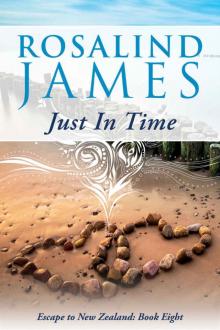
Faith and Will's story: Just In Time (In Brenda Novak's SWEET TALK boxed set;
May 1, 2015 - available for preorder now!)
Chloe and Kevin's story: Just Say Yes (Spring/Summer 2015)