Two Sagas of Mythical Heroes, page 17


It was now a ferociously hard battle, and no one could stand against King Hrólf and his champions. King Hrólf killed so many men with Skofnung that it seemed unbelievable, and so many of King Hjorvarđ’s men fell that they looked as though they were coming down in clumps.
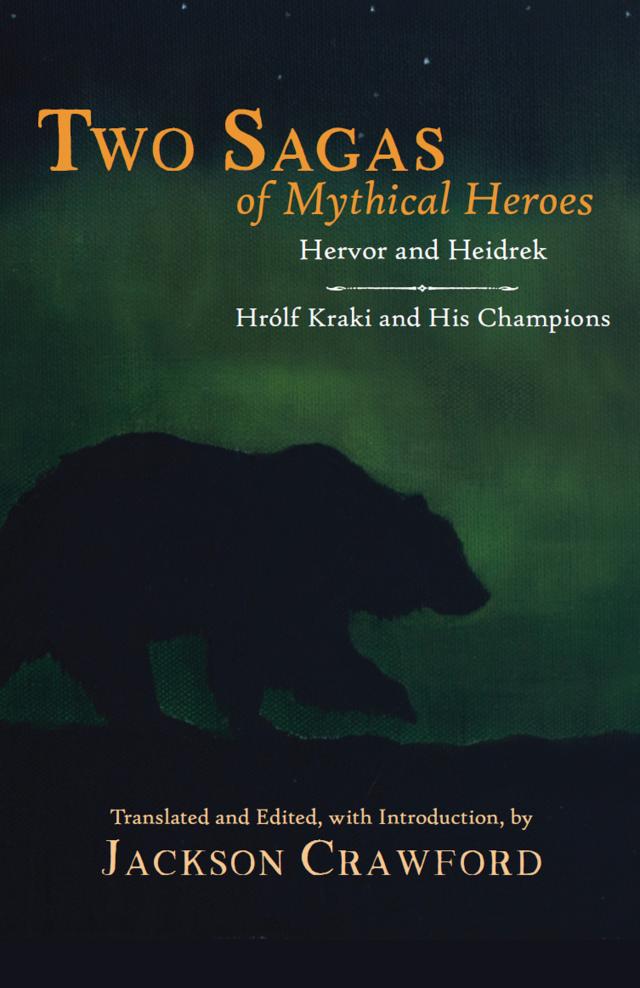
Hjorvarđ and his men could see that a large bear was going before King Hrólf’s men, and the bear was always close to where the king was. With one paw he killed more men than any five of King Hrólf’s champions, while swords and arrows alike seemed to bounce off him. This bear broke King Hjorvarđ’s men and horses alike underneath his bulk, and he crushed everything else that was near him with his teeth, until a panicked fear of his approach ran through Hjorvarđ and Skuld’s forces.
{132} Now when Hjalti looked around himself and could not see his comrade Bođvar, he said to King Hrólf, “How can it be that Bođvar is saving himself and coming nowhere near the king, such a great champion as we thought he was, and as he so often proved himself to be?”
King Hrólf said, “He must be somewhere, and I’m sure it’s somewhere that benefits us, as long as he has a say in it. Keep up your dignity and keep up your attack, and don’t slander him—not any one of you is equal to him. However, I don’t mean to scold any of you, because you are all among the most valorous of men.”
At this, Hjalti raced home to the king’s rooms and saw where Bođvar was sitting and doing nothing. “How long are we going to have to wait for the most famous champion? This is something never known before, that you aren’t even standing up on your own feet and testing your strong arms—your arms that are each as strong as a tame bear! Now get up, Bođvar Little-bear, senior man to me in this army, or I will burn down this house and you with it! But the greatest shame is that you are such a great champion, and the king is putting himself in danger for our sake, and you are losing all the great praise that you had earlier.”
Then Bođvar stood up and snorted and said, “Hjalti, you don’t need to try to scare me. I am still unafraid, and I am fully prepared to go. When I was young, I never fled from iron nor from fire. Now I have seldom tested myself against fire, but when it comes to iron, I have always endured it—and I have never failed to stand up to either until now. You say truly that I want to fight very well, and King Hrólf has always called me a champion in front of his men. I have much to repay him, first of all for my marriage to his kinswoman, but also for the twelve farms he has given me, along with many other precious things. It was I who killed Agnar the berserker, who was also a king, and that deed has lived long in the retelling.”
Then Bođvar counted up many of the great deeds he had done for Hjalti, and the many men he had killed, and he then asked him to believe that he would also go unafraid to this battle, “Though I think this one is much stranger than any we have had before. And you, Hjalti, have not been as helpful to the king in doing this as it seems to you, because by now it would have been decided which side was going to win. But you have been foolish rather than malicious toward our {133} king. And other than the king himself, no one but you would have been the right man to summon me away to the battle—and I would have killed any other. But now it will happen as it is fated to happen, and no counsel will avail. I tell you truly, now in many ways I will give the king less aid than before you called me away from here.”
Hjalti said, “It is clear that I am most concerned for you and for King Hrólf. But it is difficult to find the right course in the midst of such strange events.”
Chapter 51
After this urging by Hjalti, Bođvar stood up and went out to the battle.
But now the bear disappeared from King Hrólf’s troops, and the battle took a turn to the worse for them. Queen Skuld had not been able to get any advantage over them as long as the bear was fighting for King Hrólf. She herself sat in her black tent on a scaffolding that had been set up for her dark magic [seiđr].
Now the weather changed, as if dark night replaced bright day, and King Hrólf’s men saw a terrifying boar coming out of King Hjorvarđ’s army. It was no smaller than a three-year-old steer, and it was a wolfish-gray in color. Arrows flew out of its every whisker, and it killed the bodyguards of King Hrólf, dropping them like the waves of the sea with its monstrous magic.
Now Bođvar Little-bear began to clear a path through the men before him, chopping with both hands. He thought of nothing except to fight as hard as possible, and every man he met fell atop another one. He was bloody up to both of his shoulders, and he was piling up heaps of slaughtered men in every direction around himself, acting in a manner that seemed crazed.
But no matter how many of Skuld’s men Bođvar and the rest of Hrólf’s champions killed, it was odd to see how their army did not seem to diminish, and all the killing seemed not to reduce their numbers at all, and Hrólf’s champions thought they had never seen anything so strange.
{134} Bođvar said, “Skuld’s army is huge, and I suspect that their dead are getting revived and raised up again to fight us once more. It will be difficult to fight the undead. As many limbs as we have split, as many shields as we have torn, as many helmets and shirts of chain-mail as we have chopped into small pieces, as many chieftains as we have torn limb from limb—still the undead troops are all the more fearsome, and we do not have the strength to fight them. But now where is that one champion of King Hrólf’s, the one who most doubted my courage, and who most often challenged me to duels before I answered him? I don’t see him now, though I’m not one to talk behind anyone’s back.”
Hjalti said, “You speak truly: you’re no backbiter. Here stands the man named Hjalti, and you might say I have a little bit of work on my hands. There isn’t much distance between you and me right now, and I need the help of good men, foster-brother, because all of my protection has been chopped away. I think I have fought with valor, and though now I can no longer return every blow that is struck at me, I will not defend myself if we are to be guests in Valhalla this evening. Certainly we have never before seen stranger things than we see now, although we have expected the kind of news that we’re getting today for a long time.”
Bođvar Little-bear said, “Now hear what I tell you: I have fought in twelve great battles, and I have always been called a brave man and I have never shrunk back from any berserker.
“It was I who urged King Hrólf to make his visit to King Ađils in his kingdom, and that was a journey where we met with many forms of treachery. But that was nothing next to this current predicament. And now I have been wounded in the heart, so that I cannot be as glad to fight as I have been before. And on an earlier occasion I had already met King Hjorvarđ, at a time when we happened to cross paths, and neither of us spoke poorly of the other. We had a short fight with weapons at that time; he gave me a blow that nearly killed me, and I cut off his hand and foot. Another blow of mine hit him in the shoulder, and I cut down through his side and into his spine. Yet he did not cry out in response, and only lay down as if he were asleep. I assumed he was dead, but there cannot be many men like him, for he has fought no less bravely since. I have no idea what the source of his power might be.
{135} “Now many men have come against us here, powerful men, and men accorded high honors, and they are falling down upon us from every direction like a snowstorm, so that we can barely raise a shield against them. I do not believe that I recognize Óđin here, but I have a strong feeling of his presence somewhere near, that foul and treacherous son of war! If someone does tell me where he’s at, I’ll beat him like any other low-down vile rodent! That damned poisonous vermin will be badly treated, if I get my hands on him! Who could feel more hate in his heart now than we do, seeing his lord defeated as we watch?”
Hjalti said, “There’s no way to bargain with fate, nor to stand against magic.”
And in this way their conversation ended.
Chapter 52
King Hrólf defended himself well and manfully, and with greater dignity than any other man had ever shown. His enemies attacked him fiercely, and a circle formed close around him comprised of the select warriors of King Hjorvarđ and Skuld.
Now Skuld herself came into the fray, and vigorously encouraged her evil troops to attack King Hrólf. She could see now that his champions were not as close to him anymore, which was what Bođvar Little-bear had mentioned so unhappily, when he said he could not easily help his lord. It was the same for the rest of King Hrólf’s champions, for they were just as eager to die with him now as they had been to live with him when they had all been in the prime of their youth.
Now all the king’s bodyguards had fallen, and none would stand again. And as for the twelve champions, most had already sustained the injuries that would kill them. This went in the way such things usually go—as the teacher Galterus says, men’s strength cannot withstand such devilish power unless God’s power is with them. One thing prevented your victory, King Hrólf, that you did not know your Creator.
Now a great storm of magic came upon the champions, so that they fell over on top of one another. Then Hrólf himself emerged from the wall of shields, almost dead of exhaustion.
It does not need to be said in more words than this: King Hrólf fell there, along with all his champions, and they did so with great honor. As for how massive the battle was there, that cannot be explained with mere words. King Hjorvarđ fell as well, and all his army, except for a few traitors who rose again with Skuld.
Skuld then took the realms of King Hrólf for her own, but she governed them poorly and only a short while.
Moose-Fróđi came to avenge his brother Bođvar Little-bear, as he had sworn to do, and King Thórir Dog-foot came as well. This is told in The Tale of Moose-Fróđi. Moose-Fróđi and Thórir received a great deal of support from Queen Yrsa in Sweden, and some men say that it was Vogg who commanded the troops she sent.
They came to Denmark with their army, with Queen Skuld unaware, and they captured her in such a way that none of her magic could be used against them. Then they killed all her evil minions, and they tortured her in various ways.
Then King Hrólf’s kingdoms were returned to Hrólf’s daughters, and each of the avengers returned to his own home.
As to King Hrólf, he was buried in his mound, and the sword Skofnung was laid inside next to him. Each of his champions was also buried with a weapon. And here ends The Saga of King Hrólf Kraki and His Champions.
{137} Appendix
Chapter 1 of The Saga of Hervor and Heiđrek, from Hauksbók
A version of The Saga of Hervor and Heiđrek is preserved in the manuscript called Hauksbók (ca. AD 1300), which contains some additional material that is not in the best manuscript, designated “R” (see the Introduction for brief notes on the relationships between the manuscripts; the lost, later, manuscript “U” also included similar additional material derived from Hauksbók). While Hauksbók is the oldest physically surviving manuscript that contains this saga, the text in “R” is regarded by scholars as more faithful to the lost original, because the compilers of Hauksbók were notorious for heavily redacting the older sagas and poems copied into that manuscript. So although scholars have not accepted the extra material in Hauksbók as a valid survival of ancient tradition, the alternate beginning to the saga there (especially its expanded origin story for the sword Tyrfing) has a dark but fairy-tale-like quality that may intrigue modern readers.
Below, I have translated Chapter 1 of The Saga of Hervor and Heiđrek from scans of the Hauksbók manuscript generously provided by the Árni Magnússon Institute in Reykjavík, Iceland.
* * *
It is told that a very long time ago there was a place called Jotunheimar to the north in Finnmark, south of Ymisland and between there and Hálogaland. There were many giants there at the time, and {138} some of the people there were half-giants. There were close connections between the peoples there, because the giants married women from Ymisland.
Guđmund was the name of the king in Jotunheimar. He was a great maker of sacrifices. He lived at a farm called Grund, in the region of Glasisvellir. He was wise and powerful. He and his men lived for the equivalent of many other men’s lives. It was believed that within his kingdom lay the Field of Undying [Ódáinsakr], and that everyone who came there was freed from sickness and old age, and could not die.
After Guđmund died, people began to worship him and call him their god. His son was named Hofund; he was both foresighted and wise, and he was the judge of all the men in the kingdoms nearby. He never pronounced a false judgment, and no one dared to challenge his verdicts or sentences.
Another man was named Hergnír. He was a giant and a dweller in the mountains; he took Áma, daughter of Ymir, from Ymisland, and married her later. Their son was Hergrím the Half-troll, and he took Ogn Elf-work from Jotunheimar and married her later. Their son was Grím.
Starkađ, the great daring man of Ála, had been engaged to Ogn earlier. He had eight arms. He had gone north around Elivágar, and took her away to there. Afterward when he came home, he killed Hergrím in a duel. But Ogn killed herself with a sword because she did not want to marry Starkađ. After this, Starkađ married Álfhild, the daughter of King Álf of the Elf-homes, but Thór killed Starkađ. Then Álfhild returned to her people, and Grím the son of Hergrím went with her until he went out raiding. Then he became the greatest kind of warrior, and married Bauggerđ, daughter of Starkađ. He settled on an island in Hálogaland called Bólm, and he was called Island-Grím of Bólm. The son of Grím and Bauggerđ was Arngrím the berserker, who later lived on the island Bólm, and he was the most famous of men.
A king named Sigrlami was said to be the son of Óđin. His own son was named Svafrlami, who took over the kingdom after his father’s death and became the greatest kind of warrior.
One day, when King Svafrlami was out hunting, and he was alone without his men, he saw a large stone at about sunset. There were two {139} dwarves by it. Svafrlami enchanted them by means of his beautiful sword, so that they could not return to the stone unless he allowed them. The dwarves begged him to spare their lives. He asked them what their names were, and they told him Dvalin and Dulin.
The king said, “Since you are the most skillful of all dwarves, you must make me the best sword you can. The hilt and the boss must be golden, and the blade must cut through iron as though it were cloth. Rust must never appear on it, and it must claim the victory in every battle and duel for the man who wields it.”
The dwarves agreed to his conditions, and the king rode home.
When the appointed day for them to meet again came, Svafrlami returned to the stone. The dwarves were outside, and they handed him the sword, which was very beautiful.
But while Dvalin was standing in the doorway to his stone, he said, “Svafrlami, your sword will be the death of a man each time it is drawn, and it will be used to perform three evil deeds. It will also be your own death.”
Then Svafrlami swung at the dwarves with the sword, but they ran into the stone. The sword hit the stone, and the edges sliced into it, but the dwarves escaped through their door into the inner stone.
Svafrlami named the sword Tyrfing, and he always carried it in battles and duels, and always won the victory.
Svafrlami had a daughter named Eyfura, who was the most beautiful of all women and the wisest.
The berserker Arngrím was raiding at this time around Bjarmaland, and he came into the kingdom of King Svafrlami. He had a battle against the king, and the two of them fought personally. Svarfrlami swung Tyrfing at Arngrím, but Arngrím parried with his shield. The sword cut off the bottom of Arngrím’s shield, and got stuck in the earth. Then Arngrím cut off Svafrlami’s hand, and the sword Tyrfing fell with it. Arngrím killed Svafrlami with it, and then many other men. He left that land with a great amount of loot, and he took Eyfura, the daughter of Svafrlami, with him as well to his home in Bólm. They had twelve sons. Angantýr was the oldest, then Hervarđ, then Hjorvarđ, Sæming, Hrani, Brami, Barri, Reifnir, Tind, Búi, and the two Haddings. The two Haddings were the youngest and they were twins, and they did only one man’s work between them.
{140} Angantýr on his own did two men’s work, and he was a head taller than other men. All of the brothers were berserkers, and they were greater than all other men in strength and daring. Even though their numbers might be fewer than their enemies’, they were never on a ship with a larger force than just the twelve brothers. They traveled widely to raid and plunder, and they were often victorious in battle, and they became the most famous of men.
Angantýr had the sword Tyrfing, Sæming’s sword was Mistilteinn [Mistletoe], and Hervarđ wielded the sword Broti.
{141} Glossary of Names and Terms:
The Saga of Hervor and Heiđrek
Note that the alphabetization of this glossary is based on American rather than Scandinavian conventions. Æ is treated as A+E, Ð is treated as D, Ø and (in Swedish placenames) Ö are treated as O, ǫ is printed as and treated as O, and Þ is printed as and alphabetized as TH. The length of vowels is printed but ignored in alphabetization. More details on the anglicization of Old Norse used in this volume can be found in the Introduction.
Names that occur in the lists of descendants in chapters 15–16 are typically excluded, as they have little bearing on the overall understanding of the text. Among the names in chapter 15 are those of the chief characters of The Saga of Ragnar Lothbrok, for which see The Saga of the Volsungs, with The Saga of Ragnar Lothbrok, translated by Jackson Crawford (Hackett, 2017). The chapter in which a given name or term is first mentioned is enclosed in square brackets. Where the conventional spelling of a name in Old Norse is different from the more anglicized spelling used in the translated narrative, or when an English-language or present-day Scandinavian form of a place-name has been substituted for the Old Norse name, I have indicated the Old Norse spelling in parentheses following the name.