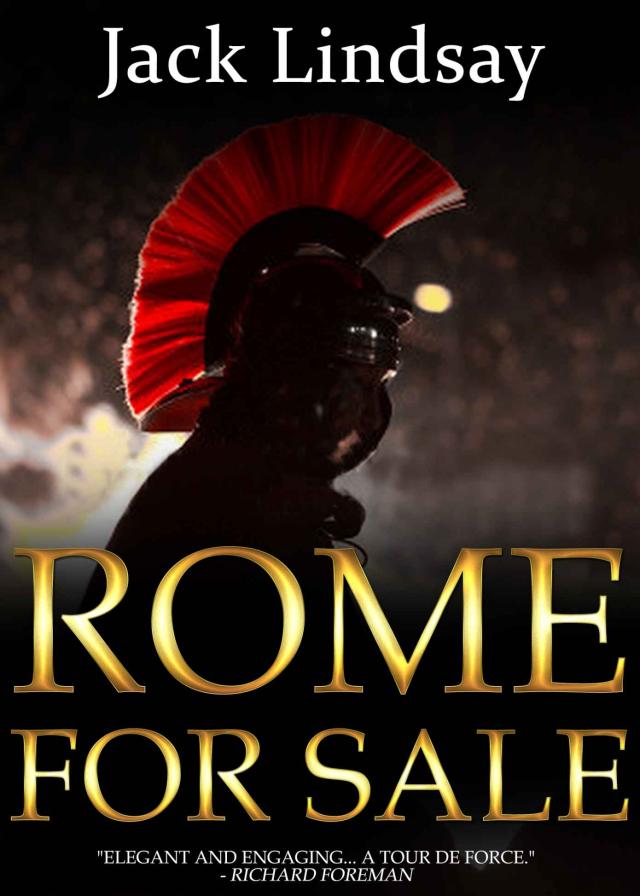
Rome For Sale, page 34


He made an effort to see her and distinguished the horror on her face. “You knew?” he whispered hoarsely.
She understood that her face had exposed her. “Yes,” she whispered back. “But you can’t let it hurt you. Such a lie. Such a meaningless lie.”
He shook his head. People were saying that he had murdered his boy, the son in whose grave so much of his hopes and plans lay buried. The world was mad, and he was mad to think of doing anything for it. He sank down with his head in his hands. Orestilla threw herself on the floor at his side and put her arms round him.
“Don’t. Don’t. You can’t be hurt by such a lie. You can’t.”
He silenced her by placing his hand over her mouth. “I want to think.” She kissed his hand and lay there accusing herself, torn by remorse.
Catalina tried to think. What had been his intentions? To stay in Rome and beat Cicero at his game of persistence?
He could not collect his thoughts. He was unutterably weary, and beyond the weariness he could feel only a desire to go away, to be among faces that were not fouled with these lies. He must leave Rome and join the army in Etruria. The cheerful, insolently submissive voice of Manlius sounded in his ears. There was a man whom he could love without reserve. Their compact was simple; no lies, no half-thoughts, no desolating subtleties and doubts could crumble it. It was simple and therefore the only thing worth having in the world.
“I’m leaving for Etruria to-night,” he said, looking up. “Send for Lentulus and Cethegus.”
11
Now that his decision was made, his mind worked easily. He gave his instructions succinctly but clearly. Messages came that Cicero was strengthening his garrison and that there was talk of starting a brawl before Catalina’s house, to end with arson and slaughter. Then the men went and he stood with Orestilla while the attendants got the horses and baggage ready. The silver eagle had already been sent on to Manlius. Orestilla was laden with her misery. She felt that she had somehow maimed and slain Catalina, though she had no way of judging whether his decision was right or wrong. She merely felt that what came out of that attack upon him could not be right. Miserable, she did not know what to say. She clung to him, carried far past tears.
He kissed her. “Love me,” she murmured. “Perhaps it’s the last time.”
He could not reply to her speech, and she clung faster, feeling that her words had been evilly omened. They were the worst words that she could have chosen. “Forgive me.”
He was impatient to go, but he lent over her, took her in his arms and tried to caress her. But it wasn’t a success. Both felt the false strain. “Love me, love me,” she repeated through set teeth, and he felt his caress become rough, violent. He wanted to finish, to go away, to break through the resistances that clenched him in. There was a wall before him, and he must smash through it.
Then he felt wretched. “Be careful,” he said. “Heaven knows what will happen.” He was leaving her defenceless amid his enemies. Suddenly he recalled the touch of the hand of Catulus, the kindly voice. “I must write a note to Catulus,” he went on. “He will see that nothing happens to you, though he’s on the other side.”
He sat down and wrote hastily:
“Lucius Catalina to Quintus Catulus, good health. Your great integrity, known to me personally, gives a pleasant confidence, amid extreme perils, to this my recommendation. I have therefore resolved to make no defence of my new course of conduct; yet I wished, though conscious of no guilt, to offer you an explanation which on my honour you may receive as true. Provoked by injuries and indignities since, robbed of the fruits of my labour and exertion, I lost the post of honour due to me, I have undertaken, according to my usual custom, the public cause of the distressed. Not but that I could have paid out of my own property the debts contracted on my own security; while the generosity of Orestilla, out of her own and her daughter’s fortune, would discharge those incurred on the security of others. But because I saw unworthy men ennobled with rank and myself proscribed on groundless suspicion, I adopted a course amply justified by my present lot for preserving what honour is left to me. When I was about to write further, news was brought me that violence is being prepared against me. I now commend and entrust Orestilla to your protection, entreating you by your love for your own children to defend her from injury. Farewell.”
He sealed the letter with a strong pressure, and then looked up to notice Orestilla sitting inertly on the couch. With an effort she threw off her dread and despair. She rose, smiled, and stood with gently dignified demeanour as he raised his arm in salutation to her and walked out.
12
November, the month of ploughing and sowing, had few rites. On the eighth the navel-pit was again opened, and on the thirteenth the old birth-goddess Feronia had her day. But while the conflict of Catalina and Cicero was being waged, the Plebeian Games had begun; they would run for almost a fortnight.
IX - AMONG THE REBELS
I
Meanwhile Marcius Rex, gathering what troops he could, had proceeded into Etruria. Manlius, hearing of his approach, sent some men to him with a petition of rights. It had been drawn up by Catalina. Appealing to the traditions of debt-relief and plebeian protest by secession, it made a sturdy statement of aim:
“We call gods and men to witness, general, that we have taken up arms neither to injure our country nor to imperil any individuals but to defend our own persons from harm. In miserable want, we have most of us been deprived of our homes and all of us of our characters and property by the oppression and cruelty of usurers. Nor has any of us been allowed according to old usage to have the benefit of the law or to keep his person free when losing his goods. Such has been the inhumanity of the usurers and the prætor.”
Marcius replied in the only terms open to him. “Let the men lay down their arms and invoke the compassion of the Senate, which none have ever petitioned in vain.” He himself would bring the petition to those who could best deal with it, but he could not parley with armed rebels.
2
The information that Catalina had at last departed overjoyed Cicero. His spies had been watching the house, and they shadowed Catalina to the gates; thence they returned with news that he had gone galloping furiously up the Aurelian Way. Cethegus and the others of the revolutionary committee spread the news that Catalina had voluntarily gone into exile to Massilia. This was to gain time and to excite odium against Cicero.
On the day after the departure Cicero called an assembly in the Forum. The square was thickly picketed, and the proletarians excluded. The purpose of the meeting was to convince the tradesmen and lower middle-class who had some small stake in the country, that Catalina was justly driven from the commonwealth. Cicero luridly outlined the dangers from which he had rescued Rome, and the types of bankrupt and libertine who constituted the rebel ranks—men who when ruined had the audacity and impiety to prefer death in rebellious company to death in a lonely ditch.
3
As soon as Catalina had ridden about thirty miles from the city he called a halt and considered his plans. Dressing twelve of his attendants as lictors, he bade them precede him as if he was on a proconsular expedition; for he knew how ingrained was respect for magisterial prerogative. The initiated might scoff, but some such show was imperative for the common people.
Addressing the peasants at every village through which he passed and gathering them in rough squads under the command of his men, he progressed northwards. Marcius Rex, finding his forces too small for Manlius, had retreated towards Rome; and the Senate, feeling that a real consul must be appointed to attack the false proconsul, named Gaius Antonius as general of all the levies. Cicero did not dare to leave Rome, the real centre of revolt; and the experienced and reliable officer Petreius was nominated as second-in-command to Antonius. Petreius was to do all the work and report on the least sign of trickery from Antonius.
The levies were going ahead fast. The Senate had sent alarmist-messages to all the richer municipalities, and the younger members of the middle-class were enrolling. Though not yet capable of meeting Manlius, the forces of the Senate were growing daily. Everything, however, depended on the events at Rome. Still not a single informer, free or slave, appeared from the rebel-ranks. At Arretium Catalina stopped to visit Flamma. He found his friend still seeking to keep a cheery outlook. “I’ve a confession to make,” said Flamma, clapping Catalina on the back. “I’ve gone and married a wife. I had to have someone to help with the accounts.”
His wife was a strong-limbed country-bred girl who shared his interest in farming. “Here’s my wife,” said Flamma, introducing her. “I know it isn’t the time for marriages, but I had to have someone to help with the accounts, didn’t I, Fannia?”
She assented with buxom gravity, and he clasped her in his arms. “It makes such a great difference in one’s life,” he confided to Catalina, “to have someone to help with the accounts.”
Fannia was unperturbed by his embraces or his description of marriage-motives. She evidently thought the wish for a helper with the accounts was a quite satisfactory reason for marriage. She saw to the comfort of the guests and departed for the poultry-yard to choose some tender specimens of bird-flesh for dinner. At the meal she sat on a chair beside the couch where Flamma reclined; and though he did not speak to her, by the time the apples were being handed round she had moved the chair closer and he had drawn himself out of the couch to lay his head on her lap. Her short but gentle hand moved every brief while over his hair, but otherwise she sat in matronly quiet.
These two were happy. Catalina thought of Orestilla and then cruelly drove the image out of his mind. But as he lay talking with Flamma of the state of Etruria, he felt that unbridgeable distance stretched between him and the wedded pair. He was bringing fire and steel, no matter what his motive, upon the earth; and these two were peaceably increasing the earth’s wealth. They owned an Elysium from which he by his very virtues was excluded, and what greater injustice was there than that a man should be damned for his virtues? Yet for what was he fighting but that this wedded pair should inherit the earth, they and all their happy other-selves? One seed must die in the earth, splitting suddenly with the unrealisable spark of growth that the ears of corn may wave in the breeze of sunlight. He was the seed broken in the darkness.
As he lay in bed later, his mind still reflected the picture of Flamma and his wife standing with arms about one another, looking out amorously on a future of harvest-days. Yet he did not want to go back the long road to the moment when he and Orestilla had stood in the marriage-awareness with a world of choice before them. Then he could have chosen the farm-life; but he had not chosen it; therefore he had not wanted it. He did not want it now. His hand felt out in the darkness for the sword which he had placed on a chair at the bedside. His palm closed round the hilt, and he rejoiced in the darkness.
4
Among Catalina’s retinue was a youth named Tongillus. He had accompanied Catalina to Campania and had been acting as one of the agents there. Catalina had a peculiar affection for the youth, which had been one of his reasons for keeping him away from Rome. Tongillus was very like in face and character to Catalina’s dead son; he had the same fair hair, the same rather dreamy manner, the same rather aimless wish to help and be useful. Catalina would have liked to adopt him, but feared that Orestilla would be hurt; and that was another reason for keeping the youth away as much as possible. But he was glad of his company now. He forgot Pollia and her dead son; he felt only the filial devotion of Tongillus, which somehow lessened the sense of frustration that at times became too painful.
Tongillus was sleeping at the foot of Catalina’s bed, and at the first streak of dawn he leaped out. Catalina rose and sat on the side of the bed, watching the lithely naked youth. He would adopt him later; it was the only way to be sure of beating the curse of sterility. The adopted son of a patrician, received with full religious sanctions, was incorporated into the blood of the family, though maybe a man still longed for a son whom he could feel to be the direct seed of his loins.
Tongillus paused in his exercises, shy at Catalina’s following glances. At that moment he was intolerably like the dead boy. The wraith of Pollia wavered behind him, and Catalina felt an anguished desire to be able to put his arms round the youth and say to himself, “This is flesh of my flesh, the seed of my loins grown into manhood.” What right had Pollia to accuse him of having overdriven their son? The boy had been strongly thewed and eager to excel. Perhaps Catalina, with his resources of energy, had expected too much of him. But who would have thought that a mere chill could slay such a clean-limbed boy?
Tongillus approached Catalina. “You won’t forget that you promised me the command of a squadron of horse?”
“ I won’t forget, but I’d rather you stayed out of the fighting.”
“Why, why?” pleaded Tongillus. “Don’t you think I’m good enough? I’ll show you!”
Catalina turned away. He did not dare to continue looking at the youth’s finely flushed face; he would not be able to control his emotions; he would clasp him and call him son and weep. “You shall have your squadron,” he said and began dressing with averted eyes.
Tongillus leaped into the air, kicking up his legs backwards and dancing the Spartan Bibasis, in which lads and girls competed for the number of times they could successively touch their buttocks with their heels. As he leaped, he chanted in a low voice a battle-song.
5
As Catalina advanced northwards, he was joined by small bands of peasants. Catalina succeeded in keeping his forces well under control, but from every side came news of villas looted by the insurgents and murders of the landlords and business-men. The town of Arretium had been seized, and those of the official class who had not fled were flogged or stabbed. But Catalina decided not to hold the town, which was lower than the dismantled and once-powerful Etruscan stronghold on the heights. He called on the men to proceed to Manlius at Fæsulæ. Manlius had taken and garrisoned Fæsulæ, and was now proceeding with a picked body of men to meet Catalina. He had sent a message fixing the meeting-place at a village some fifteen miles above Arretium. Catalina, leaving his troops under Munatius, a coarse soldierly fellow, set out with a bodyguard, pleased at the thought of once more seeing the blunt faithful face of Manlius. Manlius was drinking in the tavern when his pickets arrived with news of Catalina’s arrival. Vaulting on his horse, he galloped out to meet his master. Then, when within about twenty paces, he reined the horse in violently, slipped to the ground, and stood waiting, one hand grasping the bridle of the plunging horse, the other raised in salute.
6
Catalina waited till the rest of his forces arrived, and then set out for Fæsulæ. With Manlius he rode about the countryside, and wherever he spoke the villagers and farmers threw down their farm-gear and started off for the camping-ground. Manlius had selected reliable men who could take the recruits in hand and drill them in the army-manner; and the inexperienced men were distributed through the skeletal cohorts of veterans; but there was a great lack of weapons and armour. Many of the men had only leather-shifts, scythes, axes, hammers, or even staffs. Raids on the villas and townships increased the supply of arms, and gradually the gathering became more effective in appearance and drill.
Stragglers continued to come in from Rome, chiefly small knots of better-class young men or ruffianly down-and-outs. Catalina was carefully excluding slaves, for the Marian revolt and the Slave War had shown how ungovernable they became in victory. Some of the youths from Rome were enthusiasts for liberty; others were debauchees whose sole interest was the chance of rapine. There were curious corners of the camp where patrician rakes hobnobbed or brawled with cutthroats, and a number of camp-women had appeared from nowhere. Some of the rakes had even brought a mistress; and though Catalina objected to all disturbances of discipline, he was forced to countenance these thieves’ kitchens on the outskirts of the camp.
“Where’s Fulvius?” asked one Publicius, a lean youth with long yellow curls and small chin.
“I sent him a message,” replied his friend Munatius. “He had been banished by his father, heaven help him, to the country-estate. Something about money, I believe.”
“If I were Fulvius,” said Publicius, “I’m sure my father would have the misfortune to drink a cup of Falernian in which a careless vintner had dropped some hemlock.”
A small painted girl in a rich embroidered cloak rolled over against him. “What a talker you are.” She took up a thin-necked flagon and put it to her nipple. “Drink, pretty bottle.” Then she lifted it to her mouth. “Are they always drunk in heaven or is it heaven to be always drunk?”
Publicius held her down and blew in her ear while she squealed with dismay. “Serves you right, Chloe,” he said. “Next time I’ll blow right through.”
“That’s what I’m always frightened about with a kiss,” said Chloe, “if it takes too long.” She shook her head to jingle the long gold earrings. “That’s the kind of noise gold makes. So don’t say you can’t tell me in the dark.”
A blowsy woman sitting nearby with a dirty-faced ruffian interrupted. “Shut up. Can’t you let respectable folk drink in peace?”
“You respectable!” said Chloe. “So’s your mother’s beard.”
The woman snarled and drew a dagger from her sandal. “Put that down,” said Munatius. He took up a cup, hurled it, and knocked the dagger from the woman’s hand.