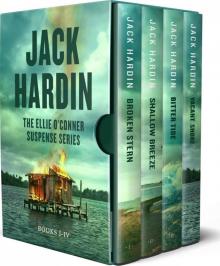
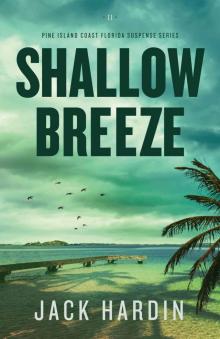
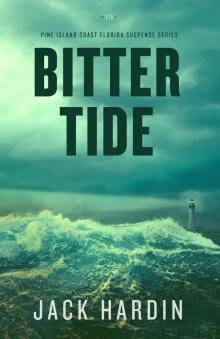
Pine Island Coast Florida Box Set, page 45
part #1 of Pine Island Coast Florida Series


The gallery’s back door was open, and the faint smell of cigarette smoke lingered inside. Ellie walked to the rear and stepped out onto the decked porch that looked out over the waters of Matlacha Pass.
Jean was leaning over the railing with a Virginia Slim tucked between her skilled fingers. She was slender and tall—a half inch short of six feet—and wore a white bohemian skirt and a multi-colored tank top of her own design. Her long, graying hair was pulled back into a loose ponytail and ended just above her tailbone.
“Hello, Jean.”
The older lady’s body jerked, and she straightened. Cigarette ash drifted to the wooden deck. “Ellie! Good Lord in heaven, you just about scared me off into the water, hon.”
Ellie smiled. “You should put up a chime in the shop so you don’t have an early heart attack. Sorry to have scared you.”
Jean waved her off. “Don’t worry about it.” She drew down on her cigarette, and the tip glowed a hot orange before it darkened against the release. She blew out a hazy line of smoke. “That’s not a bad idea about the chime. Haley Perkins mentioned the same thing to me the other day. I think I may have a simple setting I can program into the alarm system.” She looked at Ellie through clear lenses set into bright pink cat eye frames that had a small nameplate embedded near the earpiece. It read Tom Ford. Her eyeshadow matched the color of her building, except the orange over her eyelids was infused with a metallic glint that made her eyes look otherworldly, alien even, especially when she blinked. Flamboyant was the best word to describe Jean Oglesby’s style, but it was all built upon a stunning ability to capture the essence of the indigenous plant and wildlife she saw around her.
“You’re alone here today? Where’s the help?” Ellie asked.
“Carol’s mother is sick, and I told Clayton to take the day off. He was aching to go fishing. I don’t mind. What brings you in?”
“Major’s birthday is coming up. He’s turning sixty-two, and I want to get him a painting. He loves your stuff, you know.” Major was Ellie’s uncle—by relationship, not by blood—and along with being one of the most well-liked and well-known patriarchs of the local community, Warren Hall happened to own the most frequented bar on Pine Island, The Salty Mangrove, located at the southern tip of the island.
“Don’t I know it. He finds his way in here to look around every couple of months. What do you have in mind?” She took in another hit of nicotine. Her hand was shaking.
“Jean, are you all right?”
Jean followed Ellie’s gaze to her trembling hand and quickly brought it down to her side. “Oh, fine. Just a little bit of a nervous tick.”
Ellie eyed her. “What’s going on?”
“Just family stuff. I don’t want to concern you with it.” She stuck the cigarette back in her mouth and sucked in more smoke.
“Jean.” Ellie’s tone sounded like a mother warning her child not to play in the mud. “Out with it. What family stuff?”
When the artist turned to look at Ellie, her eyes were rimmed with concerned tears. “It’s Ronnie, my boy. I haven’t heard from him in a couple weeks. He calls me every Friday at lunch, you know. Has for years. It’s been two weeks, and I haven’t heard a peep or a tweet.”
“What do you think is wrong?”
Jean huffed. “He’s been involved with the wrong crowd, that much I know. He got in with some group a while back, and he seems to think of them as family. I don’t know what they are really: a gang or a cult. But they all follow the teachings of this old man who was always talking about national pride and the ‘Real America,’ whatever that means. I never could understand Ronnie when he tried to explain it to me.” Jean shook her head. “I feel like a terrible mother, not taking the time to understand.”
“Jean, you’re not a terrible mother. Ronnie, he’s my age, isn’t he? Mid-thirties?”
“Sure.”
“He’s a grown man. You can’t beat yourself up for him going with the wrong crowd.”
“I don’t know, Ellie. It’s more than just that. He has this friend who had been selling marijuana for some time and Ronnie got involved too, there for a while. Ronnie told me he got out of the whole drug thing a while back, but now he’s acting strange again.” She paused. “I know this all makes him sound bad—he really is a good man, you know.”
“I’m sure he is, Jean.”
“He just never did have any great role models. He grew up with his father in Ohio, and he was the one with all the money at the time. He and I divorced when Ronnie was little, you know. He’s still this big-shot lawyer up there in Cincinnati. He won full custody, and I lost my boy, but he never spent any decent time with Ronnie. Was always too busy in his office or his wood shop. I’ve done what I can over the years to be there for him and love him, but a mother’s love still can’t fully compensate for that of an absent father.”
“Jean, no one can predict what kind of choices kids will make when they grow up. Do you know where he is now?”
“No. He moves around so much.” Jean stabbed her cigarette into a palm-shaped ashtray. “I’m so sorry, hon. This is not why you came in here. You want to go in and pick out something for Warren?”
“Sure, let’s go see what you’ve got.” They walked back in, and Jean shut the door behind her. Ellie slowly walked the shop, gazing at the handbags, shirts, dresses, watches, earrings, and men’s neckties that all bore Jean’s art. She walked along the wall and stopped at a three-by-four foot painting of the Norma Jean pier, looking strong, sturdy, and a little weathered as it had before the airplane crashed into it over a month ago.
“Jean, this is great. Is this the original?”
“Yes, it is. Painted it just two weeks ago.”
Ellie looked at the price tag and almost cringed. “Has Major seen this?”
“I don’t think so. He hasn’t been through here for a perusal in over a month, I suppose. Harvey came in and scanned it last week, so I should have prints and trinkets with that image in the next few days.”
“He still has your Ancient Shrimp Trawler hanging over his living room fireplace. He’ll love this one.” Ellie reached up to take it off the wall and winced. She brought her elbows down a few inches to relieve the pain before trying again. Three weeks ago she had been repeatedly punched in the ribs by an ex-Navy SEAL intent on not being arrested for drug trafficking. Ellie had won out with a little help from her butterfly knife, but her ribs still had a couple weeks of healing before they were back to normal, pre-punch conditions.
“Are you okay?” Jean asked.
Ellie smiled across the fading pain. “Just a little sore.”
“I’m getting a bunion removed tomorrow,” Jean said. “I hear that recovery isn’t all sunshine either. Would you like to get it? The painting?”
Ellie disregarded the price and nodded. “He will love this.”
“Then here, let me grab it.” Jean stepped in and lifted the frame off the wall, then walked over to the checkout counter. She gently laid it down and wrapped it in bubble wrap. “You get the favorite person’s discount. Forty percent off.”
“Oh Jean, you don’t have─”
“I know I don’t, but I want to.”
“Thank you, friend.” She swiped her credit card in the card reader. Jean handed her the receipt and then the painting. The ladies walked in tandem toward the front door. When she had come in, Ellie had missed the small table set up against the wall. “Are you hosting a book signing this weekend?”
“I am. Artie Kaepernick just came out with his Pine Island Cookbook. I told him he could put his stuff out, shake hands with the incoming, and see if he can move anything. I hope he does. Anyone who hasn’t tried his Key lime grilled chicken is really missing out.”
“If I don’t make it in, grab one for me, will you? I’ll pay you for it when I see you next.” It had been Artie who had once suggested to Ellie that a requiem should be held, a dirge sung for the old Florida country that had, over the last couple of decades, been dissolved throughout the state by commercialization, fanfare, and tourism. But such a mournful song would not be sung here. Matlacha and its neighboring communities of Saint James City, Pine Island Center, Pineland, and Bokeelia all congealed to make up the laid back and naturally rural culture of the greater Pine Island area that was cherished for its serenity, ample mangrove-fringed coastline, and abundant fishing. It was Florida’s version of Mayberry, and tourists came back year after year to sit on bar stools and fish off docks with locals who always made you feel like you were a part of the family.
“Of course,” Jean said. “That will mean a lot to Artie. I’m glad you came in, Ellie. Always good to chat with you, hon.”
“You let me know if you don’t hear from Ronnie and if I can do anything to help.”
Jean nodded. “I will.”
Chapter Two
The Oldsmobile ran out of gas five miles back. He couldn’t understand it. The gauge said it was just over half full. Maybe it was the gas pump. He didn’t know, and after three minutes of trying to turn over the engine and slapping and cursing at the dash, he gave up, got out, and put his soles to the steaming asphalt shoulder.
What he didn’t know was that, had he simply asked the old lady back at the convenience store for a ride, she would have obliged him and asked where he needed to go. When he answered “Arcadia,” she would have scrunched her face, thought about it, and said, “That’s over thirty miles away, but I suppose I could manage. Don’t have nothin’ better to do.” Then at some point during the drive, she would have commented that her gauge was on the fritz and never went below the halfway mark and that she should probably stop off at the Sunoco on their way up there.
But that’s not what happened. He had stolen the car and never did see the pocket notebook on the passenger seat with her large, messy scratchings that kept track of her mileage. Even if he had noticed, he wouldn’t have guessed what it was for. Maybe tax purposes. Maybe the old lady had a little business where she made quilts or crocheted potholders or sold organic seeds. But then he wouldn't have really cared.
His hands were balled into fists as he walked, not from anger but from fear. He was tired of feeling them shake, so he curled his fingers tightly into his palms like a turtle into its shell. Every time he heard the far off drone of a car coming up the highway behind him, his throat thickened and his stomach curled and he would turn to make sure they weren’t slowing down for him. Surely they couldn’t find him out here? He had taken the back roads, and they didn’t know where he lived. At least, he was pretty sure they didn’t.
So he walked for an hour while the sun beat down on his denim jacket and his feet sweltered in his black combat boots. He mumbled to himself as he tried to process what had happened. There was no way they would think he wasn’t a part of it. He shouldn’t have run out like that. But now he had fled, and there would be no doubt. He couldn’t go back. He had stolen that car, and the cops would be looking for him.
He threw a nervous glance over his shoulder to look for any police cruisers down the road. But what he saw instead was everything he’d seen in his waking nightmare this last hour. He saw what he hoped would never materialize into reality: an orange Mustang a half mile behind him. And it was coming toward him at a crawl, moving more and more onto the shoulder. That was the moment his loins turned to water, and along the back of his spine and up into his teeth he felt a rush of cold blood. He turned his whole body around so he could keep an eye on the car and continued walking backwards. The car was coming faster now, its supercharged engine beginning to growl. Squinting, he could make out two figures through the windshield. One large, one larger. Grown men weren’t supposed to wet their pants. Not unless the switch at the end of the green mile was about to be thrown and you were strapped in, about to ride the lightning. But maybe he was. Maybe this was his green mile. He swallowed hard and then shot quickly toward his left, his feet leaving the asphalt and running down the grassy slope off the road as he bolted for the tree line.
The Mustang screeched to a stop on the shoulder. A door clicked open, and one of the men called out to him. He knew that jesting voice. Oh boy, did he know that voice.
He ran faster.
A gun discharged near the road, and the bullet smashed into the cypress tree directly to his right, sending flecks of angry wood into his cheeks and eyes. He ducked and entered the cover of the tree line.
And there was that voice again, that voice that made him want his mommy and wish that he had driven that Oldsmobile south instead of north, east instead of north, anything but north. His heart was drumming into his ears now, and he struggled on, criss-crossing trees like a mad spider until the moment the toe of his boot snagged an exposed tree root and sent him tumbling forward. When he landed his cheek fell onto a small rock which gouged him beneath an eye. Ordinarily, he would have felt an extreme amount of pain, but as it was, adrenaline was entering his veins faster than a post-surgery morphine drip, and he scrambled back to his feet and kept running.
They were both coming now. He could hear them calling for him, wooing him back in that sarcastic way that they had.
More gunshots, more woods chips in his face.
His lungs were burning now, coated with liquid fire, but he didn’t notice so much because all of a sudden his feet sloshed into stagnant water, and with every step his boots stuck a little harder, a little longer. Water reflected the broken sunlight at the base of the trees and told him he was heading into moderate swampland.
The water was now above his ankles. There would be alligators in here. Lots of them, he knew, their hooded eyes protruding from the black water, waiting patiently for some unsuspecting creature to slip on by. And yet, strangely enough, this knowledge did not induce fear.
It didn’t even bother him.
He would rather take his chances with the alligators in front of him than the crocodiles behind him.
Chapter Three
Andrés Salamanca scrolled down the web page, browsing images of surfboards as they passed, musing to himself over color and size, wondering what beach on the eastern coast of the state he should choose and whether or not he might end up being any good. He had never surfed, and the Internet said that a beginner board for a man his size should be at least six inches longer than a board for someone who actually knew what they were doing. He could rent one, but he preferred to purchase one instead. He had no hobbies of his own. Ringo had his books, his boats, and his businesses. Chewy, his tall, hairy coworker, had his motivational talks and liked to go on long walks on nature trails.
There was another shipment coming in from Mexico this weekend. Now that their biggest competition was out of the way, business was really ramping up. Once things settled down and new systems and structures were put in place to accommodate the growth, Andrés would take a vacation and go surfing. Take one, Ringo had urged. You never take any time off. And that was when, for the first time since he was a teenager and Maria Ortiz kissed him underneath the mesquite tree in his uncle's backyard, Andrés felt a tingle of excitement.
He had grown up on the dirty, blood-stained streets of Ciudad Juárez, where the only wave to be ridden was a cocaine-induced high or the thick blood lust that hit you the first few times you entered a strip club. Andrés never had tried the stuff he sold. He, like Ringo, knew a good business when he saw one. But in Andrés’s estimation, trying your product while selling it seemed, to him, much like farming piranhas and deciding one day to take a swim in the pond.
He thought briefly of his former associate, Scotch. How he had broken one of Ringo’s rules, nominating himself to be a taste tester of their cocaine, and how he had subsequently met his fate with a twenty-foot python in a sealed room not fifty feet from where Andrés now sat.
Andrés’s phone was sitting on the desktop next to the mousepad. It rang. He scrolled past a few more surfboards and answered without looking at who was calling.
“Is he there?” the caller asked.
“Yes.” Andrés stood and walked to the end of the main hallway and into Ringo’s office. The room was lined with built-in bookcases fifteen feet high. The higher shelves had to be accessed via a rolling ladder. All the books were hardback, clothbound. Classics of history, philosophy, and fiction from the Romantic and Victorian era, all of them a gift to Ringo from Andrés’s former employer, Ángeles Negros, the Mexican cartel that was the single supplier of Ringo’s cocaine.
He walked across a thick Oriental area rug woven in a pattern of two dragons facing off. Two dark leather couches sat in the center of the room, a large mahogany desk near the far window that looked down on the perfectly manicured lawn that terminated at the Caloosahatchee River beyond. Ringo sat behind the desk, leaned over, examining satellite photos of the area.
Andrés stepped close and remained silent. Ringo finally looked up from the photos, took note of the phone in Andrés’s hand, and nodded. Ringo had a policy not to personally talk over the phone. He didn’t trust encryption and masking. The best way to keep a long-standing anonymity was to simply keep your voice off the airways. He paid others enough so that they were willing to do it themselves. Andrés punched the speaker button on the cell phone. “Okay,” he said, and handed it to his boss.
“We’re all set,” Aldrich said. “Five hundred is scheduled and will run into the Alcove and the Cave.” Ringo understood the code. He had conceived it himself. Alcove was Georgia; Cave, Virginia. “Now that Nunez is gone, we can fill his empty routes. Make sure you keep them stocked. I’ll do what I can to keep eyes elsewhere.” Silence, and then, “I heard that our newest associate is running guns now? I thought we had a mutual understanding?”
Ringo muted the phone and spoke to Andrés. “We do. I’ll be dealing with him soon enough. I may want your help with that.” Andrés took it off mute, put it on speaker, said, “We do. I’ll be dealing with him soon enough. I may want your help with that.”