Beyond Singularity, page 1


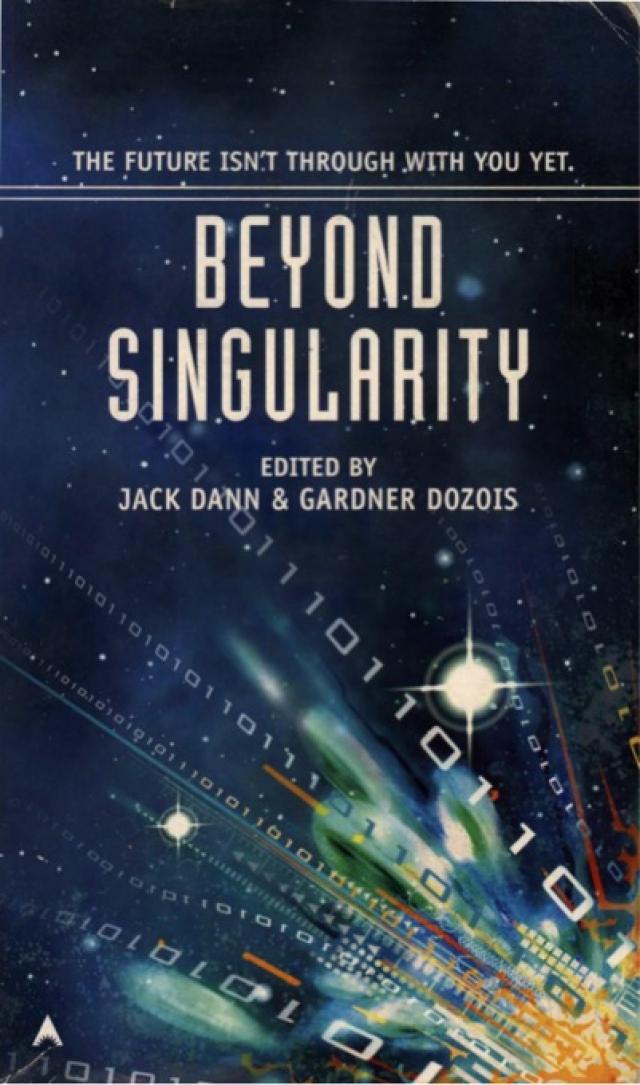
BEYOND
SINGULARITY
EDITED BY
JACK DANN & GARDNER DOZOIS
This is a work of fiction. All the characters and events portrayed in this book are fictional, and any resemblance to real people or incidents is purely coincidental.
eISBN: 978-1-62579-139-9
Copyright © 2013 by Gardner Dozois and Jack Dann
First printing: November 1992
Cover art by: Ron Miller
All rights reserved, including the right to reproduce this book or portions thereof in any form.
Electronic version by Baen Books
ACKNOWLEDGMENT IS MADE FOR PERMISSION
TO REPRINT THE FOLLOWING MATERIAL:
"Old Hundredth" by Brian W. Aldiss. Copyright © 1960 by Brian W. Aldiss. First published in New Worlds, November 1960. Reprinted by permission of the author.
"Border Guards" by Greg Egan. Copyright 0 1999 by Interzone. First published in Interzone, October 1999. Reprinted by permission of the author.
"Rogue Farm" by Charles Stross. Copyright 0 2003 by Charles Stross. First published in Live Without a Net (Roc), edited by Lou Anders. Reprinted by permission of the author.
"All Tomorrow's Parties" by Paul J. McAuley. Copyright 01997 by Interzone. First published in Interzone, April 1997. Published by permission of the author.
"Naturals" by Gregory Benford. Copyright 0 2003 by Interzone. First published in Interzone, September 2003. Reprinted by permission of the author.
"Osmund Considers" by Timons Esaias. Copyright 0 2002 by Interzone. First published in Interzone, May 2002. Reprinted by permission of the author.
"Coelacanths" by Robert Reed. Copyright 0 2002 by Spilogale, Inc. Published in The Magazine of Fantasy & Science Fiction, March 2002. Reprinted by permission of the author.
"The Dog Said Bow-Wow" by Michael Swanwick. Copyright 0 2001 by Dell Magazines. First published in Asimov's Science Fiction Magazine, October/November 2001. Reprinted by permission of the author.
"Barry Westphall Crashes the Singularity" by James Patrick Kelly. Copyright 0 2002 by James Patrick Kelly. First published electronically on The Infinite Matrix, September 30, 2002. Reprinted by permission of the author.
"Flowers From Alice" by Cory Doctorow and Charles Stross. Copyright 0 2003 by Cory Doctorow and Charles Stross. First published in New Voices in Science Fiction (DAW).
Reprinted by permission of the authors."Tracker" by Mary Rosenblum. Copyright © 2004 by Dell Magazines. First published in Asimov's Science Fiction Magazine, April/May 2004. Reprinted by permission of the author.
"Steps Along the Way" by Eric Brown. Copyright ©1999 by Eric Brown. First published in Moon Shots (DAW), 1999. Reprinted by permission of the author.
"The Millennium Party" by Walter Jon Williams. Copyright © 2002 by Walter Jon Williams. First published electronically on The Infinite Matrix, May 8, 2002. Reprinted by permission of the author.
"The Voluntary State" by Christopher Rowe. Copyright © 2004 by Scifi.com. First published
Preface
"Within thirty years, we will have the technological means to create superhuman intelligence. Shortly after, the human era will be ended."
With these provocative words, Vemor Vinge began his presentation on the future at the VISION-21 Symposium sponsored by the NASA Lewis Research Center in 1993, and so launched into popular culture the idea of the Singularity: that point in the future where humans are no longer the dominant species on Earth and where the rate of technological change becomes so great that predicting what the future will be like becomes nearly impossible, a tipping point beyond which "societal, scientific, and economic change is so fast we cannot even imagine what will happen from our present perspective, and when humanity will become posthumanity"—if it survives at all. A world as different from today's world as our world is from the world of the Australopithecus. A world in which humans may gain godlike powers or be wiped from existence altogether ... might be rendered obsolete and relegated to the equivalent of zoos or nature reserves, or merge with machines in strange ways to produce creatures few pe^^le alive today would even recognize as human. A world that is, in a literal sense, unimaginable—beyond the powers of our imaginations to conceive.
The Singularity had been envisioned before—Stan Ulam mentions a conversation with scientist John Von Neumann in the 1950s in which "our conversation centered on the ever accelerating progress of technology and changes in the mode of human life, which gives the appearance of approaching some essential Singularity in the history of the race beyond which human affairs, as we know them, could not continue," and the idea is sounded in a somewhat different key in Arthur C. Clarke's 1948 novel Against the Fall of Night—but Vinge's paper changed the Singularity from a vague speculation about something that might happen in the very distant future to something that probably would happen within the lifetimes of many of the people sitting in the audience. In Vinge's words: "From the human point of view this change will be a throwing away of all the previous rules, perhaps in the blink of an eye, an exponential runaway beyond any hope of control. Developments that before were thought might only happen in `a million years' (if ever) will likely happen in the next century." (For the entire text of Vinge's groundbreaking paper—plus links to other speculation and commentary about the Singularity—see www.ugcs.caltech .edu/-phoenix/vinge/vingesing.html. A discussion about the Singularity featuring Charles Stross and gory Doctorow titled "Is Science Fiction About to Go Blind?" can also be found at www.popsci.com/popsci/science/ article/0, 20967,676265,00. html. )
The idea of a technological Singularity, plus the related ideas of posthumanity and superintelligent Artificial Intelligences, have had an enormous impact on science fiction throughout the '90s and the Oughts to date, challenging and changing the genre's vision of what the future is going to be like. Here, over a third of the way to the date Vinge predicts for its arrival, some of the best science fiction being written grapples with the implications of the Coming of the Singularity and attempts the incredibly difficult task of peering ahead, beyond Singularity, to see what the posthuman world might be like.
Of course, today's authors can't really give us the view from a posthuman intelligence, from the far side of a Singularity, any more than an Australopithecus could have written a story seen through the eyes of a contemporary twenty-first-century human; after all, the stories are being written by people on this side of the Singularity, and no matter how lavish and radical the imaginations of the authors, they remain of necessity limited to being the human perspective on posthumanity. The idea of Singularity is so new that relatively few stories dealing with the world beyond the Singularity have been written. Yet although the task is perhaps by definition impossible, SF writers such as
Greg Egan, Michael Swanwick, Charles Stross (whose Accelerando stories, taken as a unit, may be the most complete vision yet of life beyond the Singularity), Cory Doctorow, Robert Reed, Brian Stableford, Stephen Baxter, Bruce Sterling, Greg Bear, Iain Banks, Nancy Kress, Alastair Reynolds, Peter F. Hamilton, Walter Jon Williams, Gregory Benford, Paul J. McAuley, James Patrick Kelly, Ian McDonald, Vemor Vinge himself, and the rest of the authors in this anthology, as well as a dozen others, continue to give it their best shot, producing work that dances right at the cutting edge of the genre—and which may be the best that mere humans on this side of the Singularity can do to predict the mysterious and perhaps incomprehensible future that may await us only a few decades down the line.
So before the Singularity swallows us and whisks us off to our unknown and perhaps unknowable fates, while we're still recognizably human, open the pages of this book to find fourteen visions of what might happen to us in the not-so-distant future—and, while you still can process such a primitive, meatbrain, mainframe-human emotion, enjoy!
(For further speculations on this and related themes, check out our Ace anthologies A.I.s, Beyond Flesh, Robots, Nanotech, Genometry, Hackers, Immortals, and Future War, and Gardner Dozois's Supermen: Tales of the Posthuman Future.)
Old Hundredth
Brian W. Aldiss
The far future seems to hold a special fascination and allure for Brian W. Aldiss, and in a field where such stories are relatively rare, he has almost made a specialty out of writing about it. The Long Afternoon of Earth (also known as the Hothouse series, under which title it won a special Hugo Award in 1962) remains one of the classic visions of the distant future of Earth, as well as being a foundation-stone of the subgenre of science fantasy. Aldiss has also handled the theme with grace and a wealth of poetic imagination in many other stories, including classics such as "The Worm That Flies" and "Full Sun," as well as the novels of the Helliconia trilogy (and handles a closely related theme with similar excellence in The Malacia Tapestry as well).
Never has he envisioned the far future more vividly than in the story that follows, though, which takes us to a muted, autumnal future thousands of years after a Singularity has forever changed all life on Earth; a future full of echoes and old ghosts; an ancient and ruinous Earth from which humankind has forever departed; a strange world of Involutes and Impures and musicolumns, with Venus for a moon, and hogs as big as hippos; a world of stately, living music under dusty umbrella trees .. .
One of the true giants of the field, Brian W. Aldiss has been publishing science fiction for more than a quarter century and has more than two dozen books to his credit. The Long Afternoon of Earth won a Hugo Award in 1962. "The Saliva Tree" won a Nebula Award in 1965, and A ldiss's novel Starship won the Prix Jules Verne in 1977. He took another Hugo Award in 1987 for his critical study of science fiction Trillion Year Spree, written with David Wingrove. His other books include An Island Called Moreau, Graybeard, Enemies of the System, A Rude Awakening, Life in the West, Forgotten Life, Dracula Unbound, and Remembrance Day, and a memoir, Bury My Heart at W. H. Smith's, and an autobiography, The Twinkling of an Eye, or, My Life as an Englishman. His short fiction has been collected in Space, Time, and Nathaniel, Who Can Replace a Man?, New Arrivals, Old Encounters, Galaxies Like Grains of Sand, Seasons in Flight, and Common Clay, and he's published a collection of poems, Home Life With Cats. His many anthologies include The Penguin Science Fiction Omnibus and, with Harry Harrison, Decade: The 1940s, Decade: The 1950s, and Decade: The 1960s. His latest books are the novels Affairs at Hampden Ferrers and Jocasta. He lives in Oxford, England.
The road climbed dustily down between trees as symmetrical as umbrellas. Its length was punctuated at one point by a musicolumn standing on the verge. From a distance, the column was only a stain in the air. As sentient creatures neared it, their psyches activated it, it drew on their vitalities, and then it could be heard as well as seen. Their presence made it flower into pleasant sound, instrumental or chant.
All this region was called Ghinomon, for no one lived here now, not even the odd hermit Impure. It was given over to grass and the weight of time. Only a wild goat or two activated the musicolumn nowadays, or a scampering vole wrung a chord from it in passing.
When old Dandi Lashadusa came riding on her baluchitherium, the column began to intone. It was no more than an indigo trace in the air, hardly visible, for it represented only a bonded pattern of music locked into the fabric of that particular area of space. It was also a transubstantio-spatial shrine, the eternal part of a being that had dematerialized itself into music.
The baluchitherium whinnied, lowered its head, and sneezed onto the gritty road.
"Gently, Lass," Dandi told her mare, savoring the growth of the chords that increased in volume as she approached. Her long nose twitched with pleasure as if she could feel the melody along her olfactory nerves.
Obediently, the baluchitherium slowed, turning aside to crop fern, although it kept an eye on the indigo stain. It liked things to have being or not to have being; these half-and-half objects disturbed it, though they could not impair its immense appetite.
Dandi climbed down her ladder onto the ground, glad to feel the ancient dust under her feet. She smoothed her hair and stretched as she listened to the music.
She spoke aloud to her mentor, half a world away, but he was not listening. His mind closed to her thoughts, and he muttered an obscure exposition that darkened what it sought to clarify.
"... useless to deny that it is well-nigh impossible to improve anything, however faulty, that has so much tradition behind it. And the origins of your bit of metricism are indeed embedded in such an antiquity that we must needs—"
"Tush, Mentor, come out of your black box and forget your hatred of my `metricism' a moment," Dandi Lashadusa said, cutting her thought into his. "Listen to the bit of `metricism' I've found here; look at where I have come to; let your argument rest."
She turned her eyes around, scanning the tawny rocks near at hand, the brown line of the road, the distant blackand-white magnificence of ancient Oldorajo's town, doing this all for him, tiresome old fellow. Her mentor was blind, never left his cell in Aeterbroe to go farther than the sandy courtyard, hadn't physically left that green cathedral pile for over a century. Womanlike, she thought he needed change. Soul, how he rambled on! Even now, he was managing to ignore her and refute her.
"... for consider, Lashadusa woman, nobody can be found to father it. Nobody wrought or thought it, phases of it merely came together. Even the old nations of men could
not own it. None of them know who composed it. An element here from a Spanish pavan, an influence there of a French psalm tune, a flavor here of early English carol, a savor there of later German chorale. All primitive—ancient beyond ken. Nor are the faults of your bit of metricism confined to bastardy—"
"Stay in your black box then, if you won't see or listen," Dandi said. She could not get into his mind; it was the mentor's privilege to lodge in her mind, and in the minds of those few other wards he had, scattered around Earth. Only the mentors had the power to inhabit another's mind—which made them rather tiring on occasions like this, when they would not get out. For over seventy centuries, Dandi's mentor had been persuading her to die into a dirge of his choosing (and composing). Let her die, yes, let her transubstantio-spatialize herself a thousand times! His quarrel was not with her decision but with her taste, which he considered execrable.
Leaving the baluchitherium to crop, Dandi walked away from the musicolumn toward a hillock. Still fed by her steed's psyche, the column continued to play. Its music was of a simplicity, with a dominant-tonic recurrent bass part suggesting pessimism. To Dandi, a savant in musicolumnology, it yielded other data. She could tell to within a few years when its founder had died and also what sort of creature, generally speaking, he had been.
Climbing the hillock, Dandi looked about. To the south where the road led were low hills, lilac in the poor light. There lay her home. At last she was returning, after wanderings covering three hundred centuries and most of the globe.
Apart from the blind beauty of Oldorajo's town lying to the west, there was only one landmark she recognized. That was the Involute. It seemed to hang iridial above the ground a few leagues ahead; just to look on it made her feel she must go nearer.
Before summoning the baluchitherium, Dandi listened once more to the sounds of the musicolumn, making sure she had them fixed in her head. The pity was that her old fool wise man would not share it. She could still feel his sulks floating like sediment through her mind.
"Are you listening now, Mentor?"
"Eh? An interesting point is that back in 1556 PreInvolutary, your same little tune may be discovered lurking in Knox's Anglo-Genevan Psalter, where it espoused the cause of the third psalm—"
"You dreary old fish! Wake yourself! How can you criticize my intended way of dying when you have such a fustian way of living?"
This time he heard her words. So close did he seem that his peevish pinching at the bridge of his snuffy old nose tickled hers, too.
"What are you doing now, Dandi?" he inquired.
"If you had been listening, you'd know. Here's where I am, on the last Ghinomon plain before Crotheria and home." She swept the landscape again and he took it in, drank it almost greedily. Many mentors went blind early in life shut in their monastic underwater life; their most effective vision was conducted through the eyes of their wards.
His view of what she saw enriched hers. He knew the history, the myth behind this forsaken land. He could stock the tired old landscape with pageantry, delighting her and surprising her. Back and forward he went, painting her pictures: the Youdicans, the Lombards, the Ex-Europa Emissary, the Grites, the Risorgimento, the Involuters—and catchwords, costumes, customs, courtesans, pelted briefly through Dandi Lashadusa's mind. Ah, she thought admiringly, who could truly live without these priestly, beastly, erudite, erratic mentors?
"Erratic?" he inquired, snatching at her lick of thought. "A thousand years I live, for all that time to absent myself from the world, to eat mashed fish here with my brothers, learning history, studying rapport, sleeping with my bones on stones—a humble being, a being in a million, a mentor in a myriad, and your standards of judgment are so mundane you find no stronger label for me than erratic?! Fie, Lashadusa, bother me no more for fifty years!"
The words squeaked in her head as if she spoke herself. She felt his old chops work phantomlike in hers, and half in anger half in laughter called aloud, "I'll be dead by then!"