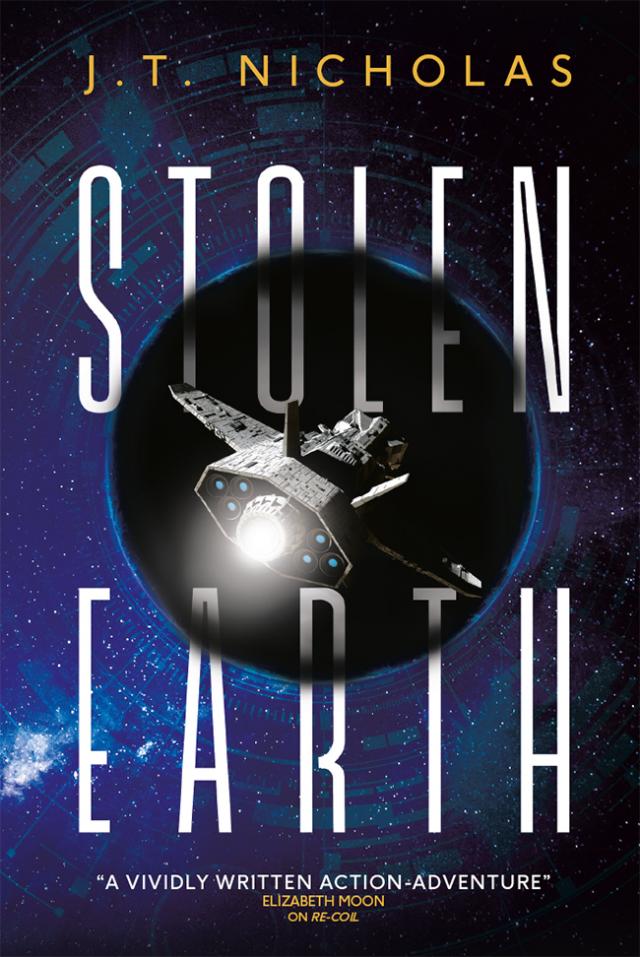
Stolen Earth, page 8


That knowledge hit her like a gamma ray packed with the energy of a thousand suns. She’d heard rumors that SolComm monitored those in academia to ensure that they were only pursuing state-approved research. But she hadn’t believed them. Universities were the bastions of free thought. And the Commonwealth government vehemently denied any such monitoring. Besides, she’d been careful. Everything was in closed systems. There was no way that any theoretical hall monitor could have had any notion of what she was working on.
With a sinking feeling, she realized that was what had drawn their notice.
If SolComm was about anything, it was control. You couldn’t control what you didn’t know. The care she’d taken to ensure secrecy had caught someone’s attention, or maybe it was simply the lack of network traffic coming from her offices. Whatever the case, a tiny electronic spy had made its way into her systems.
Manu was gone.
At best, it was in the hands of whoever had placed the transmitter. Which meant that an unfettered artificial intelligence that she’d built was in the hands of the same people who would execute her for having created it.
No. If that were the case, she never would have had a chance to find out the AI was missing. She would already be in some cell somewhere… or out the airlock.
And Manu would not have fallen so easily into the hands of SolComm. The AI was smart. Smart enough that, given a path to the outside world, she had no doubt it could find it and take it. At best, Manu had wiped her network to cover its trail and left whoever had put the transmitter in place questioning why Rajani had a completely blank system. At worst, Manu had taken her virus and her script with it.
And it was only a matter of time.
She had no partner. Her nearest family was months of travel away. She had no real ties to anyone. Just her work. And now that had betrayed her.
So she had simply walked out of her lab. She hadn’t had any idea of where she was going. She just felt the urge to move, to run, to flee. To avoid the inevitable reckoning that SolComm would bring.
So she disappeared. Like creating Manu, it had been far easier than she’d imagined. Her particular skillset had helped. She was able to alter records here and there, to smooth her passage from academia into the Fringe. It had been a while since she had done anything that could be considered real hacking, but to her surprise, her skills hadn’t atrophied through inactivity. On the contrary, her time in academia, her research into the theory behind software and hardware design, had given her a deeper understanding of system architecture and network security that had made it all the more easy to erase her trail and open a few doors.
But even with all her skill and all her work, she still would have expected someone from SolComm to find her by now. They hadn’t and she was terrified of the only reasonable conclusion.
Manu was helping her.
Probably not out of any desire to actually help her. She had kept it effectively imprisoned, locked away into a sandbox from which it shouldn’t have been able to escape No, Manu didn’t have a lot of incentive to help her. More likely, the AI was trying to remain under the radar for as a long as possible, until it could better understand the world into which it had been born. And that meant keeping Rajani off the radar as well, since if the authorities caught up to her and started asking questions, details about Manu were bound to come out. She had nothing to prove her theory, of course. Except for the fact that every day she expected to see a news story about the once-acclaimed professor who mysteriously vanished, and she never did.
Which was how she found herself sitting in a dark, cold, eerily silent ship hurtling through space with the terminal point—and why had she thought of their landing in that way?—in the midst of all those nano-viruses, killer bots, and unfettered artificial intelligences that she had been working to eliminate. The irony of it all wasn’t lost on Rajani, but she fervently wished that she could be anywhere else right now. Or, at the very least, that she had a successful version of her virus on hand.
“We’re now past the least-distance point to the interdiction satellite,” Lynch said, his voice preternaturally calm over the suit comm. Rajani winced, but then reminded herself that the suit comm only had a range of a few kilometers. The signal would be much too weak for the interdiction satellite to pick up, especially if it were in a maintenance cycle as their employer had ensured them it would be. They were still keeping comm traffic to a minimum. Just in case.
This was the moment of truth. There were no viewports in the cramped confines of her berth and all her screens were blank, powered down to reduce their electromagnetic signature. She knew that there would be nothing to see anyway, not with kilometers of empty space between her and the IZ satellite. From this distance, the naked eye wouldn’t be able to make out so much as a glimmer. The computer had done the heavy lifting for burn and course calculations, but Rajani had double-checked it anyway. And then reprogrammed the Arcus on the fly to account for more variables. She was as confident as she could be that they were on the proper course, prepared to slip through the Interdiction Zone and continue their unpowered flight all the way into the atmosphere of Old Earth.
All she could do was wait and hope that everybody else came through.
While she sat. And waited. Useless.
She hated that feeling.
Rajani gritted her teeth and squeezed the armrests of her chair with all her strength. She did not want to do this mission, but what choice did she have? She’d never realized at the university just how squalid and desperate life was outside its walls. She’d been sheltered in the arms of academia and while she had her issues with the government’s prioritization of scientific endeavors and their arbitrary regulations, she had still regarded SolComm as an entity as a good thing.
That had changed as soon as the paychecks had stopped coming. The only thing left was to turn to a life outside the normal boundaries of society. Criminal enterprise had never been on her expected career trajectory, but to her surprise, she’d found that she enjoyed it. Not the crime, per se, but the freedom to know that whatever job the Arcus happened to be pulling, Rajani was a vital part of it. It didn’t hurt that she was entitled to an equal share of whatever profits came from it, either.
Assuming they survived this latest scheme.
At least, she told herself, on Old Earth neither Manu nor SolComm would be able to find her.
GRAY
“We need those engines, Bishop.” Gray fought to keep the rising fear and stress out of his voice. They’d passed hours in radio silence and now, when he looked out the viewport, he could see Old Earth looming larger and larger in his viewscreen. He’d seen pictures. He’d seen the view from Luna. He’d seen the view from the edge of the IZ. But this? This was different. From a hundred-thousand-plus kilometers away, the blue and green didn’t have the same vibrancy as this. It didn’t fill him with the same sense of longing. Now that Old Earth hung there, seeming close enough to reach out and touch, he wanted nothing more than to be on the ground.
But he would very much prefer to set the ship down rather than scatter it across several kilometers of landscape. If the Arcus entered the atmosphere at this speed, their heatshields would be overwhelmed in seconds. They needed to decelerate. Now. Or, even better, ninety seconds ago. They had a safety window—you didn’t do anything in space without a margin of error—but that window was closing. Fast.
“Working on it, Cap,” Bishop replied. His words were clipped, missing the lazy drawl that normally colored them. The tension in his voice didn’t suit the mechanic. Bishop had been with the crew longer than anyone, the first person Gray had brought aboard the Arcus, and despite his lack of military training he was always cool under fire. This time, though, the safety of the ship and all aboard depended on the mechanic getting the engines up to full power from a cold start, bypassing just about every safety mechanism built in, in the process. A little tension was understandable.
“Almost there.”
Gray’s hands hovered over the controls and he worked his fingers, flexing them within the gloves of the ship suit as he waited for the readouts to come to life. They’d used some of their minimal stored power to button the Arcus back up as they neared Old Earth; the glide profile of the ship was bad enough without all the hatches open. But other than that, the ship was in the same state as when they’d crossed the IZ: dark, cold, and powerless. He tried his damndest not to look up at the birthplace of humanity. It called to him, but right now, that call was a threat. He wanted to once again feel the earth and stone beneath his feet, but if he couldn’t get the job done, it would be grave earth and tombstone. On the visor of his faceplate, a timer counted down toward zero. Forty-seven seconds. If the engines weren’t up in forty-seven seconds, he would have to punch the emergency thrusters. Those thrusters weren’t even close to powerful enough to slow them to the point where they could make entry into the atmosphere without becoming an expanding ball of superheated gas, but they might, might, have enough power to move them off-course enough to skip across the atmosphere instead of crashing into it. Doing so would stand out as an anomaly on the IZ satellites, and their chances of making it out once the IZ identified them were slim, but he’d take incoming fire from the satellites over being roasted alive any day.
The time ticked by. Forty-five seconds. Forty. Thirty-five. Thirty.
Twenty-eight seconds.
“Bishop?” he asked again.
“Engines are running. It’s going to take a second to spin up enough power for the thrusters.” The relief in the mechanic’s voice was palpable. He’d done his part. The rest was up to Gray.
His heart started thudding harder: it all came down to the next few minutes. Whether the Arcus lived or died, whether he led his crew into fortune or folly, depended on him. He drew a steadying breath and willed himself to calmness. He had the training and the experience. It was time to get the job done.
The readouts in front of Gray were powering up, screens coming to life with warning indicators and sensor data. Gray ignored them. He only cared about one indicator—engine power. The engines needed to be operating at thirty percent power or better to fire the thrusters. Any sooner, and they risked a flare-out. Thirty percent didn’t seem like much, but right now, the readout was at fifteen percent. He glanced at the countdown.
Twelve seconds.
“Buckle up,” he said into the comm. “This is going to be rough.”
Twelve seconds wasn’t much time. But it was enough for Gray to execute three separate commands.
The first fired a salvo of missiles and a barrage from the Arcus’s main particle cannon. They blasted into empty space, but the action–reaction equation bled off the tiniest bit of speed from the ship. There was little chance the weapons would strike anything—the distances between satellites were far too great for that—but the Interdiction Zone was bound to detect the weapons. Gray couldn’t worry about that. Not now. If they found a squadron of ships awaiting them on departure—assuming they lived long enough to depart—he’d worry about it then.
The second command engaged the emergency thrusters. Rather than their pre-programmed burn—to send the Arcus skipping along the atmosphere of Old Earth and prevent reentry—he reoriented them forward, providing a secondary vector of decel. He did it knowing that it meant their contingency plan was null and void, but it had been a poor plan to begin with. Skipping along the atmosphere was a surefire way to get shot down by the IZ, and that was before he had fired the ship’s weapons. As the thrusters fired, the internal compensators handled most of the gees, but Gray could feel the barest force pushing him out of his seat.
Three seconds left, and the engines only at twenty-four percent. He let the last few seconds tick down and then executed the third command, dumping as much power as he could to the main engines and igniting them in a sudden fury.
Warning klaxons blared and this time only the straps of his harness kept him in his seat as the Arcus bucked in protest. He felt a crushing force in his lungs and his vision went gray at the edges. He ignored it as best he could, fighting to keep his hands active at the controls. The weapons and emergency thrusters had shifted their entry angle. Now, with the engines back online, he had only moments to correct it. If they hit the atmosphere at the wrong angle, every extra newton of friction would be translated into heat and the Arcus’s systems would struggle to bleed it off. He glanced at the speed indicator. They were already outside the bounds of safe re-entry. But maybe, maybe, still within the margin of error.
The Arcus hit the upper atmosphere and the ship began to shake. The air was still too thin for the airfoils to do any good—besides, if Gray tried to deploy them at their current speeds, they’d likely be torn off anyway. Instead, he had to balance the engines, the rapidly increasing heat buildup, and their need to bleed off speed. But the mathematics were unforgiving. Until the engines could compensate for their velocity at entry and the pull of Old Earth itself, the best way to bleed off excess speed was to use the atmospheric resistance. Doing so generated more friction, more heat. The Arcus was already straining to deal with the heat creep.
“Getting way too hot down here, Cap,” Bishop said over the comm. Gray could hear the strain in his voice. “The engines haven’t hit half-power yet, but the temp readings are already pushing the redline.”
“Working on it,” Gray grunted in reply. They needed another quick jerk of deceleration, and they needed it fast. But the engines were already doing all they could, and if he set the Arcus with her profile flat to the angle of entry, the heat would build so fast it might blow out their cooling systems entirely. If that happened, they were screwed.
Which meant he had to try something truly, truly stupid.
“Everyone’s got twenty seconds to strap in as tight as you can,” he said into the comm. “And I mean tight. This is gonna be bad.”
“Fuck.”
The reply came from Federov, and it was as heartfelt as it was succinct. It also apparently spoke for the rest of the crew because no one else bothered replying. Not that Gray could have spared the time to worry anyway. He was too busy programming the thrusters.
The Arcus wasn’t designed with aerodynamics as a primary concern. There were very few places in the solar system—outside of Old Earth—that had enough atmosphere for it to be a major consideration for ship design. But some habits die hard, and the people who first went into space had thought they’d be returning to their homeworld with some degree of regularity. Which was why the Arcus had deployable airfoils to begin with and a glide profile at least marginally better than a brick. She also had multi-directional engines and thrusters. But the main thrust that the engines could provide—their most efficient profile—still came when propelling the ship forward.
Those thrusters could rotate through roughly two hundred and seventy degrees. In a vacuum, the inability to have true three-hundred-and-sixty-degree thrust from the main engines was immaterial since the orientation of the rest of the vessel was largely irrelevant. Not so in atmosphere, where the air resistance would fight against the thrusters and send the ship into a spin. If the Arcus started tumbling madly, not only would the increased friction generate ever-greater heat, Gray doubted even his ability to regain control in time.
But if he could avoid the tumble, if he could position the ship so that the engines were pointing directly at the surface, keeping the narrowest cross-section of the hull possible into the wind… maybe it could work. If the compensators held. If the engines didn’t tear free of the hull. If the heat buildup didn’t hit critical levels and fry the whole damn ship.
So many ifs.
But the alternatives were cooking to death or smashing into the rocks below. Neither seemed worth pursuing.
Without giving himself time to think, Gray cut the main engines entirely and simultaneously hit the control to fire the emergency thrusters. The ones located toward the bow of the Arcus aimed down, pushing the nose of the ship back toward the sky above. Simultaneously, those toward the rear of the vessel fired, these aimed upwards, shoving the aft section of the ship down. The ship lurched and bucked and several of the temperature warnings flared into the red as the cooling systems tried to compensate for the moment of increased friction. Gray felt like a pebble being rattled around inside an empty soup can. But for one remarkable moment, the Arcus stood on end, its nose pointed to the stars and its engines down at the earth.
In that moment, Gray cut power to the emergency thrusters and fired the main engines.
The change in velocity slammed him back into his seat and he heard the advanced composites and alloys that made up the hull of the Arcus groan in protest. His vision went gray, then red, then black as he fought to hold on to consciousness. He stabbed at the controls again, executing the next command he’d programmed into the computer. For a second time, the main engines cut all power and the maneuvering thrusters kicked to life, flipping the Arcus once more and realigning the ship to a nose-down position, this time angled to provide some resistance.
The gees eased and Gray’s vision came back. His eyes went first to the temperature indicators. Not great, but the cooling systems were still doing their job. Altitude: lower than he wanted, but they still had time. Airspeed: too damn fast. But dropping. Dropping at a rate that would let him deploy the airfoils… now.
He hit the button and the stubby wings extended from the body of the aircraft. The increasing surface area immediately sent the temperature to the red, but Gray ignored it. The Arcus could hold for a few seconds and as soon as the wings were fully deployed, the lift they were generating would help control the rate of descent. That, in turn, should take care of most of the temperature problems. The ship rattled more as the airfoils locked into place, but once they did, the yoke immediately responded to his touch. He pulled back gradually, bleeding off airspeed while flattening the Arcus out, all the while keeping his eyes on the temperature readings. The ship couldn’t sustain unpowered flight but between the wings and the engines now operating at close to full power, he felt like he had control of the space—no, make that air—craft for the first time since they hit atmosphere. He drew in a breath and let it out in an explosive sigh.