

The Black Mask Magazine (Vol. 1, No. 6 - September 1920), page 1
part #6 of The Black Mask Magazine Series


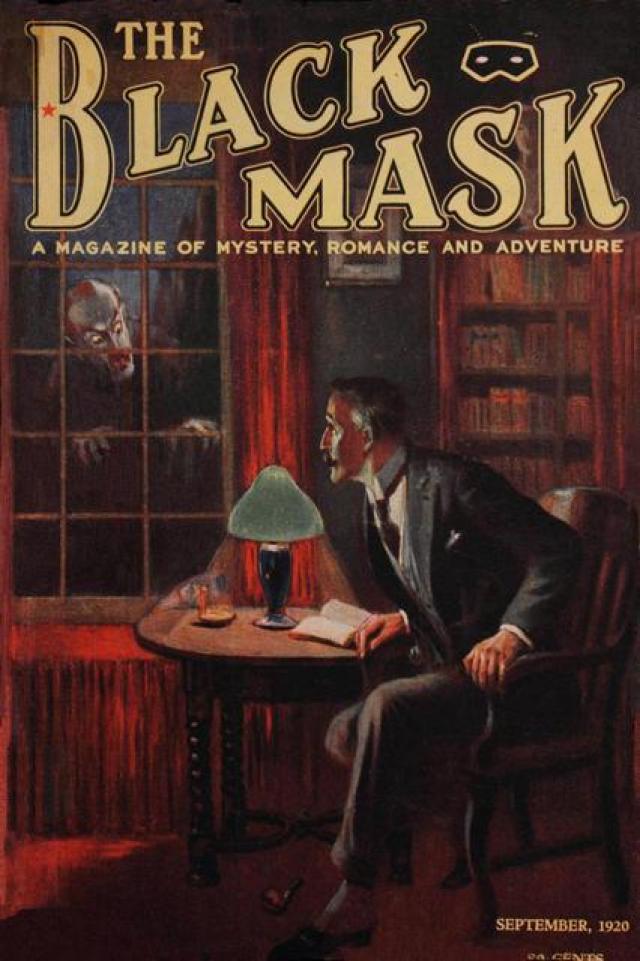
The Black Mask Magazine (Vol. 1, No. 6 — September 1920)Contents
Black ShadowsChapter I
Chapter II
Chapter III
Chapter IV
Chapter V
Chapter VI
Chapter VII
The Choice
The long arm of God
I
II
III
IV
V
Planned by the starsI
II
Fingers from the graveI
II
III
The deviltry of Dr. WaughI
II
III
Daughter of the PigeonI
II
III
IV
The Heart on the mantelI
II
The Devil takes a handI
II
The strange case of Nathaniel BroomeI
II
III
IV
V
VI
VII
VIII
IX
X
XI
XII
XIII
The man who would not dieI
II
III
IV
V
VI
VII
VIII
IX
X
XI
XII
XIII
The yellow dogI
II
III
IV
Bulling the bullsI
II
III
* * *
The Black Mask Magazine (Vol. 1, No. 6 — September 1920)
by F. M. Osborne (editor)
Contents
Black Shadows
(A Complete Novelette)
By J. C. Kofoed
Chapter I
The limousine drew up beside the curb. A correctly garbed chauffeur leaped from his seat, opened the door, and stood stiffly at attention as J. Sylvester Jones stepped out. Jones was garbed in a manner that should have made the lilies of the field blush with shame at their shabbiness. From thirty-dollar hat to forty-dollar shoes he was impeccable.
“You may wait, Hawker,” he said, in a tone that meant, “Hawker, I graciously give you permission to continue living.”
He separated a key from the others on his ring, and languidly ascended the steps of Strickland Guerney’s ornate house. It was coming on to dusk, and the great hall was almost dark. Jones switched on the light and looked about curiously.
“Bradley,” he called.
A round shouldered, misty eyed little butler came pattering from somewhere in the rear of the house.
“I am astonished at this carelessness, Bradley,” reproved Jones. “Where are the servants?”
“Ah, Mr. Sylvester, sir, I’m glad you’ve come.” The old butler pointed a skinny, shaking hand toward the ceiling. “Something’s wrong, Mr. Sylvester; I know it in my bones.”
“Wrong? What could be wrong?”
“This morning your uncle told all the servants to take the day off. I was feeling rather badly, sir, and I retired to my room, where I stayed until noon. I went to his study then, and knocked, but he would not answer. Later I tried the door two or three times, but could get no response.”
“Nonsense,” said Jones sharply. “What could be wrong? You’re too old to display the nerves of a Chestnut Street flapper, Bradley. I’ll go upstairs with you, and we’ll rouse up the old curmudgeon. Probably he went to sleep counting his bankbooks.”
Together they ascended the wide, oak balustraded stairs. There was a heaviness in the atmosphere; a gloom that permeated everything. The butler shivered. Jones’ eyes grew hard. There was no evidence of anything out of the ordinary, but both knew that something was wrong.
The door to Strickland Guerney’s study fronted the wide stairway. It was a huge affair of age-blackened oak that had been imported from a chateau in Normandy. Jones rapped several times, and called his uncle’s name. There was no answer.
“I told you, sir,” quavered Bradley.
The younger man stooped and applied his eye to the key-hole.
A limited segment of the room sprang into view; the rows of bookcases against the walls, the untidy table, and the great carved chair that Strickland Guerney used. But it was none of these things that caused J. Sylvester Jones to straighten up, with a little sucking in of his breath.
"Wait here, Bradley," he instructed. "I'll be back in a moment."
He clattered downstairs, and flung open the door to the street.
"Hawker."
The chauffeur — an old-young man, with a sharp profile and blood-shot eyes — sprang to attention.
"Yes, sir?"
"Drive like the devil to the police-station, and bring some officers here at once. Better have one who knows something about locks. We can't batter this door down."
When the limousine had roared up the street, Jones slowly re-climbed the stairs. Bradley was fussing nervously about the hall, straightening chairs and pictures that, were already in mathematically accurate positions.
"It's dreadful, sir," sighed the old butler. "I peeped through the keyhole, sir. I could just see the top of his head, slewed around at a most peculiar angle — and it never moves, sir."
"Do you — do you think he might have done himself an injury?" Jones asked.
"If injury's been done he has done it himself. You know the study, sir… There are no windows, in the regular sense; only those iron barred transoms near the ceiling, and no living thing could get through them. And this door, sir — there was only one key, and that Mr. Guerney carried on his watch-chain—"
The tramp of heavy feet sounded in the hallway below. Jones called anxiously, and a portentous file ascended the steps. First came Lieutenant Jamie-son, then District Detective O'Toole, Patrolman Bierhalter and finally a wiry, grey-eyed irresistible, known to all the city as Johnny Suggs, son of the owner of the Evening Star. Hawker edged furtively on the edge of the procession.
"Well," asked the lieutenant heavily, "what's the trouble here?" He seemed somewhat awed by Jones' wonderful sartorial display, and Suggs added to it by informing him in a whisper that J. Sylvester was the nephew of old millionaire Guerney.
Jones said, "I'm afraid something has happened to my uncle. I thought it best to call the police immediately."
"You did right, Mister Jones," commented the lieutenant. He laid his hand on the knob of the study door, and rattled it — with no results, naturally. "You couldn't break 'down this door without a tank. Hey, Bierhalter, get busy on the lock."
"Wait a minute," cut in the reporter, whipping out a magnifying glass. "What do you say if we look this over first, loot? Nobody's monkeyed with the lock. It has been opened and shut with a key, all right."
Jamieson, who prided himself on looking after the fine points of every case, flushed because he had not thought of that himself. With extraordinary gruffness he ordered Bierhalter to "get busy." It required ten minutes of concentrated effort on the policeman's part before he flung open the door.
There was the stuffiness of decay in the chamber — the nameless, creeping horror that is always present when death comes by violence. Solemnly the little party crossed the room and looked at the figure in the carved chair.
It was that of a man of sixty, big paunched and heavy lipped. Strickland Guerney had been known as a connoiseur in all that pertained to the appetites, and his face was that of a gourmand. There was a half snarl on his face, and a revolver lay on the floor below the drooping fingers of the right hand. His left fist rested on the table edge, and gripped the study-key. The fine silk of his shirt front was caked with dried blood.
Jamieson, his pique forgotten momentarily, was once more the calloused police official. He touched Guerney's pasty cheek, lifted the right arm, dropped it heavily, and crinkled the blood clotted shirt between his fingers.
"I ain't no doctor, but I can see this man's been dead at least three hours. Say, what do you know about this?" He turned suddenly on the trembling Bradley.
"N-nothing, sir, except what I told Mr. Sylvester, sir."
"What was that?"
"This morning master gave the servants a holiday, but I stayed in my room because I wasn't feeling well. At noon I knocked on his door to find out if he required lunch, and he told me to go to the devil, quite harshly, sir. That was the last time I heard him speak. Twice afterward I knocked, but received no answer. Then Mr. Sylvester came, and he sent for you. There is only one key to the study, sir, and — and Mr. Guerney has that in his hand."
"How is it you didn't hear the shot?"
"My room is downstairs, and there were several closed doors between."
The lieutenant grunted, and then looked at Jones. "Can you add anything to that?"
"Nothing of value, I'm afraid. My uncle and I were on the best of terms. I usually called on him twice a week — Monday and Friday—"
"This is Thursday," Jamieson shot out.
"I know it," retorted Jones, with some asperity. "I had intended leaving for New Haven tomorrow, and I wanted to see Uncle Strickland before I left. What are you trying to do — shoulder the crime on to me?"
The lieutenant hastily denied that any such idea had been in his mind.
"But we gotta clear up every point, you see. Now, where did you spend your time this afternoon?"
"I left the Hotel St. Regis, where I have my apartments, at one o'clock, and drove through the park until two-fifteen — yes, I'm sure it was two-fifteen, for I had an appointment with Miss Daisy Graelis, of the Bohemian Follies, at two-thirty. We went to the Ambassadeurs and danced until four, when I escorted Miss Graelis home. It was after five when I left her, and I came directly here. That accounts for every minute of my time."
"I guess it's all right," said Jamieson. He drew his detective aside, and questioned him in a whisper.
"There ain't nothin' to it at all," snorted O'Toole. "It's a dead opeт-an'-shut case o' suicide. There's a thirty-eight calibre gun, with one cartridge fired. The door was locked an' no way o' getting into the place without a keg of dynamite. Why, Loot, this is the easiest thing I ever see."
Jamieson sighed with relief. "You're right, Marty. Ring up the coroner's office, and have them send a man up. I'll leave Bierhalter here to look after things. What's the matter, Mr. Jones? You're white as a sheet."
The dandy nodded. "I'm frightfully upset — shock, you know," he admitted. "If you don't mind I'll wait downstairs for any questions you may want to ask me."
"Pretty tough on him," said Jamieson, when J. Sylvester Jones had gone.
Johnny Suggs, who had been examining the room, and particularly the table and floor, with keenest interest, said:
"Oh, do you think so? He is Guerney's only relative, and I understand that he will inherit everything the old man left."
The lieutenant looked up quickly. He had a profound respect for Johnny's shrt tvdness, and there was something in the reporter's tone that shot a shaft of suspicion into his brain.
"You don't think Jones did this?" he demanded.
"Do you?"
"No, I don't. It's suicide, all right. What else could it be? Here he is, locked in his own room with a gun — it's his gun, all right, for you can see his name on that plate on the butt."
"I saw it," said Suggs dryly.
"Then, what the devil do you mean?"
Johnny picked up a sheet of paper from the table. It bore the legend, "Strickland Guemey — 1822 Mammoth Building," and a few lines of scratchy writing, addressed to the Curio Company of America, requesting the price of a collection of weapons used by the Dayak head hunters. It was dated at noon that day.
"Doesn't it suggest anything to your mind?" the reporter asked.
Jamieson scratched his head, read it over again, and looked puzzled. "I. can't say it does," he admitted. "You don't think any of these Dayak birds did this—"
"Certainly not." The slight shrug of Johnny's shoulders indicated vast disgust with the official police. "Why, lieutenant, this letter was written by a left-handed man!" He turned to Bradley. "Mr. Guemey was left-handed, was he not?"
The butler nodded.
"Then," said Suggs triumphantly, "if Mr. Guemey committed suicide, how did he manage to shoot himself, drop the revolver on his right side, and pick up the key with his left? Suicide? This is murder, lieutenant, you can bet a year's pay on that!"
Chapter II
In the private office of the Star's owner, Johnny Suggs told his story.
"I've checked up on Jones' story," he concluded, "and everything is just as he said. The manager at the St. Regis, Miss Daisy Graelis, and the head waiter at the Ambassadeurs, as well as his own chauffeur, can account for every moment of his time that afternoon. It is possible that Bradley, the old butler, committed the crime, but I don't believe it. He's the mildest creature that ever walked. Lieutenant Jamieson arrested him, of course, but if you'll give me the chance, dad, I'll prove that he had nothing to do with it."
The elder Suggs elevated his heels to the desk-top, and looked out at the murky wrack of sky.
"It's good stuff," he said approvingly, "and will make a corking story, but what about the finish, Johnny? We want to find out who committed the murder — and you're no detective."
Johnny flushed. "Crime detection isn't a secret art," he protested. "Anybody with the wit and patience can do it. Give me a chance at it. These boneheads like Jamieson and O'Toole will never catch the murderer. I saw what they missed once. I may be able to do it again."
"You're a regular William J. Burns-Holmes, aren't you? If you can find out who killed Guerney in a locked room, with no known mode of egress, they ought to make you police commissioner. But we won't build any triumphal arches until you do the job. Go to it."
Johnny sprang to his feet and cracked his heels together.
"I'll do it, all right."
Highly elated, he descended to the street. It was eleven o'clock, and lie was tired from his chase about town, verifying Jones' story, but he had no desire to go to bed then. As a matter of fact, he intended going back to the Guerney residence and conducting a minute investigation of the dead man's study. He had not seen all he wanted, to see that afternoon, and as the house had been locked, he would have all the opportunity he desired if he could effect an entrance.
A taxi was standing by the curb. Johnny climbed in and gave the chauffeur his instructions. In a moment more he was whirling along the brilliantly lighted street, on the first lap of his search for Strickland Guerney's murderer.
Three blocks from his destination, Suggs left the taxi. A policeman was lolling in front of the house of death, so Johnny gave it a wide berth, and entered the alley behind. It required only a moment to scale the fence, and feel his way through the darkness to the kitchen window.
Anticipating his course of action, the reporter carried with him a chisel, a jimmy, and an electric torch. In the utter blackness of the yard he did not dare use his torch, for fear a roaming policeman might see it. So, depending on his sense of touch, he felt for the window, chisel in one hand.
When he found it a sudden cold streak went up his spine. It was open three inches from the bottom!
There was someone in that house. Suggs did not doubt it for a moment. He was positive it was not the police, for they had secured the key to the front door. It was either the murderer come back to the scene of his crime, or some house-breaker, who had followed close on the news of Guerney's death, and hoped to reap a harvest. Johnny was not armed, but he shoved the window higher, swung his leg across the sill, and climbed in.
The house was horribly still. Suggs framed the kitchen wall with a circle of light, and stepping very cautiously, reached the door and peered into the dining-room. No one there. No one in the butler's pantry; no one on the first floor at all.
Was there anyone in the room where Strickland Guerney had met his death?
Very softly Johnny began the ascent of the wide staircase. Then, as he strained his ears, he heard the rustle of a skirt and the soft, smothered whimper of a frightened woman. He shrank back against the wall and waited.
A bar of light crept out of the darkness and rested on the age-blackened oak of the study door. It wavered, as though the one who held it was nervous. And then, into that bar of light was stretched a woman's hand — a slim, marvelously white hand that fitted a key into the lock!
Bit by bit the reporter edged up the stairs. He had noticed where the electric light switch was located on his first visit there that afternoon, and it stood him in good stead now. His hand felt along the wall until it touched the button, and then he flooded the hall with dazzling light.
With a gasp of fright, the woman straightened up and turned. Her soft, fair hair fell about her pallid cheeks, and the graceful gown she wore was spotted and torn from her trip over the fence and the kitchen window-sill. Even in that startling moment Johnny commented to himself on her wonderful beauty.
"Who are you?" she whispered.
The reporter smiled. "I was just going to ask that question of you."
"Who are you?" she repeated tensely. "What are you doing here?"


