Hades Oath: Throne of Gods Prequel, page 1
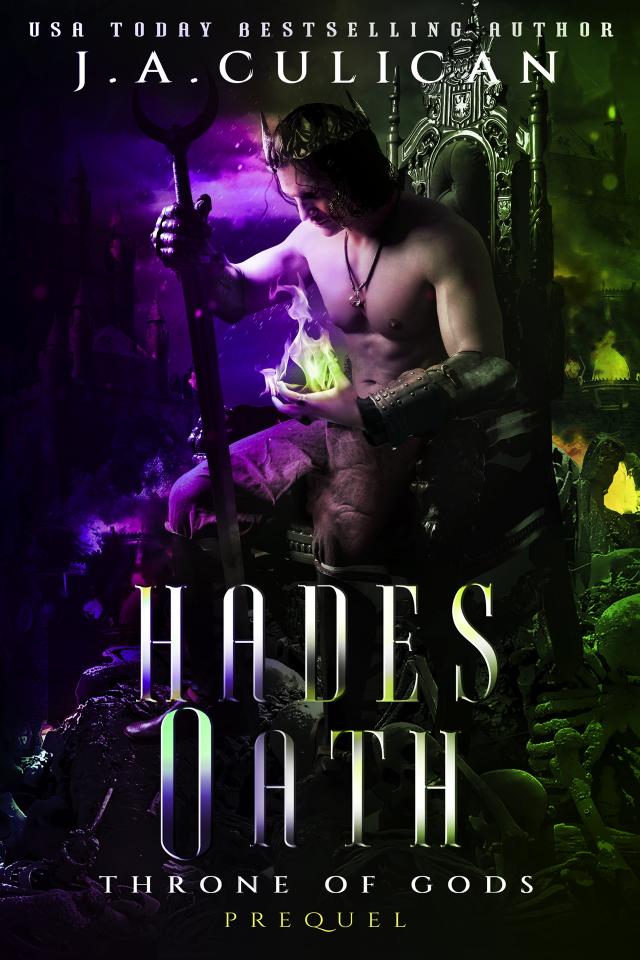


Hades Oath
THRONE OF GODS PREQUEL
J.A. CULICAN
DRAGON REALM PRESS
Copyright © 2024 by J.A. Culican
All rights reserved.
No part of this book may be reproduced in any form or by any electronic or mechanical means, including information storage and retrieval systems, without written permission from the author, except for the use of brief quotations in a book review.
Contents
Chapter 1
Chapter 2
Chapter 3
Chapter 4
Chapter 5
Chapter 6
Chapter 7
Chapter 8
Chapter 9
Chapter 10
Chapter 11
Chapter 12
Chapter 13
Chapter 14
Chapter 15
Chapter 16
Chapter 17
Chapter 18
About the Author
Chapter 1
The king of the underworld had been taken by surprise.
In his numberless years, wise old Hades had come to believe that his fortress was well and truly impregnable. It was a vast thing, built largely of black volcanic stone, and was so imposing in design that even invited guests tended to eagerly set out from the place once their business had been settled. Located deep within a shaded valley, the royal compound could only be accessed through a few choice routes, which were often patrolled for intruders. Employing several legions of skilled footmen as well as many armed bodyguards, Hades had thought himself fully insulated against outside threats.
Upon discovering one of his palace aides dead near the throne room entrance, his throat cut and weapons seized, Hades' illusions were banished at once, however.
The Olympian returned swiftly to the throne, taking up his glistening bident. Eyes as grey as smoke jumped from one corner of the vast throne room to the next in search of the assailant. With an even hand he held the lengthy weapon out before him, its metallic shaft terminating in two diamond-sharp steel prongs. Feet planted at shoulder-width upon the smooth stone floors, he looked past the row of elegant columns framing the entrance and drank in the silence, sure that the killer would reveal himself.
No sound came, however.
It was immediately apparent that the intruder was no amateur in the ancient art of assassination—no, here was one who operated at the very highest level. The intruder's movements had been swift and silent; almost phantasmal. The next attack could come from virtually any quarter, and without warning.
Hades' plain white robe fluttered in the draft as he began scanning the corners and ceilings, his brow furrowed and fists locked around the imposing bident. His harsh gaze lingered on the statues placed within the alcoves, upon the masterfully-painted historical scenes along the walls and ceilings. His eyes crept back toward the throne, too—and there, in the great shadow cast by the immense seat of black stone, his senses registered movement.
It was a single thrust, as of a hand flicking something forcefully—visible only for an instant before the shadows ate it up once more.
Hades turned on his heels and took a step back, narrowly avoiding the kiss of a dagger. The small blade flew through the air like a hornet with its stinger trained on him, and it continued to sail across the throne room until it met one of the gorgeous columns with a clatter. The one who had thrown the thing was no more in sight, vanished like a specter into the dim.
The god of the underworld started toward the throne purposefully, only to draw back once again at sighting a flurry of movement up above. Another presence had edged its way into his periphery—one who had climbed a pillar and come sailing down with sword drawn. The assailant, dressed in a black cuirass, face obscured by a strip of dark cloth, descended in utter silence, prepared to sink his blade into the god with a hard downward stab.
Hades thrust his weapon upward in a gesture of welcome, catching the assailant in the gut with both razor-sharp prongs. The masked killer was then thrown from the tip of the bident, and his writhing body slammed against the black throne with a terrible thud.
The death of his aide had not been the work of a lone wolf, then—it had been the work of multiple assassins in concert. Just how many there were remained to be seen; one had been dispatched and another was known to loiter behind the great throne, but whether there lurked still others, yet undiscovered, Hades could not say.
The Olympian strode quietly toward the fallen man, kicking his sword away and peering down into his glazed eyes. “How many of you are there?” he asked the dying man in the hopes that he might extract a bit of information from his lips before they fully cooled.
The answer came instead from across the room—from behind one of the large columns. “We are beyond counting,” replied a dweller in the shadows. “Surrender that your miserable life might be spared, old Hades.”
The king of the underworld smirked, his eyes tracing the movements of the assailant behind the throne. “I admire the boldness of a man who ventures into the land of the dead and speaks to its king with such bravado as this.” The dagger-thrower was preparing another volley; before the attack could be executed, Hades quickly rounded the corner and made a vast sweep of the darkness behind the throne with the tail end of his weapon. The butt of the bident crashed into the silent lurker, knocking the dagger from his hand and sending him flying through the air. He landed some feet from the throne, striking the floor with a bone-rattling crash. Like the other one, he wore a black cuirass and soft-soled boots that allowed for a quieter tread, as well as a scrap of dark fabric across his visage.
Hades pursued the fallen man and probed his breast with a thrust of the two-pronged staff, killing him instantly. A hush fell once again over the throne room. Surely, the intruders were having second thoughts about their mission, and didn't want to end up like their fallen comrades. Even the haughty speaker who had called out from behind the columns had now gone quiet.
“Two of your men now lay dead,” boasted Hades, wicking the gore from the tip of his weapon. His steely gaze passed over the succession of columns. “How many more shall we put to rest this day before you realize the gravity of your mistake?” He chuckled darkly, continuing, “I am rather enjoying myself. Come, if you've the Thumos—come at me, all at once.”
From shaded corners came sprinting two more men, these in the same garb as their predecessors—one armed with a sword, the other a spiked club. They rushed across the room with nary a sound, poised for savagery, and upon closing the gap let loose upon the lone Olympian.
Both were cut down with a single strike. Hades swung his weapon first to the left, raking at the legs of the swordsman and rending his knees. The other was caught on the backswing in the thigh, and let go of his club in favor of his punctured leg. Though the assassins tried to scramble away, their wounds were sufficiently deep to ensure a quick death by blood-loss.
“That's four now,” announced Hades, his rich voice tinged with pride. “Is this all you're capable of?”
This last taunt drew someone—or something—from the shadows.
A lone figure slipped past one of the columns with a calm and measured stride. He stood a reasonably good height for a mortal, and his well-proportioned limbs were dense with corded muscle. He, like his fellows, wore a black cuirass, but was further distinguished by a long black cloak that hung nearly to his feet. The hood of said garment hung over his face, keeping it hidden, and what appeared to be a large sword sat in a sheath strapped to his left side. This sword was carefully drawn out, the meaty hilt giving way to a most transfixing blade. It was no mere steel; the weapon appeared forged of a dark, inky stone. The obsidian weapon had been polished to such a degree it looked like a black mirror, and when drawn boasted a length fully half the bearer's height.
But the most striking thing about the incoming stranger was his face—or, that is, the thing which answered for a face beneath that black hood.
The sword-bearer wore what appeared to be a bone-white mask of the theatre. It was the mask of a laughing king—replete with a crown. This odd face-covering was transformed into something truly sinister when viewed in the dim perpetuated by his hood, and the bright blue eyes that stared on from within the holes of the mask chilled the blood like permafrost. Even the Olympian, powerful and confident though he was, could not help being a bit unsettled by the figure that presently came toward him.
“Who are you?” demanded Hades, raising the bident defensively.
“I am the scourge of Mt. Olympus,” came the swordsman's cool reply. His voice was proud, unruffled, and his fist was locked around the hilt of his great sword like a stony vise. “I have come to make of you a fine pyre, old Hades, and to end your line.” He singled out the black throne with his glossy blade. “This and every other throne shall be consolidated under my rule.”
The Olympian prepared to strike, the swordsman's braggadocio growing tiresome. “Allow me to awaken you from these delusions of grandeur.” Lunging forth, Hades drew back the bident and—when his lead foot once again met the floor—delivered a lightning-fast thrust.
That thrust, which might have killed a lesser man in an instant, was ineffective.
Like an insect, the masked opponent leapt into the air, carefully landing upon the tip of the outstretched bident; he then dashed up its length toward its stunned wielder. The obsidian sword found its way to Hades' throat, and might have left its mark had not the god jerked back in terr
For the first time in the conflict, Hades was forced onto his heels. He backed away from the series of wild slashes, dodging them where possible and parrying them with the shaft of his weapon when they could not be avoided. The force with which this stranger wielded his sword was incredible by the god's reckoning; he had never encountered a mortal possessed of such raw power as this. His earlier boasts retreated back down his throat as he faced off against this foe. If Hades let his guard down even an instant, death was a very real possibility.
The black blade came charging back again and again, its stony cutting edge never seeming to dull even as it left minute gouges in the dense shaft of Hades' bident. The god drew back with a wide slash, buying himself a little distance and a chance to catch his breath. Meanwhile, the stranger in the mask hardly seemed to have exerted himself. He had not slowed one iota during the exchange, had not even begun to tap into the stores of his strength and endurance, by the looks of it.
Appraising the odd visitor, Hades was no longer certain that the man was, in fact, a mere mortal. “Who are you?” he demanded once more. “Your name?”
The swordsman leveled his icy eyes on the Olympian and loosed a chuckle. Rather than reply, he let his sword do the talking, plunging once more into a series of sweeps and jabs. Despite its obvious heft, the sword was thrown around effortlessly—the speed of its transit a testament to the mysterious warrior's physical prowess.
Forced back toward the columns, Hades was beginning to truly struggle. His footing became less sure, his attempts at blocking more desperate. The swordsman delivered a punishing downward cleave, which the Olympian only caught lengthwise with the handle of his weapon. The impact knocked slivers of steel from the shaft, however, and as the two remained gridlocked the bident began to rattle. Another blow like that one and it was possible that the handle would shatter, leaving the god unarmed.
The swordsman changed tack, suddenly delivering a nasty kick to the gut. Hades was knocked backward, gasping for air, and hit the floor with a groan. The bident clattered out of his reach. The Olympian was, for the moment, helpless.
The masked intruder wasted no time in bringing the tip of his sword to Hades' breast. He pressed it in a little, shearing the god's white garment and pricking the skin beneath so that a rivulet of red marred the torn fabric. He stopped short of killing the Olympian, however. Instead, he raised a hand and signaled to his men. From all around the throne room—from corners and shadows unplumbed—came numerous men garbed in black cuirasses, their faces covered in makeshift cloth masks.
Hades stared up at his conqueror with a mixture of dread and rage. “What do you want?” he barked. “Why do you hesitate?”
The man behind the mask sheathed his mighty blade and peered down at the god with utter contempt. “If I spill your blood now, I won't be able to use you as bait. You are more valuable to me as a hostage.” He glanced at his men, now standing in orderly lines to each side of him. “Has the complex been secured, men? The bodyguards and aides taken care of?”
One of the soldiers replied in the affirmative. “The only living things in this building are located in this very room.”
Hades' eyes sprang wide with terror. “What?”
The masked man nodded, picking up the fallen bident and inspecting it narrowly. “Very good. Very good.”
The bested Olympian sat up, casting a furious gaze upon the men. “Who do you think you are?” he asked, shaking with outrage.
With a brutal shout, the masked swordsman lobbed the bident across the room. Its two sharpened prongs struck the back of the throne, sending up a mist of black stone on impact. “I think,” he replied in a mocking tone, “that I am your king now, Hades. Address me with due reverence; I plan to let you live so long as you are useful to me. Depending on your behavior, that can either be a shorter or a longer time.”
Chapter 2
“Where, then, is the messenger?”
This question, shouted several times now, echoed deafeningly through the court of Ares. The generals of the Fire Kingdom, the smattering of court advisors and several Ena attendants all cowered as the god of war stamped his sandaled foot against the floor.
Bathed in the sunlight that poured in from the opening in the domed ceiling, Ares glowed like a figure wrought of gold. His spear—longer than any mortal in attendance was tall—had been left propped against the right edge of his throne. He wore a thick metal helm, which brought only his most ferocious features to light—his wide, burning eyes and sharp, bared teeth. His furious gaze passed over the gathered officials; if looks could kill, then not a one would have survived.
“Where is my messenger?” asked the Olympian once more, leaning back against his marble throne. “He was sent with a message two days ago to the valley of Hades. Two days. Has he not returned? Have we no word yet from the lands of brother Hades?”
“None, sir,” replied one of the generals with a rueful shake of the head. “There has been no sign of the messenger, and no report from the territories of Hades.”
The god of war drew a deep breath in through his nose and looked up toward the skylight. “My messenger, then, has likely met a terrible end, has he not?” A few of the men nodded; others remained stock still lest they attract the god's ire. “This can surely be taken as a sign that Sisyphus has made his move.”
For over a month, Ares had been monitoring a tense situation in a lesser kingdom of the east. There, in a lowly land populated chiefly by farmers and tradesmen, a mortal king by the name of Sisyphus had lately been making a name for himself by enacting several controversial reforms. The man had worked his followers into a lather, severing longstanding ties with neighboring territories, shorting established trade deals with Olympian-run kingdoms, and promising an expansion into the lands of the gods. A cult of personality had been raised up around this maverick king whose chief goal was, apparently, the destruction of the Olympians.
Sisyphus had first come to the notice of Athena, goddess of wisdom, owing to the proximity of her lands to the eastern frontier. Some of her servants had been harassed on the outskirts of the small kingdom by followers of Sisyphus, threatened at sword-point. Further reconnaissance had unearthed a potential plot against the Olympians, beginning with none other than Hades. This threat on Hades' life had not been taken seriously; a mere mortal challenging the god of the underworld seemed a laughable prospect, and it had been in amusement that Ares had initially been told about the plans of this minor kingdom.
Now that Ares' messages to said god had gone without answer for two consecutive days, the strange king's plot no longer seemed so humorous.
Ares had been keeping an eye on the kingdom of Sisyphus, sending a few envoys there in disguise so that they might scope out the land and weigh its capabilities. These missions had run against frustrating obstacles, however. The citizens of this far-off land were rather tight-lipped and would not discuss local affairs with outsiders. Moreover, they possessed an almost fanatical devotion to their king. This latter detail was especially odd to the Olympians, who were used to ruling through fear and savagery, and whose societies were often based on hierarchies of force, rather than on trust and respect.
The god of war had earmarked the little kingdom as an interesting locale, a place worth keeping an eye on, but had not taken its threats very seriously until his Hades-bound messenger had vanished. The messenger had been entrusted with several scrolls pertaining to trade dealings between the two Olympians, and in the past such messages had been delivered—and answered—with haste. Two days of utter silence was most unusual; Ares could only assume that some harm had come to his fellow god.
As best he could tell with the limited information available to him, the populace of Sisyphus' kingdom was dwarfed by that of the Fire Kingdom and other Olympian-run regions. It stood to reason that their enlisted were also much fewer in number. Ares did not believe the small kingdom to pose a genuine threat, but keen tactician that he was, he always liked to keep his ear to the ground and to rout his enemies preemptively.