Missed Her, page 10


She eventually left Don and New Zealand, and returned to the Yukon alone. Her youngest son, John, would follow her in a year.
She tells me this part of the story forty years later, at her kitchen table, the part about how she pulled her car over to the side of the road in Cache Creek, at the crossroads, and pondered all those road signs for a long minute. Should she go back to the prairies, and her mother, or was it north she wanted? She claims she wasn’t thinking of Herman so much in that moment. She tells me she thought it was over, that they had ended it. But she continued north, so I don’t know if I believe her. I don’t think it was me she was lying to. I’m no shrink, but I know enough to know when a woman most needs to believe her own lies first.
I get the story from her in snapshots, short bursts, latenight kitchen table talk when the lips are loose with the whiskey. I knew she returned to the north, it was why we were all still here. She tells me part of the story in 2004: she breathes out in one long sentence that my grandfather broke her nose in New Zealand. Just a detail, an aside in another story about something else. She doesn’t rest on the memory, and I will myself not to react, so she won’t lose her train of thought. She does that now, more and more. Yesterday on the phone she confesses that she never wrote to me much about what happened to her in New Zealand because she hates to remember it, wants her sons to hold a different past in their heads. A different father. My grandfather, and what he did.
“In a fit of pent-up bottled rage, he attacked me. I can’t imagine his hatred, and anger that he would smash me in the face over and over again with his fist. The blood was spattered all over the wallpaper. He wanted to mess up my face, so that I wouldn’t be attractive to another man. The kids were there, they knew what was going on. They saw it. They had to clean up the mess. Years later I asked Rob, I said what did you do about all that blood on the wall? He said, we cleaned it up.”
Pat returned to Whitehorse, alone, and got herself a job. She stayed with friends of the family and made no attempt to contact Herman. But they ran into each other on Main Street.
“He must have thought he’d seen a ghost,” she writes. “We didn’t speak very much, but he didn’t go away. He came back. He came to see me. This time this was serious. We resumed what we had started. I thought our relationship was private. I thought nobody knew. I thought it was a secret. I thought we were kinda sneaking. It was not private. Everybody knew. The whole town knew. I didn’t have to make a secret of it anymore. I was acknowledged as his partner, and I started divorce proceedings.
“I realize now the seriousness of his drinking problem. Like he was two people. Dr Jekyll and Mr Hyde. The Dr Jekyll was a good natured, amiable, agreeable, softhearted, generous, loving … what else can I say? But the Mr Hyde could be terrifying. He could charge at me like an enraged bull, and he was bigger, he was twice the size of me. He wasn’t fat, he was just meaty. I probably should have been afraid of him, but I wasn’t. Because I knew he wouldn’t hurt me. The last thing in the world he would do would be to hurt me.
“He built that house, and I know he built it for me, I know he did. We tried to live in it, but it just didn’t work. There was just too much. It was battle stations all the time. I know it was the drinking. He spent a lot of time in bars. The Capital Hotel. I was not allowed to go there, and I never went there with him.
“He talked of getting married, but this bothered me. I couldn’t see that. But he told me that if I married him, he would give me a sapphire ring that would flash blue like my eyes did when I was mad at him. If that’s a proposal, then I guess that’s what it was.
“But it ended on Christmas Day, 1970. He collapsed in my house. Right there. Right there on the floor. A big, vital, alive man came crashing to the floor. I called the ambulance. In those days you didn’t go with the ambulance, that wasn’t done, you were in the way if you did. So I just hid in my second bedroom, I couldn’t bear even seeing them taking him away. I didn’t visit him until the next day. I went in there and I discovered that he had tried to walk out of the hospital. He had torn out his tubes and whatever they attach to you and tried to walk out. I thought this was probably a good sign that maybe he was going to be all right. Even when somebody said to me how’s Herman doing? I said I think he’s out of the woods. I said that. He was anything but out of the woods.
“That night I got the call about three o’clock in the morning that he had died. He was forty. Forty years old. The same age as you?
“But had he lived, he would be eighty-one today. He’d probably be as mean as sin. In a way, I am glad he never lived to see me grow old. I’m glad in a way. Because he wouldn’t have been very nice about it. He would have been cruel. All in all, we were together about five years. I was as happy as I’ve ever been in my life.
“Which brings me back to March, 2008. I feel his presence. I don’t believe in spirits. I can’t imagine him going to heaven. He just wouldn’t fit in. And the thought of me having to spend eternity with him in heaven? I’d rather not. We would just fight.
“You should only marry for two reasons. Only two reasons. Love or money. I know what real love is now. And what I had for Herman, there was nothing like it before him, nor has there been since. Passion helps. I mean it helps. It’s the glue that holds the love together. Well, all right, sex. Let’s face it. My love affair with Herman was passionate. Even when we fought, it was passionate. I think it can actually outlive death, and even time. In retrospect, I believe this. Now, I am ninety. Like sweet ninety and never been kissed? I still feel the same way about him that I did forty years ago. Believe it or not, that is the truth. He told me he liked to hold my little hand. Somehow, I’d like to think he still does.”
Just a Love Story
A couple of years ago I was crammed into a Honda Civic hatchback with four poets, squinting through the furious wiper blades to find the right exit off of the Number One Highway into Surrey. We were on our way to a suburban high school for a gig.
The slam poet in the back seat with the relentless bad breath squeezed his face into the front seat. “It’s Valentine’s Day tomorrow. I think we should all do love poems.”
There was an exuberant round of agreement from everyone but me. I cracked the passenger window just a little, and an icy spray of February rain hit my cheek. I took a deep breath and rolled the window back up. I was the only storyteller in the car. I am used to this. Used to being lumped in with the poets. This doesn’t bother me. I have even stopped telling people I have never written a poem in my entire life. Storyteller, poet, close enough, I guess, for most people. Even though they are not the same thing at all.
“I can’t read a love story in a high school in Surrey,” I blurt out, feeling a bit like a parent who just busted in on a pillow fight.
“Why not?” the slam poet heavy-breathed from the back seat, his eyebrow raised in a question mark.
I was also the only queer person in the car. I am used to this. This almost never bothers me. Gay person, straight person, what is the difference anymore, right? Aren’t we over all that?
Truth is, I have been over it for decades now. Most of us mostly are. But not in a high school. And not here in Surrey, British Columbia. Surrey, where they banned the Harry Potter books from school libraries for encouraging witchcraft. They also banned Heather Has Two Mommies and One Dad, Two Dads, Brown Dad, Blue Dads for promoting anti-family values.
“Because,” I say, letting out a long breath, “it is scary enough to be a homo in a high school in Surrey in the first place.”
His face shows no sign of recognition, of understanding, of camaraderie, and I suddenly feel in-my-bones tired.
I take another heavy breath. “For you, a love poem is just that. A love poem. And I am glad for you, I truly am. But for me to read a love poem in a high school in the bible belt is a political statement, whether I mean it to be or not, someone will think I am recruiting, armpits will grow moist with tension, I will be pushing the homosexual agenda on unsuspecting adolescents, I will be disrespecting someone’s interpretation of the words of their God, you know, the whole tired routine.”
“So what?” pipes up the anarchist beat poet who had been slumped in the backseat beside the slam poet. “We’ve got your back, Coyote, fuck them all, rock the boat. Surrey needs it.”
“What if I just want to tell a love story?” I asked. Only the thump of the windshield wipers responded.
I met her the first time eight years ago, in the hospitality room of the Granville Island Hotel, during the Vancouver International Writers’ Festival. She was wearing tall red boots and her wool jacket and handbag matched. Silver and black ringlets surrounded her dimples and sparkling smart eyes. Some people you can see how brilliant they are from a distance, like there are little invisible sparks coming out of their brain while it is working, creating static electric charges in the air above their heads. She was electric spark smart, and all I remember is I could make her laugh. Every time she laughed, my heart pounded possibility. When I saw her from across the room, she kind of shone. Like God Himself was pointing her out to me with a glowing finger. I left with too many plastic glasses of free wine in my belly, and without her phone number in my pocket.
I ran into her on the Drive a couple of days later, just like I knew I would.
It was one of those early spring days in Vancouver, where all of a sudden the grey of the previous week gives way and suddenly it is raining cherry blossoms everywhere, a crushed and scented carpet of them underfoot. We were talking about music. Somehow the band Nirvana came up, I can’t remember why, I like them all right, maybe they reminded me of some other band I liked better, I can’t remember, but she told me that the album Nevermind was her favorite all-time record when she was in grade seven. I quickly did some silent math in my head. How could the sexiest, smartest, silver-hairedest, woman I had ever met be too young for me to go out with?
“Grade seven?” I blurted out. “How can you be twenty-three? How did I get to be … if I had met you in 1991 when Nevermind first came out, you would have been …” I shuddered.
“Twelve years old.” She laughed again. Like this didn’t matter at all. “It’s the grey hair, right? That fooled you? I started going grey when I was sixteen. Runs in the family.”
My shoulders seemed too heavy to hold up all of a sudden. I told her I was too old for her. She told me that age doesn’t matter. I told her the only people who think there is no such thing as too old for you are usually too young to know any better. She told me that she had just come out of the closet, that she wanted an older lover. She told me I was being ageist. I told her I used to think people were just being ageist too, when I was her age. She told me I was being ageist. I told her I know. Then I let out a long sigh. Did what I had to do. Told her that I was a dirty rotten rotter, that I had been around the block a million times, that I had slept with more women than … that I had slept with a fair number of women in my long and lucky life of loving, and that she should pick someone special, that this was her second chance at having a first time, and most people never get a second first-time chance at anything, that she was lucky, and not to waste that chance on a pussy crook like me. Go, I told her, and fall in love with a nice woman. Fall in crazy stupid dumb-struck love and move in together and figure yourself out, don’t get a cat, though, and then fall out of love, suffer through a hopefully short but nevertheless nether-region-numbing bout of lesbian bed death, and break up. Lather, rinse, and repeat. I told her that if she still wanted me five years from now, to come and find me. I told her that if she still wanted me then, that I would be honoured. Told her I had to go, before I changed my mind.
I would see her around from time to time. Usually at poetry readings. Started going to a lot of poetry readings. Started dressing up to go to poetry readings. Started ironing my shirts to go to poetry readings.
Five years later I am in my car, waiting to turn left off of Commercial Drive onto First Avenue, on my way to the Home Depot. My girlfriend and I have recently broken up. We still live together, which could have been awkward, but luckily she was often in Portland with her new lover, who made more money than me, had a really hot truck, and a brand new Harley. So of course I was doing what any self-respecting butch does in this kind of situation: I was throwing myself heart-first into a complicated home improvement endeavour.
This next part seems like magic, but it is true. Some would say this is evidence that magic is for real. I was listening to classic rock and Fleetwood Mac was singing about don’t stop thinking about tomorrow, and so I was thinking about tomorrow, about how maybe this breakup was for the best anyway, right, because look, I was finally going to get the new floor down in my office, and wasn’t I now free to do what I wanted with whomever I wanted, plus, hadn’t it been five years now, so couldn’t I take that silver fox out on a date now? Thirty-eight and twenty-eight wasn’t so bad, right?
And that’s when I saw her. Standing on the corner with a coffee in her hand. Her hair now more silver than black, somehow even more beautiful. She waved when she saw me. I unlocked the passenger side door and she jumped in.
“Where you going?” she smiled, showing her one crooked tooth.
“Home Depot,” I told her.
“I love Home Depot,” she said, and winked.
We didn’t get out of bed for three days. She did a lot of yoga, it turned out. I vowed to quit smoking, so I could keep up with her. Eventually, I did. Quit smoking, that is.
Last month we went home to the Yukon. My family loves her, especially my mother. I think she is actually the daughter my mother always wanted. She is so smart and dresses so fine and almost has her PhD and it almost makes up for my mom having me and my even blacker sheep sister as her real children.
I drove her out to one of my favorite places in the world, the Carcross Desert. White sand and mountains and so much sky all over the sky. Some dirt bikers had accidentally burned a huge heart shape into the sand with their back tires. We stood together in the centre of that accidental heart, and it seemed like the perfect spot to put that big old diamond ring on her finger.
My family is beside themselves. At dinner, my cousin Dan insists that I tell his sister the whole story of how we met. It’s so romantic, he says. It is just such a love story.
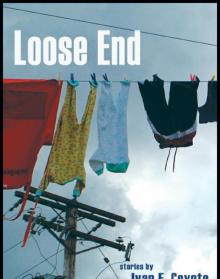
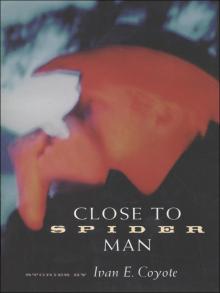
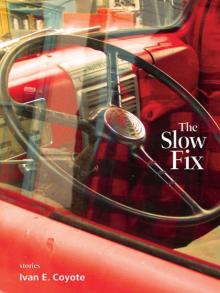
IVAN E. COYOTE is a writer and performer. She is the author of five books published by Arsenal Pulp Press: the four story collections Close to Spider Man, (shortlisted for the Danuta Gleed Short Fiction Prize), One Man’s Trash, and Loose End (shortlisted for the Ferro-Grumley Women’s Fiction Award), and her latest, The Slow Fix, as well as the novel Bow Grip (also shortlisted for the Ferro-Grumley Women’s Fiction Award and named a Stonewall Honor Book by the American Library Association). Ivan was a founding member of the performance collective Taste This, and is a long-time columnist for Xtra! in Toronto and Xtra! West in Vancouver. Originally from the Yukon, Ivan lives in Vancouver.
Ivan Coyote, Missed Her