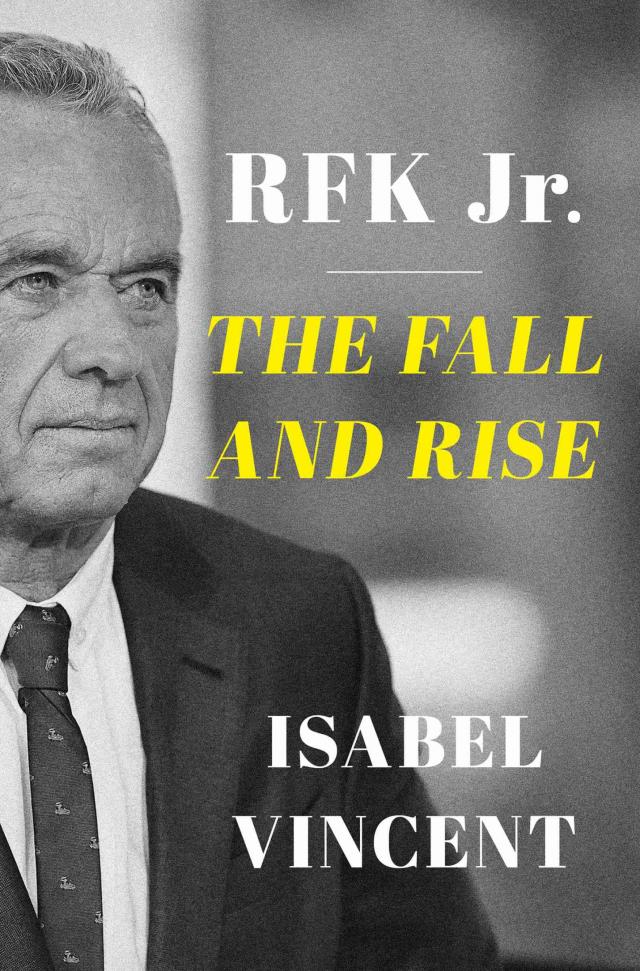
RFK Jr., page 1


Note to Readers
This ebook contains the following accessibility features which, if supported by your device, can be accessed via your ereader/accessibility settings:
Change of font size and line height
Change of background and font colours
Change of font
Change justification
Text to speech
Page numbers taken from the following print edition: ISBN 9780063472280
Epigraph
No sympathy for the devil; keep that in mind. Buy the ticket, take the ride.
—Hunter S. Thompson, Fear and Loathing in Las Vegas: A Savage Journey to the Heart of the American Dream
Whether you call someone a hero or a monster is all relative to where the focus of your consciousness may be.
—Joseph Campbell, The Power of Myth
Contents
Cover
Title Page
Note to Readers
Epigraph
Preface: “Just like the President”
Chapter 1: Prison Diary
Chapter 2: “History Was Happening All Around Us”
Chapter 3: “Everybody Takes Their Licks”
Chapter 4: “I Bought the Ticket; I Took the Ride”
Chapter 5: The Riverkeeper
Chapter 6: “The Sirens Were on Every Rock”
Chapter 7: “Things Fall Apart”
Chapter 8: “My Voice Is Gone”
Chapter 9: Vaccine Warrior
Chapter 10: “They Had No Clue What They Were Doing”
Epilogue: A Work in Progress
Acknowledgments
Bibliography
Notes
Index
Photo Section
About the Author
Also by Isabel Vincent
Copyright
About the Publisher
Preface
“Just like the President”
On the eve of Robert F. Kennedy Jr.’s Senate confirmation hearings over his appointment as secretary of health and human services, his cousin Caroline Kennedy released an extraordinary letter. “He lacks any relevant government1, financial, management, or medical experience,” wrote the daughter of John F. Kennedy in her scathing January 28, 2025, missive to the senators investigating Kennedy. “His views on vaccines are dangerous and willfully misinformed. These facts alone should be disqualifying. But he has personal qualities related to this position which, for me, pose even greater concern.” A video of the poised and bespectacled former ambassador to Australia and Japan reading the letter posted to her son, Jack Schlossberg’s, Instagram and X accounts quickly went viral.
In addition to calling Kennedy “a predator” and likening him to the birds of prey he has long kept as pets, she dug deep, going back to her cousin’s childhood and adolescence. She described how he would show off to his cousins by placing baby chicks and mice in a blender to feed his hawks. She blamed him for encouraging them “down the path of substance abuse,” leading them to addiction, illness, and, in the case of Kennedy’s younger brother David, death. And she accused him of expropriating the assassinations of both their fathers. “Bobby continues to grandstand off my father’s assassination, and that of his own father,” she wrote. “It is incomprehensible that someone who is willing to exploit their own painful family tragedies for publicity would be in charge of American life-and-death situations.”
For his part, Schlossberg accused his cousin of “trading in on Camelot2, celebrity, conspiracy theories and conflict for personal gain and fame.”
The letter and Schlossberg’s incessant and seemingly unhinged social media attacks against his cousin in the run-up to his own campaign for Congress in New York City were evidence of a long-rumored split within the storied Kennedy dynasty, which is itself a kind of American aristocracy. The boisterous and scrappy Hyannis Port heirs of Robert F. Kennedy and the much more aloof and intellectual Martha’s Vineyard descendants of John F. Kennedy were clearly deeply divided. Upon reading Caroline’s letter and her son’s social media attacks, one might be hard pressed to believe that they had ever once been the “close family” that she took pains to describe.
But the shrill, emotionally charged letter was significant for another reason: It echoed the desperation of Democrats and even some Republicans eager to block at any cost Kennedy’s appointment as the country’s powerful health czar, overseeing an annual budget of nearly $94 billion and more than eighty-three thousand employees in his bid to Make America Healthy Again—part of the rallying cry of Donald Trump’s historic presidency.
Kennedy is dangerous, and his unwillingness to back vaccinations that he felt were harmful could lead to national health emergencies, such as the resurgence of a measles epidemic, argued the experts. “With global measles cases surging3 more than 20% in a year, the specter of an anti-vaccine leader like Robert F. Kennedy Jr. at the helm of US health policy has alarmed public health experts,” said an article in the renowned medical journal The Lancet that appeared the same month as Caroline’s letter. “Kennedy, a well-known vaccine skeptic, has long promoted dangerous misconceptions about vaccines, and his influence could worsen an already dire situation.”
Earlier, some of Kennedy’s siblings had raised the alarm about Bobby Jr. They felt his controversial views on vaccine-related autism were so dangerous that they broke the family’s long-held code of silence and began to speak up against him. The opposition had begun on a hysterical note when Kennedy had decided to cut his ties to the family’s sacred Democratic Party—as important to them as their Catholic faith—and run as an independent candidate for president. And then, in an unforgivable betrayal4 that had further strained his family relationships and lost him lifelong friends, he had boldly endorsed Trump in the 2024 race. “We want an America filled with hope and bound together by a shared vision of a brighter future, a future defined by individual freedom, economic promise and national pride,” said a post on X signed by five of Kennedy’s siblings—Kathleen Kennedy Townsend, Courtney Kennedy, Kerry Kennedy, Chris Kennedy, and Rory Kennedy—months before the 2024 election. “We believe in Harris and Walz,” the statement continued, referring to Democratic presidential candidate Kamala Harris and her vice presidential running mate, Tim Walz. “Our brother Bobby’s decision to endorse Trump today is a betrayal of the values that our father and our family hold most dear. It is a sad ending to a sad story.”
But for Kennedy, now in his seventies, who was coming into his own as a controversial national power broker, it was actually a new beginning—an appointment with destiny and one that he had been mulling over since the death of his father nearly sixty years ago.
“Bobby always aroused5 very strong emotions,” said a good friend. “And in many ways, he’s a pretty determined guy.”
***
Kennedy’s break with his family’s deeply held political views was a long time coming and chronicled in a collection of three diaries that were entrusted to me in 2013, a year after I had begun covering the death of Mary Richardson, Kennedy’s second wife, for the New York Post.
In the spring of that year, I found the diaries in a plastic shopping bag hanging from my chair at an Upper East Side restaurant in New York City, where I had met a trusted source who knew the Kennedy family well. The journals, from 1999, 2000, and 2001, are red-bound volumes festooned with stickers from exotic destinations: the Maui Dive Shop in Hawaii; Ushuaia, Argentina; San Ignacio Lagoon, Baja, California; Antártida. One book features a red, white, and blue “Gore 2000” campaign sticker. There is also a Continental Airlines baggage tag stuck to the cover of one, on which Richardson had scribbled her name and included two phone numbers with the Westchester County 914 area code, the word “REWARD” written in capital letters.
Before she was found hanging in a barn on the couple’s Westchester estate on May 16, 2012, Richardson had been involved in a bitter divorce from Kennedy. At some point, he had barred her from seeing their four children over her bouts of drinking and abusing prescription drugs, although she was reportedly sober and studiously frequenting Alcoholics Anonymous meetings. On the eve of her death, she had been looking forward to putting the divorce behind her and moving on to see her children on a regular basis, sources had told me. But when Kennedy had refused to disclose his assets, many of them tied up in a secret family trust started by patriarch Joseph P. Kennedy in the mid-1940s, Richardson had seized the diaries “for insurance6,” according to my source. She had threatened to expose her cheating husband to the world if he did not cooperate in the divorce negotiations.
Initially, the Post was interested mainly in Kennedy’s philandering, grappling with what he called his “lust demons,” and perhaps for the first time the diaries offered proof that he was fulfilling a long-held tradition of womanizing, tacitly and even openly encouraged by generations of Kennedy men. At the back of the diaries, he kept ledgers of his romantic conquests, assigning numbers from 1 to 10 to rate their performance. Sometimes there were as many as three trysts in a single day. Richardson had told my source that the numbers corresponded to sex acts, with 10 denoting intercourse. In some cases, he scrawled the word “victory” followed by exclamation points in columns without a woman’s name—a sign that he had successfully resisted being “mugged” by a woman, which was his term for seduction. In September 2013, when the Post published its first story on the diaries, Kennedy went from denying that he had a diary—in this case from 2001—to later admitting that it was indeed his. “The diary served as a tool7 for self-examination and for dealing with my spiritual struggles at the time,” he said regarding the 2001 journal. “It also contains unedited, unfiltered stream-of-consciousness musings about current events and people.’’
For Richardson, the contents of the diaries were truly valuable because they documented years of her husband’s infidelities with multiple women—which drew national scrutiny a dozen years after her death, when Kennedy announced his plans to run for president. In the weeks after he ended his campaign and endorsed Trump in August 2024, there was a renewed focus on his personal life. In September, New York magazine reporter Olivia Nuzzi8 revealed to her editors that she had been involved in a “personal relationship” with Kennedy, whom she had profiled a year earlier for the magazine. The sexting scandal in which Kennedy had allegedly told her that he wanted to “possess” and “impregnate” her led to her ouster at New York and resulted in the breakup of her engagement to another journalist. Kennedy, who is married to his third wife, the actress Cheryl Hines, denied the tryst.
Around the same time, Kennedy offered a rare apology to a former family babysitter9 who had accused him of groping her on several occasions when she went to work for him in 1998, while he was married to Mary Richardson. He claimed to have no memory of the incidents, which were eerily reminiscent of his grandfather Joe Kennedy’s treatment of many of his sons’ girlfriends, “even coming into their bedrooms10 at night and kissing them full on the lips.” Jack Kennedy and his siblings often warned friends that their father “prowls at night.”
Despite their devotion to the Roman Catholic Church and its edicts against adultery, the womanizing seems to have been encouraged among Kennedy men. In the late 1920s, Joe Kennedy had a well-documented affair11 with the Hollywood actress and reigning sex goddess Gloria Swanson. In letters to his father, John Kennedy would often boast about his own romantic conquests, noting in one instance on a visit to Palm Beach that there had been “three girls to every man12 so I did better than usual.” As for Kennedy’s own father, Bobby Sr., rumors have swirled for decades of his liaisons with the glamorous women in his orbit, including Marilyn Monroe and his sister-in-law Jackie Kennedy.
Robert F. Kennedy Jr. was tormented by his womanizing and agonized in his diaries over how to become a better person. In a particularly perceptive entry on July 25, 2001, he noted, “I bought the ticket13, as Hunter [S. Thompson] says, and I took the ride. The seeds of it were easy. The restlessness, the shattered dreams, the empty hole that had to get filled with women.” Through it all, he knew that he was failing the one person he had always wanted to impress. “I knew daddy was watching me and that he loved me,” he wrote the same day. “But I also felt I was disappointing him—when I told a lie, had a sexual thought, got a bad grade.”
In fact, Kennedy’s diary entries are evidence of a lifetime spent grappling with the weight of his family’s legacy and his quest to carve out a distinct identity as an environmental crusader, public health critic, and political maverick. “Still trying to be a political and moral force14,” he wrote in his diary on October 14, 2000, during a hectic ten-day cross-country lecture tour, describing his conquests as an environmental lawyer suing corporations and others for polluting forests and waterways. “I am letting slip the opportunity for real power, and fear that I will become a kind of gentleman environmentalist without any real import or prestigious office.”
He enumerated a series of “random encounters” he’d had on a speaking tour that had taken him from California to Puerto Rico and Canada in which people who had heard him speak in the past told him he had changed their lives. One woman told him she had changed careers and become an environmental lawyer. Another lawyer had decided to take on a pro bono case against a real estate developer after attending one of Kennedy’s speeches. “This happened a half dozen times and in the past five days,” he wrote.
A year earlier, on May 21, 1999, he had confessed his deep-seated fear that his life would have no meaning unless he took the leap to enter politics. “The thing that scares me most in life15 is that I might squander the great life I’ve been given—the extraordinary access to any CEO or head of state on Earth, the enormous reserve of public good towards my father’s children, the powerful political power and the wealth, etc.,” he wrote. “Will I use these things to the maximum effect possible to improve people’s lives and bring benefits to others? Will I leave my children anywhere near the wealth and power I was given? I worry that the answer to both of these is ‘no.’ That is the fear that makes me want to run for political office.”
Besides that, he needed the cash. When his father was killed in 1968, the family was left with little. “My father, when he died16, had spent virtually all of his money on the 1968 election,” he said in a deposition during negotiations over his second divorce. “My family did not have money. It was the only Kennedy family that didn’t have money.”
He claimed under oath in the same 2012 deposition that the family had been so cash strapped that his mother, Ethel Kennedy, was also broke and could not afford the upkeep on her home at the family’s summer compound in Hyannis Port. “Those of us who stay at her house pay her, and she doesn’t know she’s being paid,” he said. “It would be a great embarrassment if she were to know.” Ethel Kennedy died in October 2024.
Since childhood, he had been told that he was the Kennedy most likely to follow in his tragic uncle’s footsteps, the most likely to become president of the United States. As Caroline Kennedy conceded in her blistering letter to the Senate, Kennedy is “charismatic—able to attract others through the strength of his personality, willingness to take risks and break the rules.”
His father would have agreed and might have admired his son’s risk taking and probing of accepted wisdom. He certainly encouraged all of his rarefied interests, buying him a red-tailed hawk when he expressed a fascination with falconry and arranging an after-school job at Washington, DC’s, National Zoo as well as lessons with a local falconer. As a child, Kennedy identified with Saint Francis of Assisi, a lover of animals and birds who had been awakened every morning by the shrill cries of a peregrine falcon on Mount Alverna. Kennedy, who grew up hearing the stories of Saint Francis from his parents, recalled his childhood experiences fondly, describing in his diary on July 25, 2001, exploring the woods near the family’s Virginia estate “with my knife and cowboy boots, turning over every rock.”
Marveling at his son’s curiosity and fascination with animals and the natural world, Bobby Sr. had once said of his third child, “He’s just like the president17,” referring to his older brother Jack Kennedy. It was an opinion shared by Kirk LeMoyne “Lem” Billings, Jack Kennedy’s best friend and a Kennedy family devotee who became a surrogate father to Kennedy after Bobby Sr.’s assassination when Kennedy was fourteen years old. It was Lem who accompanied his charge on an African safari and river trip to the Peruvian Amazon when he was a teenager, encouraging him to keep a journal and write articles about their adventures. And it was Lem who told him that he could have a greater impact on the world than his father.
Still, Robert Francis Kennedy was a hard man to emulate.
The former attorney general in his brother’s administration and junior senator from New York became a martyr, shot dead in his prime, on the cusp of greatness shortly after his victory in the Democratic presidential primary in California in June 1968. Bobby Sr. was beloved by the poor, by African Americans fighting for civil rights, union leaders and anti–Vietnam War activists. He quoted the Greek tragedian Aeschylus in a speech announcing the death of Martin Luther King Jr. at a rally in Indianapolis in April 1968, even though as attorney general he had authorized the CIA to wiretap the civil rights leader’s phones.
Bobby Sr. had also grown up in the shadow of the Kennedy legacy. He was the trusted confidant of his older brother, running his political campaigns from behind the scenes and guiding him through the various crises of his short-lived administration. He was a complicated, conflicted man whose world fell apart after his brother’s assassination. Five years after his brother’s death, he would follow in his footsteps and run for the presidency. He received numerous death threats but was determined to continue with the race, campaigning largely from an open convertible, reminiscent of the one in which his brother had been shot dead in Dallas in 1963. “At stake is not simply the leadership of our party and even our country,” he told a cheering crowd in the Senate when he announced his run in the Democratic primary. “It is our right18 to moral leadership of this planet.”