

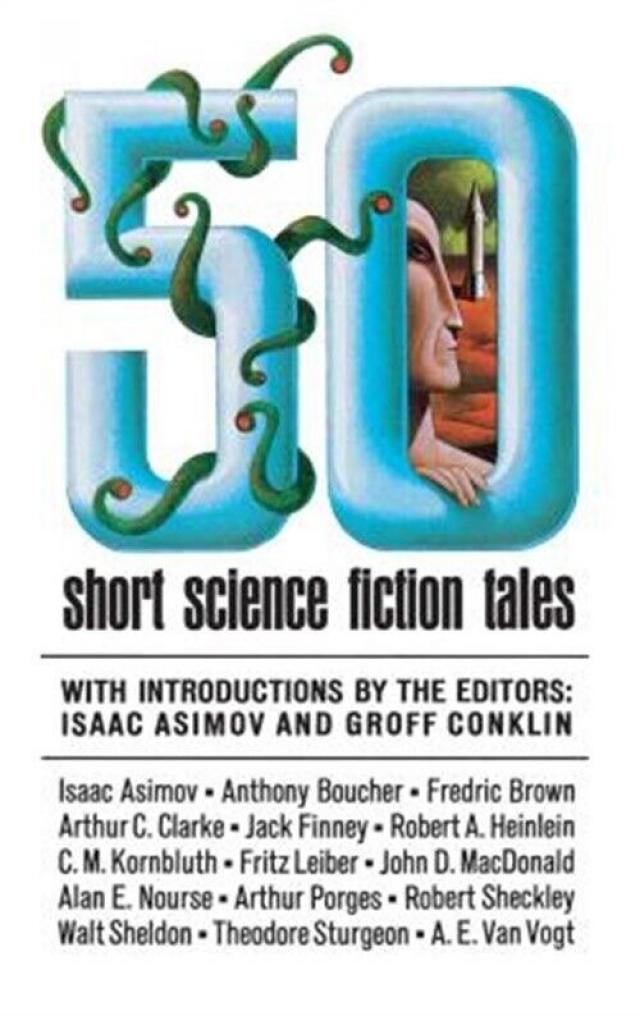
50 Short Science Fiction Tales, page 1


14-11-2023
The Editors
Isaac Asimov is a biochemist who has taught at the Boston University School of Medicine. Not only is he one of the foremost contemporary science writers, but he exercises an imaginative power that enables him to write vivid science fiction as well. His story, “The Fun They Had,” is included in this collection. Among Dr. Asimov’s factual works published by Collier Books are The Clock We Live On, The Kingdom of the Sun, The World of Carbon, The World of Nitrogen, and The Bloodstream: River of Life.
Groff Conklin, a pioneer in recognizing and evaluating the merits of science fiction, is also a distinguished science and technical writer. The diversity of his talents has expressed itself in such works as The Best of Science Fiction, one of the first science fiction anthologies, and The Weather Conditioned House, a standard work for architects.
Other Asimov and Conklin anthologies of science fiction
published by Collier Books include:
Great Science Fiction by Scientists, edited by Groff Conklin
Soviet Science Fiction, with an introduction by Isaac Asimov
More Soviet Science Fiction, with an introduction by Isaac Asimov
The Supernatural Reader, edited by Groff Conklin
Great Science Fiction About Doctors, edited by Groff Conklin and Noah D. Fabricant
Fifty Short Science Fiction Tales
EDITED, AND WITH INTRODUCTIONS, BY
ISAAC ASIMOV AND GROFF CONKLIN
COLLIER BOOKS, NEW YORK, NEW YORK
COLLIER-MACMILLAN LTD., LONDON
Copyright © 1963 by The Crowell-Collier Publishing Company
All rights reserved. No part of this book may be reproduced or transmitted in any form or by any means, electronic or mechanical, including photocopying, recording or by any information storage and retrieval system, without permission in writing from the Publisher.
Library of Congress Catalog Card Number: 62-21646
First Collier Books Edition 1963
Twelfth Printing 1971
The Macmillan Company
866 Third Avenue, New York, N.Y. 10022
Collier-Macmillan Canada Ltd., Toronto, Ontario
PRINTED IN THE UNITED STATES OF AMERICA
ACKNOWLEDGMENTS
Karen Anderson, Six Haiku. Copyright 1962 by Mercury Press. Reprinted by permission of the author.
Poul Anderson, Ballade of an Artificial Satellite. Copyright 1958 by Mercury Press. Reprinted by permission of the author.
Isaac Asimov, The Fun They Had. Copyright 1951 by NEA Service, Inc. Reprinted by Permission of the author.
Alan Bloch, Men are Different. Copyright 1954 by Groff Conklin. Reprinted by permission of the author.
Anthony Boucher, The Ambassadors. Reprinted by permission of Willis Kingsley Wing. Copyright © 1952 by Anthony Boucher.
Frederic Brown, The Weapon. Copyright 1951 by Street & Smith Publications, Inc. Reprinted by permission of the author and Scott Meredith Literary Agency, Inc.
T. P. Caravan, Random Sample. Copyright 1953 by Fantasy House, Inc. Reprinted by permission of Charles C. Munoz.
Cleve Cartmill, Oscar. Copyright 1941 by Street and Smith Publications, Inc. Reprinted by permission of the author.
Peter Cartur, The Mist. Copyright 1952 by Fantasy House, Inc. Reprinted by permission of Forrest J. Ackerman.
James Causey, Teething Ring. Copyright 1953 by Galaxy Publishing Corp. Reprinted by permission of Forrest J. Ackerman.
Arthur C. Clarke, The Haunted Space Suit. Copyright 1958 by United Newspapers Magazine Corp. Reprinted by permission of the author and Scott Meredith Literary Agency, Inc.
Mildred Clingerman, Stair Trick. Copyright 1952 by Fantasy House, Inc. Reprinted by permission of Barthold Fles.
Roger Dee, Unwelcome Tenant. Copyright 1950 by Love Romances Publishing Co. Reprinted by permission of Harry Altshuler.
Arthur Feldman, The Mathematicians. Copyright 1953 by Ziff-Davis Publishing Co.
Jack Finney, The Third Level. Copyright 1952 by Fantasy House, Inc. Reprinted by permission of the author.
Stuart Friedman, Beautiful, Beautiful, Beautiful! Copyright 1952 by Columbia Publications, Inc. Reprinted by permission of the author and Scott Meredith Literary Agency, Inc.
Edward Grendon, The Figure. Copyright 1947 by Street and Smith Publications, Inc. Reprinted by permission of Lawrence LeShan.
David Grinnell, The Rag Thing. Copyright 1951 by Fantasy House, Inc. Reprinted by permission of Forrest J. Ackerman.
Marion Gross, The Good Provider. Copyright 1952 by Marion Gross. Reprinted by permission of Barthold Fles.
Robert A. Heinlein, Columbus Was a Dope. Copyright 1949 by Standard Magazines, Inc. Reprinted by permission of Lurton Blassingame.
Albert Hemhuter, Texas Week. Copyright 1954 by King Size Publications. Reprinted by permission of Forrest J. Ackerman.
H. B. Hickey, Hilda. Copyright 1952 by Fantasy House, Inc. Reprinted by permission of Forrest J. Ackerman.
W. Hilton-Young, The Choice. Copyright by Punch, London. Reprinted by permission of The Ben Roth Agency, Inc.
Damon Knight, Not with a Bang. Copyright 1950 by Fantasy House, Inc. Reprinted by permission of the author and General Artists Corp.
C. M. Kombluth, The Altar at Midnight. Copyright 1952 by Galaxy Publishing Corp. Reprinted by permission of Mary Kombluth.
Fritz Leiber, A Bad Day For Sales. Copyright 1953 by Galaxy Publishing Corp. Reprinted by permission of the author and General Artists Corp.
Jack Lewis, Who’s Cribbing? Copyright 1953 by Better Publications, Inc. Reprinted by permission of Forrest J. Ackerman.
John D. MacDonald, Spectator Sport. Copyright 1950 by Standard Magazines, Inc. Reprinted by permission of Littauer and Wilkinson.
Avro Manhattan, The Cricket Ball. Copyright by Avro Manhattan; published in 1955 by Fantasy House, Inc. Reprinted by permission of the author.
Winston K. Marks, Double-Take. Copyright 1953 by Future Publications, Inc. Reprinted by permission of the author and Scott Meredith Literary Agency, Inc.
John P. McKnight, Prolog. Copyright 1951 by Fantasy House, Inc. Reprinted by permission of the author.
Lion Miller, The Available Data on the Worp Reaction. Copyright 1953 by Fantasy House, Inc. Reprinted by permission of the author.
Alan Nelson, Narapoia. Copyright 1951 by Fantasy House, Inc. Reprinted by permission of the author.
Alan E. Nourse, Tiger by the Tail. Copyright 1951 by Galaxy Publishing Corp. Reprinted by permission of Harry Altshuler.
Peter Phillips, Counter Charm. Originally published in Slant, North Ireland. Reprinted by permission of the author and Scott Meredith Literary Agency, Inc.
Arthur Porges, The Fly. Copyright 1952 by Fantasy House, Inc. Reprinted by permission of the author and Scott Meredith Literary Agency, Inc.
Mack Reynolds, The Business, As Usual. Copyright 1952 by Fantasy House, Inc. Reprinted by permission of the author and Scott Meredith Literary Agency, Inc.
Frank M. Robinson, Two Weeks in August. Copyright 1951 by Galaxy Publishing Corp. Reprinted by permission of the author and Curtis Brown, Ltd.
Edward G. Robles, Jr., See? Copyright 1954 by Galaxy Publishing Corp. Reprinted by permission of the author.
Eric Frank Russell, Appointment at Noon. Copyright 1954 by Ziff-Davis Publishing Co. Reprinted by permission of the author and Scott Meredith Literary Agency, Inc.
James H. Schmitz, We Don’t Want Any Trouble. Copyright 1953 by Galaxy Publishing Corp. Reprinted by permission of the author and Scott Meredith Literary Agency, Inc.
Howard Schoenfeld, Built Down Logically. Copyright 1951 by Fantasy House, Inc. Reprinted by permission of the author.
Idris Seabright, An Egg a Month from All Over. Copyright 1952 by Fantasy House, Inc. Reprinted by permission of Margaret St. Clair.
Robert Sheckley, The Perfect Woman. Copyright 1954 by Ziff-Davis Publishing Co. Reprinted by permission of the author.
Walt Sheldon, The Hunters. Copyright 1952 by Better Publications, Inc. Reprinted by permission of Harry Altshuler.
Evelyn E. Smith, The Martian and the Magician. Copyright 1952 by Fantasy House, Inc. Reprinted by permission of the author.
Will Stanton, Barney. Copyright 1951 by Fantasy House, Inc. Reprinted by permission of the author and Rogers Terrill.
Theodore Sturgeon, Talent. Copyright 1953 by Galaxy Publishing Corp. Reprinted by permission of the author.
William Tenn, Project Hush. Copyright 1954 by Galaxy Publishing Corp. Reprinted by permission of Philip Klass.
A. E. Van Vogt, The Great Judge. Copyright 1948 by Fantasy Publishing Co., Inc. Reprinted by permission of Forrest J. Ackerman.
Ralph Williams, Emergency Landing. Copyright 1940 by Street and Smith Publications, Inc. Reprinted by permission of the author and Scott Meredith Literary Agency, Inc.
S. Fowler Wright, Obviously Suicide. Copyright 1951 by Suspense Magazine.
Introductions
Introduction No. 1
I love to read reviews of science fiction books. For this, I have many ignoble motives. For instance, if a book of my own is involved, I read the review on the off-chance that the reviewer, struck by an unaccustomed bolt of benevolence, will proceed to lavish praise on me. If someone else’s book is involved, I read the review with at least the spark of a hope that if unkind words must be said, the entire supply be lavished at this point, with none left for me next time around.
Needless to say, my ignobility is not always pampered, and I have been, on occasion, irritated to find that praise and blame are assigned without the kind of partiality I would like to see.
Nevertheless, the irritation I feel on such occasions is minor, if the reviewer is a member of the science fiction fraternity. If he is, he at least knows the rules of the game; he knows the proper manner in which to judge science fiction. An outsider, on the other hand, often does not.
It is supremely irritating (frustrating, even) to watch an outside reviewer discuss a science fiction book and miss the point completely. As, for instance, when he complains (as he sometimes does) of the inadequate depth and richness of characterization and never says a word about the completely adequate depth and richness of background.
For in science fiction, more than in any other branch of literature, background’s the thing.
Consider: In a murder mystery, there is no need to describe a gun or explain what is meant by footprints. In a western, horses, sheriffs, gamblers, and steers are all familiar objects that require no detailed word-pictures. In love stories, the mores and customs of our society are well known, and, if you are the least bit sophisticated, you even know what a line of asterisks means.
In short, almost all books have known backgrounds, and the reader is an ally of the author, filling in details and elaborating on mere hints. Even when the background is exotic, a tropic jungle, the inside world of Washington politics, seventeenth-century France, most of the basic facts of life remain the same, and a few paragraphs of explanation will do the rest.
The author of such a book, relieved of the necessity to do more than nail two sticks together to supply the background, has ample time to devote to the minutiae of characterization. How fortunate he is!
But consider the one exception to the rule—the writer of the science fiction story.
A science fiction story is usually set on another world or in a future time. In either case, the background usually is a society that differs from our own, sometimes radically. The gadgetry is different; the customs are different; sometimes the most accepted things are different.
Thus a story that has its setting on the Moon must at all times keep the reader aware that the gravity is only one-sixth that of the Earth and that the very walk of a human being is changed. Since there is no air, there is, in the open, no sound in the usual manner of sounds. In a proper story, these differences may make up the nub and kernel of the complications of the plot.
I remember a story, for instance, in which two men found that Moondust caked their suits and covered their faceplates thanks to the effect of static electricity. They were then faced with the problem of removing that dust under the conditions that prevailed on the Moon. (They succeeded.) Or, more subtly, suppose the setting is on Earth, an Earth reasonably similar, physically speaking, to our world of today but with a radically different culture. Suppose it is so overcrowded that no one can possibly own a private bathroom and that a whole set of accepted rules of behavior in using a public bathroom has been developed.—And suppose a facet of the plot hinges on those rules.
Suppose tobacco is outlawed and adultery accepted.
Suppose robots do the world’s work and humanity lives in enforced and resented leisure. Suppose some men can live for centuries while other men cannot. Suppose an intelligent form of life visits our planet and suppose they (or we) happen to be good to eat?
In such cases, how does the author go about explaining a completely strange background?
He can’t just stop the story and write a little sociological tract and then say, “Now go on with the story… .” The reader won’t sit still for it.
He can’t refuse to explain and simply have his hero put in jail for scratching his chin in public without having the reader understand why this is an enormity.
Sometimes there is a strong temptation to have it all explained via conversation. One character tells another character how the “frammistant” works as he turns it on.
This, alas, is too artificial a device to impress anyone over twelve. After all, in our own culture, a man doesn’t casually explain to his friend how an electric light works.
He just flicks the switch and both accept the light as a fact even when one knows how it works and the other doesn’t.
What is the answer, then?
Well, I can do it, but I can’t explain it. All I can say is that there are ways of inserting sentences, statements, remarks, asides here and there in a story which help explain the background little by little, without perceptibly slowing the progress of the story.
There is a disadvantage to this—and an advantage.
The disadvantage is that the background, however cleverly introduced, takes up time. I should judge about half the space in a good science fiction story must be devoted to detailing the background. This leaves only half the space for such things as characterization, and in a novel of the usual length it is no wonder that the science fiction author sometimes misses a bit in these areas.
Also, the background is introduced little by little and the first portion of the book may therefore be unclear. To the science fiction reader, this actually supplies an added dimension of enjoyment for it is pleasant to watch apparent paradoxes smooth out and obscurities clear up as the story progresses. An outsider without the necessary patience may simply feel confused and give up.
The chief advantage, though, is that the background itself, if properly done, can be completely fascinating not only to the reader but to the author as well. (I speak from experience on both sides of the fence.) There is a creative delight in constructing a different world or a different society from scratch, putting it together, and making it three-dimensional in every detail. This delight cannot help but communicate itself to the reader.
The advertising-society background of Frederik Pohl’s novel, The Space Merchants, for instance, or the telepathic-society background of Alfred Bester’s novel, The Demolished Man, are far more fascinating and rewarding than the plots that work out their details in the foreground.
And I say this despite the fact that the plots, in both cases, are most competently constructed.
Now then, it is only in science fiction that this special creative joy in background is possible. If science fiction had no other justification, this would be enough, for surely to supply a new and unique pleasure is enough to ask of a particular branch of literature.
But does this mean that only the science fiction novel is possible? Does it take at least fifty to a hundred thousand words to paint an appropriate background picture, or can it be done in less? And if it can be done in less, then in how much less?
Human ingenuity is remarkable. It can be done within the limits of the short-short story.
The short-short is, in itself, a popular, if difficult, form of literature. Because it is so short, it can be read quickly, and in our hectic times a “bite-size” piece of writing, designed to be nibbled at between meals, is always welcome.
Because it is so short, it must pack a final punch to be effective; and there is then the added delight of trying to outguess the author and (we hope) failing, and therefore being at once surprised, shocked, and delighted at the final sentence.
But consider the extra dimension of the science fiction short-short. There must be the concise writing and the final punch of the ordinary short-short, and on top of that there must also be the evocation of a background differing from our own.
As an example, consider my story “The Fun They Had,” which is included in this anthology. (By talking about it, I may spoil its effect, and if I must spoil a story in this book, let it be my own.) In a little over a thousand words, I must not only describe the feelings and frustrations in the mind of a little girl, but I must get across, somehow, the entire educational system of a future society, compare it with our own, and do it all without being obvious. It was sheer fun for me to work out a way of doing so.
And so it is that Groff Conklin and I have selected fifty short-short stories for you to enjoy, I hope, in twofold fashion. You can read them casually for the events they contain and the kicker with which they usually conclude.


