

No One Sleeps on the Orient Express, page 1


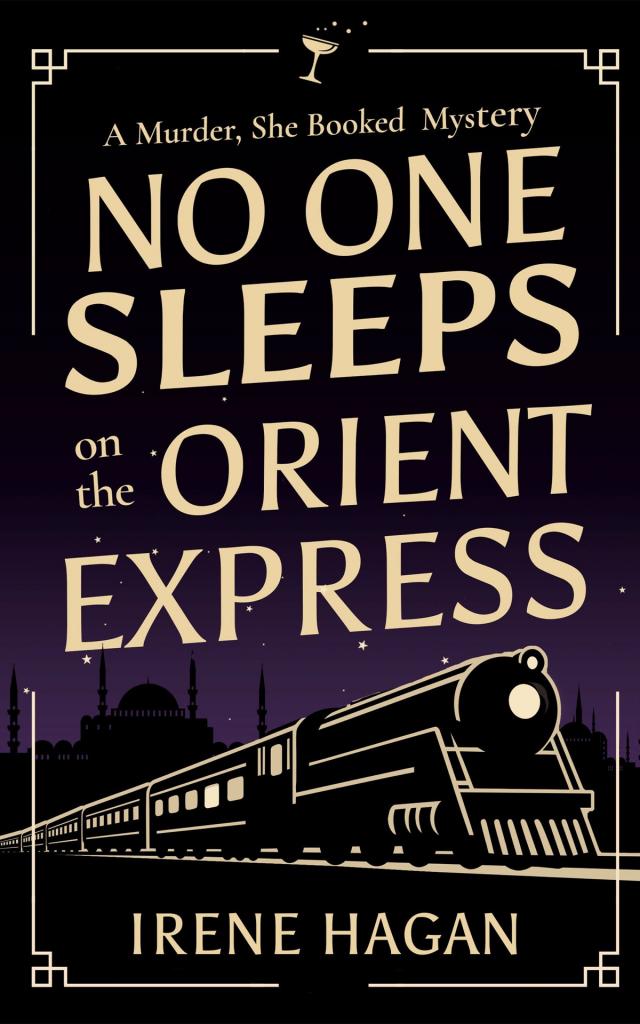
No One Sleeps on the Orient Express
Irene Hagan
Copyright © 2026 by Irene Hagan
All rights reserved. No part of this book may be reproduced, stored, or transmitted in any form or by any means without the prior written permission of the publisher, except for brief quotations in reviews.
This is a work of fiction. Names, characters, places, and events are either the product of the author’s imagination or are used fictitiously. Any resemblance to actual persons, living or dead, or to actual events is purely coincidental.
Published by Velvet Key Press
Boston, Massachusetts
For the ones who haven’t left — yet.
Contents
Chapter 1
Chapter 2
Chapter 3
Chapter 4
Chapter 5
Chapter 6
Chapter 7
Chapter 8
Chapter 9
Chapter 10
Chapter 11
Chapter 12
Chapter 13
Chapter 14
Chapter 15
Chapter 16
Chapter 17
Chapter 18
Chapter 19
Chapter 20
Chapter 21
Chapter 22
Chapter 23
Chapter 24
Chapter 25
Chapter 26
Book Club Guide
Discussion Questions
1
Turning fifty, Iris Quinn decided, was not what the brochure had promised.
Not that there had been a brochure.
But if there had been—if someone had handed her a glossy pamphlet at forty-five, outlining what to expect from this particular milestone—she felt certain it would have mentioned something. Fireworks, perhaps. Or clarity. Or at the very least, the quiet satisfaction of finally knowing where she kept her reading glasses.
Instead, she was in the library break room, eating grocery-store cake while her coworkers discussed Janet’s new refrigerator.
“French doors,” Janet was saying. “And the ice maker is inside the freezer, so you still get the full width of the shelves.”
“That’s the dream,” Mrs. Henderson said, with surprising conviction.
Iris took a sip of coffee that had gone cold sometime during the ice-maker portion of the conversation. Around her, the discussion continued. Cubic footage, crisper drawer humidity settings, whether stainless steel showed fingerprints more than black. The enthusiasm was genuine. Maybe Mrs. Henderson was right. Maybe the secret to happiness was wanting a refrigerator and then getting one.
“The old one still worked,” Janet admitted. “But it was so dated.”
Of course it still worked, Iris thought. That was never the point.
She looked from her coworkers to the cake, half-eaten on the counter. Vanilla on one side, chocolate on the other, even though her favorite was carrot cake. Not that anyone had asked. This was fifty. Not a crisis. Not a celebration. Just a Tuesday that happened to mark another year of showing up.
She scraped frosting off her fork and did the math.
Twenty-three years at this library. Twenty-three years of helping other people find what they were looking for. She was good at it—exceptionally so. She could find anything for anyone.
But somewhere along the way, she’d stopped looking for anything for herself.
She ate the cake. It was too sweet. But she ate it anyway, because that’s what you did.
The walk home took twenty minutes, most of it in a drizzle that couldn’t quite commit to being rain. At intersections, crosswinds kept inverting her umbrella, each gust a small personal humiliation. The bakery had closed early, a handwritten sign in the window apologizing for “any inconvenience this may cause,” as though inconvenience were a weather event—unpredictable, regrettable—rather than the direct result of someone locking the door.
Iris stepped over a deflated balloon on the sidewalk. Silver. PARTY still visible in sad block letters. She made a deliberate decision not to see it as a metaphor. Some things were just litter.
Her third floor apartment greeted her in the same way it always did. Without fanfare.
Beige walls she’d been meaning to paint for six years. A sofa that had started as a sensible, temporary choice and somehow lasted more than a decade, its cushions molded to her particular way of sitting. The fern by the window was alive, technically, but only in that stubborn, not quite thriving way.
Fable, her Ragdoll cat, lay draped over the couch arm in the exact position she'd left her nine hours ago. It was possible she hadn't moved. It was also possible she'd gotten up, circled the apartment, checked all her usual spots, and returned to this exact position out of spite. With Fable, you could never be sure.
"Don't get up," Iris told her. Fable didn't.
She made a third cup of coffee she didn't need and decided to clean out the hall closet. It felt productive. Decisive. The kind of thing a person did when they were definitely fine and not at all having a quiet crisis in the doorway of middle age. Other women went to Bali or had affairs or took up pottery. Iris Quinn organized storage spaces. It was on brand, at least.
An hour later, the hallway looked like an exhibit at a museum no one would visit: The Life That Almost Was: A Retrospective. There was a yoga mat, still rolled in its original plastic. A leather notebook, expensive, the kind real writers used. Chapter One on the first page in her best handwriting. Nothing after. A pasta maker that had never met pasta. A KitchenAid attachment, purchased during a brief period when she'd convinced herself she was the kind of person who made fresh fettuccine on Sunday afternoons. Italian flashcards held together with a rubber band, the first three cards dog-eared (Ciao. Grazie. Scusi.), the rest pristine. A teapot, still in the box. She'd bought it the same week as the flashcards because tea was what interesting people drank. A tote bag printed with Carpe Diem, price tag still attached like a badge of ironic honor.
Twenty years of good intentions, perfectly preserved by never being used.
Iris sat back on her heels.
This was who she'd become. A woman who bought things for the person she meant to be, then stored them in closets where they couldn’t remind her of the promises she’d made. A museum curator of her own unlived life. Every item a small act of faith that had quietly expired while she wasn't paying attention.
Fifty years old. When, exactly, had she planned to start?
Beneath a tangle of scarves that still smelled faintly of the department store where she’d bought them, her hand closed on something solid.
A small blue journal. The lock had never worked properly. It was more suggestion than security, the kind of lock that said private without actually meaning it. Inside, her teenage handwriting looped across the page with the confidence of someone who believed the world was eagerly waiting for her to show up.
After graduation, I'm going to take the Orient Express to Istanbul. I'll wear red and drink champagne and see eight countries in one week. Maybe I'll make one of them my home.
She could almost see that girl. Hair too big, dreams even bigger. So certain that wanting something badly enough was all you needed to make it happen. So sure that adulthood was the part of life where you finally got to do all the things you'd been waiting to do.
The later pages told quite a different story. The handwriting got smaller. The dreams got more polite.
Paris—someday.
Cooking class in Florence—when I save enough.
Tango lessons—after I lose ten pounds.
The entries stopped around thirty-two. Right about the time she'd started using "realistic" as a compliment.
A postcard slipped loose from the back cover. Istanbul at sunset. Gold light on calm water. Buildings climbing the hills as though they couldn’t wait to reach the top. She'd bought it at a used bookstore in college, slipped it into the journal as a promise. A placeholder for a future self who would surely, eventually, get around to making it happen.
On the back, in her own handwriting: Book that ticket.
Iris stared at the postcard for a long time.
Then at the ceiling. Then at Fable, who watched from the couch, unimpressed. She had never once deferred a nap or a sunbeam. Never wondered if she deserved good things. She just took them.
"I'm just going to look," Iris said, already reaching for her laptop.
The website loaded like a dare.
Venice Simplon-Orient Express. The photos looked professionally wistful, the kind of wistfulness that took a team of visual artists to achieve. Walnut paneling. Velvet banquettes. Champagne flutes catching the light. Rooms she’d only ever seen through screens, through windows, and within the pages of other people’s books.
She scrolled through the images the way other people scrolled through dating profiles. With longing, skepticism, and the quiet certainty that this wasn't meant for someone like her. These were rooms for women who wore silk. Women who never…or at least rarely…spilled things on themselves. Women who knew what to do with a cheese course. Women who had never, not once, bought a cardigan just because it was both on sale and machine washable.
She looked at the price.
"Ridiculous," she murmured. "Completely ridiculous."
She didn't close the tab.
The phone rang. It was Robin, of course. She had a sixth sense for moments of potential self-sabotage, which she'd either interrupt or encourage depending on factors Iris had never been able to predict.
"Happy birthday. How was the cake?"
"Half chocolate, half vanilla. A question mark candle."
A familiar clatter rang out in the background. Pots, maybe, or tools. Robin was always doing something. Even her phone calls arrived with the sound of work in progress.
“So. How are we celebrating? Wine and a documentary? Finally starting that puzzle?"
"I'm cleaning out the hall closet."
A pause. That particular quality of silence that meant Robin was deciding whether to be gentle or direct. "Oh, Iris."
"I found the journal. The Orient Express one."
More silence. The clattering stopped.
"And?" Robin said.
"I looked it up."
"Looked it up how? Like, looked at pictures, or—"
"Looked at prices."
"Ah."
A pause. "And?"
Iris told her.
"I'm sorry," Robin said. "I think I have dirt in my ears. It sounded like you said—"
Robin went quiet. Iris could picture her standing in the greenhouse with her reading glasses pushed up on her head, surrounded by seedlings and the smell of damp soil. Robin's greenhouse was the opposite of Iris's closet. It was a place where things actually became what they were meant to become.
"Well," Robin said finally. "That's a lot of money for a train ride."
“A week. Through the Alps."
"Still a lot of money."
"I know. It's crazy. I don't know why I'm even—"
"I didn't say crazy."
Iris blinked. "You didn't?"
"I said it's a lot of money. That's different." Something scraped against something else. "What does it include? Meals?"
"All of them. And champagne. And a suite."
"A suite. On a train?"
"Apparently."
"With a bed?"
"And a bathroom. Marble, supposedly."
"Marble… Well. At least if you faint from the price, you'll hit something expensive."
"That's comforting."
"I'm a comforting person." There were more sounds. Water running now.
"When does it leave?"
"Three weeks. If I—I mean, if someone were to book it. Which I'm not. I'm just looking."
"Mmm."
"I'm just looking, Robin."
"I didn't say anything."
"You said 'mmm.' That's your something voice."
"That's not the point." Robin laughed. The water stopped.
"Okay. Cards on the table. Is this a real thing you're considering, or is this a 'talk me out of it' conversation?”
Iris opened her mouth. Closed it. This was the problem with Robin. She asked the questions you were trying not to ask yourself.
"Because if you want me to talk you out of it," Robin continued, "I can do that. I can list every sensible reason why a reasonable woman with a Boston-area mortgage and a public service salary shouldn't spend her savings on a European train ride.”
"But?"
"But you didn't ask for the speech." Robin paused. "You called to tell me you found the journal. On your birthday. The one with all your dreams written in it.”
More silence. But it wasn't heavy this time. It was just Robin, thinking. Iris had sat through a hundred of these silences over the years, waiting for Robin to finish a thought she'd never rush. It was one of the things she loved about her. That willingness to let a moment breathe.
"You know what I'd miss most about you if you got hit by a bus tomorrow?" Robin said.
"That's morbid."
"I'm sixty-three. I'm allowed to be morbid… I'd miss that you still have the journal. That you've been carrying around that same dream since before I met you, and you never let it go. Even when you probably should have."
Iris felt her throat tighten.
"Most people stop dreaming by fifty," Robin said. "They settle in. Get comfortable with the idea that this is it. You never did. Drove me crazy sometimes, honestly. All that wanting."
"Robin—"
"I'm not telling you to do it. That's your call. But I'm not going to be the one who talks you out of it either." The greenhouse sounds resumed. A door opening, something being set down. "Call me tomorrow. Let me know what you decide."
"Okay."
"And Iris? Whatever happens—happy birthday. You made it to fifty. That's not nothing."
After they hung up, Iris sat staring at the booking form.
Name. Credit card. Confirm.
I'll just fill it in, she told herself. Just to see what it looks like.
Her fingers found the keyboard.
Iris Quinn. The letters looked strange on the screen. Too ordinary for a train like this. She half-expected the form to reject her—Sorry, we were looking for someone more…appropriate.
The savings debit card was in her wallet. She'd have to get up to get it. That was a sign, probably. The universe giving her an out.
She got up. Got the wallet. Sat back down.
She typed the number slowly. Double-checked each digit. Then triple-checked, because that was who she was. A woman who triple-checked things, who read the fine print, who had never in her life made a decision this impractical.
Expiration date. Security code.
The cursor blinked in the final field. Confirm.
Forty-eight thousand dollars. Nearly her entire emergency fund. Every skipped vacation and secondhand coat and I'll just cook at home she'd been telling herself since her twenties. Decades of small denials, all sitting in a savings account, waiting for an emergency that had yet to come.
Maybe this was the emergency. Maybe the emergency was turning fifty and realizing she’d spent her whole life preparing for disasters instead of living.
Or maybe she was just tired, and lonely, and about to make a terrible mistake.
Click.
The screen flickered. For a long moment, nothing happened. Long enough for her to think that maybe it didn't go through. That the card was declined. That she might be spared from her own impulse.
Then:
Welcome aboard the Venice Simplon-Orient Express, Ms. Quinn. Grand Suite, Car L. Departure: London to Istanbul. Your journey begins.
Your journey begins. That was what the website said. As if beginning were the easy part. She sat very still.
"I just spent forty-eight thousand dollars," she told Fable. "On a train ticket."
Fable yawned. It was as close to approval as Iris was likely to get. Iris stood and walked to the window. Below, the street glistened with the last of the rain. A man with a red umbrella crossed at the corner, folding it closed as he walked. The world looked newly washed.
She turned toward the bedroom, switching off the lamp as she went, then stopped.
On the bookshelf, wedged between Austen and a guide to indoor ferns— that clearly had never been consulted—sat her old paperback of Murder on the Orient Express. Dog-eared and yellowed, its spine cracked from a dozen readings. She’d first read it at seventeen, curled up in a window seat, convinced her life would be full of mysterious strangers and elegant train cars and so many glamorous adventures they would eventually all blur together.
She straightened the spine with one finger. Some books you didn't outgrow. You just kept waiting for your life to catch up.
Three weeks.
2
The Orient Express was smaller than Iris had imagined. Narrower. More precise.
She’d expected something cinematic. Exaggerated, maybe, the way beautiful things sometimes were in the movies. This wasn’t that. This was real.
Iris stood on Platform 2 at Victoria Station, ticket in hand, watching the cream-and-blue carriages gleam under the station lights. Brass fittings. Windows so clean they looked newly installed.
Thirty-three years of imagining, and here it was. Real. Waiting.
Now she actually had to get on it.


