Lightning Strikes the Silence, page 1


Praise for the Lane Winslow Mysteries
“The ‘find of the year’ . . . With the feel of Louise Penny’s Three Pines, the independence and quick wit of Kerry Greenwood’s Phryne Fisher and the intelligence of Jacqueline Winspear’s Maisie Dobbs, this mystery series has it all!” —Murder by the Book, Texas
“Whishaw nicely captures the rhythms and dynamics of small-town life while maintaining suspense. Maisie Dobbs and Phryne Fisher fans will be pleased.” —Publishers Weekly
“Relentlessly exciting from start to finish.” —Kirkus Reviews
“There are days when nothing suits a reader like a good old-fashioned classic cozy with a puzzle plot, a country setting and some nice slight characters. When that urge strikes, Iona Whishaw’s delightful BC series featuring Lane Winslow and, now, husband, Inspector Darling of the King’s Cove constabulary, are just the ticket.” —Globe and Mail
“There’s no question you should read it—it’s excellent.” —Toronto Star
“In the vein of Louise Penny . . . a compelling series that combines a cozy setting, spy intrigue storylines, and police procedural elements—not an easy task, but one that Whishaw pulls off.” —Reviewing the Evidence
“Whishaw’s writing is worthy of taking its place alongside the works of Agatha Christie and Dorothy L. Sayers . . . deftly crafted and briskly paced.” —Fiona Valpy, author of The Dressmaker’s Gift
“Think a young Katharine Hepburn—beautiful, smart and beyond capable. Winslow is an example of the kind of woman who emerged after the war, a confident female who had worked in factories building tanks and guns, a woman who hadn’t yet been suffocated by the 1950s— perfect housewife ideal.” —Vancouver Sun
“I absolutely love the modern sensibility of these novels, of their feminism, sense of justice, their anti-racism, their progressiveness, which somehow never seems out of place in a tiny BC hamlet in 1948.” —Kerry Clare, author of Waiting for a Star to Fall and editor of 49th Shelf
“An intriguing mix of character, plot, time, and place. Highly recommended.” —Ian Hamilton, author of the Ava Lee novels
“Fantastic . . . readers will stand up and cheer.” —Anna Lee Huber, author of the Lady Darby Mysteries and the Verity Kent Mysteries
“Richly conjured . . . deftly plotted . . . this series just keeps getting better!” —Catriona McPherson, award-winning author of the Dandy Gilver series
“Complex, suspenseful, and deeply felt, this is a smart series for the ages.” —Francine Mathews, author of the Nantucket Mysteries
the lane winslow mystery series
A Killer in King’s Cove (#1)
Death in a Darkening Mist (#2)
An Old, Cold Grave (#3)
It Begins in Betrayal (#4)
A Sorrowful Sanctuary (#5)
A Deceptive Devotion (#6)
A Match Made for Murder (#7)
A Lethal Lesson (#8)
Framed in Fire (#9)
To Track a Traitor (#10)
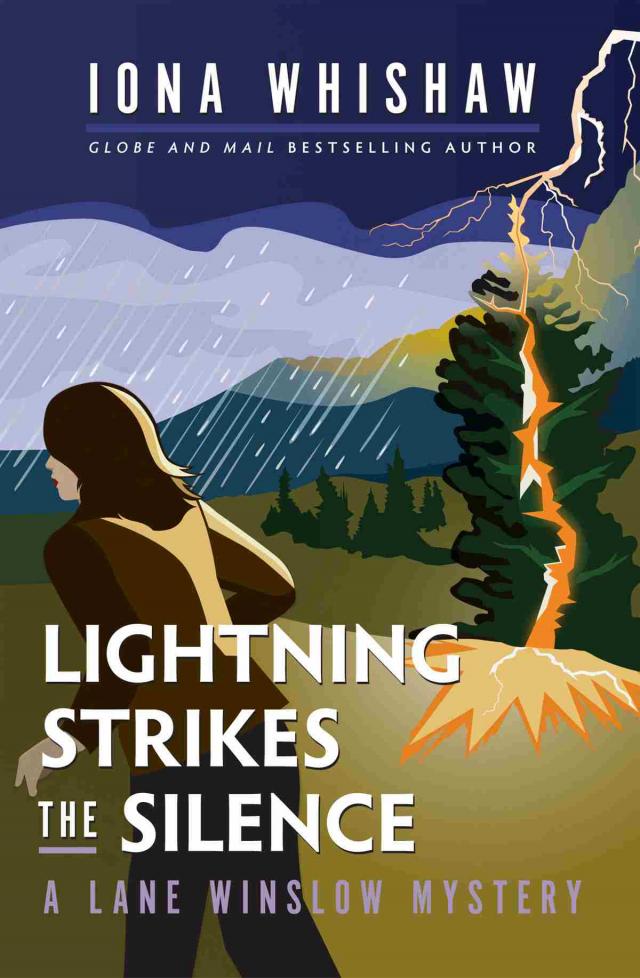
Lightning Strikes the Silence (#11)
Iona Whishaw
Lightning
Strikes
The Silence
A Lane Winslow Mystery
For Eva, my grandmother . . .
a life of joyful kindness cut short
Prologue
“look what you’ve done, you pig! Why don’t you go back where you came from!”
He barely had time to form an answer when he was pushed so violently that he stumbled backward, falling in a heap, slamming his hip on the rough ground. In a fury, he scrambled up and lunged at his attacker’s feet, knocking him over so that his head fell hard on the rocks.
“Say that again!” But the boy didn’t move.
“Say it again!” he yelled, swiping at the boy to make him move, and then struck him hard. “Say it!” he was screaming now. “Go on!” He kicked the downed figure, feeling the blood pounding in his own head. “Don’t you play dead with me! For the rest of your life, you look behind you, ’cause I’ll be there! Do you hear me?”
He was deafened now by his own rage. He heard nothing —neither the woman screaming nor the man yelling—until he felt himself being lifted off the ground, someone shouting from a distance, “Stop! For God’s sake, stop!”
Chapter One
June 11, 1948
the explosion was deep and resonant, and so unfamiliar that the residents of King’s Cove who were outside, which was most of them on a beautiful June day, looked upward thinking it was odd to have thunder out of so clear a blue sky.
Lane Winslow, reading under the weeping willow, frowned, closed her book, and struggled up from her folding canvas chair. Where had the boom come from? Having dismissed the idea that it was thunder, she turned her mind to her neighbours. Had an explosion accidentally ignited in someone’s coal cellar? It seemed to be coming from up the mountain a little south of her. The Hughes family lived up there!
She dropped her book and ran into the house to seize the car keys off the hook by the inside of the door, jumped into her little Austin, backed it hurriedly onto the road, and then swung it around and made for the fork that led on up the hill toward the Hughes house. She turned left and bumped as quickly as she could down the rutted road that ran alongside their fenced field, her tires sinking into the muddy pools still left from the torrential rain of the night before. She saw their two milking cows cowering under a tree, and she tried to go faster, conscious of the deep ruts causing the centre hump to scrape the bottom of her car. In the driveway, she stopped and gazed around her.
Not a bloom out of place. The magnificent flower borders maintained by the grande dame of the family, old Gladys Hughes, flowed around the fruit trees, and the curved patches of lawn were the luminous green of early summer. Drops of moisture on the plants dazzled in the mid-morning sun. No smoke, no fire. Just a gentle mist as the sun evaporated the remains of the night’s rain. But the two cocker spaniels were definitely kicking up a fuss. She saw what she had missed initially. At the edge of the apple orchard, all three Hughes women were standing with their hands shielding their eyes, looking west up the mountain. Then Mabel, the elder of the two “girls,” both in their fifties, leaned over and tried to hush the hysterically barking dogs.
Lane got out of the car and hurried along the final bit of grassy drive to where they were standing.
“You heard it too,” Gwen, the younger daughter, said, turning to greet Lane. “The dogs have gone mad.”
“I thought it came from here,” Lane said. She too gazed in the direction of the hill above the orchard where they had been looking.
“Good of you to come,” Gladys said, glancing at her. “All tip-top here. It came from up there somewhere.” She pointed to where the thickly treed mountainside climbed steeply above King’s Cove. “I thought it might be those Sons of whatever they are, those Freedomites blowing things up again, but there’s nothing up there to blow up. It’s just bush. Do you think some hound is blasting up there looking for silver? That would be the bloody limit!”
“Language, Mother,” Mabel said, then pointed up the hill. “Is that smoke?”
The dogs took up their chorus again. “It is, I think,” Lane confirmed. “I wonder if anyone is up there and been hurt.”
“If whatever it is sets the forest alight, we’re all for it,” Gladys said grimly. King’s Cove had lived through the fire of 1919, which had destroyed several houses and most of the orchards in the north part of the settlement. “We’d best telephone the authorities.” She started back to the house.
“How far up do you think that is?” asked Lane.
Gwen considered. “It’s hard to tell from here. We sometimes hike up that way with the dogs; it’s a good forty minutes to where we go, but that smoke is much farther still. There’s a rocky outcrop with a marvellous view of this arm of the lake and the mountains. There’s not really a proper trail there, though.”
“Higher up than forty minutes?” Lane was becoming more uneasy. The smoke was rising blackly above the thick blanket of trees and was rolling over on itself. “I think I’d better go up and make sure there’s nobody there.”
“Mother can do the phoning. We’ll come with you. Let me run and get my first aid kit,” Mabel said. “I know the way. I still keep the kit in good nick since the war, though it won’t do much if someone is badly burned.”
Lane waited impatiently, keeping an eye on whether the smoke patch was getting larger. Finally, Gwen and Mabel came, Gwen carrying a Thermos and Mabel a shoulder bag.
“The damn water is patchy again,” said Mabel. “All I got was a blast of air when I turned on the tap. That’s why it took so long. It’s been a bit dodgy for ages, but it’s just got really bad. I’ve got to get Harris to go check the lines. There must be a hole or air pockets in the pipe somewhere. Right, off we go.”
With that Mabel strode off, leading the way, the dogs bounding around her, excited about the adventure.
* * *
the jewellery heist must have been so noisy that Darling could scarcely believe the thief was even sane. He stood in front of Harold’s Fine Jewellery and Watch Repairs looking through the window into the chaos inside. No one had spotted anything amiss that morning when they were rushing off to work or shop. It was the ill fate of Mrs. Harold, the jeweller’s wife, to find the devastation when she’d come in to work at ten thirty in the morning. The streets were full of people to-ing and fro-ing, and the café was right across the street, all the window seats occupied by people having their morning break. Seeing the police and a clearly distraught Mrs. Harold had caused all those in window seats to gape out at the scene. It would happen on a Friday, Darling thought. It would keep them all busy all weekend.
The store normally opened at eleven. Mrs. Harold always came in early, she explained. “Why did the thief have to break the place up like this?” she asked Darling. “It’s wicked! Ron is away in Vancouver. He’s going to be beside himself when I tell him. How am I going to cope on my own?” She made as if to go back in. She had evidently taken one look at the mess and run off to get the police.
“I’m sorry, Mrs. Harold, you can’t go in now. We’re about to go in and see what we can find.”
“Ron’s going to be sick. It’s everything we own!” Her voice was beginning to rise.
“I understand. I’ve got a constable coming along to talk with you. He can take you back to the station and get you a cup of tea. Please tell him anything you can about your inventory. Where do you keep the records? I’ll get them out so you can give an accurate account, but let him know if there is anything unusual or of extraordinary value.”
Mrs. Harold came marginally out of her state of panic under the influence of Darling’s calm manner. “In the back, in the office. My inventory records are in the desk, in the drawer on the right.” She fumbled in the pocket of her cardigan. “Here’s the key. This one is for the back door, and this is for this door.”
“Right, thank you. We’ll lock the front for now,” Darling said. “My constable will be along in a moment.”
My inventory records, she’d said. Like so many businessmen’s wives, she must be the chief accountant and record keeper. Mrs. Harold nodded unhappily and looked in the window at the chaos.
Ames and Darling stepped out of earshot. “I’ll talk to nearby merchants to see if anyone was working last night and might have heard anything,” Ames said, readying his notebook. He shook his head in wonderment. “I was just in there yesterday.”
Darling glanced at Ames, allowing only the slightest twitch of an eyebrow, then went to peer in the window while Ames went to the first store south of the jeweller, a tobacco shop. The interior of the Harolds’ store was full of glass from broken display cases. Someone really had taken something heavy to the cases, Darling thought. It looked to him like it had been done with a sledgehammer. He frowned and examined the front door. It had been locked when Mrs. Harold had come in that morning.
So, the thief had broken into the back of the shop, performed a sort of smash and grab and escaped the same way, into the alley.
Ames came out after talking with the tobacconist. “Sorry, sir. He knocked off early because it was his wife’s birthday yesterday.”
“No joy, then. The front door was still locked, so let’s assume the back alley. All the display cases are smashed to smithereens. It looks like whoever it was just scooped up what he could.”
“It must have been an unbelievable racket.”
Darling looked back at the shop. “Yes, indeed. Well, keep at it. I’m going in the back to get the inventory records while Mrs. Harold talks to Terrell.”
Someone had come out of the café and had a hand on Mrs. Harold’s arm, consoling her where she stood, her arms tightly crossed as she looked miserably at the two policemen.
“Right, sir. I’ll try the bakery next door. They come in pretty early, and for all I know stay late.”
“Good. If Terrell gets here before I come back, get him to take Mrs. Harold to the station and scare up a cup of tea for her. Her husband is away, so she’s having to cope on her own.”
He started to walk toward the end of the street and then turned and stopped, looking closely at Ames. “You were in there yesterday? A present for your mother?”
Ames’s cheeks became pink, and Darling waved him on. “Get on with it, then.”
Making his way up the hill the half block to the alley, Darling had no difficulty recognizing which rear door belonged to the jewellery store. It was open, and a small canvas bag was lying on the ground, no doubt dropped by the thief in his flight. He picked up the bag and was about to open the drawstring when he saw that there was a smear of what looked like blood, darkening now in the warmth of the morning. The perpetrator must have cut his hand on all the glass. Not surprising considering the mess in the shop. He gingerly pulled the string and looked inside. Several gold chain bracelets. When he went through a dark short passage into the dimly lit office, he was surprised to see that it too had been ransacked. Any normal thief, he had reasoned, would have got into the display cases, seized whatever he could, and then fled. But now this. Why take the time to pull the office to bits?
As his eyes adjusted to the dim light, he scanned the office, noting the open metal filing cabinet with papers spilling out, and books swept off a low shelf. As he turned to the desk, he nearly jumped out of his skin. Certainly not in Vancouver, but slumped face down at his own desk with something very wrong with the back of his head, was Mr. Ron Harold himself.
Rushing forward, he placed his fingers on the victim’s neck, and then nearly snatched them away because it was so cold. No heartbeat. The acrid ferrous smell of blood assailed Darling’s nostrils. Nearly gagging and wondering why this man’s wife thought he was away, Darling pulled the chain on the desk lamp, but no light resulted. The wall switch was equally unforthcoming. He should have asked Mrs. Harold if there was an alarm. Perhaps the thief had cut the wires to prevent it going off. Ledgers forgotten, Darling pushed the back door wide, letting more light into the murky space, and looked for signs that the owner struggled or fought, though these would have been difficult to distinguish in the disarray of the open drawers and spilled books and boxes. Still, no chair or shelf was overturned as might indicate a physical struggle—and, after all, there was Ronald Harold himself, looking like he’d just put his head down on his desk for a nap. In the better light, Darling saw what was wrong with his head: the back of his skull had been smashed in.
He looked as closely as he dared, decided that more intense scrutiny was a job for Gilly, and took the set of keys out of his pocket. The floor was aged and much-scuffed wood—pine, he guessed—and he could not discern anything in the way of a useful footprint, had one even survived his own tramping in and out. Outside, he stopped to look at the ground, hoping that the rain of the night before would have made a muddy base for a telltale size ten boot, but again there was nothing to be seen. If the killer had left while the storm was still on, the rain would have washed away any traces.
He located the key that fit the back door. It was then that he saw that the wire that fed electricity into the shop from the main line was severed and hanging against the back wall. He locked the door and went around the building to Baker Street. They would have to secure the scene and call electricians to fix the hazard.
He was not surprised to see that a crowd had gathered in front of the store, and people were talking animatedly about the break-in. Well, they’d be shocked by what really went on, he thought.
Darling was about to push his way through but stopped. “If anyone heard or saw anything early this morning, or sometime in the night, can we get you to come to the station?” he asked. A general shaking of heads indicated there’d be little business resulting, and Darling sighed. He caught sight of Terrell walking Mrs. Harold back toward the station and pulled Ames away from the crowd. Ames had come back from the baker with an empty notebook.
“I’ve asked people to come to the station if they know anything. You get down to the station, quick as, and ask Terrell to come back here and secure the scene, then get Gilly here as fast as you can,” Darling said.
“Yes, sir.” Ames gave a quick surprised look at the store and then back. Secure the scene would be appropriate for a robbery, certainly, but Gilly? “What’s happened?”
“We have a problem. Owner, Mr. Harold, has been killed. Ask O’Brien to attend to Mrs. Harold in one of the interview rooms; keep her quiet and in the dark for now. Then phone the city to send someone out to deal with a live wire at the back of the shop.”