

Gutsy Girls Who Led India, page 1


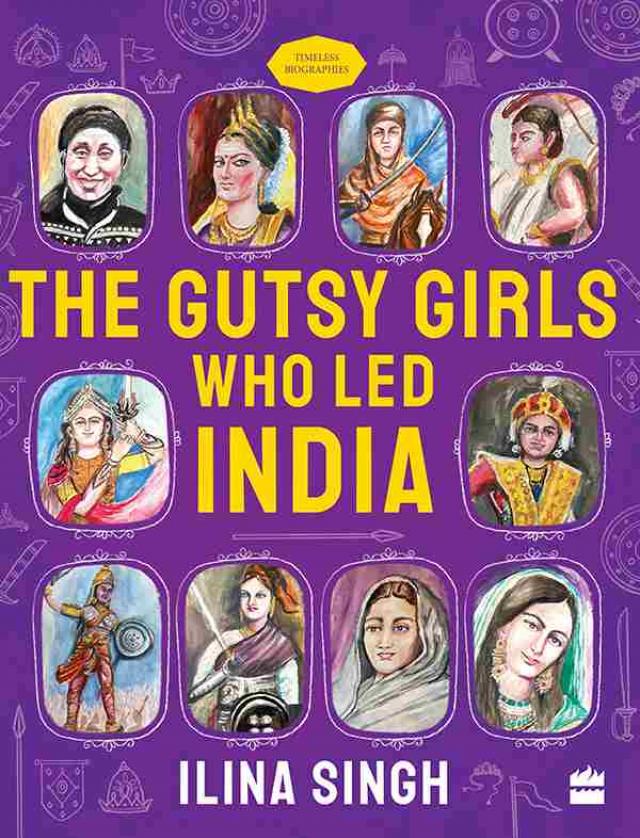
To gutsy girls
everywhere, and
to Nani
Preface
Anyone can be a leader. And everyone can learn to become a better leader. Walk into any bookstore and you’ll find enough books on leadership to fill a shelf. Indeed, we are lucky to be born at a time when we have access to learnings from a variety of leaders across the ages and regions.
We are especially fortunate to be living in India, as our country has had many brave and inspiring leaders. I’m sure you’ve met some of these — from ancient kings like Ashoka and Chandragupta Maurya to freedom fighters like Bhagat Singh and Gandhiji — in your textbooks.
However, have you heard of Rani Abakka or Queen Didda? Probably not. Unfortunately, the ladies are often missing from these textbooks. Well, it’s time to tell their story. In this book, you will meet ten Indian women who led their communities with courage, skill and wisdom; fought against the societal expectation of females to be meek and mild; and to this day inspire us to believe in our abilities and rise to face challenges.
Say hello to the Gutsy Girls Who Led India.
Of course, we will not be mounting our horses and charging into battle anytime soon, although that would be fun too. Instead, I hope this book encourages us to borrow a little inspiration as we think about our goals and how we can achieve them while also helping those around us.
For this, I have also developed a simple nine-step leadership framework after studying the leadership lessons we can take away from these inspiring women leaders. Good leaders live these lessons in their lives every day, and so can we all.
The lessons are gender agnostic — boys will, hopefully, find them equally useful.
There are two ways of enjoying this book — poetry and prose. Poetry brings alive stories almost magically. Prose is simple, easy to read and helps delve into historical detail. So, there’s a poem on each leader, followed by their story in prose. You may choose to read these in the order that you prefer and then move on to the leadership lesson and activity.
Here’s to the leader in you! I can’t wait to see the wonderful things you are about to do.
Contents
Nine Steps to Leadership
Queen Didda
Gaidinliu Pamei
Velu Nachiyar
Abakka Chowta
Ahilyabai Holkar
Keladi Chennamma
Mai Bhago
Rani Lakshmibai
Begum Hazrat Mahal
Rani Durgavati
About the Book
About the Author
Copyright
Nine Steps to Leadership
Whilst everyone’s journey of discovery will look very different, I found that there are nine important steps along the way to becoming an effective leader. Each step asks us to pause and reflect on a certain value, skill or intention. I’m sure you have come across some of these in life already! In isolation, none of them are particularly rare or challenging. However, when you are able to practise them together over time, you will see how your ability to lead and work with others is strengthened by these skills.
At the end of each chapter, I have provided a short activity that will make you think a little deeper about what you want to accomplish and how you can approach your goals. Try to complete the tasks as honestly and openly as possible to unlock your true potential!
Queen Didda
There was a king in Cashmere
Who prayed for a child, an heir;
To take over the royal crown
And rule over every hill and town.
A bonny baby girl soon arrived
But the unhappy king just sighed;
His heart full of anger and shame
For the child was sadly born lame.
The King’s love shrivelled and dried
The child was insulted and deprived;
Destiny broke this sorry spell
When Princess Didda married well.
Her husband made her an equal partner
Royal coins had pictures of both him and her;
Queen Didda was clever and cunning
She quickly learned the tricks of ruling.
When her husband took ill and died
Didda was heartbroken and cried;
Her refusal to join him in the pyre
Earned her the wicked ministers’ ire.
She became regent to her young son
And got rid of her enemies one by one;
Alas, her son too did not live long
Yet Didda’s regency continued strong.
She groomed her three grandsons
Unfortunately, they died quite young;
She took the throne and became Queen
The fiercest one the land had ever seen.
Ruthless and ruling against all odds
She quelled revolts and exposed frauds;
Love her or hate her, but the fact remains
Peace and prosperity adorned her reign.
Art, religion and culture were inspirations –
In one year she laid 64 temple foundations;
When she finally died at the ripe age of 79
Her kingdom was strong, and her legacy fine.
Step 1: Self-awareness
Wouldn’t you agree that imperfect characters, who achieve greatness despite their flaws, make for the most interesting stories? Queen Didda of Kashmir has a life story filled with action and adventure and many twists and turns. Luckily for us, an author and poet named Kalhana wrote a book titled Rajatarangini on the lives of the kings of Kashmir, in which he recorded her remarkable tale.
In the year 924 CE, a baby girl was born in the house of the King of Lohara, Simharaja. (Lohara lay in the Pir Panjal mountain range, on the route between western Punjab and Kashmir.) The girl was also the maternal granddaughter of the very powerful King of Gandhara, near present-day Kabul. Despite her noble birth, Didda’s life was not a bed of roses.
Coins with Didda’s name and portrait have been discovered in Kashmir.
Legend has it that Didda, though very beautiful, was lame. Although this was not her fault, it made her father dislike her. Her early childhood was sad, and her future seemed uncertain. Her father married her off to the King of Kashmir, Ksemagupta, to bind the two kingdoms together in an alliance. This marriage proved to be a blessing in disguise for Didda.
Didda was a quick learner and adapted well to her new position as Queen. She won her husband’s trust and respect, and he soon began to consult her in official matters. When he issued royal currency, he made sure coins were minted with Didda’s name and image as well. The court was filled with several courtiers and ministers who tried to influence royal affairs to serve their own selfish interests. Didda’s growing influence did not sit well with these ministers — they resented a woman becoming so powerful.
Queen Didda was one of the longest reigning Indian monarchs. Her rule lasted over forty years.
Didda’s husband, the King, was very fond of a luxurious life. He especially enjoyed fox hunting. Upon his return from one such hunting expedition, he fell ill and died. Didda was suddenly alone amidst powerful, ambitious ministers who expected her to commit sati. But she refused to jump into her husband’s pyre when the time came, and stated that her only child, young Abhimanyu, needed his mother. With the help of a kind minister, she placed Abhimanyu on the throne. Since the boy was young, Didda effectively ruled as Queen Regent.
Didda had to swiftly get rid of the cunning and rebellious elements that threatened her. She used rewards, punishment, negotiations and sly divide-and-rule policies to break up the ministers and courtiers who tried to destabilize her. So effective was she in doing this, that she was accused of witchcraft since it was unthinkable for society to credit a woman with superior political skills.
Didda was born with a deformity in one leg that caused her to limp. This was considered an ill omen at the time.
Didda’s ruthless side took a backseat after her son passed away from ill health. She plunged into sorrow and decided to honour his memory by building a temple in his name. She laid the foundation of several temples at this time and took it upon herself to repair old temples and monasteries.
Didda’s three grandsons ascended to the throne one by one, but none of them lived long. After the death of her last grandson, Didda took the reins of the kingdom in her own hands. This made her one of the few female monarchs in Indian history. Her rule was long and ushered in a period of peace and stability in Kashmir. She died at the ripe old age of seventy-nine in the year 1003 CE. Before dying, she selected her brother’s son as her successor to the throne. Even today, the legend of Queen Didda lives on as young people rediscover her rollercoaster tale.
Activity
Be Self Aware
Queen Didda used her sharp mental skills to overcome the physical challenge presented by her deformed leg. She did not let her limitations define her. Instead, she identified and developed her mind as a strength.
Before we set out to change the world, we need to understand ourselves well. We will be better leaders when we are tuned into what makes us tick. Knowing our strengths will help us power our journeys and understand the unique magic we add to the world. Also, knowing our weaknesses will help us work on them and find partners who can complement us.
Let us start your leadership journey by knowing more about you:
To download the activity PDF, scan this QR code:
Gaidinliu Pamei
Now let’s take our marching band
To the northeastern state of Nagaland;
It’s not a state visited by many
But it’s as important a place as any.
In this state seen by the lucky few
Was born the great Queen Gaidinliu;
With a spiritual strength rarely seen
She joined the Heraka at only thirteen.
Heraka was a movement of the Naga –
It was both a religious and political saga;
So dazzled were the Nagas by her prowess
That Gaidinliu was soon declared goddess.
Heraka soon took up the difficult stand
Of driving out the British from Nagaland;
The girl helped her cousin, who led at first
Till the British caught him and did the worst.
The child could have wallowed in sadness
But instead, got up and held the harness -
Of the Heraka and of the noble mission
Of sending back foreigners, of the vision,
that united her people into a coalition
the four tribes running the administration.
Resisting the attack on her dearest traditions
She fought the forced religious conversions
The terrible, harsh labour and the high taxations.
For three years she bravely led the resistance
It made the British worried and rather tense.
She was only 16 when caught and sent to jail
And was freed in 1947, when the Brits set sail;
She continued serving her people, she never sat still
Nehru praised her as “Rani” and “daughter of the hills”.
Step 2: Purpose
As you already know, India won her independence from British rule as a result of many sacrifices by several men and women across the country. One remarkable story that’s seldom told is that of Rani Gaidinliu. She was born on 26 January 1915 in the Tamenglong district of present-day Manipur in the Rongmei tribe (also known by the name Kabui).
When Gaidinliu was little, she saw the British exploiting the people and resources of her land and forcing the people to convert to Christianity. Gaidinliu belonged to one of the three Naga tribes that made up the ethnic group called Zeliangrong. This group of people worshipped the Supreme God Haipou Tingkao Ragwang or Tingwang. Little Gaidinliu loved her culture and wanted to protect the religious and social uniqueness of her land.
Rani Gaidinliu was born on 26 January 1915 in Tamenglong district in present-day Manipur.
When Gaidinliu turned thirteen, she joined her cousin Haipou Jadonang’s Heraka movement. While initially this was more of a spiritual movement aimed at resisting foreign interference in local religious and cultural practices, over time it expanded into political protests, and aimed to unite the Naga people against the British.
When her cousin was captured and executed in 1931, Gaidinliu took charge of the Heraka movement at the age of sixteen. She led the guerilla forces that fought against the British. She led an armed revolt in Nagaland, Manipur and Assam. She encouraged her people to stop paying taxes to the foreigners and take pride in their tribal identity and religion. This made her one of the few women leaders of the Indian Independence Movement who actively fought the British. She became a target of the government, and search operations were launched, where soldiers hunted for her across villages. Although she managed to escape several such attempts, she was finally arrested in 1932 and sentenced to life imprisonment. She was moved across various jails. In 1937, Jawaharlal Nehru met her in jail and gave her the title “Rani”. She served her jail term till her release in 1947, when India finally became free.
Rani Gaidinliu was awarded the Tamrapatra, Padma Bhushan, Vivekananda Seva and Birsa Munda awards for her work.
Gaidinliu continued her good work for the upliftment of the Zeliangrong people after her release. She opposed the Naga National Council that wanted to break away from India after independence and insisted that the Zeliangrong people stay within India. She had to live underground for six years while fighting the Naga separatists and emerged in 1966 after reaching an agreement with the Indian government.
Gaidinliu was awarded the Tamrapatra Freedom Fighter Award in 1972 for her fight against the British. She was also bestowed with the Padma Bhushan in 1982 and received the Vivekananda Seva Award in 1983.
She worked for the welfare of her people till her last breath and passed away in 1993 at the age of seventy-eight. She was awarded the Birsa Munda posthumously, and a postage stamp was released by the Indian government in her honour in 1996.
In 1996, a postage stamp was issued by the Indian government in Rani Gaidinliu’s honour.
Activity
Find Your Purpose
Take a moment to think why a thirteen-year-old girl might choose danger over a comfortable life. Clearly, she valued something so much that it became the purpose of her life, a purpose so important that she was willing to sacrifice everything for it. Some of us may have to make such difficult choices in life. The one thing common to all leaders is the discovery of the ideas, values and goals which matter to them. Here is an exercise that will help you think about your goals and how you might reach them. Don’t worry if you can’t think of a big purpose yet! These things take time. Start practising with smaller goals. Perhaps you want to make sure your home segregates its waste. Or you want your family to start practising healthier eating habits. Or maybe you want your school to minimize the wastage of water and adopt water recycling. I encourage you to write down your goals in the activity sheet on the next page.
To download the activity PDF, scan this QR code:
Velu Nachiyar
Was every little princess treated like a doll?
Sure, some royal girls were, but certainly not all;
In the case of brave and clever Velu Nachiyar
Childhood was spent getting ready for war.
Her father taught her many a battle skill
Combat rules and using weapons to kill;
Training in Horse riding and archery
Also, martial arts – Silambam and Valari.
And since warriors also negotiate peace,
Velu was taught to talk with much ease
In languages like French, Urdu and English
And she spoke many tongues with a flourish.
Velu was kept busy by this packed schedule
An only child, she was being trained to rule;
When the talented girl was good and ready
A suitable king was found for her wedding.
Velu’s husband was respectable and kind
And a happier couple was hard to find;
But he was killed by the East India Company
Queen Velu was left alone and had to flee.
Her father’s training had not gone waste
She vowed to fight back and made haste,
To reach out for help from one Hyder Ali
the mighty ruler of Mysore principality.
Hyder agreed and so did many others –
Tipu Sultan, Pillai and Marudhu brothers;
After eight years of patient practice
Velu defeated the EIC’s army with ease.
But it took some unimaginable sacrifice
Before her kingdom’s flag could again rise;
Velu found the EIC’s ammunition depot
Commander Kuyili dealt it a body blow.
She knew that this was a suicide mission
But iron clad was the Velu army’s conviction;
Velu took charge of her dear kingdom and
In time passed it to her daughter’s hand.
People loved their Tamil warrior queen
Such valour and wisdom are seldom seen;
She set the bar, the standard so very high
She’s earned the epithet Veeramangai.
Step 3: Initiative
Raja Chellamuthu Vijayaragunatha Sethupathy and Rani Sakandhimuthal of the Ramnad kingdom in present-day Tamil Nadu were blessed with a baby girl on 3 January 1730. They named the child Velu. Since she was the couple’s only child, her father insisted on bringing her up in a manner befitting a future monarch. He wanted her to be well equipped to handle matters of the state as well as the battlefield. Velu was trained in warfare, horse-riding and archery. She also learned Tamil martial arts like Silambam, which involves wielding a bamboo staff, and Valari, which uses a contraption like a boomerang. Velu was fluent in many languages including Urdu, English and French. This was a rare feat at a time when girls did not commonly receive education.


