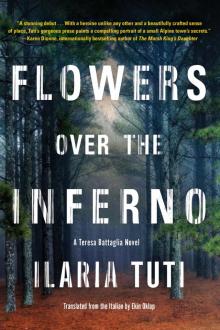
Flowers over the Inferno, page 29


Marini was walking by her side across the car park. It was hard to know what he was thinking. He had seemed upset, perhaps even moved, during their meeting with Andreas, and that had affected Teresa. Somewhere inside him, in that chest of his that was always bursting with a pride she delighted in needling, was a soft heart.
They reached their respective cars and looked at each other, standing face to face without saying a word, like a pair of gunslingers too exhausted to shoot. The same thing seemed to happen at the end of every shift they shared.
She noticed that his face was lined with fatigue. He was probably thinking exactly the same about her.
She wondered if she hadn’t perhaps been unfair on her young colleague recently, burdening him with too many tasks. But perhaps she’d been unfair on herself, too; she was always with him after all, encouraging him, in her own way, to keep going and do the best he could.
Teresa put her hand in her pocket. There was a rustle of candy wrappers.
He looked at her askance, and she thought of what an unlikely pair they made. He had this terrible habit of reproaching her with silence, without even giving her the satisfaction of saying a few choice words to put him in his place.
Teresa opened her mouth to speak, but quickly closed it again. She placed the temples of her glasses between her lips and chewed on them nervously. The streetlights came on. The wind blew a little colder.
“Right,” she said, walking toward her car. “See you tomorrow.”
He waved at her.
“Till tomorrow.”
Teresa opened the car door, then changed her mind, turned around, and threw a sweet at him. He caught it.
“I’m meeting the boys at the pub for a beer,” she said. “If you’re not busy with that librarian tonight . . .”
“I’ll see you there.”
She nodded with a scowl that might have been a smile, biting her tongue to stop herself from pointing out how ridiculous he looked with that smug expression plastered all over his face.
She got into her car. She could see him in her rearview mirror, still standing there and watching her.
What the hell is his name?
She shrugged, turned the key, and drove off.
AUTHOR’S NOTE
This novel has its roots in the landscapes of my homeland.
In that sense, none of it is made up. Travenì, with its millennial forest, the gorge, the quarries, the alpine lakes, and its vertiginous peaks, really does exist, if by another name. The mountains, the seasons, the smells, the colors of nature have been part of my life since I was a child, and it was inevitable that they should become the backdrop to this story—and even play an integral part in it, like a separate character.
The land I come from is generous, but it can also be demanding. Its sons and daughters have been shaped by the toil of an agrarian past, and the violence of an earthquake that has erased countless homes and families, but has not dented their determination. Everything has been rebuilt exactly as it was before, where possible, by anastylosis, with the fallen bricks already tagged and numbered while the dead were still being counted. We moved on, but we did not forget, and the earthquake became a part of our DNA.
This novel is dedicated to my homeland, too.
The study of the devastating effects of emotional deprivation on infants, to which I allude in the novel, was conducted by René Spitz, an Austrian psychoanalyst who was later naturalized as an American. Between 1945 and 1946, Spitz observed the behavior of ninety-one children housed in an orphanage. Bereft of the most basic manifestations of love, the children found their growth stunted, suffered delays in the development of their cognitive and motor skills, exhibited an absence of facial expressions, and an overall weakening of their immune defenses. After a few months, they fell into a state of lethargy. Spitz termed their condition “anaclitic depression.”
Nearly 40 percent of the infants under observation died before they reached two years of age.
The study, which was in its time considered to be pioneering, would today raise serious ethical questions, but it did establish irrefutably that in order to survive, a child needs more than just the fulfillment of its material needs. To develop properly, including in its physical features, it must form strong and lasting emotional bonds.
The exposure to emotional stimuli enables the formation of a physiological correlation between aggression and libido—intended as the vital force that perpetuates life and ensures survival. In the absence of any form of tenderness, the children whose development Spitz observed released their aggression on their own bodies, which were the only outlets at their disposal. Thus, despite being adequately fed, they allowed themselves to die.
Being caressed, kissed, and shown physical affection was as important as being properly nourished.
And finally, Teresa Battaglia.
Teresa was born two years ago. I was searching for a story to tell, and she appeared in my mind, this slightly tetchy but compassionate woman, no longer young, struggling with being overweight and with illness. I pictured her hunching over and writing things down in the light of a desk lamp. Those notes would become her memories in paper form.
Teresa is part of my life now, her investigations whirl in my mind, demanding to be written. She entertains me with her barbed wit, and she moves me with her wonderful maternal and protective instincts, though she has never been a mother herself.
Teresa is a rational being, but she knows when to let her instincts guide her. She bedevils the young officers who work with her, but she is also drawn to their energy, and she fosters it. She’s tenacious, as I hope I will know how to be in my life. She possesses an integrity I admire and the strength to maintain it.
I watch her suffer and fight her own private battles between these lines, and page after page, I feel as if I am growing with her.
This novel is also dedicated to the many Teresa Battaglias of this world, those who wake up more tired every passing day, and who battle solitude and illnesses of the kind that target both the body and the mind. May they never cease to love themselves.
ACKNOWLEDGMENTS
Dreams are born and quietly nurtured in private, but in order to come true, they need other people to believe in them and contribute to their realization. I have had the privilege and good fortune to meet those people:
Stefano Mauri, my publisher.
Fabrizio Cocco, my editor (four words that thrill me). Indispensable. An exemplary professional and an extraordinary person. Thank you for having loved this story.
Giuseppe Strazzeri, the editorial director of Longanesi. Thank you for your faith and for having grasped the beauty of those flowers over the inferno.
Viviana Vuscovich, thank you for helping Teresa travel across borders!
All the staff at Longanesi, who have helped me feel at ease even in the face of what felt like an epic endeavor. Thank you for your enthusiasm.
Thank you to Federico Andornino and my W&N, Orion and Hachette family for bringing my novel to English-language readers in the UK and around the world. A special mention to the incredible team at Hachette Australia and New Zealand for their hard work. It’s been a privilege getting to know you all.
Ekin Oklap, my English translator: thank you for taking such care with my words—and with Teresa, too.
Michele, my most eager reader. Sometimes friendship can blossom even without a meeting.
Mom, Fedora, and Franco, for all your help, without which I would have been lost these past few months. Dad, who would have been proud.
The most important thanks: to Jasmine and Paolo, for being part of my life.
When a dream comes true, the time comes to set it free on its journey: thank you to the readers who will, I hope, come to the end of this tale and love Teresa as much as I do.
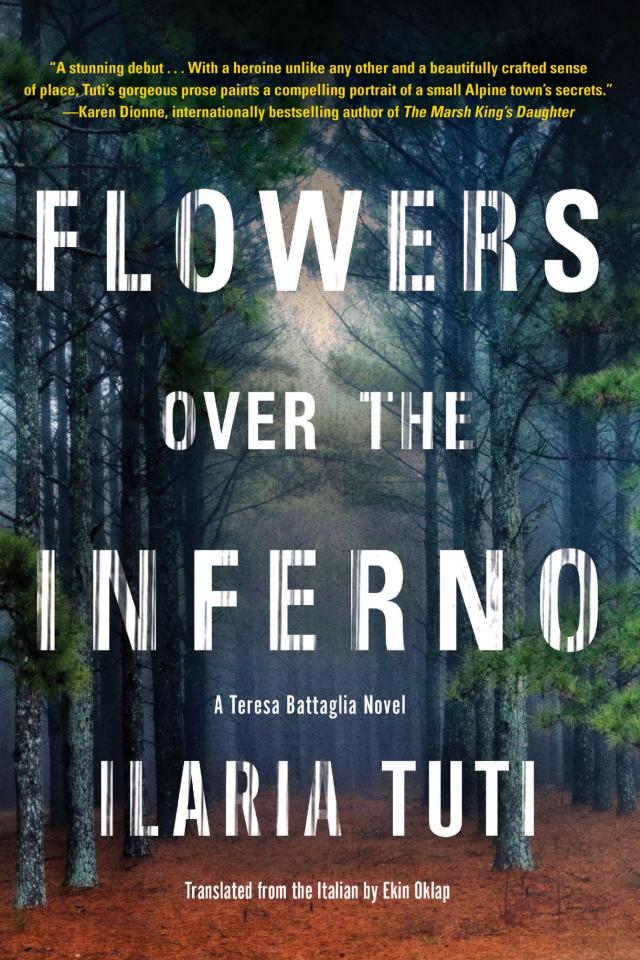
Ilaria Tuti, Flowers over the Inferno