Hard Questions, page 1


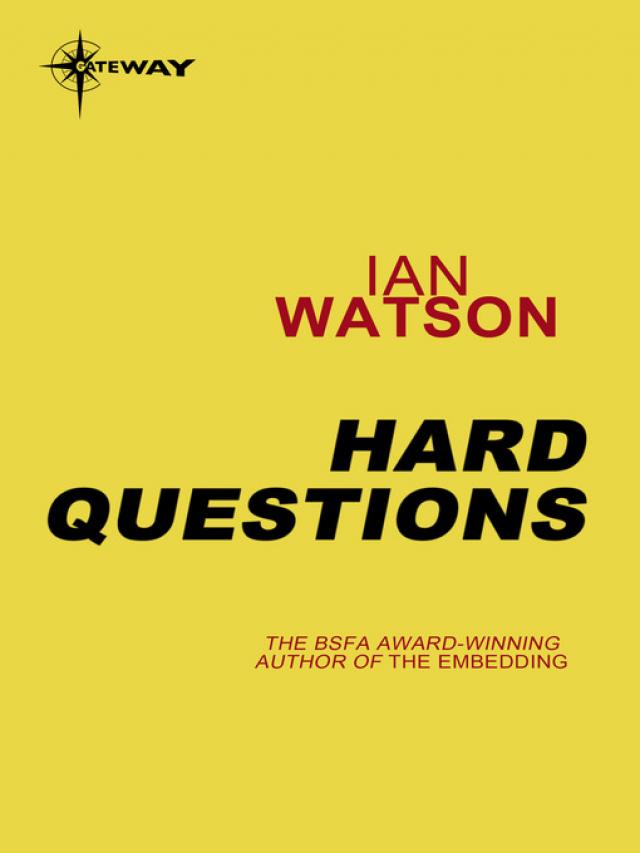
Hard Questions
By
Ian Watson
An [e - reads ] Book
No part of this publication may be reproduced or transmitted in any form or by any means, electronic, or mechanical, including photocopy, recording, scanning or any information storage retrieval system, without explicit permission in writing from the Author.
This book is a work of fiction. Names, characters, places, and incidents are products of the author's imagination or are used fictitiously. Any resemblance to actual events or locals or persons, living or dead, is entirely coincidental.
Copyright 1996 by Ian Watson
First e-reads publication 1999
www.e-reads.com
ISBN 0-7592-0733-X
Author Biography
Born in England in 1943, Ian Watson’s first novel THE EMBEDDING appeared in 1973, placing second in the John W. Campbell Memorial Award and winning the French Prix Apollo, establishing Watson’s themes of communication and consciousness, altered perceptions, the evolution of mind, and the nature of alien intelligence (including whales and dolphins). Alchemy, perfumery, costume, cosmology, cake decoration, the history of lighting, the Renaissance art of memory-all is grist for his thirty-odd novels and hundred and fifty or so stories. Brought up in 1950s in Tyneside, he read extensively, daydreamed, and grew cacti because they seemed like the vegetation of an alien planet. He received a degree in English from Oxford University, and then lectured in East Africa and Tokyo. Africa awakened him politically to developing nations. Japan zapped him with Future Shock. In the late 80s he went through a horror phase, culminating in THE FIRE WORM (1988), a novel developed from a story (“Jingling Geordie’s Hole”) which Interzone readers simultaneously voted the best and worst story of the year. He subsequently published BOOKS OF MANA consisting of LUCKY’S HARVEST (1993) and THE FALLEN MOON (1994) inspired by Finnish mythology, and the science fiction technothrillers HARD QUESTIONS (1996) and ORACLE (1997).
Other works by Ian Watson also available in ereads editions
The Fire Worm
Converts
Acknowledgements
For assistance and advice I warmly thank John Cramer, Howard Davidson, Bill Froud, Jonathan Vos Post, Rudy Rucker and Michael Ward. All misuse of their advice is my doing, of course.
1
Built on earlier cemeteries and sand dunes, the Richmond district of San Francisco between the Golden Gate Park and the Golden Gate Bridge became home after the Russian Revolution to thousands of refugees. Forty years on, the golden onion-domed cathedral of Saint Mary the Virgin in Exile arose. Beneath its floor was laid the body of the priest-become-bishop known as John the Barefoot, who had campaigned for a new home for those exiles.
But émigrés grew old or drifted away to suburbs. Instead, many Asians moved in to the Richmond district. Chinese, Cambodians, Koreans. And then the collapse of Soviet Communism caused a new influx of Russians, escaping from hard times and from the new gangsterism, or simply to do business.
When three men who called one another Night and Dawn and Noon met in a small apartment in an unassuming townhouse on an avenue in the mid thirties off Geary Boulevard, no one would have paid much attention.
White Venetian blinds obscured the half-open window through which a slightly salty breeze blew from the ocean a mile away. A computer was scrolling as its program trawled. Key words were being highlighted and tagged.Quantum. Chip. Encryption .
Maps were thumb-tacked to walls. Files and journals and directories were stacked around the floor, along with some unopened packages from Gump’s and FAO Schwartz, gifts to take home to Russia. A bottle of Stolichnaya and glasses and an ashtray of Marlboro butts weighed down news clippings on a low table.
Both Night and Dawn had the high cheek-bones, dark wiry hair and lack of fold to the eyelids denoting the Mongol blood which flows in so many Russian veins. These two might easily be mistaken for native Americans. Fair-haired Noon was Caucasian. Noon and Dawn were burly; Night was rangy and lean. All three were entering middle age, bitterly.
They spoke softly in Russian. Even when arguing, they would do so quietly.
‘The agency must be stupid sending us something like this,’ said Dawn. The news clipping was illustrated by a photograph of a young woman standing nude on a beach. Her groin was blurred. ‘National Investigatoris full of bourgeois shit. I was raped by an alien from Venus. Elvis Presley is on Mars.’
‘Think again,’ said Night, whose real name was Andrei. ‘Look at the Matsushima connection. Quantum computers. She’s due to attend a conference shortly in Tucson.This woman knows things.’
‘Cambridge… inEngland , not in Massachusetts… However did those journalists come by this story? And the pin-up photograph too!’
Night shrugged.
On the computer screen a message flashed:Invitation only . Immediately to be overlaid by:Please wait . Without much delay the software invaded a private bulletin board.
‘I have a hunch about this,’ said Night.
Noon nodded. ‘It’s a wild card. But maybe you’re right.’
They talked about the recent boating accident which had put Tony Racine in hospital. Strong rumours were that Racine’s QX Corporation in San Jose were edging very close to a prototype quantum computer. Supposedly so were Motorola’s corporate research laboratories in Phoenix. Matsushima likewise, at their labs in Japan and in England.
‘If we agree,’ said Night, ‘I’ll fly to Phoenix —’
‘But we already tried to penetrate Motorola —’
‘— and I’ll drive down to Tucson to check out this conference and this young lady. I do have a feeling.’
Dawn nodded. Night’s hunches had sometimes paid off handsomely. Noon filled three glasses.
Since Night would fly much of the way, he wouldn’t be taking a gun which could show up on airport scanners. The young woman should be a soft touch.
2
Seen from the air the desert had resembled pale cracked cardboard. Driving down the interstate from Phoenix in a rented Pontiac, under a sky too bright to be quite blue, the widespread ugliness of raped landscape offended Andrei’s eyes.
Whole zones were wired off. Former farmland, perhaps, to judge by sporadic decaying buildings. Abandoned now to bales of tumbleweed. A sign proclaimed something about a water authority. It came to Andrei that this land had been bought and forsaken for the sake of whatever water was underground. He had heard that the cities and their sun-dwellers were draining the desert even drier than it was already. And over in the west, wasn’t the Colorado river a pygmy compared to its former self?
A few bullet holes had pocked that sign. Other signs along the route had been shot into illegibility. No drivers of cars or rigs currently cruising the route were acting as if they were on a firing range, but obviously some people did, presumably at night.
In the midst of nowhere, a vast half-completed housing development loomed. It looked like a colony under construction on one of the dead seas of the Moon, or on Mars.
Once during the drive Andrei stopped and got out to stretch his legs and smoke. As soon as he left the artificial chill of the car, he was smitten by heat and light which seemed quite interchangeable. The light was sheer heat; the heat was luminous. Air trembled, faintly tainted. Since the air was so dry, the haze must be pollution drifting from dozens of miles away.
The droning of crickets seemed like tinnitus within one’s own ear. Shrubs were razor-wire. Bushes were bundles of dried rubbish. Mountains in the distance were two-dimensional. The mountains might have been merely cutout backdrops, a studio set for an amateur cowboy movie, or the scenery of a hostile alien planet.
A huge bronzed rig powered past, hooting mournfully. Following it was a long silver fuel-tanker. The tanker could have been a ballistic missile condemned to roam the interstates of America horizontally forever. Along came a truckload of volcanic cinders, destined perhaps for landscaping.
Andrei felt sick at heart, then angry.
Much of Russia’s wilderness had also been ravaged – in the service of society. Yet to no ultimate profit. Futilely! And then the servants of the state had been betrayed, impoverished, while only gangsters thrived.
Coming closer to Tucson, Andrei passed a great oasis of a golf course. A few miles further on was yet another golf course. Aquifers were being drained so that people could knock balls across greens.
3
The Convention Center was simultaneously hosting a motorbike fair and a convention of tax consultants. In fact the upcoming conference about consciousness wasn’t slated for the main building with its vast exhibition hall and galleria and ballroom and its arena which could seat nearly ten thousand people, but for a theatre adjoining the complex which would comfortably house the expected five hundred attendees.
Registrations and accommodation for the conference were being handled by the University a mile to the east. Before heading there, Andrei took Polaroid pictures of the Leo Rich Theater and its surrounds. Each picture which emerged was paled by the drenching light.
The immediate vicinity included a score of parked Harleys and their owners. Almost all of the tanned young men were dressed in baggy jeans and leather bomber jackets. Shades hid their eyes. Blue bandanas soaked up sweat from their brows. Baseball caps were turned backwards. Chubby-cheeked and hard-jawed, those fellows. Even though Andrei hadn’t pointed his camera at any of them, someone assumed so. While Andrei waited for a final picture to appear, four bikers spread out at a trot to bracket him.
‘Why you taking our photos without permission?’
‘What you up to, man?’
‘I’m interested in architecture, that’s all, guys.’
Dozens of other people were around. Surely enough bystanders were present for him to be safe from assault. However, a biker snatched the picture from his hand and glowered at it. Only men, when some of the other men in bomber jackets moved, did Andrei spy an item of graffiti upon the theatre wall. In bold black zig-zag letters:Inzane Nation .
A biker eyed Andrei’s part-Mongol face. He raised his shades, revealing slanted eyes.
‘Whatnation are you, man?’
Had they figured Andrei for a foreigner? Oh no, these were Indians, native Americans. They thought that he was one of them, but of an unfamiliar tribe – working as a plain clothes security employee for the Convention Center, capturing evidence of vandalism with his camera.
‘I’m a tourist,’ Andrei protested. The biker tore the photo in half.
‘Hey —’
A young white patrolman, in jackboots and short-sleeved blue shirt and vizored helmet, was approaching.
‘What’s going on?’
His hand hovered by the side-arm in its holster. Such a mood of menace, in the glaring sunshine.
‘It’s nothing,’ Andrei replied. ‘A slight misunderstanding, officer. They thought I was taking their photograph.’
The patrolman grinned.
‘Oh, you mustn’t do that – not unless you pay them a dollar each.’
Was the patrolman in collusion with this gang of bikers against the foolish foreigner? Maybe he was trying to appease the bikers to ease the tension. Their attitude was sullen. The patrolman continued to grin.
‘Dollar’s the going rate on the reservation, right?’
Should Andrei take the hint, and hand over money as if paying a fine?
The bikers’ spokesman scowled at the patrolman:
‘NavajoNation , man, not reservation!’
Was the patrolman a racist? Andrei had seen so many swarthy faces on the streets. It was as if he had actually crossed the nearby border into Mexico.
‘You boys are a long way south.’
‘Come to see the bike fair, what else?’
The officer scanned the assembled Harleys. If he noticed the phrase upon the theatre wall, he chose to ignore it.
‘Thinking of changing your wheels, then, boys?’ Was he being ironic or appreciative? The incident seemed to be subsiding. Onlookers were losing interest. The officer advised Andrei: ‘Move along, mister.’
4
Towards evening, a sudden storm briefly freshened the city, and Andrei too. The heat had begun to sicken him.
Clouds boiled forth from the mountain range to the north like sulphurous smoke gushing from a volcano in eruption. A ten-minute rain shower lowered the temperature a bit and settled some of the smog trapped in the valley. In the aftermath the sunset was gory – and fleeting. Within what seemed a few minutes the sky was a gloomy lavender; then indigo. Streetlights were a myriad hovering fireflies. Headlamps hurried by, the eyes of prowling beasts. A coyote began to yip somewhere in the city, its voice carrying eerily through the evening. From elsewhere, another wild urban animal answered.
The rapid disappearance of daylight had surprised Andrei. Still, an almost-full moon was up, so he took numerous Polaroids around the Desert Hacienda, where a certain young Englishwoman was scheduled to stay the following week.
The Hacienda was much more up-market than the cheap hotel which Andrei had chosen for himself. Twenty minutes’ leisurely walk, at most, from the Convention Center, the Hacienda’s spread boasted luxury adobe cottages set around semi-private garden patios. Palm trees shaded walkways, illuminated discreetly after sundown by occasional low mushroom-lamps. With its lawns and bushes and low walls of sun-baked brick, the Hacienda was easily accessible to a prowler – who might, after all, merely be using its cocktail lounge or its gourmet restaurant.
When Andrei had visited the University earlier, to register for the conference, he had pretended to be a psychologist from a clinic in Zürich. He was on vacation, he’d said. He’d come to Tucson because of his hobby. His private passion in life, so he claimed, was cacti. He had intended to spend a whole week exploring the Saguaro and Organ Pipe national monuments. Only by chance did he learn about the conference.
Glancing through the list of delegates in a secretary’s office, he was surprised, delighted to come upon the names of three or four old acquaintances. Oh, and here’s another one: Dr Clare Conway from England.Where’s shestaying during the conference?
Oddly, he was the second person to have asked that same question today, though the previous enquiry had been by phone. Another old friend. An American.
A subsequent phone call by Andrei to the Hacienda had confirmed Dr Conway’s reservation.No, sir, not a double. The Visitors’ Bureau definitely told us a single. Yes, sir, Cottage 12’s a single all right …
Cottages 11 and 12 shared a veranda fronting on a little lawn. A white plastic table and chairs stood under a graceful paloverde tree. The camera whirred as it produced another Polaroid of the adjoining moonlit chalets.
A stiff metallic finger pressed against Andrei’s neck.
‘Don’t move.’
His first thought was that a security guard had crept up on him. When a second person in jeans and thin leather jacket relieved him of the camera, he briefly imagined that a couple of members of the Navajo Nation had trailed him. The thin-faced individual was no Indian, though. The gun muzzle stayed against the base of Andrei’s skull while his wallet slid free, and then the keys to the Pontiac. Were the two men muggers?
‘Where are you parked?’ a voice whispered.
Andrei told them, hoping that the men would run off and steal his car.
‘We’ll take a walk to your car. We’ll have a conversation.’
5
It was a conversation about his interest in the chalet. And about the conference literature which was in the glove compartment. And about a photocopy of the clipping from theNational Investigator .
While unheeding traffic drove past the parked Pontiac, Andrei nerved himself to ask, ‘Who are you?’
Facing Andrei in the back of the Pontiac, the thin man had pushed up the sleeves of his jacket. On his left arm above the wrist, passing headlights revealed a tattoo of an angel in flight carrying a naked woman. Bearing a bare soul away up to heaven in his embrace. A typical motif from a medieval painting – except that this was modernized and erotic.
The other man — who had sat in the driving seat and searched for documents – was chunky, freckled and ginger-haired. He wore a military combat jacket with many pockets, open over a thin T-shirt emblazoned in psychedelic script with the phraseLOVE THY LORD.
‘Who are you?’
The ginger man grinned into the driving mirror.
‘We’re Soul Brothers, you could say.’
But they weren’t blacks.
‘Maybe we can co-operate,’ suggested Andrei. ‘Who are you representing?’
‘Oh, you’ll co-operate,’ the thin man assured him. His companion started the engine.
They drove to a cemetery on the far side of the interstate. There, his captors relocated Andrei into the trunk of the car. They wrapped parcel tape around his wrists and ankles and stuck some over his mouth.
Andrei guessed that the car returned downtown. Several times it halted, presumably at red lights. Then the engine died. Doors opened and shut. About ten minutes passed before the pair returned. Had they stopped at Andrei’s hotel to collect his belongings? The cheap hotel wasn’t hot on security.
When the car stopped again a short while later, only one door opened and closed. One of the two must be transferring to their own vehicle.
A hideous journey followed, during which Andrei lost all track of time. Despite some draughts, the air in the coffin-like trunk became stifling. By day he would surely have died. After an interminable distance the route became rough, bruisingly so. The Pontiac must be negotiating a track through wilderness.