

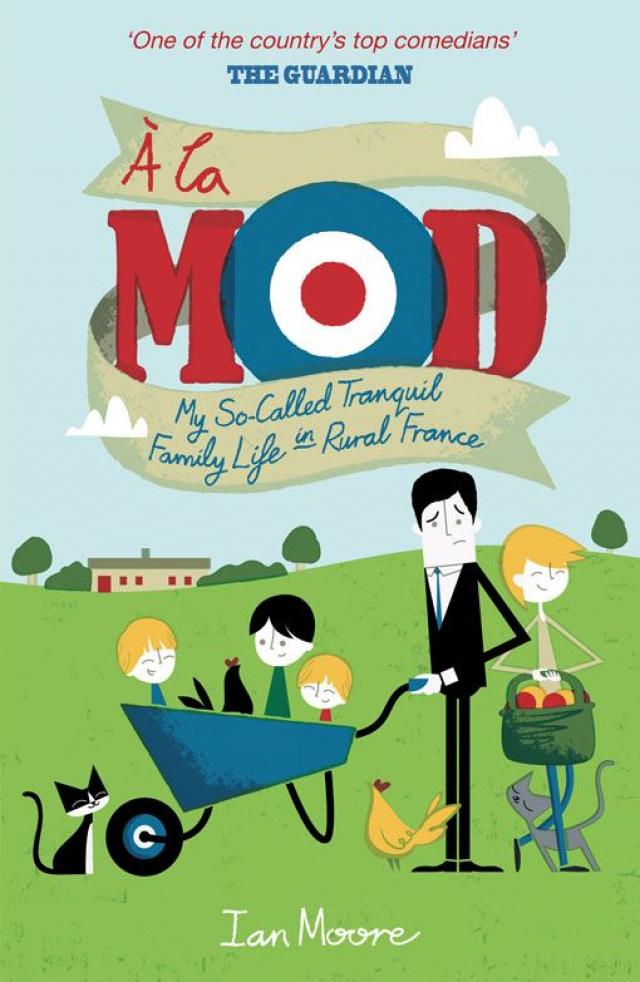
Á La Mod: My So-Called Tranquil Family Life in Rural France, page 1


Praise for Ian Moore
'Don't miss a single word... Moore is a cultured comic'
LONDON EVENING STANDARD
'Relaxed, laconic, hilarious'
THE STAGE
'A brilliant storyteller'
THE BOSTON PHOENIX
Praise for À la Mod
'À la Mod is everything its author is: immaculately turned out, sharp and consistently hilarious'
MARK BILLINGHAM
'C'est Mod-nifique'
MARCUS BRIGSTOCKE
'There are a great many comedians who think that they can also write books, myself included, but very few who can rival Ian Moore's immediate warmth and skill with language'
JON RICHARDSON
'Take one life-long mod and chuck him into rural France, complete with pond-dredging, chutney-making, child-rearing and a horse with VD. The result is funny, revealing and oddly touching. Paul Weller meets A Year in Provence...'
MIRANDA SAWYER
'Ian Moore is a brilliantly funny writer and that's all there is to it'
ANNABEL GILES
À LA MOD
Copyright © Ian Moore, 2013
All rights reserved.
No part of this book may be reproduced by any means, nor transmitted, nor translated into a machine language, without the written permission of the publishers.
The right of Ian Moore to be identified as the author of this work has been asserted by him in accordance with sections 77 and 78 of the Copyright, Designs and Patents Act 1988.
Condition of Sale
This book is sold subject to the condition that it shall not, by way of trade or otherwise, be lent, re-sold, hired out or otherwise circulated in any form of binding or cover other than that in which it is published and without a similar condition including this condition being imposed on the subsequent purchaser.
Summersdale Publishers Ltd
46 West Street
Chichester
West Sussex
PO19 1RP
UK
www.summersdale.com
eISBN: 978-0-85765-907-1
Substantial discounts on bulk quantities of Summersdale books are available to corporations, professional associations and other organisations. For details contact Nicky Douglas by telephone: +44 (0) 1243 756902 fax: +44 (0) 1243 786300 or email: nicky@summersdale.com.
For Natalie, without whom nothing would be possible
Contents
1. A Moore in the Loire
2. My Animals and Other Family
3. Liberté, Égalité, Reality
4. Feeling a Little Chaton
5. Upsetting the Apple Cart
6. Vets and Docs
7. Foreign Hoarders and Brocante Dreams
8. Hunters, Gatherers, Mods
9. When a Butterfly Flaps its Wings
10. Planes, Trains and Automobiles
11. En Famille! En Famille!
12. Away From the Numbers
13. And Then There Were Two
14. The Napoleonic Code-Breaker
15. A Bird in the Hand
16. The Out-of-Towners
17. Light at the End of the Tunnel
18. On the Marché
19. Treading on Eggshells
20. Taking the Peace
21. Self-Insufficiency
22. Different Strokes
23. A Fête Worse than Death
24. Ships in the Night
25. Fosse and Bother
My Quince Recipes
Acknowledgements
About the Author
A Moore in the Loire
It was one of those moments that a stand-up comedian dreams of. That moment when you are on stage and you have the audience in the palm of your hand; you can lead them anywhere you want; you can tease them, raise them up, lower them down. You have total mastery over the room and your view of the audience and of yourself is almost from above the stage, like an out-of-body experience.
There is no better feeling.
I looked out at the room and at the faces convulsed with laughter; 450 people all dancing to my tune, I felt – hang on! What's that bloke doing? That bloke in the second row with the goatee beard and the leather jacket – what's his problem? Why is he not laughing like all the others? What's wrong with him?
I tried everything. I brought out the big guns, the infallible old material. My rhythm changed, my tempo increased; the rest of the audience looked like they may die from laughing, but 'goatee face' in the second row… nothing. Maybe he has locked-in syndrome, I thought. Then he yawned.
The red light came on, showing my time was up. I thanked the audience and left the stage to deafening applause. 'That was Ian Moore!' shouted the MC, struggling to be heard as the noise increased, 'Ian Moore!'
'Wow!' said Chris, one of the newer acts, as I stomped back into the dressing room. 'That was brilliant. You must be really pleased with that?'
I took a long drink of water as Chris, obviously really new to the game, waited for my response – maybe some advice, some words of comfort, before he went out there himself.
'There's a bloke in the second row,' I said, 'real attitude problem. Watch him, he might be trouble.'
'But they loved you!' he said, almost shouting. 'They LOVED you!'
'Four hundred and forty-nine of them loved me,' I replied, looking at him like I was his sensei or something and he was my protégé. 'That bastard ruined it for me.'
'Well, I'd be happy with that!'
'Ha!' There was a derisive snort from the corner of the dressing room. John, another old hand like me, was sitting on a leather sofa with a bottle of beer in hand. He was due on next, but he was in no hurry; unlike the excess of nervous energy that prevented Chris from sitting down, John may even have to be woken up before he went on. 'Look at him,' he said to Chris, pointing at me, 'look at him. Look at the way he's dressed! If his tie was crooked or he had fluff on his sleeve it would ruin his gig for him. He's a mod. Have you not seen Quadrophenia? They're never happy!'
He had a point.
While mods have a well-deserved reputation for impeccable dress sense, with very English sharp suits and matching patterns, they also have something of a reputation for po-faced, standing-in-a-corner-trying-to-look-cool detachment; possibly also very English. If mods are anything, they are stiff upper lips in well-ironed trousers.
'Nothing wrong with perfection, John,' I said, putting on my 1960s Michael Caine Ipcress File mac, 'you should try it some time.'
Striving for perfection eats away at you though and the yawning, goatee-bearded man in the audience bothered me, and what bothered me more was that it bothered me – and a four-hour, late-night and solitary drive home is no place to try and shake the demons.
I was in a hurry to get home. I'd been away performing in Manchester since Wednesday and now it was the early hours of Sunday morning. I wanted to get home and wake up in my own bed, next to my wife Natalie; to feel the warmth of my beloved Jack Russell, Eddie, at my feet and hear my three-year-old, Samuel, quietly breathing in the next room.
Only… did I? Did I really?
Firstly, the constant driving was beginning to get to me. I had been up and down the motorways of the UK as a club comedian for six years now – that's 40,000 miles a year, mostly driving bleary eyed through the night. There were times when I had got on a motorway in the North and a few hours later would suddenly realise that I was nearly home, the drive having been done almost subconsciously while my mind was elsewhere. Like a fighter pilot who had been on too many missions, I felt lucky to be alive, but also convinced that disaster was just around the corner. It had got to the point where Natalie almost had to talk me into the car to go to work.
And secondly, where was I actually going? Yes, I was going home to my family, but we lived in Crawley in West Sussex, and even if you love your family (which I do) and you are used to travelling (which I am), if your final destination is bland, concrete 'New Town' Crawley there's always going to be a part of you dragging its feet.
We'd moved there from South London seven years previously 'to get more for our money' and to help me to turn professional as a stand-up – for a couple of years Natalie commuted to London every day, supporting us as I built up my career. It didn't take long for me to get the lie of the Crawley land. A local pub was advertising a 'comedy night' and I went in to offer my services.
'Oh, sorry, mate,' said the landlord, 'we knocked it on the 'ead. Got too violent.'
It was half three in the morning by the time I drove past our house. I wasn't driving past because I had a reluctance to go in, but because – as usual – I couldn't park outside the place. We lived in a row of terraced and semi-detached Victorian cottages near the centre of town; there were no driveways, no off-street parking, but plenty of cars. Interlopers used the street as a source of free parking while they sauntered into town pleased with their discovery. It was one of my many bugbears.
Twenty minutes later I was opening our front door, having parked up a couple of streets away and struggled back with my luggage (mods don't travel light). I was being as quiet as I could be, though obviously not quiet enough. As soon as the door shut, Samuel started screaming the place down. I panicked and tripped over my case, falling into the kitchen in an undignified heap and banging my head on the oven. Natalie came charging down the stairs, clearly thinking a burglary was in progress.
/>
'What are you doing?' she hissed, pointlessly as Samuel was now very much awake.
'I fell over. I've hurt my head,' I replied pathetically, also whispering.
'You've woken him up!'
'All I did was close the front door!'
'Well don't!'
'What?'
Every parent of small children knows the scene. You've been through months and months of trying to get the little sods off to sleep and then, when they finally are, you almost daren't move or speak in case you wake them up. You creep around your own house, glare at each other accusingly if one of you makes a sudden noise and you watch television with the sound so low that you're constantly turning to each other whispering, 'I missed that. What did he say?' This goes double for a very small house, and as I lay there with my 5 foot 10 inch body partly in the kitchen, partly in the 'hall' and partly in the living room, after a four-hour drive, a gig I didn't enjoy and in a town I didn't want to be in, I just closed my eyes, rolled over and went to sleep.
At some point in the night I had made it to my own bed without either waking Samuel or being told off, and now as I hazily awoke in the late morning I felt slightly better disposed towards the world. I was home at least, even if home could be trying at times. Natalie came into the bedroom, a welcome cup of tea in her hand. 'I don't want to rush you,' she said, 'but someone's just left. There's a car-parking space right outside. I'd do it, but I don't know where you left the car.'
It was a depressingly regular game we had to play and as I hurried to get dressed I kept glancing out of the window to make sure the space was still there. I ran downstairs and out of the door, trying to remember where I had in fact left the car.
'Block the space with something!' I shouted over my shoulder.
'With what?' Natalie shouted back.
'Er, I don't know, Samuel's tricycle!'
'I'm not leaving his tricycle in the road! Hurry up!'
It was a fair point and I went haring off. Five minutes later I returned and of course the space had gone. I got out of my car and just stared at the 'foreign' object, a gleaming BMW. I closed my eyes, threw my head back and just howled, the frustration and fatigue combining to make it a primeval cry from the depths of middle-class, small-town-frustration hell. Neighbours came to their windows to see what could possibly have happened to tear apart their peaceful Sunday morning so violently, and what they saw was me standing in the middle of the road, my car blocking the traffic, my eyes closed and my head thrown back roaring at the sky. The fact that I was impeccably dressed must only have added to the 'man at the end of his tether' feel of the scene, and as someone in a blocked car started beeping his horn at me I just stayed frozen in that position, unwilling to move.
Natalie came out, waving nervously at the neighbours and apologising to whoever it was beeping their horn. She put her hand on my arm and said quietly in my ear, 'Go inside, my love, go inside. I'll put the car away.' I began to trudge off, 'And Ian,' she said firmly, 'we need a holiday.'
I remember, as a ten-year-old child, watching Ian Botham hitting six after mighty six over the heads of the Australian fielders; his mixture of swagger and belligerence was utterly captivating. It was the summer of 1981 and 'Botham's Ashes', and I was stood outside a Radio Rentals in Truro unable to move. I was spellbound and despite my dad, not a fan of cricket in the slightest, imploring me to move so that we could get on with what had hitherto been a pretty dull Cornish holiday, I couldn't. My love of cricket started there; a lifelong passion that would lead to days glued to the television or radio and nights poring over statistics. I knew even then that this was life-changing, not just for Ian Botham, but for me.
Over twenty years later and I was standing outside an estate agent's in a small town in the Loire Valley, going through a similar shop-on-the-high-street life-changing epiphany.
'Have you seen how much places cost around here?' I asked rhetorically, Natalie having wandered off down the road with Samuel. She knew the score. Natalie's parents, despite being the main reason that we had moved to Crawley, for which I will never truly forgive them, also had a small holiday cottage nearby. We had been visiting every year for the last ten years. We loved the place. Danielle, Natalie's mum, is French and some of her younger siblings grew up in the town and her father was Post Master there; Natalie's grandparents, who were coming for lunch, still lived locally.
The town is everything you imagine a small, rural French community to be. It has a large, dominating church, a small chateau on the riverbank, a couple of nice restaurants, two or three bars, a number of boulangeries, charcuteries and alimentations, a grand-looking Hôtel de Ville, a weekly farmers' market and, as with every small French town, about half a dozen opticians. It is kept scrupulously clean, vast amounts of money are thrown at floral displays and again, as with all French towns, parking is free.
'Seriously, Natalie, come and look! Look at what we could afford over here. We could buy a village!' OK, that was something of an exaggeration, but at the time the pound was massively strong against the euro and I was just making a point. Natalie carried on walking. The plan had always been that we would retire here, settle down later in life and just soak up the pastoral tranquillity of the Loire Valley; I would write light, undemanding comic novels and Natalie would tend to her horses. It was a pipe dream; an ambition, but one that seems so far off when you're in your early thirties that you may as well lay claim to a rural idyll on Mars and set about designing your own personal spaceship. Natalie sensibly kept walking.
'Come on,' she said over her shoulder, 'we'll be late for lunch.' I picked up the magazine from the rack outside the agency and ran off after her.
The hazy afternoon sun beat down as Natalie and I, along with her parents and her French grandparents, sat around lazily in the small garden. Samuel was asleep indoors, so the rest of us were taking advantage of the chance to rest; the only noises were the bees on the deep mauve hibiscus and the crickets in the next-door field. I could contain myself no longer.
'I think we should move here,' I said, breaking the silence as we lay in the garden.
'Yes,' Natalie replied, 'it would be lovely, it—'
'Now. I think we should move here now.' I sat upright as if to indicate that this wasn't some idle thought or that the lunchtime rosé had taken a mischievous hold.
'What did he say?' asked Natalie's grandmother.
'He wants to move here,' Brian, Natalie's dad, translated. Whereupon her grandmother just rolled her eyes and tutted.
It wasn't that I didn't get on with Natalie's grandparents, but the language difference was a big barrier for all of us, and they could never properly hide the disappointment that their eldest granddaughter hadn't married a Frenchman. That she'd married an Englishman was just about tolerable, but one that dressed as some kind of anachronistic dandy was a constant source of bewilderment for them. I wasn't going to drop the subject.
'Give me one good reason why we shouldn't?' I was asking Natalie specifically, but throwing it open to the group.
'You don't speak the language,' said Brian.
'Natalie is fluent and I can learn,' I countered.


