The Psychopath: A Maitland Noir Thriller #1, page 27


A villa in the south of France, eventually.
Paddling in the pool. Stretching out in the sun.
Our life will be just perfect. For ever and ever.
Yes, it’s all coming together very nicely now, extremely well indeed. We’ve had some trouble along the way, for sure we have – but nothing I couldn’t handle. From here, though, it’s all going to be plain sailing. But you know that by now, don’t you?
I’ve told you that.
Yes, I definitely have.
We’re looking at a very happy ending. What you might call a happy ever after. And it all starts when we wake up in the morning.
81
11.44pm, SUNDAY 1 NOVEMBER
God almighty, what was that? I’ve been fast asleep.
Night-time surely? But it’s as bright as day.
The tower is ablaze with lights.
I sit up, checking William is still next to me. He is. The tower is brightly lit and I can hear someone shouting, from somewhere far away, but can’t make out the words. The wind blows the voice this way and that.
I crawl on my hands and knees to the edge of the tower – I daren’t stand up and be seen – and peer down towards the ground below. In the distance, a line of police cars blocks the top of the avenue. There’s an ambulance there too, with paramedics, ready and waiting. I see one or two coppers stopping people from coming in. The houses and bungalows to either side are dark. I can make out an elderly man here and a young family there being ushered away by even more police.
There are a lot of them down there.
All with their eyes on me.
And guns? Yes, I reckon so.
In front of that line of police cars, in the dead centre of the road, is a cluster of five or six policemen, between two spotlights aimed up at the tower, all clearly talking among themselves and deciding what to do. One has a megaphone and that, I assume, is the voice that woke me. Here he goes again. I still cannot make out what he’s saying. But these are angry, demanding words.
Do I need to make them out?
What he’s saying is directed at me and obvious.
“Give yourself up.” No more, no less.
I crawl back and look down at my little boy with his soft and gentle face, his features not yet properly formed. He’s still not much more than a baby, really, untouched by life. He lies there, asleep, not moving at all. I crawl away. I just have to think, get my head straight, and decide as fast as I can what to do next.
I run quickly through the options.
Any which way, it’s the end.
One way or the other, it’s over.
If I stand up now, straight and tall, as proud as a daddy should be, with my head and shoulders in view, I have no doubt the police marksmen, out there somewhere, will shoot me dead where I stand. The houses are dark, but I know, deep down, that there must be police with guns at the windows.
I thought I was safe here.
I did not think things through. Someone must have seen me, reported it to the police.
The coppers with guns are there, somewhere, just waiting.
I could stand up, with my beautiful William in my arms; they daren’t shoot me then. And we could, dad and his little lad, go together. Over the side and into the night forever.
Can I do that?
I could make my way down to the ground alone and give myself up. But they’ve got me marked down as a cop killer by now. And they think I have a gun. They’d shoot me as I got to the bottom of the steps. Will say they thought I was armed. That they had to kill me.
That would leave William an orphan.
Even if they didn’t kill me – if that policewoman back in that seafront car park is still alive – they’d hustle me down to the floor, with other coppers and the paramedics rushing by me to get to William. He’d be terrified, he would, poor little mite. And I’d never get to see him again, to say goodbye, and would spend the rest of my life locked up; what with Smith in the annexe and that woman from Nottingham and the one from Aldeburgh. There was that man in the house too, wasn’t there? And the policewoman. So many. Too many. God forgive me, what have I become? I have done some terrible things.
Would I want to go on without William?
Would he want to go on without me, his daddy?
I know the answer to that, you don’t have to tell me.
I could lift William up and we could go down the steps together, a last cuddle and maybe, somehow, if we could slip out over the back steps, we might still have a chance to get away.
There’s always a chance, isn’t there?
It’s worth trying, isn’t it? Surely?
I’d rather die than leave William alone.
Suddenly, happening quickly now, I hear, down below, two or three police cars revving their engines, moving into different positions in the avenue, I’d guess. I’m not sure why. Then, a louder, more aggressive engine noise coming in – a van, coming to a halt; policemen, armed and ready to attack, leaping out of the doors at the back, waiting for instructions, ready to strike.
It’s almost over, when all’s said and done.
I have to make my decision.
For both of us.
Live or die.
The two spotlights, aimed at the tower, seem brighter somehow, or maybe that’s just my imagination. Driven by fear and panic. I hear the copper with the megaphone shouting up at me again. I can make out some of the words now, “ . . . yourself up . . . last chance”. They’re getting ready to storm the tower, that’s what, are now ready to take me out if I don’t come down with my darling little boy.
I’ve decided.
I know what we are going to do.
It’s the end.
I crawl on my hands and knees back to William. I turn him gently over onto his back. I am going to kiss him and give him one last cuddle. He is pale and still, moving beyond sleep I think. And then I see him twitch and spasm and I think there is some sort of froth around his bottom lip. He’s still alive but dying, just like the man with the shotgun said.
My boy is dying. My beautiful, dear sweet little William.
I lift him up in my arms. Stand upright and turn around.
Move to the edge and hold him high so the coppers can see him.
I’m shouting now, but I’m not sure what I’m saying; it all pours out of me in fear and anger and hatred and built-up fury. If only they’d just left us alone, let us go. We’d have gone away, been no trouble to anyone. We’d have started our new life together in the south of France and no one would have heard from us ever again. We’d have been happy, my little boy and me. I’d have brought him up properly, to be a good, kind person. Leave us alone, just leave us alone, that’s what I wanted to say.
He’s awake now, William, or so it seems.
His head lolling to one side. Frothing at the mouth.
They must see that in the spotlight, must see what a terrible state he’s in.
I have to put my William down by my feet. I need to be fast now, before the police storm the tower. I must be quick. I have to clear my head and calm my voice and move to the edge of the tower again and say what I have to say in a loud and steady voice. I have to tell them what I am going to do. They have to hear me.
They have to know.
I lay sweet William down.
I know what I am going to do.
I step forward into the light.
The End
Author’s Notes
Okay, if I may, first things first – I’ve written this as if I were a psychopath; as though I were deep inside Raymond Orrey’s head. So it’s not always comfortable reading but I’m told it’s pretty realistic. An early draft was read by someone who worked at Rampton Hospital – please Google if you need to – and I was told the voice was spot-on. Even so, I toned things down a little bit – the effing and blinding and some of the violence – before we got to this final version. It’s a tricky balance, all in all.
I should also add that, unlike Raymond Orrey, I love all of the locations in The Psychopath. My grandparents and mother, Charles, Edna and Maureen Gayther, came from Nottingham before they moved to London for my grandpa’s work in the late thirties. I was brought up in south London on stories of Balfour Road, the Palais and my great-grandmother’s offal shop. Fifty or so years on, when our children, Michael, Sophie and Adam, were small, my wife Tracey and I, now living in Suffolk, would go up to Nottingham for shows at the Arena and plays and pantomimes at the Theatre Royal. We visited Sherwood Forest in the spring and summer and running through the woods, what’s left of the forest, was the inspiration for the start of the book.
The big house and annexe are imagined as being close to Clumber Park. It’s not meant to be Rampton, which is fifteen to twenty miles or so away. It’s just a coincidence. Orrey hides in a ditch – I’ve been in it myself – on the Ollerton Road near Edwinstowe and then makes his way across to the A614 where he hitches a lift in the lorry. There are many ways over the Trent and plenty of housing estates similar to the one where Orrey enters the house. You probably won’t find any that are exactly as I’ve described them. If you do, it’s coincidence too.
We’ve been going to Aldeburgh for the best part of forty years. Michael pedalled his little red bicycle along the prom when he was about three years old. All these years on, we still visit regularly. We always go to the bookshop and have fish and chips upstairs at the Golden Galleon. A walk round the shops, up and down the beach, a coffee or an ice cream up by the boating lake, depending on the time of year; a perfect afternoon out. Aldeburgh is lovely.
Those of you who know Aldeburgh will realise that I have moved the carnival from August to Halloween. I had the fairground scene of Hitchcock’s Strangers on a Train movie in my head when writing and I think a cold and misty October night works better than a warm summer’s evening for this story.
Much of Aldeburgh remains the same – you can work your way from the car park along the front to the boating lake and back up to Chopping’s Hill and into the roads behind. The park and promenade are a little different, but not so you’d notice too much. The rest of it – the toilets, the hut where Orrey snatches William, the terraced houses above the town – is all there. Maybe not the exact terraced houses, but as near as makes no difference. The way out of town? If you know Aldeburgh, you’ll know where the marshes are as well as I do. If not, it doesn’t really matter.
Eventually, Orrey makes his way with William to a housing estate outside of Felixstowe in Suffolk and on to the tower. If you drive along the long A14 road, you will, just before you reach Felixstowe, see the tower to your right and the fields that Orrey crossed to the left. I’ve walked our dogs, Bernard and Dolly, around these fields for many years and they are much as they are presented in the book. The housing estate exists – it’s nice – and you can walk in the footsteps of Raymond Orrey. The tower is there at the end of The Langstons, which is, give or take, much as I have described it.
Going back to the big house and annexe where Orrey was, after sentencing, detained under section 37, the scenario and those living there and the escape are all broadly accurate; the text was read by a number of hugely experienced people who work in such a system, including Rampton, and with a range of what might be described as heavy-duty prisoners. People like Orrey can and do escape in the way described.
Type one diabetes – not to be confused with type two – is a serious condition and can be fatal. The US story referred to in the book is a real one. The symptoms and effects shown in the book are much as you might expect, but they are, of course, seen through Orrey’s eyes. He sees his child, becoming ill, as being little more than sleepy-headed. We had the book read by those with long experience of type one diabetes, including a doctor and a parent of a child with type one diabetes. Personal experiences can all be different, of course.
The police procedures were checked carefully and we had plenty of assistance from, among others, an ex-Met police detective who has worked on similar cases. There is a fairly typical, I think, sense of confusion early on that allows Orrey to get away, but, once it has become clear that a child has been taken, it’s all hands on deck after that and the police are coordinated in what they are doing. Mistakes do happen and those on the run do slip through the net. I have tried to reflect this mix in the book.
This is, or is meant to be, a thriller, a page-turner, a ‘what happens next?’ story. I have tried to write it instinctively in Orrey’s voice, not my own, without stopping and starting to check nitty-gritty facts such as which way the wind was blowing on a particular night. I hope it is read in the same way. For those readers who enjoy spotting errors, such as anachronisms in a period drama, I am sure there is something for you to enjoy here too. Please note though that the story is seen through the eyes of Raymond Orrey and, to a lesser degree, the other characters. Orrey is, to put it mildly, an unreliable narrator.
Iain Maitland
www.iainmaitland.net www.x.com/iainmaitland
Author’s Acknowledgements
A book does not, of course, go from the author’s mind to the page without the help of very many people in between. The Psychopath is no exception.
I must thank those who read the book at an early stage. and for your help in getting prison, medical, police and other scenarios and procedures as accurate as possible. Your input was invaluable.
In particular, thank you Dr Sheena Meredith, Martin Brennan, Jeannie Lumb and David Burgess.
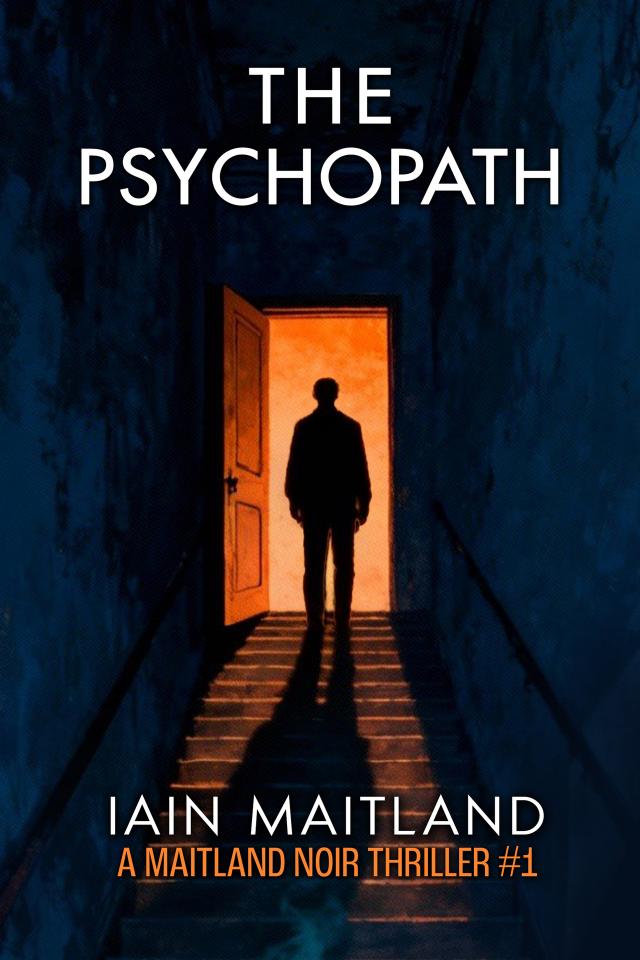
Thank you to Haroon for doing the cover for me.
Thank you too to Belinda who did the formatting.
Tracey, Michael, Sophie and Adam – my family. I doubt anyone will recognise you anywhere in The Psychopath. That’s not to say you’re not in there. I’m sure you spotted yourselves.
About The Author
Iain is the author of a range of books across different genres, most recently, six psychological thrillers for Inkubator Books, including The Perfect Husband and The Surrogate.
He is also the author of Dear Michael, Love Dad (Hodder), a book of letters written to his son who suffered from depression and anorexia, and co-author (with Michael) of Out of the Madhouse: An Insider’s Guide to Managing Depression and Anxiety (Jessica Kingsley). He has also written a semi-autobiographical novel, The Old Man, His Dog & Their Longest Journey (Vellum Publishing).
Iain is an ambassador for Stem4, the teenage mental health charity, and talks about mental health issues in schools and workplaces. A writer since 1987, as a journalist he has contributed to the Sunday Times, Financial Times and The Guardian as well as writing books on management and business.
He is married and lives in Suffolk with his wife, Tracey, and their dog, Dolly. His children, their partners, and his grandchildren live nearby.
You can find Iain online at IainMaitland.net. He is also on X and Facebook and Instagram. If you want to get in direct contact, it’s imaitland@aol.com Please feel free.
Iain Maitland, The Psychopath: A Maitland Noir Thriller #1