SBS, page 1


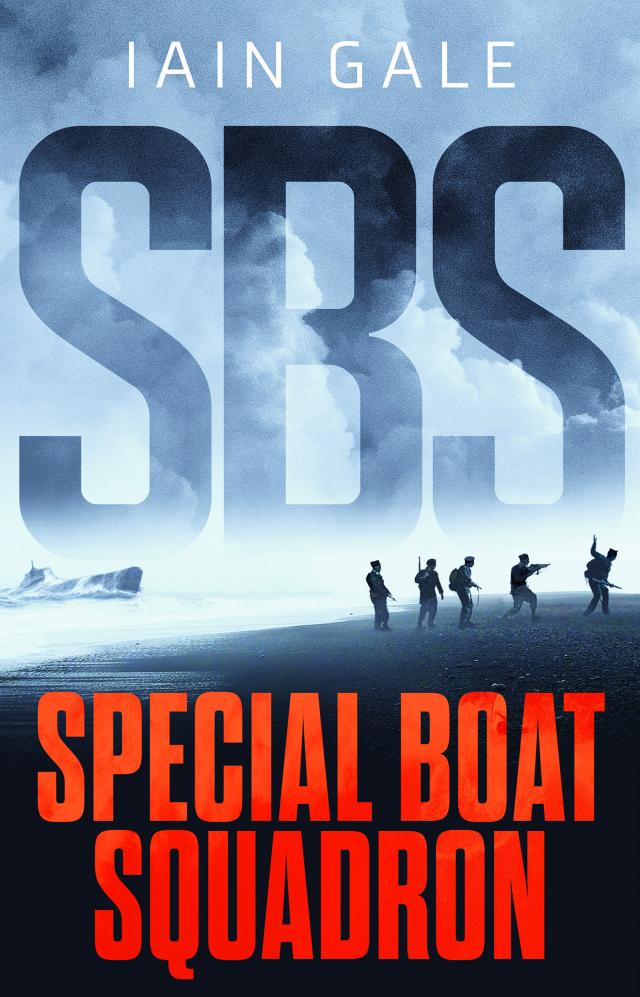
SBS
SPECIAL BOAT
SQUADRON
ALSO BY IAIN GALE
Four Days in June
Man of Honour
Rules of War
Brothers in Arms
Alamein
The Black Jackals
Jackals’ Revenge
Keane’s Company
Keane’s Charge
Keane’s Challenge
Conspiracy
Zero Hour
Scotland Forever
Always a Borderer
SBS
SPECIAL BOAT
SQUADRON
IAIN GALE
www.headofzeus.com
First published in the UK in 2022 by Head of Zeus Ltd,
part of Bloomsbury Publishing Plc
Copyright © Iain Gale, 2022
The moral right of Iain Gale to be identified as the author of this work has been asserted in accordance with the Copyright, Designs and Patents Act of 1988.
All rights reserved. No part of this publication may be reproduced, stored in a retrieval system, or transmitted in any form or by any means, electronic, mechanical, photocopying, recording, or otherwise, without the prior permission of both the copyright owner and the above publisher of this book.
This is a work of fiction. All characters, organizations, and events portrayed in this novel are either products of the author’s imagination or are used fictitiously.
A catalogue record for this book is available from the British Library.
ISBN (HB): 9781801101318
ISBN (XTPB): 9781801101325
ISBN (E): 9781801101349
Cover design: Ben Prior
Head of Zeus Ltd
First Floor East
5–8 Hardwick Street
London EC1R 4RG
WWW.HEADOFZEUS.COM
In memory of
Bruce Dingwall 1959–2021
Contents
Also by Iain Gale
Title Page
Copyright
Dedication
Chapter 1
Chapter 2
Chapter 3
Chapter 4
Chapter 5
Chapter 6
Chapter 7
Chapter 8
Chapter 9
Chapter 10
Chapter 11
Chapter 12
Chapter 13
Chapter 14
Chapter 15
Chapter 16
Author’s Note and Glossary
About the Author
An Invitation from the Publisher
1
There is something eerily unsettling about the inside of a submarine at any time. But at 11.30 in the evening, with your stomach churning with terror of what the coming hours might hold and your mouth full of a half-eaten ham sandwich, it becomes particularly unpleasant.
Sergeant Jim Hunter pushed away the remains of his supper and gazed in wonder at one of the men in his landing party. Jenkins had already devoured two of the grease-laden slabs of white bread and tinned ham that the Royal Navy seemed to be able to conjure up at such moments and had just snatched a third from a plate of them in the centre of the table and crammed it whole into his mouth. Hunter shook his head.
‘You never cease to amaze me, Corporal Jenkins. We’re about to go ashore into enemy territory, to conduct an operation behind the lines, and all you can think about is your stomach.’
Jenkins, sweating profusely as they all were in the cramped space, spoke through the sandwich, spraying the wooden table and the three men seated at it, with wet bread and pieces of half-chewed ham: ‘Well, Sarge, it’s a shame to waste them, isn’t it? You’ve got to admit, you never know when you might get another one.’
It was true enough, thought Hunter, lighting a cigarette, permitted when, as now, the submarine was on the surface. They had no idea when they might eat again. Or even if any of them would live to see another dawn. He inhaled deeply, savouring the smoke. Bugger the sandwich, this would be his last cigarette for days. None allowed in the field. Too dangerous. He looked around at his five companions. Noticed their nervous habits: the things that all men did as they prepared to go into battle. They all had their own means of remaining calm; of maintaining sanity. The insistent tug at the sideburn; the repeated, sometimes frenzied twiddling of thumbs; the light drumming of fingers on the tabletop; the almost imperceptible whistling under the breath. And, inevitably, in one corner of the room, the apparent calm of the slumbering man. In this case a bearded British Army officer.
Hunter hated this moment. It was neither one thing nor another. You were neither able to relax, nor were you in action. It was just a ghastly limbo in which the mind filled with the horrors of what might be. He looked at his watch. Felt again the familiar hollowness in the pit of his stomach. Spoke out loud: ‘Christ, how long now?’
The sleeping officer opened one eye and closed it, smiling.
Hunter gazed at him, marvelling at his appearance. Lieutenant Peter Woods was remarkable for the neatness of his dress, which consisted of a neatly pressed battledress tunic, trousers with razor-sharp creases, gleaming puttees and heavy boots, all topped off with a turquoise cravat.
‘Dandy’ Woods, as the men knew him, was just that. But he was also, as Hunter knew too well, one of the finest officers in the SBS: the Special Boat Squadron. Furnished with men selected from across the British Army and the Royal Marines for their endurance, their quick-wittedness and their fighting ability, the SBS was just one of the new elite forces that had been created to carry Churchill’s war into the heartland of enemy-occupied Europe. Until such time as the Allies were able to take on Hitler with a major invasion.
Recruited from the Gordon Highlanders in 1941, just a year ago, Woods had previously served in France, being one of the few men to escape from the debacle of the 51st Highland Division at St Valery. Commando training at Achnacarry had followed and then he had been with Layforce on Crete. That’s where Hunter had first seen him. And what a bloody shambles that had been. Now, at twenty-six, two years older than Hunter, Woods was a hardened veteran. They both were. And that, he knew, was the reason that they had both ended up here. Poised to jump off a submarine and go sneaking behind enemy lines on some godforsaken Greek island.
He looked round at Jenkins, who had begun to eat a fourth sandwich. Hunter shook his head again. ‘Good God, when the hell do we go?’
Woods opened his eyes and looked at Hunter. ‘Soon enough, Hunter. Soon enough. Patience is a virtue, and all that.’
Woods closed his eyes again and pondered the word. Truth be told, there was little that was patient about Jim Hunter, thought Woods. And damned little that was virtuous. But he trusted Hunter. Would trust him with his life. Had done. Even if it was damned nigh impossible to get to know him. To get beneath his skin. Jim Hunter was an enigma. Famously hard to befriend. Not cold. Just defensive. A man who guarded his secrets. Whatever they might be. And Woods was determined to be the one who would unravel him. First though they had a mission.
Hunter spoke again: ‘For Christ’s sake. Let’s just get on with it. When do we go?’
As if in answer there was a tap on the steel door of the anteroom and a heavily bearded young naval officer stuck his head into the room. ‘Alright, chaps. Time to go.’
As one the six men leapt to their feet. Gone now was the officer’s pretence of sleep.
As they made their way up the steel steps towards the conning tower, they were joined by another two men, both unmistakably Greek. Hunter knew them from the ops briefing and smiled as they saw him. One of them did not return his gaze but the other man shot him a smile.
In silence now, they climbed the iron ladder up inside the tower and, reaching the top, emerged into the balmy night. The vessel lay three-quarters of a mile off the coast of the island of Rhodes. The sea was perfectly calm and, as planned, there was no moon.
Taking a last, long drag, Hunter flicked his cigarette into the sea. Four two-man collapsible canoes lay along the casing in readiness. Woods nodded to another, younger British officer, who led the way along the casing, to the farthest two canoes, followed by two marines and one of the Greeks. Then he gave a second nod to Hunter, and the four of them climbed into the remaining two canoes, into which they had already loaded their stores and weapons.
*
They had left Beirut four days ago and the decadent luxuries of Lebanon were now a distant dream.
On paper, their mission was simple. Though Hunter knew as well as anyone that no ‘op’ was ever simple.
Sitting in the canoe, waiting to go, Hunter went through it once more in his mind.
Once ashore, they were to split into two parties. Woods, one of the Greeks, Jenkins and himself would head south for Kalathos, close to the east coast port of Lindos. The others – Lieutenant Roy Percival, two marines and the other Greek – would make for Maritsa, near the town of Kremasti, in the north. Both parties would lay timed bombs on as many enemy aircraft as they could find and leave the remainder to explode in stores and supply dumps. Then they would all head for the shore. The submarine would be back to pick them up and it would be plain sailing down to Alexandria. That, at least, was the plan.
*
At a given signal, almost in unison, the four little boats slipped off the casing of the submarine and into the dark waters of the Mediterranean.
They paddled hard, yet all the time increasingly conscious of the noise, as they grew closer to the shore.
Unlike on other raids, this night they were not looking out for any flashed torchlight signals . All of them were well aware that they were not going to meet any friends here. If they saw any lights, it would probably mean trouble. Twice Hunter saw a light, but guessing from the looming silhouette outline of the high mountains that was now so clear, despite there being no moon, he presumed it to be a car’s headlamps or some electric house light being switched on and off.
Gradually they neared the shore and then, quite suddenly, they could see the surf on the beach and hear the waves as they lapped at the land. One by one the little canoes grounded on the hard shingle and sand. Hunter braced himself for the sudden bump and then heaved himself out of the aperture, landing his feet on the beach in time with Jenkins, before the two men dragged their boat up on to dry land.
Down the beach the other three canoe teams were doing the same, before foraging in the boats for their kit. Each man carried a canvas bag of grenades, a haversack of rations for five days, a full water bottle, a belt with two pouches of spare ammunition and, most importantly, a Sten gun, fitted with a silencer.
Having strapped on the ammunition and slung the two sacks and the submachine gun across his body, Hunter looked up and saw Woods approaching them. ‘Sarn’t Hunter, Jenkins, find Zombanakis. We’ve got to move fast.’
He turned to Percival. ‘Roy, we’ll split here. All good with the plan?’
‘Khushi.’
Percival turned to his party: ‘B’ Party.
‘Phillips, Barry, find Lieutenant Pitridis. We’re off.’
Silently, they made their way away from the beach by two separate paths, each group led by a Greek, both of whom were local men. Percival’s lot got the smiling officer. ‘A’ Party – Hunter, Jenkins and Woods – were left with the taciturn foot soldier, whose name was Zombanakis.
Their targets lay directly across the island and Hunter was well aware that it would be a gruelling journey.
On the first night, all the time in silence, they made only three miles through the dense undergrowth of hard, spiny scrub. From the cliffs which rose high above the coast, they touched on inland vineyards, groves of cypresses and fragrant orange trees. They laid up at dawn, around 0600, in a cave and, after sleeping for most of the day, taking turns, with one man on ‘stag’, doing sentry duty, they began to move again, only when night came down, towards 2230.
They made five miles on the second night. Their guide seemed to know his stuff, for they encountered none of the enemy and, apparently, remained on course.
Halfway through their rest during the second day, however, around 1400, just as he was drifting off to sleep, Hunter woke to the sound of raised voices and saw Woods and their Greek guide locked in what appeared to be an animated conversation. He pushed himself up on his elbow and strained to hear what they were saying. It was clear that neither man was happy and, after a few more minutes, Zombanakis walked off a few yards down the mountain. Woods walked slowly back to Hunter, shaking his head, his face a mask of fury. He was rubbing at his temples. ‘Christ all bloody mighty.’
‘Sir?’
‘He’s just told me that he has no idea where we are. No idea at all. Not a bloody clue. He’s a native, for God’s sake. How can he not know where we are? I lost his thread I was so bloody furious. Your Greek’s better than mine, Hunter.’
‘Sir.’
‘Have a word with him. Find out what the bloody problem is.’
Hunter got up and walked across to the Greek. It didn’t take him long to understand completely what was wrong. The man was frozen with terror. He reported back to Woods. ‘Cold feet, sir.’
‘Sorry? What?’
‘He’s bloody terrified. He’s realised what he’s done by helping us and thinks that if he’s caught his family will all be shot.’
‘He’s too bloody right. But he knew that before he volunteered.’
‘Well now he wants to “unvolunteer”. He’s had enough, he says. Wants to jack it in.’
Woods shook his head. ‘Well he can’t. Tell him that. It’s too bloody late for that. He can’t just resign. He’ll get us all killed. Never mind his bloody family. He can get us to the aerodrome and then he’s welcome to take to the hills. You tell him that. I’ve done with him.’
Hunter turned and walked slowly back to Zombanakis. He smiled at the Greek and spoke quietly. ‘Listen, my friend. There is nothing I can do for you now. Believe me. But if you don’t help us, many men will die. Not just us, but many other men, because we were unable to carry out our mission. Not just British, but Greeks too. Your countrymen will die. What you do now will help to save your country. That’s why we’re here. We have come to help you. Of course you’re worried about your family. We all would be. But you must see that there is more to this than that. This is a time to make sacrifices. To take risks. Unless we do that, all of us, then your country will never be rid of the Nazi scourge.’
Hunter spat on the ground and slapped his thigh. Then he pulled out a flask from his pocket, opened it and then offered it to Zombanakis, who took a long draught of the fiery raki, before handing it back to him. Hunter put it to his own lips and drank an equal measure. They passed the flask two more times, and when they had finished, Hunter spoke again: ‘That is what we want. Your help against the Nazi scum. Your help to free your people. That is what we all want. Please help us. Then you are welcome to go back to your family. That’s all we ask.’
The Greek slapped Hunter on the back, smiled, nodded, and walked away.
Of course, Hunter knew in his heart that Zombanakis was right. The Italians might be in de facto control of the island, but the Germans were ruthless with the families of anyone who aided the British. Hunter walked back to Woods. ‘It’s done. He won’t be any trouble. He’ll help us.’
*
It must have been close on 2100 when Hunter awoke. Lying there, under the emerging stars, as their first day became their second night, lost in the singing of the cicadas and the heady scent of a nearby orange grove, he found his mind wandering. Thinking about the extraordinary journey that had brought him here.
He had, of course, like so many of them, joined up at the outbreak. When Chamberlain’s voice had come over the radio in the small Soho pub where he had been working at the time, he’d been out of the door like a shot. The Black Watch had been the obvious choice. He had given it some thought. His mother’s family were Scots and he recalled as a very young boy seeing photographs of uncles in tam-o’-shanters and kilts. Well, family or not, it was as good as any mob and Hunter soon took to it, assimilating easily with the men from Perth and Fife who filled its ranks. He had boxed at school and quickly excelled at inter-regimental matches, much to the amusement and pride of his Scottish comrades.
His training had still been going on when 1st Battalion had gone into the bag at St Valery, almost to a man; 2nd Battalion had been out in Palestine then and Hunter had joined them in July 1940, a replacement for recent fever casualties, in Aden.
Then they had been sent to a horrible little place called Jibuti, in British Somaliland. That had been his baptism of fire. A bayonet charge downhill to rout the Italians. It had earned him his first stripe.
Leave in Cairo had introduced him to everything the Orient had to offer, from shishas, to a minor dose of the clap, and by the time they sailed for Crete in the winter of ’40, he was a corporal.
The first few months had been idyllic. He had improved his Greek and managed to take long walks in the hills, getting to know the country and its people.
And then, Armageddon. May ’41. The German invasion of Crete.
At first the stupid buggers had dropped from the skies in their thousands – and been massacred. But once they had got hold of a couple of airfields and landed their mountain troops on the island, well then Hunter knew that he and all the 38,000 other British and Commonwealth troops in the garrison were all but done for.
His battalion had defended Heraklion airfield heroically, until they had been overwhelmed and outgunned. Most had got off with the navy. But Hunter hadn’t made it out with the others. He’d found himself caught up in the retreat south. That was when he’d first bumped into the commandos. Brigadier ‘Bob’ Laycock’s mob – ‘Layforce’. So he’d fought with them, all the way down to Sphakia and eventually got off – by the skin of his teeth – on a fishing boat to Alexandria.