H'ard Starts: The Early Waldrop, page 9


He was last seen before he went over a hummock, the sunlight gleaming on the armor of the father of a girl who had been killed because she had loved him. Then he was gone.
When the morning sun shone down on Camrain Hill the next day, it fell on four dead, blood-spattered bodies; one in mail, one horned and hoofed, and two others.
Westsan became a dead land.
2. The Filthy Pro
Early Professional Sales
“Lunchbox”
“Onions, Charles Ives, and the Rock Novel”
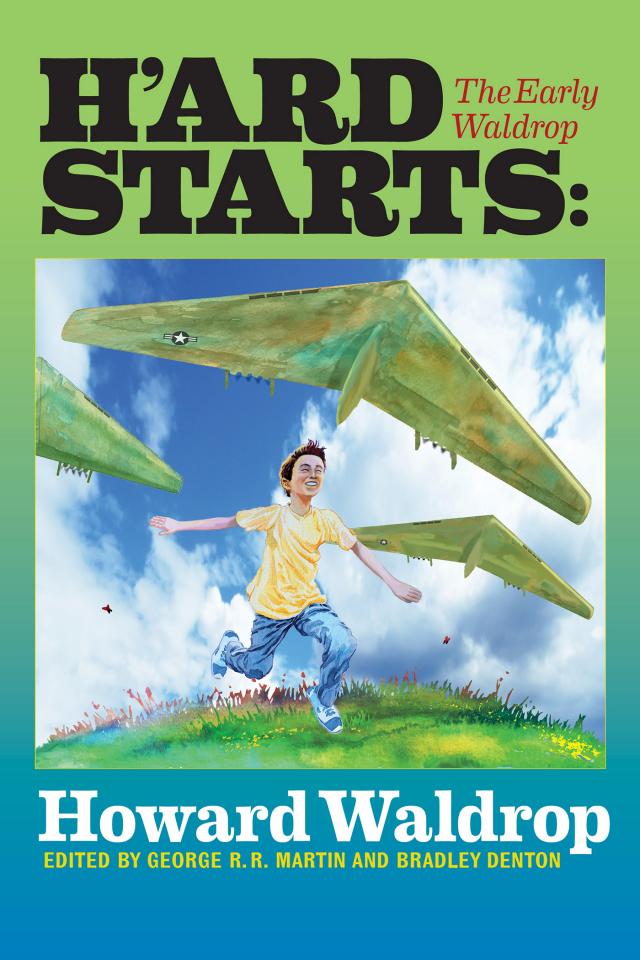
“Love Comes for the YB-49”
“Mono No Aware”
“Billy Big-Eyes”
“Unsleeping Beauty and the Beast”
“My Sweet Lady Jo”
Interview, Part Two
1. “Lunchbox”
BRAD: Now we come to your earliest professional sales, in the early 1970s. This is when your name started appearing alongside names like Isaac Asimov and Anne McCaffrey. We’re talking about “Lunchbox” in the May 1972 Analog.
“Lunchbox” was your first professional sale, right?
HOWARD: Right. It was written in ’68, and I sent it to Ed Ferman (at that time the editor and publisher of The Magazine of Fantasy and Science Fiction), like I always did. I sent everything to him first, and I knew he would buy it, right? And I would always count the days. I’d wait ninety days, and I’d get a letter back saying, “No.” I did that for three or four years.
So after Ferman rejected “Lunchbox” – I could go get my logbook and tell you who I sent it to next. See, it was written in ’68, and I marketed it all through ’68 and ’69. And then I sent it to Analog, like, two weeks before I was drafted. I went in for the draft on October 27, 1970. And I was in my fourth day of basic training when I got a letter from my wife with a xerox of the check stub in it, you know?
BRAD: Wow!
HOWARD: We were standing in formation and had mail call, and I got that. I got to enjoy it for like thirty seconds, and then I had to do a hundred push-ups or whatever we were doing at the time.
BRAD: (Laughing.) I shouldn’t laugh, because that’s awful. But in retrospect – In the movie of your life, this would be a big scene, you know? Your first sale, and you immediately have to “Drop and give me a hundred!”
HOWARD: “One, Drill Sergeant! Two, Drill Sergeant! Three, Drill Sergeant!” But that’s what I had to do, right?
BRAD: And you just covered the next two or three questions I had. But it leads me into the next thing I was going to say: I think “Lunchbox” is a swell science fiction story, but it doesn’t yet display the voice and the sensibility that your readers would later come to call “Waldroppian.”
HOWARD: Right. See, the thing was, I sold it to Campbell (John W. Campbell, then the longtime editor of Astounding/Analog) in October of 1970. And then Campbell dropped dead in May of 1971. In the interregnum, Ben Bova was appointed editor of Analog, and he wrote me a letter that was forwarded to me by my wife – by then I was at Fort Bragg, probably – and he said that the nomenclature of the actual mission to Mars (the situation and setting for “Lunchbox”) had changed in the meantime. Originally it was the Voyager mission, and they changed it to the Viking mission. So he wrote me a letter saying, “Can I change the nomenclature in the story to match what NASA’s plans are?”
I started to write back a snotty letter saying, “No, Ben, just publish it like it originally was so I’ll look like a dork when it comes out!” But I didn’t do that. I said, “Of course, Mr. Bova, sir!”
“Lunchbox” went into the Army with me – like I said, I got the acceptance letter four days after I went in – and it was published the month I got out of the Army because Nixon had given us that six-months-early out, right? So it came out in May of 1972 along with me.
BRAD: That’s a pretty typical publishing lag, even now. About eighteen months.
HOWARD: But of course that one was complicated by the fact that Bova wasn’t the editor when I sent it in.
BRAD: So it might not have been the very last story that Campbell bought, but it was certainly one of the last stories he bought.
HOWARD: Right. But I always took credit for killing John Campbell, just like I later took credit for killing magazines when they bought stories from me … and then died.
2. “Onions, Charles Ives, and the Rock Novel”
BRAD: Let’s talk about your essay “Onions, Charles Ives, and the Rock Novel” – which was in Crawdaddy, right?
HOWARD: Right. It should have appeared in the original Crawdaddy.
BRAD: Because you actually sold it to them before they switched?
HOWARD: I sold it to the actual Crawdaddy when Chester Anderson – who wrote The Butterfly Kid and all that stuff, a trilogy with him, Paul Williams, and T.A. Waters as protagonists of three different books. Anyway, The Butterfly Kid was the one that got the most press and stuff. He was the editor of Crawdaddy at the time. His acceptance letter said, “When I saw the Grand Prairie, Texas postmark, I thought my past was coming to get me.” Because he lived in Grand Prairie at one time.
BRAD: The address on the manuscript that we have says Arlington.
HOWARD: But I think I mailed it from Grand Prairie. Anyway, Chester Anderson thought it was some of his past coming back to haunt him. He had accepted it, and then the issue of Crawdaddy that was on the stands was Number 33, I think. My piece was supposed to be in Issue 34 or 35, but then Number 33 stayed on the stands for three or four months. And I said, “Uh-oh,” right? That’s always a sign that the distributor hasn’t gotten a notice from the publisher to put the next issue out. Then it finally disappeared, and a year later when I was in the Army – ready for this? – I got a Third-Class envelope. I opened it up, and it was copies of the first two new Crawdaddys. And there was a sixty-dollar check in between the two issues.
Me and my wife were on our way to a friend’s house in Newport News, Virginia from Fort Gordon, Georgia. We were going to visit them because they had moved from Arlington, Texas to Newport News. He was restoring an organ in his house, a big pipe organ he’d gotten from a church. Anyway, I got the Crawdaddy issues from the mailbox as we were on our way to Newport News, Virginia – and there’s a photograph of me holding them up with a check, right? Because as far as I knew, Crawdaddy had died with my article.
The article itself came out of a PBS performance by an orchestra performing Charles Ives’ previously unperformed Fourth Symphony. His Third Symphony was what won him the Pulitzer Prize in 1947. Then he wrote the next one in ’48. [BD Note: Howard’s article says that Ives’ Pulitzer was awarded in 1947, but that his Third Symphony was actually written in 1911 … with the Fourth probably having been written between 1911 and 1914.] But it had never been performed in his lifetime. So they got an orchestra together (in 1969) and performed it. And while I was listening to it, the idea for the article came to me.
The article was about the “rock novel,” as they called it. And Chester Anderson’s letter to me said, “I think the Who have a ‘rock novel’ out called Tommy.”
BRAD: That is exactly what I was going to ask you about.
HOWARD: Right. I wrote the article before Tommy came out. Anyway, what I called a “rock novel” is what everybody calls a “rock opera” now, of course. But at the time, everybody was talking about the possibilities for “comic book novels,” “graphic novels,” and “rock novels.” That was the terminolgy people were using at the time.
BRAD: And that’s what you talk about in the essay. I thought it was very prescient – but only a few months prescient, you know? Because I think you must have written this essay in early ’69, and Tommy came out later that same year.
HOWARD: Right, like in May or June.
BRAD: And yeah, what you describe in the essay is what Pete Townshend was trying to do in Tommy. Whether you feel he was successful or not is another thing, but that’s clearly what he was shooting for.
HOWARD: Exactly. And that’s what I was thinking about when I heard the Ives piece performed.
Ives was big on counterpoint and cacophony, you know? Counterpoint, to the point of cacophony. His thing was, like, he had a thing in there where two marching bands are coming towards each other. And the tunes they’re playing, for a while, syncopate up with each other, then become cacophonous as they get closer together.
Anyway, like I said, just listening to that made me think about the “rock novel.” And I didn’t know about Tommy yet, since it hadn’t been released.
The essay is pretty self-explanatory, if I remember correctly.
BRAD: It is. And as I say, you were a few months prescient, because what you describe is pretty much what the Who attempted to do. And then of course other people tried to do it as well, with varying degrees of success. I remember, maybe just a year or two after Tommy, Jethro Tull did one called Thick as a Brick. And then even a few years later than that, do you remember – oh, I forget the guy’s name. His first name was Jeff … I’ll look it up. But he did War of the Worlds.
HOWARD: Yes, he did! What’s his name … I’ll think of it in a minute.
[BD Note: Neither Howard nor I remembered the name during our conversation, but the musician in question was Jeff Wayne, and his musical version of War of the Worlds was released in 1976.]
BRAD: But yeah, he did a whole concept album that was basically musical-novelizing, or opera-izing, War of the Worlds.
HOWARD: And of course Andrew Lloyd Webber did Jesus Christ, Superstar and Joseph and the Amazing Technicolor Dreamcoat.
BRAD: So it all morphed into Broadway, and double albums, and all kinds of stuff.
HOWARD: You know, it (Jesus Christ, Superstar) was originally conceived of as just an album. And then it became a play, you know? If I remember correctly. We all thought Andrew Lloyd Webber would be something besides an institution, when he started out. You know, everything he did in Jesus Christ, Superstar, he and the other guy had done in Joseph and the Amazing Technicolor Dreamcoat beforehand.
Anyway, like I said, my thinking about it (the “rock novel”) was all from the PBS film of the orchestra doing Ives’ Fourth Symphony, which was broadcast either late in ’68 or early in ’69, if I’m not mistaken. At least on our PBS station.
BRAD: So that’s “Onions, Charles Ives, and the Rock Novel.” You were clearly on to something. But it sounds like by the time it finally came out in Crawdaddy, the other things (like Tommy) had already started happening.
HOWARD: Oh, yeah, it didn’t come out in Crawdaddy until ’71. Because it was delayed across that year and a half.
3. “Love Comes for the YB-49”
BRAD: Now we’re going to talk about “Love Comes for the YB-49.” I mentioned to you the other day that I love this essay, because even though I’m twelve years younger than you, I was obsessed with the same things – just different models of the same things. As a ten-year-old, you were fascinated with the early X planes, but by the time I was that age, I was obsessed with the X-15.
HOWARD: Right! You remember Jules Bergman, who was the science editor for ABC News, wrote a book on the X-15.
BRAD: I may have actually seen that book when I was a kid. But what I remember for sure is that two of the magazines my parents got at the house were Popular Science and Popular Mechanics. They were essentially the same magazine with different titles. But that’s where I remember reading about the X-15, and how I became obsessed with it.
So I wanted to ask you: In the essay, you mention that the Flying Wing was featured in some of the movies you loved when you were that age, and I’m wondering if the first time you became aware of the Flying Wing was from those movies.
HOWARD: No, I knew about the Flying Wing before that. As I say in the essay, we lived in Arlington, Texas, which was near Carswell Air Force Base in Fort Worth. It was a Strategic Air Command base. So what I saw flying over me were B-36s. If the world had been different, it wouldn’t have been B-36s, but YB-49s.
Out in California, Edwards Air Force Base is named for a guy who was flying a Flying Wing. The plane had some, whatchacallit, “drag problems.” Because it didn’t have tail surfaces and stuff, it crashed. And they named the Air Force base after him.
But I was aware of everything, like the X planes, and Chuck Yeager, and the YB-49, and everything. And I knew they had flown the scale models of the YB-49, which were exactly the same plane, but scaled down for just a single pilot. They had flown that in the ’40s, you know. Then they adapted that design to the Flying Wing, which was supposed to have a crew of thirteen, six of whom could sleep at a time. So it could stay in the air for something like eighteen hours.
I was fascinated by it. First because of the fact that it didn’t look like any other plane that had ever been built. And you know, when they finally built the Stealth fighter and the B-2 bomber, they were essentially updated versions of the Flying Wing. Because Northrup had the right idea: The more surfaces you can get rid of, the less it shows up on radar.
I believe they showed it to Northrup when he was in his nineties, right before he died. They took him to Lockheed and showed him the Stealth fighter, even though they weren’t supposed to. But they had adopted all his ideas – thirty, forty years later. So he was vindicated, you know?
But I knew about all that stuff. X planes, rocket planes, stuff like that … just fascinated me when I was a kid.
BRAD: What was your medium for finding out about all this? Was it comic books, or magazines, or – ?
HOWARD: Well, in America in the ’50s, you got everything from TV, or the radio, or you saw LIFEmagazine. It came to the house every week, and there were pictures of the YB-49 there all the time. And if Stuart Symington (first Secretary of the Air Force, from 1947 to 1950) hadn’t been such a dipshit, we would’ve had YB-49s flying out of Carswell rather than B-36s.
What he tried to do, was he tried to get the Air Force to adopt the B-49, but only if Convair would get the contract for the engines. My theory is he had some fingers in some Convair pies. Convair is what became General Dynamics eventually, by the way. So we wound up adopting the B-36.
If you see the movie Strategic Air Command with Jimmy Stewart and Harry Morgan, they take a tour of the B-36. Stewart plays a baseball player who’s called back up to service and becomes a Strategic Air Command pilot just as they’re about to adopt the B-47 medium bomber, you know? But they fly to the North Pole and back a few times early in the movie, and you get a lesson on what the B-36 was like.
But like I said, I’d rather have had them flying the YB-49.
BRAD: I’m struck again by the parallels and differences between you and me, being a dozen years apart in age. I grew up near Wichita, Kansas, which was the home of McConnell Air Force Base.
HOWARD: Another SAC base!
BRAD: Another SAC base, that’s right. And what I saw flying over all the time were B-52s.
HOWARD: Right. They were just gettin’ ready to adopt the B-52 when the B-36’s were phased out. I even remember the B-58, which had a brief, about a one-year, operational life. That was the delta-wing bomber that had different pods you could stick on the bottom of it. One was an anti-radar pod, another one had a thermonuclear bomb in the pod, and another one had other stuff. One of ’em was a pod full of chaff to screw up the radar everywhere instead of just jamming it.
They only flew those for about a year and a half. But the B-52 was the workhorse once it was adopted, because they were still flying those even in Desert Storm, you know?
BRAD: Yeah, those things were probably held together with duct tape at that point. But they still flew. They’d probably still be flying now if not for the B-2.
HOWARD: There were guys in the Air Force who flew nothing but B-52s their entire career. They’d come in, they’d get into a B-52, they’d fly it for thirty years, and then they’d leave the Air Force. And that B-52 would still be going with different crews.
But like I said, that could have been the YB-49, if things had been different.
When Crawdaddy was revived, I sent ’em the YB-49 article, and that was the only one of mine they managed to publish before they went out of business again.
BRAD: That was the next thing I was gonna ask you about. This essay was published in Crawdaddy in 1971. Had you sold it before you even made your first professional fiction sale?
HOWARD: Lemme see … Yeah, I believe I had sold the YB-49 article before I sold “Lunchbox” to Analog. I had sold Paul Williams two articles. The other one was “Onions, Charles Ives, and the Rock Novel.” Neither appeared in the original Crawdaddy, which was printed on slick paper. Then the new Crawdaddy was printed on newsprint.
BRAD: So you just sent these in as cold submissions, right?
HOWARD: Oh yeah, sure.
BRAD: That’s kind of wild, because I don’t think there are any journalistic magazines at all now that would take a cold submission.
HOWARD: Well, even then, Crawdaddy was different from any other magazine around it.
But a lot of ’em did take cold submissions back then. It was a different world, right? The world I grew up in, and the world we live in now.
BRAD: My last real question about “Love Comes for the YB-49” is this: You finally have a Flying Wing model! (An AMT/Ertl 1/72 scale model, re-released 1995.) How did you finally get your Flying Wing model, and do you think you’ll put it together?
HOWARD: If my eyes hold up, I will. The Revell kit from the ’50s was reissued in the ’90s. They were on a kick of doing that, because people would be saying, ‘Why don’t you do a reissue of the Sabrejet model’ or whatever, you know?
Anyway, Ed Bryant sent it to me as soon as it was reissued.
BRAD: He just bought one and mailed it to you?
HOWARD: Yes, exactly. Because he had read the YB-49 article when it came out in Crawdaddy, more than twenty years before. And he knew how fascinated I was with it. And this was the first version since the 1950s that they put out as a model kit.
BRAD: That was a really cool thing for Ed to do for you.