The Brambleberry Bride, page 8
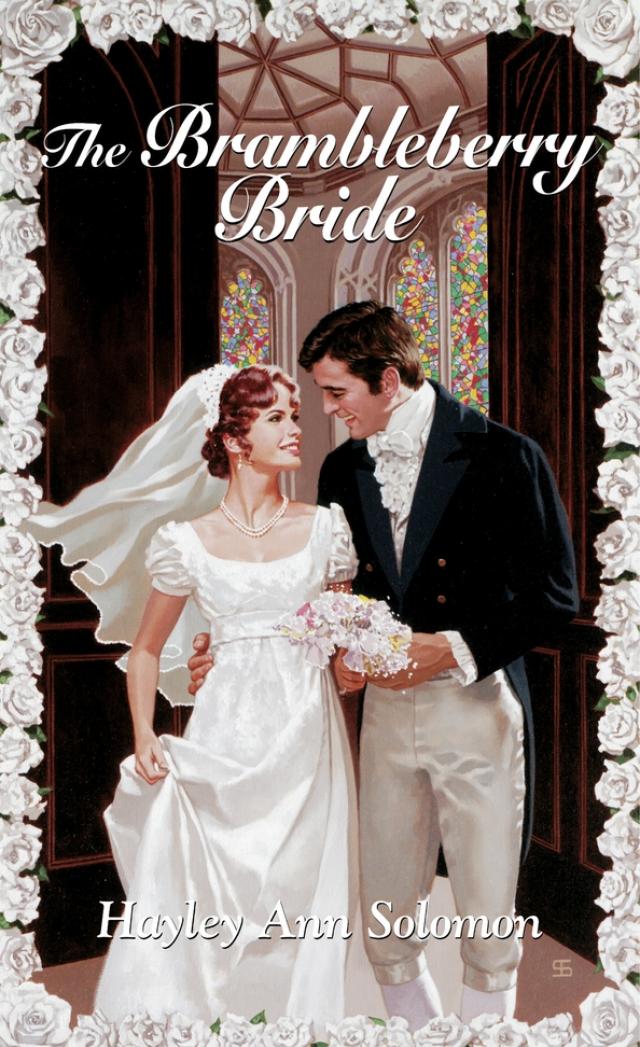


Bertram, supporting his brother on this quite unlooked for occasion, grinned madly and glanced about the hall for Vivienne. She, being only the companion, was relegated to a stone pillar toward the back of the church, despite Anastasia’s earnest protests. On this point, however, Lady Richmond had prevailed, citing the numerous calamities that Miss Townsend had been privy to, if not the direct cause of, in the past.
In this edict, she had a surprising champion. It was Vivienne herself, who declared she would be mortified if she disturbed the proceedings by giggling—a failing her lively temperament made her unfortunately prone to—or worse. She could trip over the potted palms that lined the aisle; she could sing out of tune and make a spectacle of herself in the front row; she could step on the hem of Anastasia’s gown . . . oh, the list was endless and had ended in Anastasia throwing a book at her and finally agreeing.
Of course—and here Vivienne’s delightful eyes sparkled mischievously—she could regard Captain Ralston’s extremely pleasing visage quite brazenly from the back of the cathedral. In front, she would be on pins that her close interest would be remarked upon.
Thus it was that Bertram did not waste his time gazing out at the front rows but rather peered quite shamelessly across the hall, twisting his head to see if the heavenly vision in soft pink was, indeed, the love of his life. He also wondered, as Andrew stepped forward to take his vows, whether he could possibly twist his head a little, for the confounded pillar was disturbing his view. His reverie was unceremoniously cut short by a sharp dig to his ribs as his brother, a wry look of amusement upon his perfect features, reached for the ring a second time.
“What? Oh! Yes, of course!” Bertram forgot Vivienne at the back and searched his pockets. Good Lord, the thing was not there! He tried the other pocket as a slight murmuring began about the room. Needless to say, his luck not being prodigious, the matrimonial band was nowhere to be found. The archbishop, an imposing figure, looked a trifle nonplussed. It was unthinkable that he should marry a peer of the realm without the requisite ring to bind the couple in their vows.
Anastasia stood immobile at the altar, her lovely eyes fixed unwaveringly on the viscount. In the solemnity of the moment, she knew undoubtedly that she wanted this man, ring or no. This marriage was not simply an escape from spinsterhood or a respectable alliance, as she had told herself a dozen times. She knew with a sudden blinding clarity, that she yearned for it with a passion.
“Anastasia.” The viscount stepped forward and clasped her gloved hand in his own. “I made a trip to Waverley to procure for you the family jewels. Now, it seems, by peculiar circumstance”—he threw a darkling glance at Bertram—“I have nothing to offer you save my signet. I hope you shall accept that in lieu of the other, more valuable, offering I’d intended.”
He glanced at her then, and she thought she saw uncertainty cloud his vision. Surely he could not imagine she would refuse his personal signet? Yet in the act of removing his gloves, she saw his fingers tremble a little. Undoubtedly, too, his dark brows were furrowed in tension. Bertram, at his side, looked suddenly stricken, and she wondered why. So much hue and cry, it seemed, over a little gold! True, the bridal party must now be offering a degree of entertainment to all the witnesses, but surely nothing to occasion the pain she glimpsed in Lord Waverly’s devastatingly magnetic eyes. They were shuttered now, almost as if an impersonal mask had dropped over them.
The viscount was struggling with the ring, which had sat on his finger for more years than he cared to count. The archbishop was attempting to make light of the matter to the gathering, but Anastasia was paying no heed. Suddenly, she believed she understood.
How stupid of her! He must be thinking of Miss Araminda Fallows, who had left him in precisely these circumstances. The whole morning, with all its fanfare, must have been evoking the memories of that other, less auspicious event. How unhappy a reminiscence it must be, and how sad that he should suspect her to be as callous and as grasping as that other young woman had been. “Sir, if you had no signet, no gold, and no coat on your elegantly clad back, I would still have you.”
There was a hush in the hall, for she had spoken with such sudden, unthinking passion that her voice had pealed throughout the cathedral, causing a scandal. Most in the flower-festooned pews beamed indulgently, but there were several high sticklers who looked significantly at each other in aghast horror. Ladies—especially well-nurtured young ladies—did not proclaim themselves in such a ramshackle fashion, wedding or no.
Even Vivienne, seated at the back, understood the significance of what Anastasia had done. Instead of being shocked, however, she offset her excellent friend’s sin by standing up and committing a social solecism of her own. She removed her bonnet—a delicious confection of rosy chip straw and cheery ribbons—and threw it into the air with an animated whoop of encouragement. In the front, Bertram’s lips twitched. Lady Jersey turned around and stared rather coldly at the miscreant. The archbishop looked as if he’d have an apoplexy until Captain Ralston joined in Miss Townsend’s applause.
Then a strange thing happened. Lord Richmond, ignoring his wife’s furious glares, stood up and clapped. Then it was the turn of Beau Brummel, the most notable arbiter of fashion in all of London. Of course, after that it was pandemonium as almost every person who was anybody followed his lead. Even Lady Richmond, noting that the starchy Countess Lieven was smiling, declared that perhaps, after all, Anastasia might be forgiven her outburst.
None of this mattered to Lord Waverley or the lady who had just, amid all the bustle, quietly become his wife. Whilst Bertram winked at Vivienne and Lady Jersey contemplated etiquette, whilst the great Beau clapped and the hall resounded with cheers, applause, gossip, whispered predictions, and significant nods, the viscount had slipped the signet on Anastasia’s finger and softly declared her his bride.
This had been duly attested to by the archbishop, whose head was still spinning with the strange circumstances of the affair. Still, the matter of the ring had been happily resolved. He now felt free to proceed to Brampton, where he was eager to sample a modest glass of Lord Richmond’s legendary red.
As for Anastasia, suddenly shy, her hand trembled as she felt Lord Waverley’s chaste kiss upon her ungloved palm. It burnt like fire, but she did not immediately draw away as was proper. A smile crept into Andrew’s eyes at this defiant gesture. Her eyes were sparkling silver and held tremulous tears he wished to kiss away. At that precise moment, his cold heart melted. Lady Aramirida Tarradale was consigned, at last, to the devil. His future lay with this woman, his wife. He had dismissed her once, rather offhandedly, as decorous and demure. He did not think he could ever again make that same mistake.
NINE
“Anastasia!” Lord Waverly called.
“My friends call me Stasia,” she answered, joining him.
“Ah, but I am not just your friend.”
“No.”
“You are pleased with this match we have contrived?”
“I am pleased, sir.”
“Then come here and let me exchange that paltry little signet for something more suitable.”
Anastasia saw the flash of diamonds as Andrew opened the casket. It contained a multitude of pieces, all of them the hereditary jewels of the Viscountess Waverley.
“No!”
“Beg pardon?”
“I will not exchange this ring for all the gems of England!”
“It is a man’s ring, my love.”
My love. Anastasia glowed at the sound of the word on his tongue. Had it just been a fortuitous turn of phrase? The new viscountess’s eyes crept to the viscount’s, but he seemed unconscious of any particular slip.
“You gave it to me, and I should like to keep it.” Her chin took on a stubborn tilt that the viscount found fascinating.
“Very well. You shall have it. Here, I shall put it on your third finger, for it is so big it will fall off otherwise.”
Anastasia meekly extended her hand. The viscount took it, slowly slipping off her long sarcenet glove and removing the heavy rose gold from her ring finger. Anastasia felt strangely bereft without its comforting weight, though the intimate gesture caused her virtuous senses to reel in shock. Then Andrew, Viscount Waverley, slipped it, lingeringly, onto the third.
Her fingers felt cool and shapely. He bent to kiss each one, and Anastasia stood stock still, willing herself to remember that though she adored him dearly, the feeling was not reciprocal. The ice white heat between them was real, but ephemeral. Somehow, though she forced herself to think it, the thought did not ring true. She closed her eyes, and though the viscount was now rather daringly kissing her arms—and yes, her shoulders—she willed herself to be satisfied with what she was receiving. Unashamed passion that begged only for a response. She was not unwilling in that regard, as the viscount was soon to discover.
Later, much later, when she was in truth his viscountess, he drew her closer and announced that he had a horrible secret to confess.
Anastasia paled, for she was certain it had something nasty to do with the countess of Crewe. Perhaps, though she had jilted him, he still wore the willow for her.
“I am not certain you ought to tell me, sir.”
“Andrew would sound better on your tongue, my lady.” He drew a strong, bronzed arm around her slender form “And whilst we are on the subject of tongues. . . .” He smiled at her wickedly.
Anastasia could not help a tiny, wisp of a smile in response, though her heart was fearful of the confession to come. Once spoken, the words would be difficult to retrieve.
“Andrew.” The word was at once strange and intoxicating. She did not dwell on it, however, for her mind was set on taking a more serious turn. “You need not confess a thing to me. I am not, you must remember, your keeper.”
“Oh, but I wish you were.” The words, though flippant, were accompanied by a darkening of his eyes that made Anastasia tremble.
“You are a rogue, sir! You see fit to tease me!”
“Indeed, I have to confess, there is a certain diversion in that!” The glint in his eye was unmistakable, but Anastasia disentangled herself from the heavenly warmth of his arms to sit up. Sad to say, her pins, long since removed, were now nowhere to be found, so she had to resign herself to hair that tumbled hopelessly about her face. Andrew thought the effect charming, but she pushed the locks back crossly.
“I am glad I am such a source of amusement to you!”
The viscount laughed, his head somehow closer to her body than was quite sensible for one determined to scold.
“So am I,” he whispered. Somehow, his tone was so intimate that Anastasia shivered and had to forcibly push him away to continue her self-sacrificing train of thought.
“I know that you have a tendre for Lady Tarradale . . .”
Now it was the viscount’s turn to sit up.
“What stuff and nonsense! The only inclination I harbour in her direction is the recurring need to throttle her undeniably pretty neck!”
“See! You call her pretty!”
“Shrew! Shall you be a very jealous wife, I wonder?”
“I shall try not to be.” Anastasia’s voice was so low the viscount almost missed her words.
“I shall be disappointed if you are not, for jealousy indicates caring, and I want, very much, for you to care for me.”
This time, there was no more teasing in his tone. Anastasia looked up to see an earnest honesty in his breathtaking features.
“You mean—”
“Yes, widgeon! That horrible secret I have to confess. I have loved you from the day you tumbled off your pony. You complained not a whit, despite the fact that it was so obviously Bertram’s fault. You spared him a whipping that day, I am very certain of it.”
“But Lady Tarradale—”
“Was a young greenhorn’s silly mistake. I was cutting my eye teeth then, and clearly had not a groat of sense.”
“But you cannot love me! You have said so yourself—”
“I told you I was a mere greenhorn! Silly gudgeon that I am, the truth only revealed itself to me today, when we took our vows. You were magnificent.”
“And highly improper!”
“Deliciously so. And now, Lady Waverley, since you are already so wreathed in smiles, may I tempt you again to impropriety?”
And of course he did.
Lady Brandoven’s ball was always the most august affair on the social calendar. Bertram took especial care with his neckerchief, for he wished to look particularly dapper for the event. Three months, he considered, was a long enough interval to allow Viscount and Viscountess Waverley their privacy. He had been languishing in the country all this time, loath to act the spare wheel in his brother’s home whilst he entertained his lady wife. Now, by all accounts, matters were settled most amicably between them. It was only today, after all, that Bertram had been told, rather shyly, that his standing as heir to Waverley was about to be usurped. He had whooped with joy at this pronouncement, and had begun cosseting Anastasia so solicitously that she finally had to tell him to go away, she could not stand nine months of such treatment.
Bertram untied the neckerchief and began the provoking knot again. He was not sure why he bothered, for Vivienne was bound not to notice whether the wretched thing looped over or under. Still, pride was pride. He did not wish to be behindhand in any attention. Besides, one could not be expected to recite poetry—the captain had diligently learned one of Byron’s verses—if one’s shirt points drooped.
Captain Ralston was cured of his loathing for matrimony. This was due largely to the fact that he was convinced Miss Townsend would be a most unwifely wife, a fact that redounded quite inordinately to her credit. As a consequence, he’d decided that tonight would be the sticking point. He would formally request her hand—for up until now he had only informally done so—and see to it that they were wed at once. The special license bristled invitingly in his pocket.
He wondered how Vivienne did, for by now she must be heartily sick of running errands for Lady Richmond. Despite Anastasia’s good-hearted pleas, she had refused resolutely to relocate to the viscount’s London town house after the wedding. Like Bertram, she did not believe that three made company.
“Will you be taking the tilbury, sir?”
“No, Siddons. Send down for the barouche, will you? I have no idea where the evening will take me.” With these cryptic words, Bertram wedged his hat on over his merry curls and prepared to leave.
Lady Richmond was agonisingly slow. She dithered unmercifully over her toilette, changing this and that until Vivienne thought she might either die from impatience or pour a pitcher of water over her. Fortunately, she veered toward the former, for she would undoubtedly have been dismissed without a character had she tried the water trick.
She had been ready an age ago, having thrown on a discarded gown of Anastasia’s and piled her bright, irrepressible hair on top of her head. Had Lady Richmond only known it, it was being secured by no more than three pins. Still, it appeared to be holding, and the bright peonies she had added to the ensemble looked very merry indeed, if slightly unusual. Roses and violets were customary.
“Shall it be the emeralds or the rubies, Miss Townsend?” Lady Richmond asked, suffering yet another spasm of indecision.
“Oh, undoubtedly both,” came Vivienne’s impatient reply.
“Both? How clever of you! I declare you are right. Bettina! Fetch both boxes, will you?”
Vivienne sighed with relief. They might not be so terribly late, after all. She had not minded being tardy for the masquerade or Lady Davina’s card party, but tonight was different. Tonight, she knew, Bertram was back. Her eyes shone at the thought. She imagined his splendid shoulders encased in a perfectly fitting coat styled by Weston, his top boots gleaming. He would notice her at once across the room and would sail over to her and say . . .
What would he say? Her heart hammered quite painfully at the thought.
“The Viscount and Viscountess Waverley, the Honourable Captain Ralston . . .” The names announced were endless, but Bertram paid them no attention. He made his obligatory bow to the hostess, Lady Amelia Brandoven, then went off in search of Lady Richmond’s party. Bother! They had not yet arrived.
Anastasia regarded her new brother with some amusement and more than a little twinkle in her sparkling eyes. Commending her excellent husband to the card room, she marched up to him and demanded the first dance of the evening.
“It is a quadrille, Stasia! Dreadfully boring, and I wish to preserve my boots.”
“How churlish of you, Bertie! Come, come, you will not deny me! A certain young lady has not yet arrived. If I know Mama, it will be ages before they are finally announced.”
In this she was wrong, for Lady Richmond and Miss Vivienne Townsend were at that precise moment in the process of being announced. Lord Cowper, a kindly sort of man, solicited Miss Townsend’s hand at once. He had an astute notion that if he did not give her the cut direct for her behaviour at the Waverley wedding, no one else would. In this surmise he was correct, though Vivienne remained happily oblivious to all these manoeuvrings. She did offer him a very pretty smile, however, and adjured him to “watch his toes,” for she was a deplorable dancer and only ever successful with a broomstick.
Though Lord Cowper’s lips twitched at this refreshing confession, he obligingly reassured Miss Townsend that he would be careful. Thus it was that when the set was formed, both Bertram and Vivienne were participants. Neither noticed the other, however, until it was too late to do anything but grimace deplorably and wink.
“Bertram! I have great plans for your wedding. You shall marry from Waverley with due pomp and splendour. We can have the most fabulous wedding feast out on the lawns—”
“Spare me, Anastasia! I would not marry Vivienne that way for all the tea in China.” Unfortunately, Miss Townsend, dancing quite close to the couple and unable to resist indulging her deplorable habit of eavesdropping, heard most, but not all, of Bertram’s reply. Mortified, she stumbled a little, causing Lord Cowper to wince as his foot took the brunt of her misstep.