Lady Caraway's Cloak, page 15
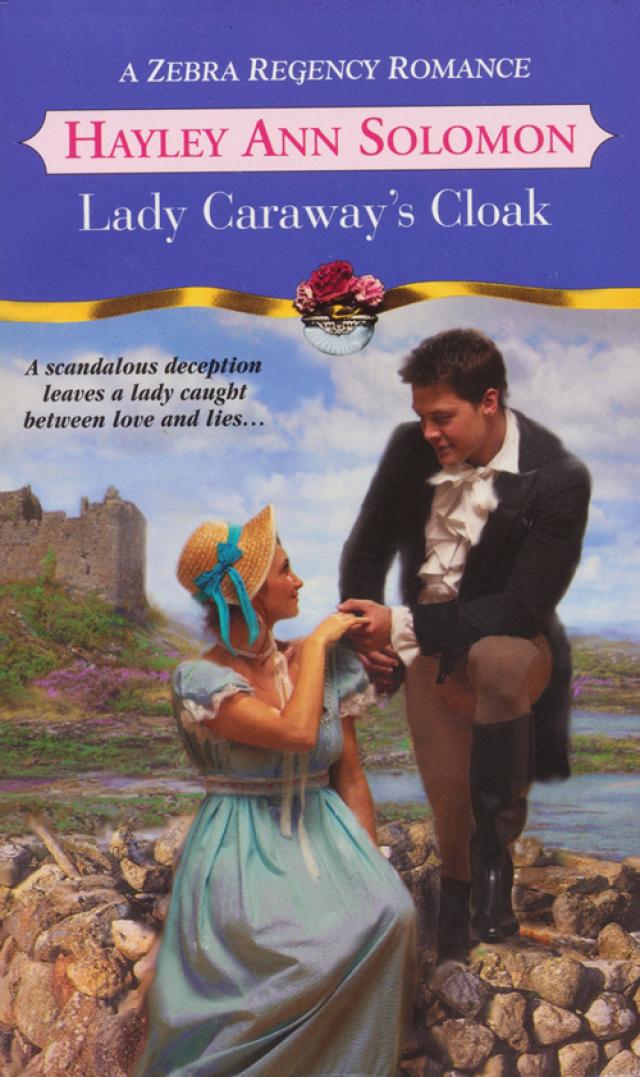


His instincts, as it happened, were unerring, for Miss Julia, far from raising her hands in horror, really seemed quite deliciously pleased. Shocking, really, for a closeted schoolroom miss of tender years, but Captain McNichols, apparently, was a rogue beyond all shock. If he could have kissed her he would have, but the wretched maid seemed to be reappearing out of the thin air, and he had no wish to incur Lady Serena’s wrath. He contented himself, instead, with innocent sweet nothings that left Miss Waring prettily pink and himself a little breathless.
After a few minutes of this pleasant discourse, Captain McNichols remembered it was Serena he was meant to court. He wrenched himself from Julia and walked across the deck to her ladyship, where he tried, for a few valiant moments, to make convivial small talk. Not that he did a particularly good job of it, for despite his excellent manners, his eyes kept trailing to Miss Waring, who was now leaning dreamily over the railings and throwing crumbs to the seagulls.
“She is lovely, is she not?” Serena took pity on him.
“Miss Waring? She is delight itself. You do not mind if I say so, Lady Serena? It is just that I can think of little else.”
“I have heard love attacks the brain in that peculiar manner.” Serena did not say she knew firsthand, for try though she might, her thoughts kept flying to Lord Caraway, who was treading lightly on the other side of the deck, and murmuring orders to two of his staff. She did not know that they were discussing her and her various amiable features until Lord Robin threatened to draw their blood if they so much as uttered another word, never mind cast another appreciative eye in her direction.
“Yes, it is passing strange, I had not expected to be affected so. Lady Serena, do you think the dowager can be brought round to accept my suit? I am not wealthy, but I own a great deal of land in the Americas, and I have made several worthy investments on the exchange ...”
“My dear Captain McNichols, you do not have to justify yourself to me! I am perfectly certain that you are all that is acceptable, and Julia appears positively giddy with happiness. She is wearing that dreamy look I know very well indeed, so I must suspect that maid or no, something intriguing has taken place between the two of you. I make a very poor chaperon, I am afraid.”
As usual, Serena was blunt and forthcoming, a fact that startled Adam, but would have made Robin chuckle had he but heard it. Serena waved her white-gloved hand dramatically into the air.
“No, do not begin making excuses! I must applaud your taste, for truly Julia is the most delightfully good-natured young lady you could ever desire. What is more, she is good and dutiful and biddable, all qualities I am afraid I lack, but which she has in abundance.”
“Yes, but Miss Waring’s mama ...”
“Captain McNichols, Julia’s mama does not despise you particularly, but rather anyone who stands in the way of a union between her daughter and the earl.”
“Robin?” Adam, for once, looked stupid.
“Of course, Robin.”
“But Robin has no interest ... that is to say ...”
“Robin shall make his own declarations, Adam.” This from the Earl of Caraway himself, who had finished his discourse on the starboard side, and had returned in time to hear Adam’s musings. Hands behind his back, his expression was unreadable. Serena, unsure, hoped it was not forbidding.
Julia, having supplied every last crumb to her feathered friends, now returned—with her maid following faithfully behind—to the circle. She squeezed Serena’s hand meaningfully, then, quite unable to contain herself any longer, blurted out that she had just accepted Captain McNichols’s proposal of marriage.
Adam shot a guilty look at his greatest friend. “I did not intend ... that is ...”
“Gracious, Captain! First you did not intend with me, and now you do not intend with Julia! I am beginning to think you unchivalrous in the extreme!”
“You tease, Lady Serena! You know perfectly well that I do intend ... that is ...”
“Oh, Serena, he is being all stuffy because Mama has taken him in dislike!”
“I should not have asked you before gaining consent from your parent. It was very poor form ...”
“Oh, bother form ...” came the combined voices of both an unusually disobedient Julia, and a forthright Lady Serena, who had very little patience left for the dowager countess’s wishes.
“I wish you very happy, Julia ...”
“And I,” came an amused voice from behind—oh, subtly, slightly behind—the nape of Serena’s neck. She tried to ignore the presence, but it was hopeless, and she thus hardly heard Robin claim his right as head of family to deliver all necessary permissions. Adam, as a matter of form, insisted that the dowager be consulted, and Julia, perfectly certain that her mama could be brought round, allowed her happiness to overshadow all qualms.
Serena had many qualms of her own, not least of these being the necessity to lie about her plans for the next day, a lie that had Lord Caraway regarding her too closely for her liking—it was so inconvenient how he could read her thoughts! To make up for the blunder, she was almost certain he knew she was telling a Banbury tale—she began almost to chatter.
Then she drew out her journal from the fold of her cloak, and began to inscribe quite randomly any thought in her head, so that Robin would take the hint and walk away. He did not; he stood watching her, noting with amusement that the little book was upside down. Something about it arrested his attention, but before he could quite place the notion, Serena had obviously changed her mind about her activity and now slammed the book shut almost as if it were guilty of some hideous crime.
Then she stared up to see if he was watching her, flushed up when he was, and began, once again, with her silly chatter on such topics as the sugary ices at Gunther’s to matters of such extreme frippery my lord could not recall the half of them, save perhaps the classic where she bemoaned the loss of a peacock feather.
Lord Caraway, watching her, decided firmly that if ever he was going to uncover her mysteries, it was now, before he positively went mad. This would either be from her small talk, or from her sensuality, which he tried very hard to ignore, but which caused him to struggle against his piratical urges for many long and tormenting hours.
He held his tongue, though, restrained his carnal desires, and mildly commented that the change in winds made the carriage journey look more favorable. “Perhaps,” he suggested, “if they were all ready, they should begin to make their departure?”
Serena, already wrapped in her mantle, had nothing more to do than follow sedately down the gangplank, and make several adjustments to her modish bonnet. This had been tossed mercilessly in the breeze, but thanks to some exquisite stitchery remained miraculously intact, feathered plume and all.
As Lord Caraway gave his orders to the coachman, she wondered whether she had imagined their private interlude of earlier, for he was paying her less attention now than his horses. Whilst he was extremely solicitous of Julia, he threw her up into the chaise without so much as a pretty compliment. If he glanced at her, it was so speedily she felt sure it had been the merest of chance.
What with both the maids, the picnic basket, and both gentlemen, the carriage was rather cramped. Save for feeling slightly crowded—and more than a little breathless, for Serena was seated just opposite the earl and their knees did keep bumping, despite her best efforts—they all made do.
Was Robin a pirate, or was it just her silly imagination? Had he winked at her, or had she just wished it? What did the fabulous red ribbon mean, save that he looked so sensuous without it, so utterly debonair with it? She wished she knew and wished she was not behaving as foolishly as every heroine she had read of in the Minerva press.
She shook herself, charmed Captain McNichols diagonally opposite her with her repartee, clasped Julia’s hand, and made perfectly certain not to catch Lord Caraway’s eye more than she could help it. In this, naturally, she was highly—and perfectly adorably, if only she knew it—unsuccessful.
Chapter Thirteen
It was perhaps a couple of days after this unnerving outing that Serena received a posy of flowers from the earl. This, in itself, was not unusual, for it had been his custom to send around a nosegay of flowers each morning, but it was usually a simple one for Julia.
This particular one, however, was sent directly up to Serena’s rooms, with a shilling to the maidservant to sneak it past before she woke. It smelt heavenly, and consisted of blooms and buds all in red. Upon each long stem was a ribbon, bright, crimson red; and attached to the whole, a poem, or more accurately, a riddle, which made no sense to Serena’s sleepy brain.
What did touch her, however, was that the earl had been at the flower markets before dawn, else he would not have been able to assemble such a bouquet. Further, though she could not quite fathom why, she suspected that its sentiments were hardly proper—a floral arrangement for the boudoir rather than for the drawing room.
She could hardly tell why she thought that, or why that now-familiar frisson of excitement flooded through her as she handled each bud and examined the velvet ribbons carefully. They were cheerful and exotic, and told her something she had been really too stupid this morning to perceive. She grappled with the puzzle, a classical quotation scrawled carelessly across the card.
“Cum finis est licitus, etium media sunt licita.” Definitely not Homer, or Aristotle. She rather thought it might be something more seventeenth century in tenor ... It certainly sounded familiar ... . The Medulla Theologiae Moralis perhaps?
Possibly, although at this time of the morning she could not be certain. She would have to peruse the library to decipher whatever message the earl had wickedly contrived. How much easier if he had just used simple English ... or quoted from someone contemporary like Byron. But no! Nothing simple for Robin, Earl of Caraway. He, of course, must dredge up hideous quotations from her past and force her to puzzle them out. Wicked, wicked, wicked! But Serena was smiling as she clambered out of bed.
She waved away Davina, with her chocolate, and ordered up coffee, instead. She needed her wits about her today and clearly, so far, they had all gone begging. And all because a damnably handsome man, with an irresistible smile and a wicked mind, was playing havoc with her thoughts.
“Serena Addington Winthrop Caraway,” she admonished herself, “use your wits!” But she had little chance to do any such thing, for soon after she was dressed—in something a little drabber, today, for she was journeying to Caraway and did not think she would bump into any stray laughing earls who might tell her to wear periwinkle blue—there was a knock upon her chamber door.
The upper maidservant, with a message for her to see Royce, the butler, with some urgency. Curious, for she had never received such a summons before—Royce always managed Number 2 York Crescent, with silent grace—she sought out the manservant at once.
“My lady,” said the butler portentously, “I am afraid there is a ... person waiting for you in the servants’ quarters of the Crescent.”
“A person? Whoever can that be?”
“A Mrs. Hitchens, ma’am, should that mean anything whatsoever to you. For,” said the butler with a distinct frown upon his forehead and heavy disapproval in his tone, “the person—I shall not say lady, ma’am—was insistent I speak with you. Very strange, I am sure and you must forgive my impertinence in bringing the small matter to your attention ...” His voice trailed off but returned with renewed vigor at a nod of encouragement from Serena.
“The person, as I say, was adamant that she speak with you, my lady. I naturally referred her instantly to Mrs. Higgs, but she said she would wait!”
Serena’s eyes twinkled at his outrage. “Then I suppose I had better see her, for I cannot think you would wish her to do all this waiting in your kitchens.”
“No, ma’am, not with her crying and all, and sniffing pitifully into her handkerchief, and with Jenkins laughing, you know what scullery hands can be like ...”
“It sounds like you are earning your wage!”
The butler allowed himself a small smile. “Oh, I can deal with the likes of Jenkins. He now has all of the silver plate to polish, and very sorry he is too. Shall I tell this Mrs. Hitchens that you will see her presently?”
“Please do. I shall set down these tiresome draperies and come at once.”
“Not to the kitchens, ma’am!”
“Why ever not?”
“It is not fitting. No, not fitting at all. Let me rather deposit the, ah ... person ...”
“Mrs. Hitchens,” Serena interposed gently, for she was tired of dear Mrs. Hitchens, whom she had known all her life at Caraway, being described in such disparaging terms.
“Precisely. Let me deposit her in the blue salon. It won’t take a moment to light a fire, for there is already kindling in the grate.”
“Very well. Tell her I shall be down directly.” The butler bowed and seemed satisfied with this arrangement.
After just a moment, a slight pause for puzzled reflection, and for the promised fire to soothe away the inclement chill, Lady Serena Caraway found herself in the aging blue salon she had hardly paid much attention to up until now. It was very pleasant in style, with high ceilings and fluted cornice work, but it was the one room that had not yet undergone her tasteful transformation. Some of the heavier pieces of furniture had been removed to storage, but not much had as yet been purchased to replace them, save for a mantel clock, two mahogany chairs by Thomas Chippendale, and a Louis XIV writing desk complete with quills and a few pots of dried ink.
“Mrs. Hitchens!”
“Lady Serena, bless yer lovely ’eart! I do go beggin’ yer pardin’ but Joseph, wot is Tommy’s son an all, ’e be coming up to Lunnon-like and it seemed a blessing, you see, for it saved me the cost of the stage. Very comfortable it were too, save for all them bobbin’ apples wot kept rollin’ onto my side of the seat. But the weather ’eld off, it did, for it would ’ave been an almighty wetting what with the leaking roof an’ all, not but that I have not fared worse in me time ...”
Serena smiled, knowing that if she waited patiently, the point would gradually reveal itself. “Take a seat, Mrs. Hitchens.”
“No, bless me soul, I would rather stand as wot’s proper.”
Nothing Serena could say would convince her that it would not be the most grievous breach of decorum to sit with the lady of the house, so she ceased trying but managed to coax some sense, at last, from the lady.
“It is about me son, like. Stanforth, wot has returned from the war but ’as ’alf ’is foot blown off, ’e ’as.”
“I am so sorry.”
“Ah, it is right glad I am to see ’im alive and that is the truth of the matter, but the silly old fool ’as gone an’ taken it into ’is ’ead that ’e be a burden an’ all, an’ ... oh, me lady, I am right fearful for him!”
“Mrs. Hitchens, how simply dreadful! Is there anything I can do? May I fetch him a doctor ... ?”
“No, for the wound is merciful right and tight, but ’e ’as no work, me lady, no one seein’ no call for a one-legged farm ’and, like, and the army ain’t wantin’ ’is services no more wot with the war an’ all finished-like ... oh, me lady, it’s regular hopeless, ’e feels!”
“Nonsense, Mrs. Hitchens, he is a hero! If it were not for the likes of him, Lord Wellington might not have been so fortunate at Waterloo. He shall naturally always be provided for at Caraway.”
“He’ll not take charity, he won’t! Right stubborn ’e is and that I be telling ’im, don’t you worry your ’ead! ’E won’t take nothink that don’t rightfully belong to ’im, ’e won’t.” Serena tried to interrupt the flow but failed. Mrs. Hitchens continued. “But wiv a gammy leg like that ... They won’t even try ’im out for them newfangled steam engines and don’t you go thinkin’ ’e ’asn’t tried!”
“I shall think nothing of the sort, Mrs. Hitchens! But I still say you need not worry so. He shall be well provided for at Caraway.” But even as Serena said it, she had that nasty knot in the pit of her stomach that told her she could no longer set about ordering things at Caraway as she had in the past.
Mrs. Hitchens, fussing about the fire, set down the poker she had taken up and repeated her point miserably. “There ain’t no ’oping ’e is goin’ to sit back an’ take your kindness. Don’t ’old with no charity, does Stanforth, ’e don’t!”
“Who is talking about charity? I am certain there are a hundred useful things that require work about the place, but not necessarily the use of one’s legs. Can he get about at all?”
“ ’E can ’obble about on crutches, ’e can, and ’e can mount a ’orse wiv a little ’elp from Barnaby ...”
“Excellent! Then he will serve very well as a steward for Caraway. He can report back to the bailiff on what roofs need mending, he can negotiate with merchants, he can ... Mrs. Hitchens, can Stanforth write?”
“No, but it’s a quick learner ’e be, and that’s a fact!”
‘Well, then I am certain he will be much in demand. He shall be the bailiff’s apprentice, when appointed, and earn every cent of his wage, I assure you!”
“Oh, Lady Serena! You are goodness itself and so I ’ave always said! But what of the new lord, that is wot is worryin’ me and I won’t nohow deny it! It ain’t up to you anymore, is it?”
“It never was, really.”
“But the late lord, bless ’im, ’e never paid much attention to these matters. It was always you, Lady Serena.”
“With his lordship’s approval, Mrs. Hitchens. I shall have to gain the new earl’s approval, too.”
“It’s wot I thought, and him not being born of Caraway, ’e’ll not look at it in the same way!”
Out came the handkerchief again and Serena, guility aware that she had no right to be promising jobs for his lordship’s tenants, waited as the lady blew long and hard. When Mrs. Hitchens had returned her handkerchief to her commodious apronlike pocket, Serena put her arms about the old lady impulsively and received for her kindness much clutching of her hand and blessings and the occasional extra sob.