

stay with me, page 1


Copyright © Hanne Ørstavik, 2023
English translation copyright © Martin Aitken, 2025
First published as Bli hos meg by Forlaget Oktober AS, 2023
Published in agreement with Oslo Literary Agency
First Archipelago Books Edition, 2025
All rights reserved. No part of this book may be reproduced or transmitted in any form without the prior written permission of the publisher.
Library of Congress Cataloging-in-Publication Data available upon request.
ISBN 9781962770187
Ebook ISBN 9781962770194
Archipelago Books
232 3rd Street #A111
Brooklyn, NY 11215
www.archipelagobooks.org
Distributed by Penguin Random House
www.penguinrandomhouse.com
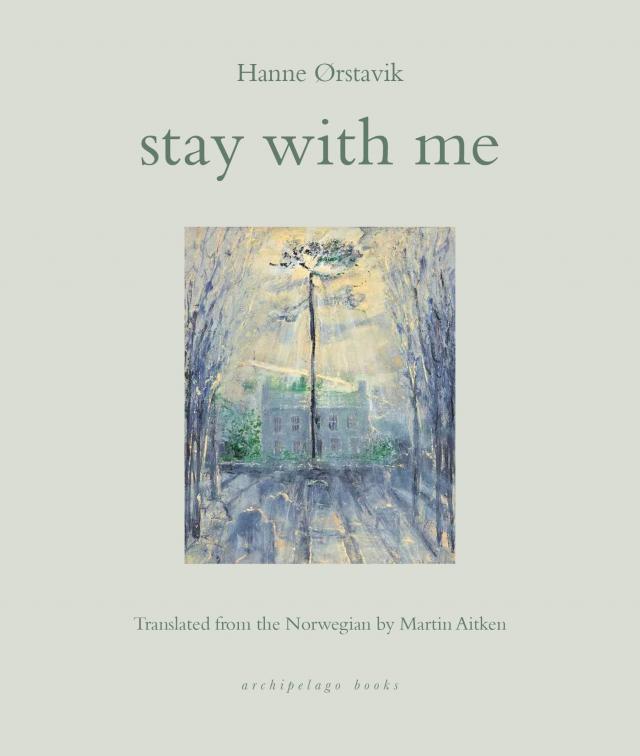
Cover Art © Celia Paul. The Brontë Parsonage (with Charlotte’s Pine and Emily’s Path to the Moors), 2017, Oil on canvas, 91.8 × 74.3 cm. Courtesy of the artist and Victoria Miro.
This work is made possible by the New York State Council on the Arts with the support of the Office of the Governor and the New York State Legislature.
This translation has been published with the financial support of NORLA.
This publication was made possible with support from Hawthornden Foundation, the Jan Michalski Foundation, the Carl Lesnor Family Foundation, the National Endowment for the Arts, and the New York City Department of Cultural Affairs.
a_prh_7.1_150811624_c0_r0
Contents
Chapter 1
Chapter 2
Chapter 3
Chapter 4
Chapter 5
Chapter 6
Chapter 7
Chapter 8
Chapter 9
Chapter 10
Chapter 11
Chapter 12
Chapter 13
Chapter 14
Chapter 15
Chapter 16
Chapter 17
Chapter 18
Chapter 19
Chapter 20
Chapter 21
Chapter 22
Chapter 23
Chapter 24
Chapter 25
Chapter 26
Chapter 27
Chapter 28
Chapter 29
Chapter 30
Chapter 31
Chapter 32
Chapter 33
Chapter 34
Chapter 35
Chapter 36
Chapter 37
Chapter 38
Chapter 39
Chapter 40
No one at home ever said they loved me. If I’d asked, I know they would have said yes, Mamma and Pappa, of course they loved me. Only I didn’t ask, part of the reason being that I didn’t want Pappa getting angry. And of course it was such an unquestionable thing. Like God loving mankind. It’s something you know. Why couldn’t I feel it?
They never touched each other, caresses, there was no tenderness between them. Mamma thought Pappa was sentimental, pathetic, pitiful, and at the same time she was afraid of him, afraid to death, there’d been that business with the axe out in the fields in the snow, in the middle of the night, Pappa had been drinking homemade vodka (so Mamma said), he went mad, ran wild and jumped over the stone wall, I can see it in my mind’s eye, over the wall in one leap, in the snow, so young and strong and lithe he must have been then, Pappa, younger than M is now, thirty-three or thirty-four, but now Pappa tells me it wasn’t like that at all, he hadn’t touched a drop, and he hadn’t gone mad either, the axe part had been misunderstood, he hadn’t been going for anyone but had taken the axe with him to use as a gavel, like in court, to emphasize something, a standpoint, most likely they’d been talking politics, your father’s gone mad, he’s gone running after people with an axe, and it all ended with the vet injecting him with a sedative, it took several men to bring him down and keep him there. But the thing with the axe is such a long time ago now, Mamma was pregnant with me when it happened, and it was only the once. It wasn’t Pappa with an axe we were afraid of. We were just afraid. What was it we were so afraid of?
It had to do with love, with the word being taken so much for granted I couldn’t feel anything. The only thing I could feel was afraid, afraid was real, the whole time. I can’t remember how it would happen, that Pappa would get angry. It just did. You could knock a glass over or be late for dinner. Your boot could have chafed your ankle while you were up on the fell, so you needed a plaster. You could get a fishing lure stuck after a cast. Perhaps you’d scribbled on the pad by the telephone. Or a school friend might come and ring the doorbell while we were having our dinner. It wasn’t these things in themselves, it was what they stood for: not being thoughtful enough, not being heedful. It wasn’t leaving the milk out, it was being that sort of person. The sort who’s negligent, thoughtless, who never pays heed. It seems like such a small thing when I write it down. But it wasn’t small, it was everything. The world was hard. Wrong was wrong. When it could have been right. Afraid was a state of being. I don’t know when it started. All I know is that I was afraid, afraid was a skin beneath my skin that couldn’t be shed.
It’s strange to be writing this. That we were afraid. It makes me cry, I’m crying now as I write, I’m saying out loud to myself: afraid was all we were. We were afraid the whole time. Now I’m nearly fifty-three years old.
And I ask myself – what were we supposed to have been if we hadn’t been afraid? It’s almost as if there’s something missing, something else to have been instead. That too seems strange as I write it down, but it’s what I’m thinking: if we hadn’t been scared, if being scared had suddenly stopped, what would we have been instead?
When fear has become one’s inner layer, the part of you that’s real. If that’s then taken away: what’s left is like an enormous crater. Fear is total. Fear is water coming in everywhere, in every nook and cranny, under every bed. The girl I was, when she was ten for instance, if the fear she knew, if the reason for that fear, the most obvious reason, Pappa, hadn’t been there any more, if Pappa had died or Mamma had left him and taken me with her, would I not have been afraid any more? What would I have been then? Who am I, when I’m not afraid?
There’s something more. There’s something that can’t be traced back to a single point – it’s not like that. It’s something else, and I don’t know what it is.
I just didn’t understand. You can see it in the photos from when I was little. We were at the photographer’s in Vadsø when I was two, black and white, shades of gray, I’m sitting on Pappa’s knee, in a dark pleated skirt and white tights, my brother a year older on Mamma’s knee beside us. The others are smiling, but not me, I look scrutinous. It’s like I’m struggling to understand, the whole time. What are we doing? What are we doing here? I think I just didn’t get the point of anything the whole time I was growing up. Why live, if there’s no joy? If life isn’t good, if there’s no softness to it, if there’s no – love?
And, at the same time, feeling left out. Love was something others were doing. I saw it in films and could imitate it. But it wouldn’t let me in. I had no idea how to do it, felt ashamed of myself for the same reason. I tried to hide it. It just wouldn’t happen for me.
So when my husband, the father of our daughter, said, after twelve years, that there were other ways of living with a person, ways that were more loving, I knew he was right. I couldn’t do it. We got divorced. Because knowing never helped. I’ve known it all along. I’ve just never known what to do about it.
Ten years ago I met L, a publisher, and with L being close to someone became something good. What do I mean by that? I mean that slowly – sometimes yes, sometimes not – I began to loosen up and accept the presence in my life of another person. He was so kind. Gentle. His soft olive skin. The way his goodness shimmered in him, the way it could be seen in his face, his eyes, his little tremble. His hand, dry and warm. He asked nothing of me that I didn’t have. He made me feel, again and again, that I was good enough, better than I often thought. That I was welcome, and that he wanted me the way I was.
Four years it lasted, during the last two L was ill, and then he died. That’s two years ago now. A year later I met M. But even before L died, I knew I was going to write this novel. I’ve known it was there, I just never got started, I’ve waited and waited for it to open itself out to me and take me in, I’ve waited like mad for it to start happening.
——
The first thing I wrote, even before L died, was this:
She kneels and looks down into the water. A floating jetty extends some distance, it could have been a bridge, only it stops. Where it stops is where she kneels.
She looks down into the water, as if the water was a membrane and there was another world underneath.
As if what’s there, in that other world, is bits of her, bits that aren’t visible to her, or to anyone.
And so she kneels and looks down into the water, and it’s not that she’s waiting, she’s just being.
For a couple of years, only that image. I got no further. And it’s true, she wasn’t waiting. She was being. Being there on the jetty, being that image inside me, a state of being. It’s me who’s been waiting. Going around with that image, standing on the shore, walking all the way out along the jetty beh ind her, sitting down next to her, trying to see what she sees. Only I’ve never been able to reach her, have seen nothing.
And then one day it becomes possible to write:
She has remained there. She came with Myrto who was conducting at the concert hall, only then he died.
They’d been married just over a year, known each other five. She buried his ashes under the tree in front of the house, the one she sees from the window when she looks out. Last week his daughter told her she wanted some of his ashes too, to spread them somewhere (Papà). Judith scraped the grit aside with a trowel and there underneath lay the ashes still, as if a whole autumn of rain and a winter of snow had not passed since she buried them there, piles of snow that froze and later melted, over and over, and she tipped some of the ashes into a small container made of metal and sent them by post across the sea.
The images are so still. Unmoving. As if they’ve simply stopped. Her being is all there is. But what is she? She is this body that exists through the days. When night comes she lies down in the big bed, on the mattress that’s too soft, she turns off the light and the night is then all around her until it’s morning again.
A short time he was with her. In the mornings when they woke, he would look at her from his pillow and his gray eyes were so soft upon her.
Afterwards, in the beginning, she cried from the pit of her stomach, a weeping that was heavy and felt endless, that she could go in and out of, that was there with her the whole time.
How long does the beginning last. When does the beginning melt into something else, and become a person’s days. And when do those days change, and become something else still.
And what is there now? It’s as if she has emerged from what was dark and oppressive and hung over her, into something wide open and empty.
It’s not possible to know more about her than this. We see what we see. She knows no more about herself.
There are no eyes any more that see her as he saw her. That see in such a way that she could feel waves surging from a point in her middle, the heart presumably, as if her heart was a pink and opening bud agitating the surface of a bright green lake, bringing its waters into motion.
She had never been there before, to it lasting. To the softness in her chest enduring. To it not being cut off, the goodness in his eyes, that made it happen. To it not suddenly being gone. She started to believe in it, to bend, and become without thought.
And then it was he who was gone.
They were picked up at the airport by the concert hall’s factotum. They had two big suitcases each, Myrto’s two red ones and hers, a black and a blue. Her hand luggage included her laptop, the old heavy one, and a few books she hadn’t been able to leave behind. There’d been no logic to her choice, she’d simply taken the ones that had stood out to her as she scanned the bookshelves back home in Milan. Besides his sheet music, Myrto had with him a collection of Chekhov’s short stories and two books in French about music and meaning, as well as the notebook in which he wrote things down in tiny handwriting. It had always bemused her how a hand that could write so small could also make so much sound happen – how his body, so soft and gentle next to hers, could contain the same man who would burst into such life in front of an orchestra. So wild he appeared then, so unfamiliar and unexplored. The way she often thought of him when he came inside her, that every thrust was him, straining for the very limits, for insecurity and frailty too, straining for where there was no longer any distance between what was inside him and what was outside, in the music. And she had her first dress with her too, the one she’d sewn in secondary school, the fabric was brown, cotton, she’d sat in the kitchen with the sewing machine on the wobbly table, the evenings grew lighter with each day and when at last she was finished she’d worn it one day at school, only it hadn’t been at all like she’d imagined, that something about her would be made visible, that the dress would open something, draw the others closer to her, instead it was the opposite that happened, it was as if they moved still further away, she saw how they tried to hide their sniggers, no one understood, and yet the dress had survived, she took it with her every time she moved somewhere new.
In the car on their way from the airport Myrto chatted with Hardy, as the driver was called, while Judith looked out of the window, and even then: the feeling of everything being too big. That she’d ended up in a world where everything was oversized, the streets were extra wide, the buildings extra tall. As if everything was so big she could see the curvature of the earth, like on a beach where the whole horizon stretches out in front of you, the way it tilts away at the edges.
And the way she’d felt immediately that the green timber house in front of which Hardy pulled up was a place to be glad for, a home. It was a semi, theirs was on the right, two floors, red and yellow around the windows, it made her think of Pippi Longstocking. The other half, identical, was empty when they arrived, and still is now. The house belongs to the philharmonic and the concert hall. Hardy gave them the keys and wished them welcome, turned and waved as he went back to the car, and they stood a moment on the porch with their suitcases before unlocking the door and going inside.
Myrto holds the front door open for her as she steps through into the big hallway where the first thing she notices is the staircase, its brown hemp runner secured by a polished brass rod on every stair. He follows her in and pauses, his fawn-colored coat hanging open, his tousled hair swept back from his face as if he’s been standing in a strong wind, and he smiles, yes, he smiles at her.
And in that image of him smiling there, in the hallway of the house in which they’re going to live, she sees glimpses of so many other moments, she sees him in the music room in Milan, where the piano was, and the keyboard with the headphones, the big iMac on the desk beside it where he wrote his music, and in those moments he is so very far inside himself, or what he is listening to, or doing, standing shaking his arms that are held out at his sides, his eyes closed, or else he’s seated at the piano and looks so small, as if the piano is enormous and he’s just a little boy sitting on the stool, stretching up to reach, his back quite straight and his nose as pointed as a bird’s beak, stretching towards the sheet music higher up.
The way she’s closest to him when he’s not thinking that she’s there too, when he’s doing what he does and is not only immersed but consumed, it’s the intensity in him then that opens him to her, something opens to show her the place inside him that is so alive, and when he smiles at her in the hallway in the green house, she sees that place inside his smile.
Further inside, everything is so big, the worktop in the kitchen, like the ones she’s seen in films, in the middle of the floor, The Bridges of Madison County, Meryl Streep a fifties housewife, Clint Eastwood constantly pulling up outside in his pickup, he’s a photographer and from the Midwest, from Bellingham, Minnesota, not far from where they are now, and Francesca, as Meryl’s character is called, is Italian, and now she and Myrto coming straight from Milan, as if there’s a connection, Judith thinks, standing there in the kitchen, but says nothing, simply watches Myrto as if he was Clint and she was Streep, and now it’s all about them, the two of them together, in the kitchen, where the sink stands in front of a wide bay window. Now we’re in America, she thinks as she opens the extra-wide fridge. The 2.5-litre plastic bottle of milk, the brown paper bags on the worktop with the groceries someone’s bought for them at the supermarket. The big sofa, also green, in front of the fireplace, a blanket with stars and stripes draped over the armrest.
And there, inside the door, Myrto lifts her up in his unmuscular arms, strong enough nonetheless, and staggers the few steps to the staircase, and they laugh, she buries her nose in his white hair and sniffs in his smell, his hair, thinning now on top, revealing to her the brown flecks on the pink of his scalp, here a strand, there a strand, like stems of trees in a vast forest in which she’s running about – Myrto, she says, and pulls his head to her chest, the globe of the earth and the heavens together, and now she holds the whole world in her hands.
And then he had to go and die? It’s impossible to even imagine then. No one goes around thinking about death like that, Judith tells herself afterwards, by which point she thinks about death all the time, she sees it in her own face, Hello death, she says to the wrinkles around her mouth, to the skin that sags beneath her chin, Hello there, and death is then no longer unfamiliar, death is the inside of her hand as she smooths a length of fabric that will be made into a dress that will be draped upon her body that will one day die, it too, yes, the body inside the dress will die, and this gives everything a strange lightness, Judith thinks, that this is how it is, that everything is dead too.


