

Instinct: An Animal Rescuers Anthology, page 1


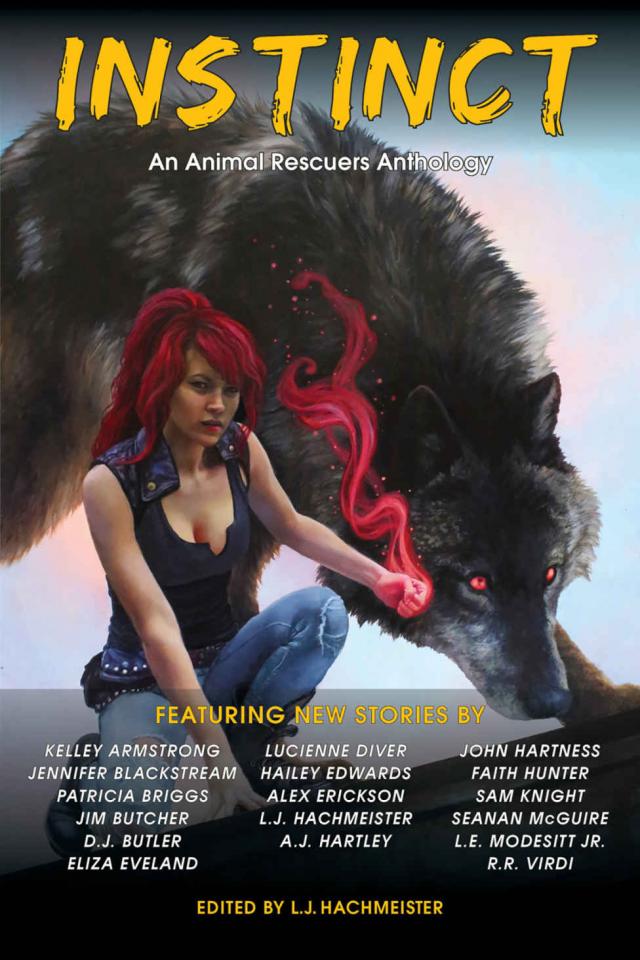
Table of Contents
Title Page
Copyright Information
Dedication
The Gold Standard by A. J. Hartley
Howl-O-Ween by Alex Erickson
Dog by D. J. Butler
Safe Place by Eliza Eveland
George and KitKit Save the Witches by Faith Hunter
Keeting it Real by Hailey Edwards
Helpful by Jennifer Blackstream
Fugitive by Jim Butcher
The Unlikeliest Places by John G. Hartness
Forever and A Day by Kelley Armstrong
The Unexpected Dachshund by L.E. Modesitt, Junior
The Kitcoon by L. J. Hachmeister
A Cry in the Night by Lucienne Diver
The Kindness of Cats by R.R. Virdi
Junkyard Rex by Sam Knight
Nine by Seanan McGuire
A Memory of Witches by Patricia Briggs
To Our Readers by L. J. Hachmeister
Instinct: An Animal Rescuers Anthology
Executive Editor: L. J. Hachmeister
Associate Editor: Sam Knight
Copyright © 2023 by Source 7 Productions, LLC
www.triorion.com
First Edition
This is a work of fiction. All names, characters, events, and situations portrayed in this book are products of the authors’ imaginations. Any resemblance to actual persons or events is purely coincidental.
All rights reserved. No part of this book may be used or reproduced in any manner whatsoever without written permission, except in the case of brief quotations embodied in critical articles or reviews. Please do not participate in or encourage the piracy of copyrighted materials in violation of the author’s rights. Purchase only authorized editions.
Cover art by Alessandra Pisano – www.alesspisano.com
Design by Nicole Peschel – Source 7 Productions, LLC
Executive Editor – L. J. Hachmeister – www.triorion.com
Associate Editor – Sam Knight – www.knightwritingpress.com
Published by Source 7 Productions, LLC Lakewood, CO
Dedication
This anthology is dedicated to Scott Cromer and all the wonderful folks at Lifeline Puppy Rescue.
Thank you for all the work you do to save lives.
The Gold Standard
A Will Hawthorne Tale from Bowescroft
By A. J. Hartley
RIGHT OFF THE BAT I SHOULD say that I didn’t like the dog. It wasn’t anything personal. I’m just not a dog person. I prefer my companions to have a bit more conversation and a bit less in the stink and teeth department. I should also say that the feeling was mutual. As the others fawned over the great brute, it stood there glowering at me as if determining if it would prefer me raw or lightly broiled.
Renthrette and Garnet had brought it home. Naturally. They said it would make an excellent watchdog, but really, they just liked its fur, which was white, and its eyes, which were blue, and its teeth, which were massive.
Also, they liked that it scared me.
“It’s just a dog, Will,” said Renthrette, pulling her sword from its sheath and rubbing its edge with a greasy rag. “What’s the big deal?”
“I don’t trust large animals,” I replied. “You know that.”
Getting me to ride a horse had required the kind of effort usually reserved for redirecting rivers.
“Being only a small animal yourself,” she replied with that wicked little grin she wore when she thought she was being witty.
“Hilarious as ever, Renthrette,” I said. “But the others won’t let you keep it anyway, whatever I say. We’ve barely had work in a month, and that beast will cost as much to feed as I do.”
“Maybe we should keep the dog and drop you,” she replied. “Or feed you to it.”
“More sparkling repartee. Excellent.”
“Well, at least the dog has a use.”
“Which is?”
“It’s an imposing guard,” she shrugged. “If people try to break in it will bark loudly and scare them off. Do you think you could learn to bark, Will?”
“I have proven myself more than useful to this little band of outlaws, thank you very much.”
“Look at those ears though!” said Renthrette, rubbing the dog’s head so that it half closed its eyes and grinned at me triumphantly. “So soft and cute. It’s really too bad you don’t have ears like his.”
“Stop. I’m, laughing too hard,” I said flatly.
“I’m enjoying myself,” said Renthrette. “I have a new adorable pet.”
“So, you are enjoying yourself at the expense of your old adorable pet,” I said, batting my lashes winsomely.
She rolled her eyes.
“His name is Durnok,” she said, “after the ancient wolf god.”
“You shouldn’t name it,” I cautioned. “You’re only making it harder on yourself.”
“Why?”
“Because,” I said very slowly, “the others won’t let you keep it.”
They let her keep it.
I argued, but the great brute padded around snuggling up to them, and they smiled at each other and rubbed its head till even I knew the battle was lost. Then it curled up at Lisha’s feet like the world’s most lethal rug, eying me in a smug sort of way and growling softly if I made any sudden moves, which Renthrette and Orgos thought hysterically funny. I managed a few growls of my own but when I did so the dog’s hair stiffened and it developed the kind of sudden stillness which promised bloody death soon after, so I stopped. That made Orgos laugh all the louder.
“What is with you and the dog?” he demanded when he had recovered. “And don’t give me that I don’t trust animals thing. We’ve been through too much. What I think is that you resent the dog because you’d rather it was your belly Renthrette was rubbing…”
I told him to shut up and when he started laughing again, I threw a bread roll at him, missing badly and startling the elderly woman who had come in to make up the fireplace, making Orgos laugh all the harder.
We were waiting on a job. More specifically, we were waiting for a man with information on a job. I was waiting to get paid. The man in question was one Rasnor Rains who we had never actually met because he was far too important to deal with the likes of us, but he had sent a handful of assorted flunkies to handle the details of our assignments. And the money. This was job five and, we surmised, the most important one to date.
So far, we had escorted a Lazarian spice dealer, whose breath could strip varnish, and his five camels, which smelled so bad they left you longing for the simplicity of varnish stripping, a wine merchant with a cargo of a sweet russet vintage he absolutely refused to let me sample (twice), and a Cherrat silversmith whose entire cargo fit in the hampers of two mules. The last job had been the shared harvest of a village some thirty miles from Bowescroft: three wagons of rice in sacks.
Pretty gripping stuff, right? In each case our job was to handle fees to guards (bribes), make sure the cargo made its way to the right collection point (different each time) and oversee the transit of said cargo from a distance which balanced inconspicuousness with the necessary immediacy required by actual combat. Fortunately, everything had gone smoothly so far. So much so, in fact, that I had started to think we were being overpaid; not a thought I have often had since I started putting my life on the line for money. That thought evaporated when we were given the details of our fifth and final cargo. It was gold. Not just gold though. It was gold from the Blackbird mine, which meant it was Empire property, but it wasn’t being handled by Empire operatives, which meant—in turn, as it were—that it was stolen.
Now, don’t get me wrong. I am quite happy to lift anything I can from the Empire and will sleep like a babe the night that I do. Why? Because the Empire is a brutal, soul crushing machine that flattens the world beneath it like a mill stone and anything I can do to be a thorn in their side, I’ll do. I’ll hold my hand up to that. The problem is that if they see me hold my hand up, they’ll cut it off, along with other assorted bits to which I am (in every sense) attached. So, acting as armed escort for whoever had stolen from the Empire made me, shall we say, uneasy.
When I say the gold was stolen from the Empire, I don’t mean someone broke in, fought off a hundred heavily armed troopers, and made off down the alley with a couple of sacks. That wasn’t how things worked. This was what you might call creative accountancy. Someone on the inside filled in a form, made some completely believable errors in basic arithmetic and quietly siphoned off a stream of ready coin into a corner where, officially, it didn’t exist. With the right connections, it was just a matter of marks on a few papers and a few inspectors being paid to look the other way. In other words, it was good old-fashioned corruption. But conceptual theft—robbing someone of numbers in a book—becomes a very different beast when those imaginary numbers have to become actual money. Then we get the aforementioned sacks which have to be sneaked down the alley.
Which is where we came in.
The minting process requires a lot of heat: all that melting of precious metals followed by a cooling process Orgos says is called annealing, repeated multiple times before the blanks are ready to be stamped into coins. This means that the mint consumes wood and coal at a massive rate, and produces tons of ash every week, but since the Empire knows how to turn everything—and I mean everything—into gold, the ash is carefully carted away and sold on to make soap, fertilizer and God knew what else. The poor sods whose job it was to collect the ash, sweep it into crates and haul it away, were only one step up from the miserable buggers who carted out the night soil. In some ways, the ash haulers had it worse since the blokes who handled the contents of the latrines didn’t have to worry about it still being hot enough to seer the skin off your hands, or roast your lungs from the inside if you made the mistake of breathing in. Actually, I suppose inhaling is best avoided in both professions, but you know what I mean.
Anyway.
All this skin blistering and lung searing meant it was clearly Our Kind Of Job. Lethal and illegal? Sign us up.
The gold would be still in its ingot form, carefully stashed within one of the smoking heaps of ash and, under cover of our lowly task, we were to make off with enough to buy someone a house. Possibly a village. And if it sounds like the smart course of action (instead of turning over our trove to our employer in return for fifty pounds in silver) would be to hightail it out of there with all that raw wealth in our saddle bags, don’t think I hadn’t already made that suggestion.
“And do what with it?” sneered Garnet.
“Spend it!” I said. “Obviously.”
“It’s bars of gold, not coins,” said Orgos.
“Sell it then!” I replied. “We’d make a fortune.”
“We’d get killed,” said Mithos, ever the ray of sunshine.
“We’re just cutting out the middleman,” I replied.
“Who will come after us,” said Garnet.
“And do some cutting of his own,” said Renthrette, completing her brother’s thought before he could have it.
“We don’t have the connections, Will,” said Lisha. “Unminted gold is carefully regulated. We’d need to be able to show provenance.”
“Where we got it,” said Orgos helpfully.
“I know what provenance means,” I snapped. “But we’re making a fraction of the profits despite doing all the work!”
“Welcome to real world economics,” said Orgos, returning to the dagger he had been sharpening on a whetstone.
I slumped to the table.
“It’s just that there will be So. Much. Gold,” I managed.
“For which we’ll be paid,” said Mithos.
“After which we will walk away with all our fingers and toes still attached,” added Orgos, eyes on his blade. “Won’t that be nice?”
“Assuming we don’t burn them off rooting through the red-hot ash,” I grumbled.
“Right,” said Renthrette, “because what our employer wants is that we risk melting all his gold. The ingots will be hidden in old ash. Cold ash.”
I muttered mutinously into the tabletop, opening my eyes to see the great white hound watching me with the canine equivalent of wry amusement.
“And you’ll be helping how?” I demanded.
The dog gave me a blank look, but Renthrette rallied to his defense as if I’d kicked him.
“He’ll be our watchful companion, won’t you Durnok?” she said, brightly at first, then in her best gruff doggie voice. “Yes, you will! Good boy, Durnok. Ignore silly Mr. Hawthorne. What does he know about anything? That’s right Durnok, he knows nothing! Stupid Will. He’s an idiot, isn’t he, Durnok? Isn’t he? Why don’t you bite his leg?”
“We should get our gear loaded,” said Lisha. “Raines will be here within the hour.”
Rasnor Raines was our contact at the forge, the man responsible for the creative accounting and, to all intents and purposes, our employer, though—for obvious reasons—he didn’t know our real names. He was the one who would be strolling off with the Empire’s hard-extorted cash minus the ten per cent grudgingly pushed in our direction. The son of a gold smith who had combined his father’s skills with a talent for finance, Raines had been in business in Bowescroft for a little over a decade. In that time, he had upgraded his facilities—and his contracts—twice, finding his way onto the Empire’s payroll four years earlier. Whether he had pulled this kind of stunt at their expense before, I couldn’t say. Maybe I’d ask him when he showed up.
I rethought that the moment I saw him. I wasn’t sure what I had expected—some kind of mild mannered and soft-spoken accountant-type, I suppose—but that was not what we got. Rasnor Raines was at least three quarters pirate, complete with eye patch and gold teeth. The remaining quarter also had a vaguely nautical feel though it was all stuff that lived under the surface. His skin was oily and his hair—braided into three thin rat tails—was yellow and lank, and hung down like the tentacles of a squid. His eyes were fishy too, not bulbous but blank, unfeeling and impossible to read. He would have made a good card player, assuming they played cards under the sea.
The dog didn’t like him. It grew stiff and watchful the moment he showed up, and its hackles prickled in little waves as he sat at the table and started talking in a low rasping voice without inflection. His eyes moved without interest or concern from hound to us, to the papers he had brought with him, sliding languidly back to the dog when its guttural snarl became impossible to ignore.
“Don’t mind Durnok,” said Renthrette, fractionally embarrassed. “It takes him a moment to get used to strangers.”
Raines shrugged, uninterested, and went back to his outline of our mission.
“You’ll need to be positioned here as soon as the gate opens at four,” he said, pointing at his makeshift map. “If you’re late, you’ll have to take your place in line with the other ash haulers and they’ll want to know who you are. There’s a community amongst these low lifes, and you’ll stand out. Park your wagon behind Franklin’s cotton warehouse on Low Street. Bring wheelbarrows to move the ash and move fast. Take only from vat 4. The ingots will be bagged. You’ll need to be loaded and gone in a half hour. That’s when the guard arrive. I’ll be making a show of opening for the day then, which means we need to be closed and you need to be gone well before.”
I made a sour face at Orgos. Four in the morning? This job just kept getting better. Raines caught my glance.
“Or you can sleep in and get arrested on the spot,” he said, his hard little shark eyes meeting mine and holding them. “Then I can say I’ve never seen any of you before, and you can take your chances in court.”
He flashed his sharp little fish teeth in a kind of mechanical smile. We all knew how the courts handled people suspected of trying to rob from the Diamond Empire.
“We’ll be there,” said Mithos.
“And you’d better be at the meet that evening,” I remarked, feeling the need to stand up to him a little. “With our money.”
He gave another impassive shrug as if my concern was unworthy of his attention, but he said, “Ten-o’clock in the alley behind the Clockmaker’s Arms on the corner of Jarvis and Hessian. Don’t be late then either.”
And then he was up and leaving, leaving a single coin on the table to pay for our food and drinks and five more “As a taste of things to come.”
That rather changed things. I hadn’t liked the man, but you couldn’t argue with gold. I picked up one of the coins and examined it closely, looking for that hint of brass which might make his generosity less impressive.
“Gold,” I pronounced. “Solid and as pure as I’ve seen in a long time.”
“He is a smith,” said Lisha cautiously.
Something in her tone caught my attention, and I looked up to find the others looking still and thoughtful.
“What?” I said. “He’s the real deal. His money certainly is. What’s the problem? We show up—admittedly earlier than I would like, but still—we load a wagon, and we take it to a pub where we get paid. Simple.”
“The dog doesn’t like him,” said Renthrette.
I laughed but she turned an acid glare on me.
“I was serious,” she said.
“So was I,” I shot back.
“You didn’t say anything,” said Garnet, always helpful.


