

Gunpowder God, page 1
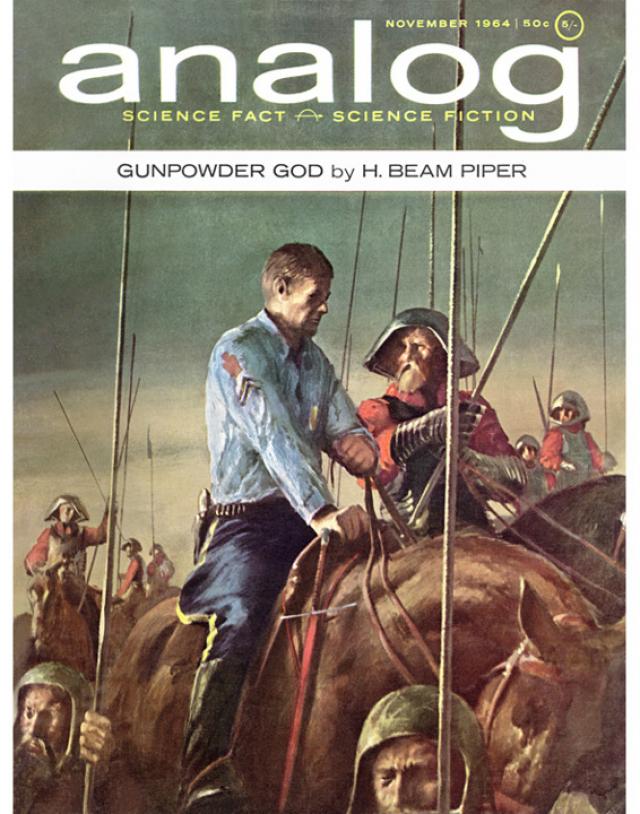


H. BEAM PIPER
GUNPOWDER GOD
Sometimes the Paratime transporters
slipped ... and then a whole new branch of
history was sure to start!
But for Corporal Calvin of the
Pennsylvania State Police that slip
was labeled “Opportunity” in large letters...
Tortha Karf, Chief of Paratime Police, told himself to stop fretting. Only two hundred odd days till Year-End Day, and then, precisely at midnight, he would rise from this chair and Verkan Vall would sit down in it, and after that he would be free to raise grapes and lemons and wage guerrilla war against the rabbits on the island of Sicily, which he owned on one uninhabited Fifth Level time-line. He wondered how long it would take Vall to become as tired of the chief’s seat as he was now.
Vall was tired of it already, in anticipation. He’d never wanted to be chief; prestige and authority meant little to him, and freedom much. It was a job somebody had to do, though, and it was the job for which he had been trained, so Vall would take it, and do it, he suspected, better than he himself had done. The job, policing a near-infinity of different worlds, each one of which was this same planet, Earth, would be safe in the hands of Verkan Vall.
Twelve thousand years ago, facing extinction on an exhausted planet, the First Level race had discovered the existence of a second, lateral, dimension of time, and a means of physical transposition to and from the worlds of alternate probability parallel to their own. So the conveyers had gone out by stealth, to bring back wealth in abundance to First Level Home Time-Line, a little from here, a little from there, never enough to be missed.
It all had to be policed. Some Paratimers were unscrupulous in dealing with outtime peoples—he’d have retired five years ago, but for the discovery of a huge paratemporal slave trade, only recently smashed. More often, by somebody’s bad luck or indiscretion, the Paratime Secret would be endangered, and that had to be preserved at any cost. Not merely the technique of para-temporal transposition, that went without comment, but the very existence of a race possessing it. If for no other reason, and there were many others, it would be utterly immoral to make any outtime people live with the knowledge that there were among them aliens indistinguishable from themselves, watching and exploiting. So there was the Paratime Police.
Second Level; it had been civilized almost as long as the First, but there had been long Dark-Age interludes. Except for paratemporal transposition, it almost equaled First. Third Level civilization was more recent, but still of respectable antiquity. Fourth Level had started late and advanced slowly; some Fourth Level genius was inventing agriculture when the coal-burning steam engine was obsolescent on the Third. And Fifth Level—on a few time-lines, subhuman brutes, fireless and speechless, were using stones to crack nuts and each other’s head; on most of it nothing even humanoid had evolved.
Fourth Level was the big one. The others had devolved from low-probability genetic accidents; Fourth had been the maximum probability. It was divided into many sectors and subsectors, on most of which civilization had first appeared in the Nile and Tigris-Euphrates valleys, and, later, on the Indus and the Yangtze. Europo-American Sector; they might have to pull out of that entirely, that would be Chief Verkan’s decision. Too many thermonuclear weapons and too many competing national sovereignties, always a disaster-fraught combination. That had happened all over Third Level within Home Time-Line experience. Alexandrian-Roman, off to a fine start with the pooling of Greek theory and Roman engineering ability, and then, a thousand years ago, two half-forgotten religions had been rummaged out of the dustbin and their respective proselytes had begun massacring each other. They were still at it, with pikes and matchlocks, having lost the ability to make anything better. Europo-American would come to that, if its competing politico-economic sectarians kept on. Sino-Hindic, that wasn’t a civilization, was a bad case of cultural paralysis. Indo-Turanian, about where Europo-American had been a thousand years ago.
And Aryan-Oriental; the Aryan migration of three thousand years ago, instead of moving west and south as on most sectors, had rolled east into China.
And Aryan-Transpacific, there was one to watch. An offshoot of Aryan-Oriental; the conquerors of Japan had sailed north and east along the Kuriles and Aleutians, and then spread south and east over North America, bringing with them horses and cattle and iron-working skills, exterminating the Amerinds, splitting into diverse peoples and cultures. There was a civilization along the Pacific coast, and nomads on the plains herding bison and cross-breeding them with Asian cattle, another civilization in the Mississippi Valley, and one around the Great Lakes. And a new one, only four centuries old, on the Atlantic seaboard and back in the Appalachians.
The technological level was about that of Europe in the Middle Ages, a few subsectors slightly higher. But they were going forward. Things, he thought, were about ripe to happen on Aryan-Transpacific.
Well, let Chief Verkan watch that.
She tried to close her mind to the voices around her, and stared at the map between the two candlesticks on the table. There was Tarr-Hostigos overlooking the gap, just a tiny fleck of gold on the parchment, but she could see it all in her mind, the walls, the outer bailey, the citadel and the keep, the watchtower pointing a blunt finger skyward. Below, the little Darro glinted, flowing north to join the Listra and, with it, the broad Athan to the north and east. The town of Hostigos, white walls and slate roofs and busy streets; the checkerboard of fields and forests.
A voice, louder and harsher than the others, brought her back to reality.
“He’ll do nothing? What in Dralm’s name is a Great King for but to keep the peace?”
She looked along the table, from one to another of them. The speaker for the peasants, at the foot, uncomfortable in his feast-day clothes and ill at ease seated among his betters, the speakers for the artisans and the merchants and the townsfolk, the lesser family members, the sworn landholders. Chartiphon, the captain-in-chief, his blond beard streaked with gray like the gray lead-splashes on his gilded breastplate, his long sword on the table in front of him. Old Xentos, the cowl of his priestly robe thrown back from his snowy head, his blue eyes troubled. And her father, Prince Ptosphes of Hostigos, beside whom she sat at the table-head, his mouth tight between pointed mustache and pointed beard. How long it had been since she had seen a smile on her father’s lips!
Xentos passed a hand negatively in front of his face.
“The Great King, Kaiphranos, said that it was every prince’s duty to guard his own realm; that it was for Prince Ptosphes to keep raiders out of Hostigos.”
“Well, great Dralm, didn’t you tell him it wasn’t just bandits?” the other voice bullyragged. “They’re Nostori soldiers; it’s war! Gormoth of Nostor means to take all Hostigos, as his grandfather took Sevenhills Valley after the traitor we don’t name sold him Tarr-Dombra!”
That was a part of the map her eyes had shunned, the bowl valley to the east, where Dombra Gap split the mountains. It was from thence the Nostori raiders came.
“And what hope have we from Styphon’s House?” her father asked. He knew the answer; he wanted them all to hear it at first hand.
“Chartiphon spoke with them,” Xentos said. “The priests of Styphon hold no speech with priests of other gods.”
“The archpriest wouldn’t talk to me,” Chartiphon said. “Only one of the upper priests. He took our offerings and said that he would pray to Styphon for us. When I asked for fireseed, he would give us none.”
“None at all?” somebody cried. “Then we are under the ban!”
Her father rapped with the pommel of his poignard.
“You’ve heard the worst, now,” he said. “What’s in your minds to do? You first, Phosg.”
The peasant leader rose awkwardly, cleared his throat.
“Lord, my cottage is as dear to me as this fine castle is to you,” he said. “I’ll fight for mine as you would for yours.”
There was a quick mutter of approval along the table. The others spoke in their turns, a few tried to make speeches. Chartiphon said only: “Fight. What else?”
“Submission to evil is the worst of all sins,” Xentos said. “I am a priest of Dralm, and Dralm is a god of peace, but I say, fight with Dralm’s blessing.”
“Rylla?” her father asked.
“Better die in armor than live in chains,” she said. “When the time comes, I will be in armor with the rest of you.”
Her father nodded. “I expect no less from any of you.” He rose, and all with him. “I thank you all. At sunset, we dine together; until then, servants will attend you. Now, if you please, leave me with my daughter. Xentos, you and Chartiphon stay.”
There was a scrape of chairs, a shuffle of feet going out, a murmur of voices in the hall before the door closed. Chartiphon had begun to fill his stubby pipe.
“Sarrask of Sask won’t aid us, of course,” her father said.
“Sarrask of Sask’s a fool,” Chartiphon said shortly. “He should know that when Gormoth’s conquered Hostigos, his turn will come next.”
“He knows it,” Xentos said calmly. “He’ll try to strike before Gormoth does. But even if he wanted to, he’d not aid us. Not even King Kaiphranos dares aid those whom the priests of Styphon would destroy.”
“They want that land in Wolf Valley, for a temple farm,” she said slowly. “I know that would be bad, but—”
“Too late,” Xentos told her. “Styphon’s House is determined upon our destruction, as a warning to ot hers.” He turned to her father. “And it was on my advice, Lord, that you refused them.”
“I’d have refused against your advice. I swore long ago that Styphon’s House should never come into Hostigos while I lived, and by Dralm neither shall they! They come into a princedom, they build a temple, they make a temple farm, and make slaves of the peasants on it. They tax the prince, and force him to tax the people till nobody has anything left. Look at that temple farm in Sevenhills Valley.”
“Yes, you’d hardly believe it,” Chartiphon said. “They make the peasants on the farms around cart in their manure, till they have none left for their own fields. Dralm only knows what they do with it.” He puffed at his pipe. “I wonder why they want Wolf Valley.”
“There’s something there that makes the water of those springs taste and smell badly,” she considered.
“Sulfur,” Xentos said. “But why do they want sulfur?”
Corporal Calvin Morrison, Pennsylvania State Police, crouched in the brush at the edge of the old field and looked across the brook at the farmhouse two hundred yards away, scabrous with peeling yellow paint and festooned by a sagging porchroof. A few white chickens pecked disinterestedly in the littered barnyard; there was no other sign of life, but he knew that there was a man inside. A man with a rifle, who would use it; he had murdered once, broken jail, would murder again.
He looked at his watch; the minute hand was squarely on the nine. Jack French and Steve Kovac would be starting down from the road above where they had left the car. He rose, unsnapping the retaining-strap of his holster.
“I’m starting. Watch that middle upstairs window.”
“I’m watching,” a voice behind assured him. A rifle action clattered softly as a cartridge went into the chamber. “Luck.”
He started forward across the weed-grown field. He was scared, as scared as he’d been the first time, back in ‘52 in Korea, but there was nothing to do about that. He just told his legs to keep moving, knowing that in a few moments he wouldn’t have time to be scared. He was almost to the little brook, his hand close to the butt of his Colt, when it happened.
There was a blinding flash, followed by a moment’s darkness. He thought he’d been shot; by pure reflex, the .38-special was in his hand. Then, all around him, a flickering iridescence of many colors glowed, in a perfect hemisphere thirty feet across and fifteen high, and in front of him was an oval desk or cabinet, with an instrument panel over it, and a swivel chair from which a man was turning and rising. Young, well-built; wore loose green trousers and black ankle boots and a pale green shirt; a shoulder holster under his left arm, a weapon in his hand.
He was sure it was a weapon, though it looked more like an electric soldering iron, with two slender metal rods instead of a barrel, joined at the front in a blue ceramic knob. It was probably something that made his own Official Police look like a kid’s cap pistol, and it was coming up fast to line on him.
He fired, holding the trigger back to keep the hammer down on the fired chamber, and threw himself down, hearing something fall with a crash, landing on his left hand and his left hip and rolling, until the nacreous dome was gone from around him and he bumped hard against something. For a moment, he lay still, then rose to his feet, letting out the trigger of the Colt.
What he’d bumped into was a tree. That wasn’t right, there’d been no trees around, nothing but brush. And this tree, and the others, were huge, great columns rising to support a green roof through which only stray gleams of sunlight leaked. Hemlocks, must have been growing here while Columbus was conning Isabella into hocking her jewelry. Come to think of it, there was a stand of trees like this in Alan Seeger Forest. Maybe that was where he was.
He wondered how he was going to explain this.
“While approaching the house,” he began aloud and in a formal tone, “I was intercepted by a flying saucer, the operator of which threatened me with a ray pistol. I defended myself with my revolver, firing one round—”
No. That wouldn’t do, at all.
He swung out the cylinder of his Colt, ejecting the fired round and replacing it. Then he looked around, and started in the direction of where the farmhouse ought to be, coming to the little brook and jumping across.
Verkan Vall watched the landscape flicker outside the almost invisible shimmer of the transportation field. The mountains stayed the same, but from one time-line to another there was a good deal of randomness about which tree grew where. Occasionally there were glimpses of open country and buildings and installations, the Fifth Level bases his people had established. The red light overhead winked off and on, and each time it went off, a buzzer sounded. The dome of the conveyer became a solid iridescence, and then a cold, inert metal mesh. The red light came on and stayed on. He was picking up the sigma-ray needler from the desk in front of him and bolstering it when the door slid open and a lieutenant of Paratime Police looked in.
“Hello, Chief’s Assistant. Any trouble?”
In theory, the Ghaldron-Hesthor transposition field was impenetrable from the outside, but in practice, especially when two conveyers going in opposite paratemporal directions interpenetrated, it would go weak, and outside objects, sometimes alive and hostile, would intrude. That was why Paratimers kept weapons at hand, and why conveyers were checked immediately on emergence; it was also why some Paratimers didn’t make it home.
“Not this trip. My rocket ready?”
“Yes, sir. Be a little delay about an aircar for the rocketport.” The lieutenant stepped inside, followed by a patrolman, who began taking the transportation record tape and the photo-film record out of the cabinet. “They’ll call you when it’s in.”
He and the lieutenant strolled outside into the noise and color of the conveyer-head rotunda. He got out his cigarette case and offered it; the lieutenant flicked his lighter. They had only taken a few first puffs when another conveyer quietly materialized in a vacant space nearby. A couple of Paracops strolled over as the door opened, drawing their needlers. One peeped inside, then bolstered his weapon and snatched a radio phone from his belt; the other entered cautiously. Throwing away his cigarette, he strode toward the newly arrived conveyer, the lieutenant following.
The chair was overturned; a Paracop, his tunic off and his collar open, lay on the floor, a needler a few inches from his outstretched hand. His shirt, pale green, was dark with blood. The lieutenant, without touching him, looked at him.
“Still alive,” he said. “Bullet, or sword-thrust?”
“Bullet; I can smell nitro powder.” Then he saw the hat lying on the floor, and stepped around the fallen man. Two men were coming in with an antigrav stretcher; they and the patrolmen got the wounded man onto it. “Look at this, lieutenant.”
The lieutenant glanced at the hat. It was gray felt, wide-brimmed, the crown peaked with four indentations.
“Fourth Level,” he said. “Europo-American.”
He picked it up, glancing inside. The sweatband was lettered in gold, JOHN B. STETSON COMPANY. PHILADELPHIA, PA., and, hand-inked, Cpl. Calvin Morrison. Penna. State Police, and a number.
“I know that outfit,” the lieutenant said. “Good men, every bit as good as ours.”
“One was a split second better than one of ours.” He got out his cigarette case. “Lieutenant, this is going to be a real baddie. This pickup’s going to be missed, and the people who’ll miss him will be one of the ten best constabulary organizations in the world on their time-line. They won’t be put off with the sort of lame-brained explanations that usually get by on Europo-American. They’ll want factual proof and physical evidence. And we’ll have to find where he came out. A man who can beat a Paracop to the draw won’t sink into obscurity on any time-line. He’s going to kick up a fuss that’ll have to be smoothed over.”
“I hope he doesn’t come out on a next-door time-line and turn up at a duplicate of his own police post, where a duplicate of himself is on duty. With identical fingerprints,” the lieutenant said. “That would kick up a small fuss.”
“Wouldn’t it?” He went to the cabinet and took out the synchronized transposition record and photo film. “Have that rocket held; I’ll want it after a while. But I’m going over these myself. I’m going to make this operation my own personal baby.”


