

Federation, page 1
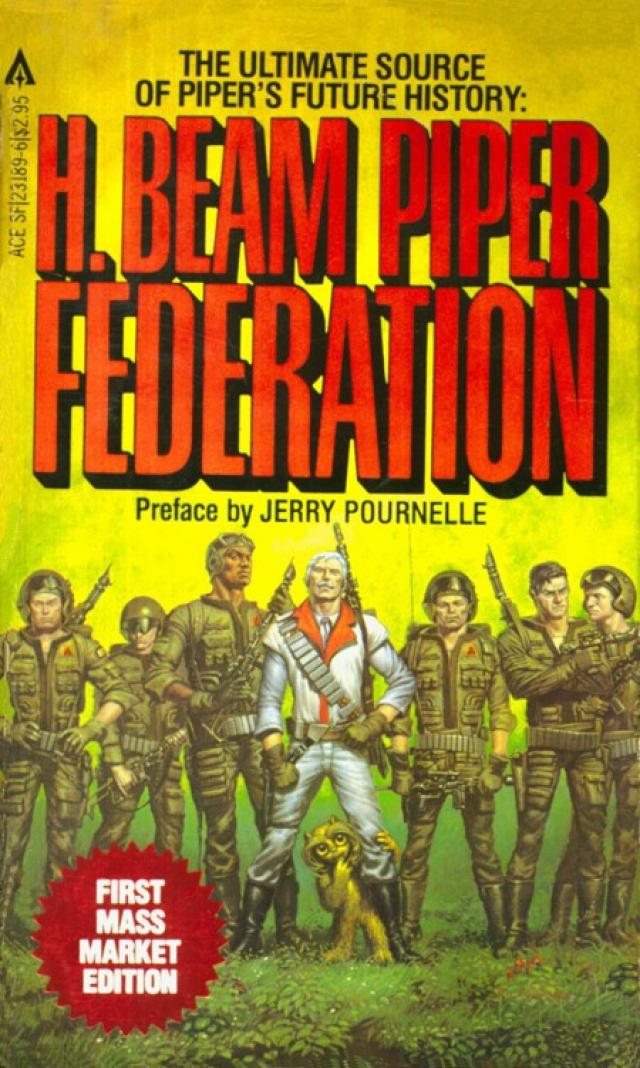


Scanned by Highroller.
Proofed more or less by Highroller.
Made prettier by use of EBook Design Group Stylesheet.
Federation by H. Beam Piper
Preface: PIPER'S FOUNDATION
Jerry Pournelle
I have a unique privilege: I have the legal right, acknowledged by the copyright owners, to do stories in H. Beam Piper's worlds.
This didn't come lightly. It was given to me by Beam Piper himself many years ago, long before I had any suspicion that I might write science fiction. Beam apparently knew my future better than I did.
It happens sometimes: an instant bond between two men on very short acquaintance. It was that way with Beam. He was twice my age. I had admired his writing. He had never heard of me, but was fascinated by my tales of the space program. We met, I think, in Poul Anderson's room, and we began talking; when we realized the time, it was dawn. The next night also ended at dawn; and for both of us the convention ended too quickly.
Afterwards we corresponded. I was then a graduate student in political science, studying the history of government, the pain and hopes and dreams of political philosophers and statesmen, the brutal realities of politicians…
Our letters read like treatises. Beam, though not formally educated, had read more books than most professors; and he was a keen observer of human nature. I for my part asked questions, or called attention to works he had not seen, adding little to the vast tapestry of the future Beam had conceived; and he expressed his thanks by offering me an equal right to the finished product. It was more than I had coming, but Beam never believed in doing anything by halves.
Then my degree was finished at last, and with my wife and young son I moved to California, where I was general editor of a top secret Air Force forecast of missile technology; a job that required me to understand everything, from warheads to guidance to rocket motor casings. I threw myself into the work. Beam continued to write, and I replied with post cards, or not at all; and one day I heard that he was dead by his own hand.
I didn't believe it. I called the police in Williamsport, convinced that he had been murdered by someone clever; but no, the note was authentically Beam Piper.
There remain questions. His extensive notes have never been found; yet I know that he kept a well-organized set of looseleaf notebooks, with entries color-coded; a star map of Federation and Empire; a history of the Systems States War; and other materials including some of my own letters which answered historical questions he had posed. Somewhere out there is a gold mine.
It isn't all lost. I have his letters; and some of his notes can be deduced from his writing. Beam firmly believed that history repeated itself; or at least that one can use real history to construct a future history. The casual reader will not easily deduce the historical models Beam employed. He was familiar with forgotten details: as an example, one of the battle scenes in Lord Kalvan is drawn directly from the obscure Battle of Barnet in the Wars of the Roses. He knew the grand sweep of history, but he also knew the small tales; the intrigues and petty jealousies, heroism and cowardice, honor and betrayals.
This, I think, is why his stories have such a ring of truth. They seem real because many were real. Such things as ix happen in Piper's statecraft have happened time and again to real politicians.
And to real heroes and heroines: for all his knowledge, Beam was no dry intellectual. He was a story teller; a man who could keep you up all night with his books and tales. He had respect for the intellect and for intellectuals, but he was never one of the breed.
He was a cavalier.
INTRODUCTION
John Carr
Acknowledgements
I would like to thank Jerry Pournelle for allowing me to use some of his personal reminiscences of H. Beam Piper and for allowing me to study the Piper notes and letters in his possession. I would also like to thank Charlie Brown for allowing me the use of his letters, Fred Pohl for his reminiscences, and Piper researchers William J. DenholmIII, Richard A. Moore, and Paul Dellinger, for their encouragement and support.
SCENE: The Beckman Auditorium, Pasadena, California; the California Institute of Technology—a cement circus tent the size of a zepplin hanger. In the first two rows of the balcony; A. E. Van Vogt, Theodore Sturgeon, Jack Williamson, Larry Niven, Greg Bear and Astrid Anderson, Dr. Donald Kingsbury, Harlan Ellison, Gregory Benford, and others of the SF clan, including your intrepid reporter. All guests of NASA and Jerry Pournelle, our gracious host for the weekend. On stage: Ray Bradbury, sf poet laureate and Martian Chronicalist; Carl Sagan, Mr. Cosmos: Walter Sullivan, Science Editor of the New York Times since 1966; Dr. Philip Morrison, Institute Professor of Physics at M.I.T.—first scientist to call upon the professional community to begin a serious search for extraterrestial signals; and lastly, Dr. Bruce Murray, Director of J. P. L. and creator of Purple Physics.
TOPIC: SATURN AND THE MIND OF MAN: Fourth in a series of symposiums on man and the planets.
Dr. Murray, his short cropped silver hair gleaming in the spots, looking like a California-tanned version of one of the original astronauts ten years later, hunches forward: "Saturn, our first look at this most magnificent planet, and we are there! This first glimpse at the terra incognita of Saturn will remain one of the finer moments throughout the time of man."
Great stuff, but what does it have to do with Beam Piper?
He wasn't there; and he should have been.
In my study of the life of H. Beam Piper, I ran head-on into a number of perplexing questions: Why, despite numerous reprintings, have Piper's books been ignored by academic critics and scholars? How is it that the man who created one of science fictions most detailed future histories received the following note in Peter Nicholls' The Science Fiction Encyclopedia: "Many of his (Piper's) novels and stories… are set in a common future history, but are insufficiently connected to be regarded as a coherent series."? (This last comment is mere sloppy scholarship, as I shall show in the essay on the Federation.) And why is Piper, who published most of his best fiction in Astounding/Analog, seldom mentioned as one of the great Campbell writers although he always places in the top ten in the readers polls?
The answers to these questions are bound within the Gordian knot of Piper's character, the low stature of science fiction and sf writers in general during the fifties and early sixties, Piper's premature death, and the subsequent unavailability of most of his work.
Horace Beam Piper was born in 1904, the son of a Protestant minister. He had no formal education and at age eighteen went to work as a laborer for the Pennsylvania Railroad's Altoona yards. Throughout his life he was a reticent and guarded man and as a result we know little about his early years. He was largely self-educated; he obtained a deep knowledge of science and history: "without subjecting myself to the ridiculous misery of four years in the uncomfortable confines of a raccoon coat."
While still working for the Pennsy Railroad, he sold his first story to John W. Campbell at Astounding Science Fiction. "Time and Time Again" appeared in the April 1947 issue and was the first of many time travel tales. Like the themes of nuclear war and the lost Martian races, time travel was a theme that would appear in many guises. In a moment of guarded confidence, Piper once admitted to Jerry Pournelle that "He Walked Around the Horses"-another time travel tale—was a true story. "I know," said Piper, "I was born on another time line." Even now Jerry can only say, "Beam looked me right in the eye when he said it. And if there was a twinkle in his eye, I couldn't find it." Jerry's still not sure whether he believes it, but he's almost certain Beam did. This would certainly go a long way toward explaining Piper's fascination with time travel, his Paratime stories, and his interest in the time theories of John Dunne, which dealt with parallel worlds coexisting in time and space. Although on the other hand it raises some questions that are far beyond the scope of this short study.
In a self-revealing quote from Murder in the Gun Room (Piper's only published mystery novel) a character describes his own writing:
Science fiction. I do a lot of stories for the pulps… Space-Trails, and Other Worlds, and Wonder Stories; mags like that. Most of it's standardized formula stuff; what's known in the trade as space-operas. My best stuff goes to Astonishing. Parenthetically, you mustn't judge any of these magazines by their names. It seems to be a convention to use hyperbolic names for science-fiction magazines; a heritage from what might be called an earlier and ruder day. What I do for Astonishing is really hard work, and I enjoy it. I'm working now on one of them, based on J. W. Dunne's time-theories, if you know what they are.
What was H. Beam Piper like? He was a lean man of medium height, with dark hair and a thin moustache. He was almost never seen without his pipe. A thin patrician nose bridged two flint-hard eyes which would occasionally twinkle as though listening to the punch line of some inner joke on the human condition. Jerry Pournelle describes him as a courtly gentleman of the old school; and even Jerry admits that Piper did not suffer fools gladly. He was soft-spoken and spent most of his time at sf conventions by himself, not even fraternizing much with the other writers.
I recently received a letter from Paul Dellinger, an old time fan, who had the following remembrance of H. Beam Piper. "My most vivid recollection of him (Piper) was his recalling attendance at a movie which sounded, from his description, like THEM. Anyway, he said about the time the giant insects appeared he stalked out in disgust. Another man who exited at the same time struck up a conversation with him, including the question of whether Piper had ever read any science-fictio n. "Hell," Piper said, "I WRITE the stuff!" This is a remembrance from Mr. Dellinger's first sf con in Washington D.C. in 1963, not long after the publication of Little Fuzzy.
That Piper was a hard working and conscientious man, there can be little doubt. From 1946 to 1956 he was a part-time writer and was published in Astounding, Future Science Fiction, Space Stories, and Amazing Science Fiction. All during this time he supported his elderly mother and continued to work for the Pennsy Railroad; it wasn't until 1956—after the death of his mother—that he was able to retire. Several years later he married a French woman whom he viewed with some ambivalence. He once confided to Jerry Pournelle that "she only married me to get an expensive Paris vacation." A letter to Charlie Brown, dated July 2, 1963:
I am now in the process of being divorced, if my future-ex-wife can ever get her French lawyers to get all the red-tape untangled. I suspect that she just doesn't know who to bribe. We are writing to each other again, in a very cordial and friendly manner. She reports that our red dachshund, Verkan Vail, of whom she retained custody when we split up, was in a movie, along with Bridgitte Bardot and Jean Gabin, a couple of years ago.
Piper was also very fond of guns and had quite a respectable gun collection, one that would be valued in six or seven figures today.
John H. Costello described it for the fanzine Renaissance:
His collection of more than 100 antique and modem weapons, ranging from a 450-year old French sword and a 400-year old Spanish poiniard with a gold inlaid blade, to a small brass cannon once mounted on a pioneer's blockhouse during the Indian fighting and a nine-millimeter pistol of the type used by German SS troops in World War II formed the background of his non-science fiction mystery. Murder in the Gunroom, published by Knopf in 1953.
While it's hard to judge the emotional effects of Piper's failed marriage, it is certain that the French honeymoon and subsequent divorce left him financially destitute. It was during this period that he wrote the Fuzzy novels, Cosmic Computer, Space Viking, and the "Lord Kalvan of Otherwhen" stories. It is a sad irony that while at the height of his writing prowess, he saw himself as a failure. When Ken White, his long-time agent, died, Piper was reduced to shooting pigeons from his hotel window to supplement his meager diet. White, who had kept all his clients' records inside his head, left Piper's business concerns in such a state of disarray that Piper was unaware of several sales to John W. Campbell. And when the third Fuzzy novel, Fuzzies and Other People, was rejected by Avon as being too dependent upon the other books in the series, he felt his career had come to an end. (The third Fuzzy novel has since become lost and is the property of the Piper estate now owned by Ace Books. Anyone aiding in its recovery will be amply rewarded.)
A solitary man to the end, Piper did not tell his friends of his financial predicament. Instead he took a way out that could only be reasonable to a man who abhorred state handouts and was determined not to burden his friends and family. On Monday, November 9th, 1964, H. Beam Piper shut off all the utilities to his apartment in Williams-port, Pennsylvania, put painter's drop-cloths over the walls and floor, and took his own life with a handgun from his collection.
In his suicide note, he gave an explanation that is pure Piper: "I don't like to leave messes when I go away, but if I could have cleaned up any of this mess, I wouldn't be going away. H. Beam Piper."
After ten years of neglect—from 1965 to 1976—due in large part to the problems of ownership and control of his estate, Piper's books have begun to fill the racks again in various Ace editions. The first to see print were the classic Fuzzy novels (often selling for $10 to $20 in their original Avon printings): Little Fuzzy and Fuzzy Sapiens, originally known as The Other Human Race. They have remained almost constantly in print ever since. These were followed by new editions of Cosmic Computer (Piper's title; the old Ace edition titled it Junkyard Planet), Lord Kalvan of Otherwhen, Space Viking, Four-Day Planet/Planet for Texans. With several more short story collections to come, the next few years should see the publication of almost the entire Piper cannon.
With the availability of Piper's short stories, many of which have been out of print since the forties and fifties, we should see a reevaluation of Piper's work and stature within the sf field. Had Piper lived to enjoy the sf boom of the late sixties and mid-seventies there is little doubt that he would be a major figure, standing among writers of Astounding's silver years such as Harry Harrison, Jerry Pournelle, Gordon Dickson, and Poul Anderson. In a recent poll of Analog readers' favorite writers, Piper placed well within the top ten—without having appeared there in 14 years.
While it is our loss that we will never know Beam Piper as a man, or read what he might have written had his life not come to such an abrupt end, it is our consolation that we can come to know and treasure him through his novels and stories.
I can still remember reading Lord Kalvan of Otherwhen and Space Viking, both good action-adventure novels, in the late sixties. But my real appreciation of H. Beam Piper didn't start until I went to work for Jerry Pournelle as his editorial assistant and researcher in 1977. Jerry had signed a contract several years before to do a sequel to Space Viking called Return of Space Viking, based on a rough outline and some notes Jerry had taken during talks with Beam. There had been some talk of a collaboration, and they continued to work on the project through their correspondence and late-night convention talks.
The project, of course, was shelved after Piper's tragic death. Jerry thought very little about it until the mid-seventies, when Roger Elwood, who had just become series editor of Laser Books, began to badger him about writing for the Laser line. Jerry eventually responded with several proposals, two of which eventually became the Laser Books titled Birth of Fire and West of Honor. The third of these proposed books, Exiles to Glory, was never released because of the internal problems which eventually brought an end to Laser Books. Of the four books Jerry proposed, only Return of Space Viking was never written, for several good reasons. While on casual inspection Space Viking may look like just another space opera, in reality it is one of the most complex and historically developed books in the science fiction field. As Jerry told me then, "It just seemed easier to write a new book from scratch than to spend several years doing the research necessary to do justice to Beam's Viking book."
So naturally my first research assignment was to take extensive notes on all the planets, history, characters, artifacts, and personal and political relationships contained in Space Viking. I thought it would be a piece of cake; after all, hadn't I done post-graduate work in history? My surprise! There aren't more than one or two pages in Space Viking that don't have some kind of historical or planetary reference, some which run for pages. On the first reading I picked up only the obvious; it took two more readings and several hundred note cards before I was finished.
But, of course, I wasn't done; now that I had discovered the fascinating and intricate tapestry of Beam's History of the Future I had to know it all. This meant reading everything he ever wrote as well as making elaborate charts and chronologies, and spending hours talking with Jerry about the historical events and models Piper used. Then, using Beam's correspondence and Jerry's notes, I tried with Jerry to plot the uncharted areas of the TerroHuman Future History.
Slowly and steadily we began to fill in large chunks of the missing territory. We began to gather steam as more and more of his conversations with Piper began to return to Jerry. Piper's original plan had been to write at least one novel per century of his future history; accordingly he had file folders for each century containing all the pertinent historical data and characters. Even had he lived his full life span it is doubtful that he would have ever finished this monumental task, for there is evidence that the TerroHuman Future History (to simplify matters, we will call it TFH) was to continue for over six thousand years. It is hard to believe that even Beam could have written another fifty to sixty books in the twenty years he might have been expected to live—although it would have been nice to see him try. But he had already admitted the futility of this plan to Jerry during one of their discussions on the popularity of the Fuzzy novels—a popularity which forced him to write two sequels, only one of which was published, in the Seventh Century Atomic Era.


