

Down Styphon!, page 1


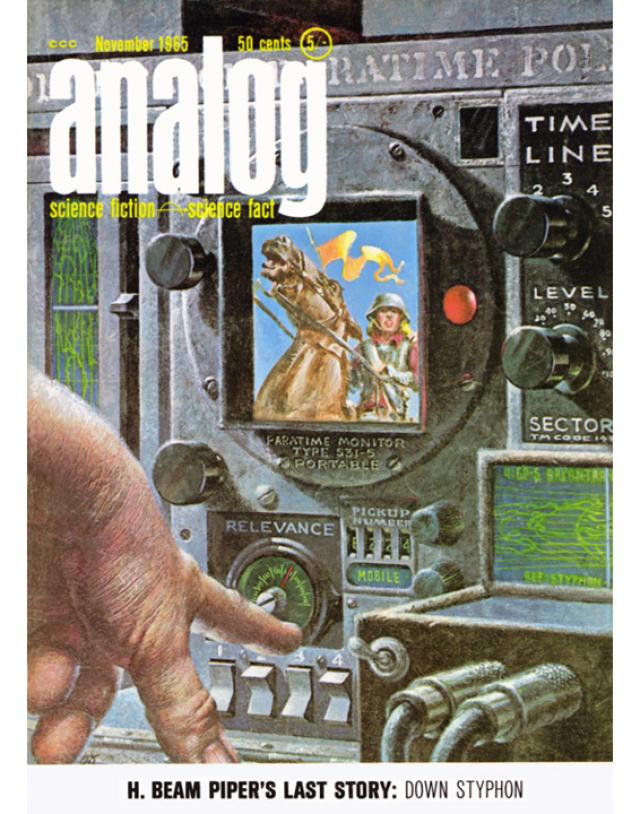
H. Beam Piper
Down Styphon!
The last story Beam Piper finished
before his death—another tale of the
Pennsylvania State Trooper thrown on
his own in another time-line.
With one great advantage—he knew
military history those folks never heard of!
In the quiet of the Innermost Circle, in Styphon’s House Upon Earth, the great image looked down, and Sesklos, Supreme Priest and Styphon’s Voice, returned the carven stare as stonily. Sesklos did not believe in Styphon, or in any other god; if he had, he would not be sitting here. The policies of Styphon’s House were too important to entrust to believers. The image, he knew, was of a man—the old high priest who, by discovering the application of a half-forgotten secret, had taken the cult of a minor healer-god out of its mean back-street temples and made it the power that ruled the rulers of all the Five Great Kingdoms. If it had been in Sesklos to worship anything, he would have worshiped that man’s memory.
And now, the first Supreme Priest looked down upon the last one. He lowered his eyes, flattened the parchment on the table in front of him, and read again:
PTOSPHES, Prince of Hositgos, to SESKLOS, calling himself Styphon’s Voice, these:
False priest of a false god, impudent swindler, liar and cheat! Know that we in Hostigos, by simple mechanic arts, now make for ourselves that fireseed which you pretend to be the miracle of your fraudulent god, and that we propose to teach these arts to all, that hereafter Kings and Princes minded to make war may do so for their own defense and advancement, and not to the enrichment of Styphon’s House of Iniquities.
In proof thereof, we send you fireseed of our own make, enough for twenty musket charges, and set forth how it is made, thus:
To three parts of refined saltpeter add three fifths of one part of charcoal and two fifths of one part of sulfur, all ground to the fineness of bolted wheat flour. Mix these thoroughly, moisten the mixture and work it to a heavy dough, then press the dough to cakes and dry them, and when they are dry, grind and sieve them.
And know that we hold you and all in Styphon’s House of Iniquities to be our mortal enemies, and the enemies-general of all men, to be dealt with as Wolves are, and that we will not rest content until Styphon’s House of Iniquities is utterly cast down and ruined.
PTOSPHES
That had been the secret of the power of Styphon’s House. No ruler, Great King or petty lord, could withstand his enemies if they had fireseed and he had none. Given here, armies marched to victory; withheld there, terms of peace were accepted. In every council of state, Styphon’s House had spoken the deciding word. Wealth had poured in, to be lent out at usury and return more wealth.
And now, the contemptible prince of a realm a man could ride across without tiring his horse was bringing it down, and Styphon’s House had provoked him to it. There were sulfur springs in Hostigos, and of Styphon’s Trinity, sulfur was hardest to get. When the land around the springs had been demanded of him, Ptosphes had refused, and since none could be permitted to defy Styphon’s House, his enemy, Prince Gormoth of Nostor, had been raised against him, with subsidies to hire mercenaries and gifts of fireseed. When Gormoth had conquered Hostigos, he was pledged to give the sulfur springs to Styphon’s House. Things like that were done all the time.
But now, Ptosphes was writing thus, to Styphon’s Voice Himself. For a moment, the impiety of it shocked Sesklos. Then he pushed aside Ptosphes’ letter and looked again at the one from Vyblos, the high priest of the temple at Nostor Town. Three moons ago, a stranger calling himself Kalvan and claiming to be an exiled prince from a far country—the boast of every needy adventurer—had appeared in Hostigos. A moon later, Ptosphes had made this Kalvan commander of his soldiers, and had set guards on all the ways out of Hostigos, allowing any to enter but none to leave. He had been informed of that at the time, but had thought nothing of it.
Then, six days ago, the Hostigi had captured Tarr-Dombra, the castle guarding Gormoth’s easiest way into Hostigos. The castellan, a Count Pheblon, cousin to Gormoth, had been released on ransom-oath, with a letter to Gormoth in which Ptosphes had offered peace and friendship and the teaching of fire-seed making. A priest of Styphon, a black-robe believer, who had been at the castle, had also been released, to bear Ptosphes’ letter of defiance to him.
It had, of course, been the stranger, Kalvan, who had taught Ptosphes’ people the fireseed secret. He wondered briefly if he could be a renegade from Styphon’s House. No; only yellow-robe priests of the Inner Circle knew the full secret as Ptosphes had written it, and had one of these absconded, the news would have reached him as swiftly as galloping relays of horses could bring it. Some Inner Circle priest could have written it down, a thing utterly forbidden, and the writing fallen into unconsecrated hands, but he questioned that. The proportions were different, more saltpeter and less charcoal. He would have Ptosphes’ sample tried; it might be better than their own.
A man, then, who had re-discovered the secret? That could be, though it had taken many years and many experiments to perfect the processes, especially the caking and grinding. He shrugged. That was not important; the important thing was that the secrecy was broken. Soon anyone could make fireseed, and then Styphon’s House would be only a name, and a name of mockery.
Perhaps, though, he could postpone the end for as long as mattered. He was near his ninetieth year; soon he would die, and for each man, when he dies, the world ends.
Letters of urgency to the Arch-priests of the five Great Temples, telling them all. A story to be circulated among the secular rulers that fireseed, stolen by bandits, was being smuggled and sold. Prompt investigation of all stories of anyone collecting sulfur or saltpeter or building or altering grinding mills. Immediate death by assassination for anyone suspected of knowing the secret.
And, of course, destruction of Hostigos; none in it to be spared, even for slavery. Gormoth had been waiting until his crops were harvested; he must be made to strike now. And as Archpriest of Styphon’s House Upon Earth to Nostor, this was quite beyond poor Vyblos’ capacities, with more silver, and fireseed and arms, for Gormoth.
He glanced again at Vyblos’ letter. A copy of Ptosphes’ letter to him had been sent to Gormoth; why, then, Gormoth knew the fire-seed secret himself! It had been daring, and fiendishly clever, of Ptosphes to give this deadly gift to his enemy.
And with the archpriest, fifty mounted Guardsmen of the Temple, their captain to be an Inner Circle priest without robe, and more silver to corrupt Gormoth’s nobles and his mercenary captains.
And a special letter to the high priest of the temple at Sask Town. It had been planned to use Prince Sarrask of Sask as a counterpoise to Gormoth, when Gormoth had grown too mighty by the conquest of Hostigos. The time for that was now. Gormoth was needed to destroy Hostigos; then he, too, must be destroyed, before he began making fireseed in Nostor.
He struck the gong thrice, and as he did he thought again of the mysterious Kalvan. That was nothing to shrug off; it was important to learn whence he had come before he appeared—he was intrigued by Vyblos’ choice of that word—in Hostigos, and with whom he had been in contact. He could have come from some distant country, in which fireseed was commonly made by all. He knew of none such, but it could well be that the world was larger than he thought.
Or could there be other worlds? The idea had occurred to him, now and then, as an idle speculation.
It was one of those small late-afternoon gatherings, with nobody seeming to have a care in the world, lounging indolently, smoking, sipping tall drinks, nibbling canapes, talking and laughing. Verkan Vall, who would be Chief of Paratime Police after Year-End Day, flicked his lighter and held it for his wife, Hadron Dalla, then applied it to his own cigarette. Across the low table, Tortha Karf, the retiring chief, was mixing another drink, with the concentrated care of an alchemist compounding the Elixir of Life. The Dhergabar University people—the elderly gentleman who was head of the department of Paratemporal Theory, the lady who was professor of Outtime History (IV), and the young man who was director of out-time study operations—were all smiling like three pussycats at a puddle of spilled milk.
“You’ll have it all to yourselves,” he told them. “The Paratime Commission has declared that time-line a study area, and it’s absolutely quarantined to everybody but University personnel and accredited students. And five adjoining, near-identical, time-lines for comparison study. And I will make it my personal business to see that the quarantine is rigidly enforced.”
Tortha Karf looked up. “After I retire, I’ll have a seat on the Commission, myself,” he said. “I’ll make it my business to see that the quarantine isn’t revoked or diluted.”
“I wish we could account for those four hours after he was caught in the transposition field and before he came to that peasant’s farm,” the paratemporal theorist fretted. “We have no idea what he was doing.”
“Wandering in the woods, trying to orient himself,” Dalla said. “I’d say, sitting and thinking, for a couple of hours, trying to figure out what happened to him. A paratemporal shift like that is a pretty shattering experience for an outtimer. I don’t think he was changing history all by himself, if that’s what you’re worrying about.”
“You can’t say that,” the paratemporal theorist reproved. “He might have killed a rattlesnake which would otherwise have fatally bitten a child who would otherwise have grown up to be an important personage. That sounds farfetched and trivial, but paratempor al alternate probability is built on such trifles. Who knows what started the Aryan migration eastward instead of westward on that sector? Some chief’s hangover, some tribal wizard’s nightmare.”
“Well, that’s why you’re getting those five control-study time-lines,” the operations director said. “And that reminds me; our people stay out of Hostigos on all of them for a while. We don’t want them massacred along with the resident population by Gormoth’s gang, or forced to use First Level weapons in self-defense.”
“What bothers me,” the lady professor said over the rim of her glass, “is Vall’s beard.”
“It bothers me, too,” Dalla said, “but I’m getting used to it.”
“He grew it when he went out to that time-line, and he hasn’t shaved it off since. It begins to look like a permanent fixture. And Dalla’s a blonde, now; blondes are less conspicuous on Aryan-Transpacific. They’re both going to be on and off that time-line all the time, now.”
“Well, your exclusive rights don’t exclude the Paratime Police. I told you I was going to give that time-line my personal attention.”
“Well, you’ll not introduce a lot of probability contamination, will you?” the paratemporal theorist asked anxiously. “We want to observe the effect of this man’s appearance on that time-line—”
“No, of course not. But I’m already established with these people. I am Verkan, a free-trader from Grefftscharr, that’s the kingdom around the Great Lakes. I am now supposed to be traveling on horseback to Zygros, about where Quebec is on Europe-American; I have promised Lord Kalvan to recruit brass-founders to teach the Hostigi how to cast brass cannon. He needs light field-pieces badly.”
“Don’t they have cannon of their own?” the historian asked. “I thought you said—”
“Wrought iron, welded up and strengthened with shrunk-on rings. They have iron works, there’s a lot of bog iron mined in that section, but no brass foundries. There are some at Zygros, they get their copper and tin by water from the west.” He turned to the operations director. “I won’t be able to get back, plausibly, for another thirty days. Can you have your first study team ready by then? They’ll be the Zygrosi brass founders.”
The young man nodded. “They have everything now but local foundry techniques and correct Zygrosi accent. They’ll need practice, you can’t get manual dexterity by hypno-mech. Yes, thirty days’ll be plenty.”
“Good. We have two Paratime Police agents in Hostigos now, a supposed blind minstrel and a supposed half-witted boy. As soon as I show up with your crowd, they can take off their coats and go to work, and they won’t even have to hunt for coathooks. And I’ll set up a trading depot to mask your conveyor-head. After that, you’ll be in business.”
“But you’re helping him win,” the paratemporal theorist objected. “That’s probability contamination.”
“No, it isn’t. If I didn’t bring in fake Zygrosi brass founders, he’d send somebody else to get real ones. I will give him information, too, just what any other wandering pack trader would. I may even go into battle with him, as I did at Tarr-Dombra, with a local flintlock. But I want him to win. I admire the man too much to hand him an unearned victory.”
“He sounds like quite a man,” the lady historian said. “I’d like to meet him, myself.”
“Better not, Eldra,” Dalla warned. “This princess of his is handy with a pistol.”
“Yes. The man’s a genius. Only a police corporal on his own time-line, which shows how outtimers let genius go to waste. We investigated his previous history. Only son of a clergyman; father named him for a religious leader, and wanted him to be a clergyman, too. As a boy, he resisted, passively; scamped all his studies at college except history, and particularly military history, in which he was much interested. Then they had this war in Korea, you know what that was, and it offered him an escape from the career he was being forced into. Father died while he was at war, mother a year later. After the war he entered the Pennsylvania State Police. Excellent record, as far as his opportunities went; held down by routine because nobody recognized him for what he was. Then he blundered into the field of that conveyor, just when it went weak, and—”
Three months ago—no, just “at another time,” he was sure of that—he had been Corporal Calvin Morrison, Pennsylvania State Police. Now he was the Lord Kalvan, in command of the army of Prince Ptosphes of Hostigos, and soon he would marry Ptosphes’ daughter Rylla and become heir-matrimonial to the princely throne. That couldn’t have happened in his own world.
Hostigos, of course, was no vast realm. It was only as big as Centre and Union Counties, Pennsylvania, with snips of Clinton and Lycoming. That was precisely what it was, too, except that here-and-now there was no Commonwealth of Pennsylvania, it was part of the Great Kingdom of Hos-Harphax—Hos- meant great—ruled by a King Kaiphranos. No, just reigned over lightly; outside his own capital at the mouth of the Susquehanna, Kaiphranos’ authority was nonexistent, the present situation for example.
When he was was less evident. Going to arrest a perfectly routine hillybilly murderer, he had entered what could only have been a time-machine; emerging from it, he had landed on what could only have been another time-dimension. He had theorized a little about that, and his theories had demolished themselves half constructed. Then he had given it up and dismissed the whole subject. He had other things to think about.
Rylla, for one; it was hard not to think about her all the time. And commanding an army, once he got it made into one. And manufacturing gunpowder in competition with Styphon’s House. And fighting a war, against uncomfortably steep odds. And, at the moment, a meeting of the General Staff, all of whom were new at it. So, for that matter, was he, but he had a few vague ideas of military staff organization which put him several up on any of the others. And he was hot and sweat-sticky, because he was wearing close to thirty pounds of armor, to accustom himself to the weight.
They all stood around the big table, looking at the relief map of Hostigos and surroundings which covered the entire top. Just to show you, none of this crowd had ever realized that maps were weapons of war. Maps, here-and-now, were illuminated parchment scrolls, highly artistic and wildly inaccurate. This one had taken over a month, he and Rylla doing most of the work, from what he remembered of the U.S. Geological Survey maps he’d used on the State Police, from hundreds of talks with peasants, soldiers, woodsmen and landlords, and from a good deal of personal horseback reconnaissance.
“The bakeries in Nostor work night and day.” That was old Xentos, the blue-robed priest of Dralm, who was also Prince Ptosphes’ chancellor and because of contacts with his co-religionists in Nostor, head of espionage and fifth-column operations. “And milk cannot be bought at any price, it is all being made into cheese, and most of the meat is being ground for smoked sausages.”
Field rations, stuff a soldier could carry in his haversack and eat uncooked. That could be stored, but Xentos also had reports of wagons and oxen being commandeered and peasants impressed as drivers. That wouldn’t be done too long in advance.
“Then they’ll strike soon,” somebody said. “Taking Tarr-Dombra hasn’t stopped Gormoth at all.”
“It delayed him,” Prince Ptosphes said. “He’d be pouring troops in through Sevenhills Valley now if we hadn’t.”
There was a smile on the thin lips, between the pointed gray mustache and the small chin-beard. Ptosphes had been learning to smile again, since the powder mill had gone into production. He hadn’t, before.
Chartiphon, bulky and grizzle-bearded, stood glowering at the map. He had been chief captain of Hostigos for as long as Ptosphes had been Prince; now he was second in command—Field Marshal and Chief of Operations—and gratifyingly unresentful at Lord Kalvan being placed over him. His idea of war was to hit every head you saw, and whoever hit the most heads first won. All this staff-stuff, maps and fifth columns and logistics and intelligence and security, he did not understand, and he was happy to let somebody do it who did. He’d been informed that Lord Kalvan had been hurled into the past from a thousand years in the future by sorcery, and he probably half suspected that Lord Kalvan was a sorcerer, himself.


