They Fear Not Men in the Woods, page 1


Copyright © 2025 by Gretchen McNeil
All rights reserved. Copying or digitizing this book for storage, display, or distribution in any other medium is strictly prohibited. For information about permission to reproduce selections from this book, please contact permissions@astrapublishinghouse.com.
This is a work of fiction. Names, characters, places, and incidents are products of the author’s imagination or are used fictitiously. Any resemblance to actual events, locales, or persons, living or dead, is entirely coincidental.
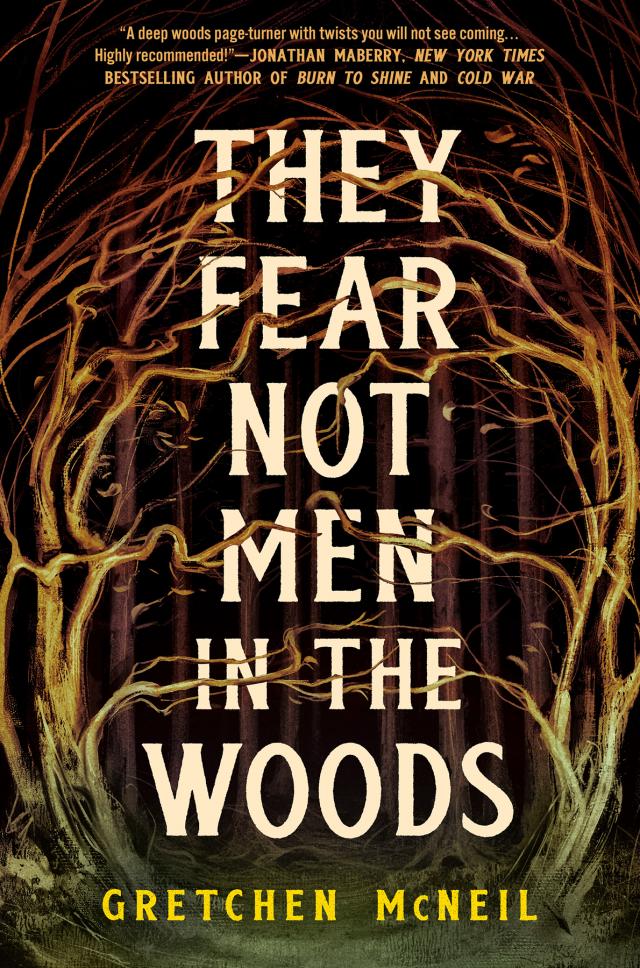
Jacket illustration by Sam Wolfe Connolly
Jacket design by Katie Anderson
Edited by Navah Wolfe
Book design by Fine Design
DAW Book Collectors No. 1988
DAW Books
An imprint of Astra Publishing House
dawbooks.com
DAW Books and its logo are registered trademarks of Astra Publishing House
Printed in the United States of America
Library of Congress Cataloging-in-Publication Data
Names: McNeil, Gretchen author
Title: They fear not men in the woods / Gretchen McNeil.
Description: First edition. | New York : DAW Books, 2025. | Series: DAW Book Collectors ; no. 1988 | Summary: “When Jen Monroe hears her father’s remains have been found, she returns home to disprove his death, only to find the forests of rural Washington are hiding horrors beyond imagining”-- Provided by publisher.
Identifiers: LCCN 2025012502 (print) | LCCN 2025012503 (ebook) | ISBN 9780756420086 hardcover | ISBN 9780756420093 ebook
Subjects: LCGFT: Horror fiction | Novels
Classification: LCC PS3613.C58597 T47 2025 (print) | LCC PS3613.C58597 (ebook) | DDC 813/.6--dc23/eng/20250325
LC record available at https://lccn.loc.gov/2025012502
LC ebook record available at https://lccn.loc.gov/2025012503
First edition: September 2025
CONTENTS
TITLE PAGE
COPYRIGHT PAGE
DEDICATION
EPIGRAPH
ONE
TWO
THREE
FOUR
FIVE
SIX
SEVEN
EIGHT
NINE
TEN
ELEVEN
TWELVE
THIRTEEN
FOURTEEN
FIFTEEN
SIXTEEN
SEVENTEEN
EIGHTEEN
NINETEEN
TWENTY
TWENTY-ONE
TWENTY-TWO
TWENTY-THREE
TWENTY-FOUR
TWENTY-FIVE
TWENTY-SIX
TWENTY-SEVEN
TWENTY-EIGHT
TWENTY-NINE
THIRTY
THIRTY-ONE
THIRTY-TWO
THIRTY-THREE
ACKNOWLEDGMENTS
In memory of the Yuba County Five:
Bill Sterling
Jack Huett
Ted Weiher
Jack Madruga
Gary Mathias
THE WAY THROUGH THE WOODS
They shut the road through the woods
Seventy years ago.
Weather and rain have undone it again,
And now you would never know
There was once a road through the woods
Before they planted the trees.
It is underneath the coppice and heath,
And the thin anemones.
Only the keeper sees
That, where the ring-dove broods,
And the badgers roll at ease,
There was once a road through the woods.
Yet, if you enter the woods
Of a summer evening late,
When the night-air cools on the trout-ringed pools
Where the otter whistles his mate,
(They fear not men in the woods,
Because they see so few.)
You will hear the beat of a horse’s feet,
And the swish of a skirt in the dew,
Steadily cantering through
The misty solitudes,
As though they perfectly knew
The old lost road through the woods.
But there is no road through the woods.
—RUDYARD KIPLING
ONE
Sunshine is overrated.”
There’s no one around for miles, so I say this out loud to myself, shivering as I scramble over a fallen Douglas fir, trunk lacquered in a slick coating of moss and lichen. It’s the first week of August, and though air conditioners are fired up everywhere else, beneath the thick canopy of a Northern California redwood forest, it’s downright chilly.
The word California conjures up specific imagery: sunbaked beaches scattered with tan lines and umbrellas, the iconic outline of a palm tree against a cerulean sky so bright, the silhouette is burned in to your retina before you can blink, freeways crammed tighter than a Tokyo bullet train at rush hour.
That’s Southern California.
My California is six hundred and fifty-ish miles north, and fuck me if you’ll find a sunbather, a palm tree, or a traffic jam not involving CalTrans work on a two-lane mountain road between Nowhere and Anywhere. Up here in Humboldt County, there’s more rain than sun, and the trees are not only much taller than your average Mexican fan palm but much, much older.
Case in point, the behemoth in front of me. Gnarled and demented in its beauty, this astonishingly old specimen of Sequoia sempervirens, aka the coastal redwood, soars thirty-plus stories above my head and has a diameter big enough to drive a car through.
That’s a real thing. Drive-thru redwoods. They’re peak kitsch out here, where tourists snap Instagram-worthy shots of their minivans scraping through the carved-out interior of a tree that’s been around since before their European ancestors invaded this continent. #drivethrutree #norcalroadtrip #bestlife
But you won’t find tourists or cars—or people, for that matter—in this isolated ravine, which is why I’m here.
I unhook my backpack, then lean against a horizontal tree corpse, easing the weight off my shoulders. As soon as the pack hits the ground, I get to work. An accurate assessment of size is tricky with a specimen this massive, but using a simple tape measure and my dad’s ancient clinometer, I’ve worked out a fairly accurate system. In less than an hour, I’ve made my rough estimates.
Long story short: this tree is fucking huge.
Hidden away in a mostly inaccessible notch valley deep in Prairie Creek Redwoods State Park, it’s a good bet that no human has visited this tree in a really, really long time. Now, thanks to a state grant, I’m part of a team on a fact-finding directive to, and I quote, “strengthen the nation’s woodlands through science-based, sustainable land management with the goal of conserving mature and old growth stands.”
Which means we’re counting and measuring trees.
Specifically, we’re counting and measuring really old trees, those that survived California’s timber boom. Our funding covers three sets of boots on the ground, including me, little old Jen Monroe from Barrow, Washington. The three of us are tasked with cataloging the mature and old-growth pockets in ten of Humboldt County’s designated state parks, recreation areas, and nature reserves. That’s over seventy-five thousand acres of land.
For three people.
It’s a Sisyphean task, and I’ve made twelve separate survey trips out here this summer alone, but there’s no place I’d rather be than knee-deep in the underbrush, the sun blotted out by the towering crowns of ancient redwoods, no other humans in sight.
I lower my instruments, staring cross-eyed at the number in my log. Eighty-four meters tall, at least. Damn. If my math is correct, we might have a new top-ten-tallest tree in the park. This is huge for our research, pun intended.
Mission accomplished, I double-check the tree’s coordinates against my GPS, then snap my notebook closed and pack everything away. Though I can’t see the sun, my watch tells me it’s time to head home.
I swing back toward the creek. After a quick leap over its narrowest point, I should be able to find the path I blazed on the way down into this valley. It’ll still be a tough trek up to the main trail, bushwhacking through wild huckleberry and chain ferns, my route blocked every quarter mile or so by a massive blowdown precariously balanced on the incline.
At least I won’t run into any rando hikers looking for Fern Canyon so they can recreate a scene from a Jurassic Park movie I’ve never seen. Leave it to Hollywood to ruin some perfectly perfect nature.
The lack of casual day hikers is good for me and them. For me, well, I’m not really a people person. Which is probably why I spend most of my free time here, off the grid. For them, these trails are dangerous, and it’s stupidly easy to get lost. Five miles of hard terrain to reach a road that maybe sees ten cars a day, and the weather in the valleys can turn real frigid real fast. The tourists, who show up in shorts and tank tops expecting July in Northern California to resemble the northeast or the Midwest or whatever humidity-steeped climate they hail from, freeze their asses off. Within twenty-four hours of arrival, they’re swarming the Target down in Eureka, grabbing any long pants and hoodies that’ll fit.
But none of them would venture this far off the main trail. Hell, they couldn’t even find this trail. I barely did, and I’ve been hiking the backcountry since I was a kid. For a brief moment, I think maybe I’m lost, but as I scale the side o f the ravine, I catch the outline of a hairpin turn etched into the embankment. A forgotten trail remnant from a time before records were kept. I found this path without a map or a guide or a well-meaning hint from my faculty adviser. Trailblazing is my superpower, a gift from my dad, Deputy District Ranger Hank Monroe of the USDA Forest Service, who’s been taking me camping since I was old enough to carry a pack.
He instilled in me a deep, all-encompassing love of trees. Just walking into a forest improves my mood. The soft, springy duff under my hiking boots, the crinkle of bark beneath my palm, nose assaulted by the peatiness of decay mixed with the sharp spice of fresh needles. The flora here may be different than the Douglas firs, western hemlocks, and western redcedars I grew up with in Washington, but forests are forests, and forests are magical.
And I’d rather spend time in the forest than with most humans I know.
Dappled by sunlight in the densest, deepest bowels of the valley, these trees hold a millennium’s worth of secrets. One or two of the specimens I cataloged on this trip might even be new “finds,” trees not laid eyes upon since this land became a protected forest, and whose rediscovery only adds to the list of old-growth behemoths in this park. It’s exciting. I’m actively contributing to the conservation of an ecosystem that’s been around since the reign of Charlemagne.
My dad’ll be proud.
With no one around to hear, I belt out one of his favorite songs, a diddly Irish piece my mom loathes.
“On the rocky road to Dublin, one-two-three-four-five.”
Even alone, I feel close to him.
Wherever he is.
Once I turned twelve, I was allowed to accompany my dad on survey assignments during spring and summer breaks. Sometimes it would just be the two of us. Sometimes Todd Johnson, the kid next door, would tag along, and together, we’d pretend to be junior rangers, training for our future careers. It was during these trips that I absorbed most of my dad’s wilderness and backcountry knowledge. I brought all that experience with me to college, and it has proved incredibly valuable, landing me a coveted graduate assistant position after I finished senior year. My department head, Hans, saw my promise, selecting me from dozens of applicants.
Oh, Hans.
Dr. Hans Martinez and Deputy Hank Monroe have more in common than just their initials and the fact they knew each other in college. They’re both environmentalists, both tireless advocates for silviculture education and forest protections, and they both inspire me.
Okay, so yes, when I was an undergraduate, I probably hero-crushed on Hans a little bit more than was entirely healthy, and after I graduated, I might have let that develop into something more . . . intimate.
And yes, falling into a relationship with a married man more than twice my age who is essentially my boss and who is also clearly a replacement for my long-missing father might not have been the best choice I’ve ever made, but my therapist says that we ultimately chase versions of our parents as romantic partners, and though sleeping with a facsimile of my dad might seem squicky on paper, it’s a helluva lot better than banging my mom.
Trust me.
Sweating despite the chill, I finally reach the main trail. The creek and my beloved old-growth redwoods are far below and miles away, where they will stay, unseen and unharmed as long as my heart beats. I inhale sharply, relishing a musty lungful of moist, loamy dirt, then check the time again. Half past four. It’s a three-hour up-and-down hike back to the trailhead parking lot, which would get me to my car well before dark, though my quads are already crying uncle. I could just camp here and head home in the morning, but Hans and I made tentative hookup plans for tonight, and skin-to-skin contact makes for a good motivator. I start down the ridge with renewed vigor, vaulting over yet another moss-painted log.
That’s when I hear voices.
Maybe “voices” is overplaying it. I hear whispers.
If you’ve ever been in a room full of kids who are desperately trying to keep their shenanigans a secret from the adults within earshot, then you know what I’m talking about. Miranda, my best friend from high school, has three younger brothers, so I am well versed in this discreet-yet-not-at-all form of communication, and these whispers, though unintelligible, are certainly not stealthy. They’re agitated. No, excited. Like they’ve just made some sort of discovery and can’t wait to share. I pause, chest heaving, and let my mouth gape open to minimize the sound of my own breathing while I listen.
There’s a term for this: auditory pareidolia. When the human ear discerns indistinct voices in random noise. After years exploring the wild and lonely wilderness, it’s a phenomenon I’m quite familiar with, so it’s with some authority that I say that what I’m experiencing is not auditory pareidolia. For one thing, that requires a baseline of noise: an exhaust fan, a white-noise machine, the constant hum of the wind gusting through trees. The problem is that other than the whispers, the forest has gone dead quiet. Not a bird, not a breeze, not a snap of a twig.
So, this time, the whispering is actually whispering.
It’s difficult to tell how many voices are coming through the trees—more than two but less than a dozen—and I stand as immovable as if I’ve grown roots in the spongy soil, fully expecting to see a group of hikers appear from behind the big tree at the bend in the path. Ten seconds turn into sixty. My breaths steady, then still. The whispers continue, but I realize they’re not getting louder, no Doppler shift. Whoever’s out there is neither coming nor going, just standing in one place.
Like me.
Weird.
“Hello?” My voice is jarring and raw with disuse. I’ve had no other company but myself for the past three days. “Can I help you?”
I sound like a saleswoman eyeing some raucous teens who’ve just entered her store, suspicious without cause. I don’t know why this chorus of raspy murmurs has put me on edge, but I can feel the skin on my neck tightening, tensing against whatever lurks around the next bend.
You’re being ridiculous, Jen. I’ve never once been afraid in the woods and I’m certainly not going to start now. Forcing my legs to work, I traipse forward. “Are you lost? Injured?” My attempt at casualness falls flat. Even a child could pick out the tremor in my tone.
No change in the whispers other than an increase in their volume and intensity as I approach, positively teased up with excitement. The forest is thinner here on the ridge, the main trail well-cleared, and the diameters of second-growth trees not nearly as mammoth as the ones below me in the valley. I should be able to see something between these slender trunks, but other than a flutter of fern branches as a summer breeze crests the ridge, nothing moves.
My fists are clenched though I have no idea why. A vague, half-formed sense that something is off. I’m not even sure what I’m expecting to see, but as I round the bend, I freeze.
There’s nothing here. Not a person, not an animal, not a hand radio that’s been dropped and forgotten. Nothing.
And the whispers have stopped.
I swallow, tamping down the fear that crowds my mouth and tastes like fermented cabbage. It must have been pareidolia after all. Or maybe a different kind of auditory illusion, voices from farther down the trail magnified by some bizarre atmospheric condition I’ve never heard of. I wait, listening for the whispers to start again. The wind ruffles my hair, pulling strands from my tightly bound ponytail. They drape across my face like a dark blond veil. But the silence remains.
Then from the corner of my vision, I see something. Way down trail, a figure darts behind a tree.
I don’t see it clearly; it’s gone in an instant. And dart might be too active a verb to describe the loping movement I see. Regardless, a quick glimpse is enough for my brain to matrix a human form, and for some reason I’m convinced its female.
“Hello, ma’am? Are you okay?”
I pick up my pace, fear vanished, as I morph from victim to hero in a heartbeat. Again, my dad’s legacy. Hikers lost in the woods are probably dehydrated, possibly injured, and almost always scared out of their freaking minds. That combination can do weird things to the brain. My dad told me stories of missing hikers who actually ran from search-and-rescue teams, the paranoia of days alone in the wilderness having done a number on their perception of reality. Between the whispering and the instinct to hide at my approach, I’m worried I might be dealing with a similar situation.
Pack bouncing as I trot toward her, I pull my phone from my hip pocket and glance at the screen. As expected, no signal. Our meager grant money doesn’t cover a fancy GPS satellite device, so if she’s unable to walk, I’ll either have to carry her out or race down the mountain until I can find some coverage. Neither are great options. I reach the tree in question—a larger specimen than most in this area—and all my worries vanish.