

The Collected Short Fiction, page 1


Jerry eBooks
No copyright 2022 by Jerry eBooks
No rights reserved. All parts of this book may be reproduced in any form and by any means for any purpose without any prior written consent of anyone.
The Collected Short Fiction
Greg Bear
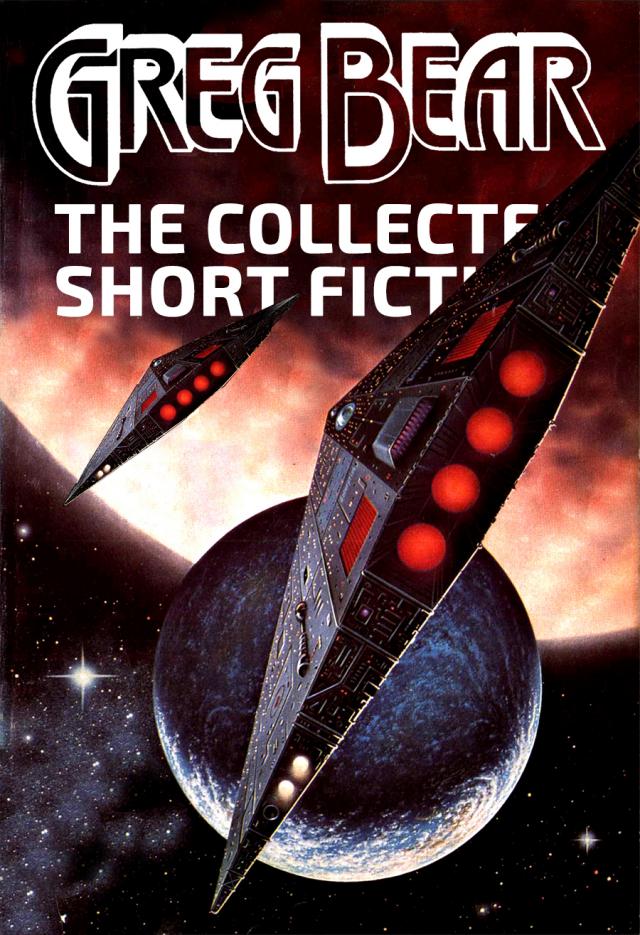
(custom book cover)
Jerry eBooks
Title Page
About Greg Bear
“Jay Kay Klein’s biolog: Greg Bear”
Bibliography: Novels
Bibliography: Serials
Bibliography: Chapbooks
Bibliography: Collection
Bibliography: Omnibus
Short Fiction Bibliography: chronological
Short Fiction Bibliography: alphabetical
Fiction Series
1967
Destroyers
1974
Webster
1975
Perihesperon
The Venging
1976
A Martian Ricorso
1977
Sun-Planet
1978
Mandala
Scattershot
The Wind from a Burning Woman
1979
The White Horse Child
1980
Ritchie By the Sea
If I Die Before I Wake
1981
Eucharist
1982
Petra
Schrödinger’s Plague
1983
Hardfought
Blood Music
1985
Through Road No Whither
Dead Run
1986
Tangents
1987
The Visitation and Other Divine Encounters
1989
A Seamless Future
Sleepside Story
Sisters
1990
Heads (Part One)
Heads (Part Two)
1991
The Man Who Would Be Kzin
1992
The Venging (1992 version)
Perihesperon (1992 version)
A Plague of Conscience
1995
Judgment Engine
1996
The Fall of the House of Escher
1999
The Way of All Ghosts
2000
Deep Ice and DNA languages
2002
MDIO Ecosystems Increase Knowledge of DNA Languages (2215 C.E.)
2005
RAM Shift Phase 2
2010
Warm Sea
2014
Genius
2015
Object 00922UU
The Machine Starts
2016
Silicon Times E-Book Review
2019
The Hungry Shadows
Gregory Dale Bear was born August 20, 1951 in San Diego, California, to Wilma M. and Dale F. Bear. His father was in the navy, and by the time he was twelve years old, he had traveled with his parents to Japan, the Philippines and Alaska, as well as touring various parts of the United States.
It was in Alaska, at age ten, that Bear completed his first short story. He had been writing for a year or so already. At age thirteen or fourteen Bear began submitting stories to the magazines, and at fifteen he sold my first short short to Robert Lowndes’ Famous Science Fiction. (It appeared when he was sixteen.) It took five years to sell his next story, but by the time Bear was twenty-three, he began selling regularly.
In the late 1960s, a group of high school friends, Bear, and local fans helped found San Diego Comic-Con. Bear served on the committee for a number of years. Today, Comic-Con is a totemic multimedia extravaganza drawing more than 120,000 attendees yearly.
Bear attended San Diego State University (1968–73), where he received a Bachelor of Arts degree. At the university, he was a teaching assistant to Elizabeth Chater in her course on science fiction writing, and in later years her friend.
In 1975, Bear married Christina M. Nielson; they divorced in 1981. In 1983, he married Astrid Anderson, the daughter of the science fiction and fantasy authors Poul and Karen Anderson. They have two children, Chloe and Alexandra. They reside near Seattle, Washington.
Occasional work as a freelance journalist had taken Bear to the Jet Propulsion Laboratory in Pasadena, where he covered all the the Voyager planetary encounters for the San Diego Union. In the 1970s and 1980s, he wrote many articles on film for the Los Angeles Times. Between 1979 and 1982 he reviewed books for the San Diego Union Book Review supplement. Bear’s opinion pieces and nonfiction have been published in Nature, Newsday and other journals and newspapers around the world.
Greg Bear’s last formal job was at the late, lamented La Jolla bookstore, Mithras. In the 1970s and 1980s he frequently lectured for the San Diego City Schools, acting as a roving teacher and conducting short classes on ancient history, the history of science, and science fiction/fantasy.
Bear is often classified as a hard science fiction author because of the level of scientific detail in his work. Early in his career, he also published work as an artist, including illustrations for an early version of the Star Trek Concordance and covers for Galaxy and F&SF.
In his fiction, Bear often addressed major questions in contemporary science and culture and proposes solutions. For example, The Forge of God offers an explanation for the Fermi paradox, supposing that the galaxy is filled with potentially predatory intelligences and that young civilizations that survive are those that do not attract their attention but stay quiet. In Queen of Angels, Bear examines crime, guilt, and punishment in society. He frames these questions around an examination of consciousness and awareness, including the emergent self-awareness of highly advanced computers in communication with humans. In Darwin’s Radio and Darwin’s Children, he addresses the problem of overpopulation with a mutation in the human genome making, basically, a new series of humans. The question of cultural acceptance of something new and unavoidable is also brought up.
One of Bear’s favorite themes was reality as a function of observation. In Blood Music, reality becomes unstable as the number of observers (trillions of intelligent single-cell organisms) spirals higher and higher. Blood Music was first published as a short story (1983) and then expanded to a novel (1985). It has also been credited as the first account of nanotechnology in science fiction. More certainly, the short story is the first in science fiction to describe microscopic medical machines and to treat DNA as a computational system capable of being reprogrammed; that is, expanded and modified. In later works, beginning with Queen of Angels and continuing with its sequel, Slant, Bear gives a detailed description of a near-future nanotechnological society.
While most of Bear’s work was science fiction, he had written in other fiction genres. Examples include Songs of Earth and Power (fantasy) and Psychlone (horror). Bear had described his Dead Lines, which straddles the line between science fiction and fantasy, as a “high-tech ghost story”.
Greg Bear had received many accolades, including five Nebula Awards and two Hugo Awards. He also served on the Board of Advisors for the Museum of Science Fiction.
Bear cited Ray Bradbury as the most influential writer in his life. He met Bradbury in 1967 and had a lifelong correspondence. As a teenager, Bear attended Bradbury lectures and events in Southern California.
Greg Bear died on November 19, 2022 in Seattle, Washington.
Jay Kay Klein’s
biolog
Greg Bear
l Authors are often known to complain about how an illustrator misread a story and screwed up a cover illustration. What can an author’ say to himself when he doubles in brass and gets his own cover all wrong? Greg Bear managed that feat early in his dual writing and illustrating career. He started writing science fiction at age 8. always thinking of himself as a “writer,” until at 15 he actually sold a story to a small, now defunct magazine. This ranks with the earliest sales on record, Charles Cloukey having equalled this back in the 1920s and Kenneth Sterling holding the record in the 1930s with a published story at age 12.
Analog held out a few more years, with editor John Campbell bouncing Greg’s single-spaced stories. He was gratified to receive Campbell’s famous, sprawling signatures on the rejection slips, and whatever words of wisdom the great man would offer It took ten years of trying to make that first Analog sale. And with years and years of writing behind him, it’s no wonder that first piece had style and polish. Editor Ben Bova gave “A Martian Ricorso” the lead-off position in the February 1976 issue and a Sternbach cover. Matter of fact, his second appearance also received a cover.
Greg was a Navy brat, growing up in Japan, the Philippines, Texas, Rhode Island, and Alaska He prefers his native state of California, though, and has lived there since 1964. The exotic locales of his childhood have contributed to a sense of the strange and inexplicable, which often appears in his writings—a basic feeling of the poverty, beauty, and history that underlie the lands beyond our borders.
A first novel, Hegira, followed closely by Psychlone and Beyond Heaven’s River, proved more rewarding—and writing more demanding—than illustrating, so Greg regretfully cut back to perhaps two paintings a year, just to keep his hand in. His covers have appeared on several of the science fiction magazines, as well as on hardcover and paperback books. Arkham House recently published a short story collection, The Wind from a Burning Woman.
He is a reader of fine books, with a fondness for those that a re beautifully illustrated and bound. His 6,000-volume library reflects interests in science fiction, fantasy, history, myth, and science. He has been teaching for the past several years on a freelance basis in the San Diego City Schools, lecturing on ancient history, history of science and magic, and science fiction.
Like small-town residents, science fiction fans and writers tend to mingle and marry within the community Greg is engaged to Astrid Anderson, daughter of writer Poul Anderson. Greg notes that among her many good points is a merciful tolerance for the foibles of a writer’s existence.
Originally appeared in Analog Science Fiction/Science Fact, June 1983
BIBLIOGRAPHY
NOVELS
Hegira (1979)
Psychlone (1979)
Beyond Heaven's River (1980)
Strength of Stones (1981)
Corona (1984)
The Infinity Concerto (1984)
Blood Music (1985)
Eon (1985)
The Serpent Mage (1986)
The Forge of God (1987)
Eternity (1988)
Heads (1990)
Queen of Angels (1990)
Anvil of Stars (1992)
Moving Mars (1993)
Legacy (1995)
/ (1997)
Dinosaur Summer (1998)
Foundation and Chaos (1998)
Darwin's Radio (1999)
Rogue Planet (2000)
Vitals (2002)
Darwin's Children (2003)
Dead Lines (2004)
Quantico (2005)
City at the End of Time (2008)
Mariposa (2009)
Hull Zero Three (2010)
Cryptum (2011)
The Mongoliad: Book One (2012)
The Mongoliad: Book Two (2012)
Primordium (2012)
The Mongoliad: Book Three (2013)
Silentium (2013)
War Dogs (2014)
Killing Titan (2015)
Take Back the Sky (2016)
BIBLIOGRAPHY
SERIALS
Heads, Interzone, July-August 1990
BIBLIOGRAPHY
CHAPBOOKS
Sleepside Story (1988)
Heads (1990)
Sisters (1992)
Hardfought (2011)
BIBLIOGRAPHY
COLLECTIONS
The Wind from a Burning Woman (1983)
Early Harvest (1988)
Tangents (1989)
Bear's Fantasies (1992)
The Venging (1992)
The Collected Stories of Greg Bear (2002)
W3: Women in Deep Time (2003)
Sleepside: The Collected Fantasies (2004)
Women in Deep Time (2008)
Sleepside Stories (2011)
Just Over the Horizon (2016)
Far Thoughts and Pale Gods (2016)
Beyond the Farthest Suns (2016)
BIBLIOGRAPHY
OMNIBUS
Star Trek (box set) (1989)
Songs of Earth and Power (1992)
Star Trek (box set) (1992)
Eon & Eternity (1999)
Journeys Through Time & Space: 5 Classic Novels of Science Fiction and Fantasy (2017)
The War Dogs Trilogy (2017)
SHORT FICTION BIBLIOGRAPHY
CHRONOLOGICAL
1967
Destroyers, Famous Science Fiction, Winter 1967/1968, December 1967
1974
Webster, Alternities, July 1974
1975
Perihesperon, Tomorrow: New Worlds of Science Fiction, 1975
The Venging, Galaxy Science Fiction, June 1975
1976
A Martian Ricorso, Analog Science Fiction/Science Fact, February 1976
1977
Sun-Planet, Galaxy Science Fiction, April 1977
Some Quantum Parables, Speculative Poetry Review #2, 1977
1978
[untitled poem], The Anthology of Speculative Poetry #3, 1978
Mandala, New Dimensions: Science Fiction: Number 8, April 1978
Scattershot, Universe 8, May 1978
The Wind from a Burning Woman, Analog Science Fiction/Science Fact, October 1978
1979
The White Horse Child, Universe 9, May 1979
1980
Richie by the Sea, New Terrors 2, 1980
If I Die Before I Wake, Dragons of Light, October 1980
1981
Eucharist, The Magazine of Fantasy and Science Fiction, June 1981
Strength of Stones, Flesh of Brass, Rigel Science Fiction #1, Summer 1981
1982
Petra, Omni, February 1982
Schrödinger’s Plague, Analog Science Fiction/Science Fact, March 29, 1982
1983
Hardfought, Isaac Asimov’s Science Fiction Magazine, February 1983
Blood Music, Analog Science Fiction/Science Fact, June 1983
1985
Through Road No Whither, Far Frontiers, January 1985
Dead Run, Omni, April 1985
1986
Tangents, Omni, January 1986
1987
The Visitation and Other Divine Encounters, Omni, June 1987
1989
A Seamless Future, Lotus Magazine, 1989
Sleepside Story, Full Spectrum 2, April 1989
Sisters, Tangents, August 1989
1990
Heads (Part One), Interzone, July 1990
Heads (Part Two), Interzone, August 1990
1991
The Man Who Would Be Kzin, Man-Kzin Wars IV, September 1991
1992
The Venging (1992 revision), The Venging, February 1992
Perihesperon (1992 revision), The Venging, February 1992
Jet vs. Sam the Sailor Sheep, Yarf! The Journal of Applied Anthropomorphics #20, April 1992
A Plague of Conscience, Murasaki, May 1992
1995
Judgment Engine, Far Futures, December 1995
1996
The Fall of the House of Escher, David Copperfield’s Beyond Imagination, December 1996
1999
The Way of All Ghosts, Far Horizons: All New Tales from the Greatest Worlds of Science Fiction, May 1999
2000
Deep Ice and DNA Languages, Nature, January 13, 2000
2002
MDIO Ecosystems Increase Knowledge of DNA Languages (2215 C.E.), The Collected Stories of Greg Bear, September 2002
2005
RAM Shift Phase 2, Nature, December 15, 2005
2010
Warm Sea, Gateways, July 2010
2014
Genius, A Darke Phantastique: Encounters with the Uncanny and Other Magical Things, 2014
Rebirth, HALO: Silentium, February 2014
2015
Object 00922UU, The Madness of Cthulhu: Volume Two, October 2015
The Machine Starts, Future Visions: Original Science Fiction Inspired by Microsoft, November 2015
2016
Silicon Times E-Book Review, Just Over the Horizon, April 2016
2019
The Hungry Shadows, The Hungry Shadows, November 2019
SHORT FICTION BIBLIOGRAPHY
ALPHABETICAL
#
[untitled poem], The Anthology of Speculative Poetry #3, 1978
A
A Martian Ricorso, Analog Science Fiction/Science Fact, February 1976
A Plague of Conscience, Murasaki, May 1992
A Seamless Future, Lotus Magazine, 1989
B
Blood Music, Analog Science Fiction/Science Fact, June 1983
D
Dead Run, Omni, April 1985
Deep Ice and DNA Languages, Nature, January 13, 2000
Destroyers, Famous Science Fiction, Winter 1967/1968, December 1967
E
Eucharist, The Magazine of Fantasy and Science Fiction, June 1981
F
The Fall of the House of Escher, David Copperfield’s Beyond Imagination, December 1996
G
Genius, A Darke Phantastique: Encounters with the Uncanny and Other Magical Things, 2014
H
Hardfought, Isaac Asimov’s Science Fiction Magazine, February 1983
Heads (Part One), Interzone, July 1990
Heads (Part Two), Interzone, August 1990
The Hungry Shadows, The Hungry Shadows, November 2019
I
If I Die Before I Wake, Dragons of Light, October 1980
J
Jet vs. Sam the Sailor Sheep, Yarf! The Journal of Applied Anthropomorphics #20, April 1992
Judgment Engine, Far Futures, December 1995


