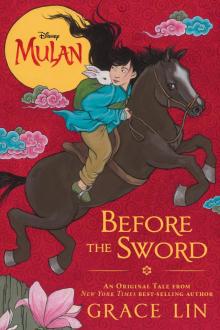
Mulan, page 21


“Mulan!” the voices called again. “Your parents want you! Xiu wants you!”
“Coming!” she said, giving one last look at the disappearing ears as she squeezed Black Wind farewell. Then Mulan, the great warrior, turned and ran into the warm yellow light of the tulou, transforming back to a daughter and sister.
ON THE edge of the desert, where hills of golden sand rose and fell like ocean waves, the bird that had once been the Red Fox landed.
She could never be the Red Fox again, she knew. Seeing Daji die—seeing the White Fox turn to that black puddle oozing insects—made her realize that she never wanted to be like Daji again.
Why didn’t that girl kill me, too? she wondered. Mulan. The girl, Mulan, must have seen how helpless she was trapped under the gourd. She would have been easy to destroy.
But instead Mulan had let her go. She remembered how their eyes had met that last time. All the things that had reminded Xianniang of Bouyue were still there in Mulan’s face—the sincerity, the innocence, the determination—but they had been tempered with something else. It had been sorrowful, but it was not pity, like the Rabbit. It had been understanding.
Xianniang stared toward the desert, but she was not seeing the shimmering, serpentine sands. She was thinking of Mulan. All this time she had believed that Mulan reminded her of Bouyue, but truly, Mulan had never been like him at all. Mulan had been like Xianniang. Mulan reminded her of herself.
Mulan would be returning home now, with a cure to save her sister. Perhaps she was already there. What would my homecoming have been like, Xianniang thought, if I had not become entangled with Daji?
But she was free of Daji now. Free from Daji’s demands, her anger, her maltreatment. But somehow not free. While Xianniang had not loved Daji, she did, oddly, miss her. Because now, she was alone.
Without realizing it, Xianniang had let her head droop, and a grey lizard slithered at her feet. It flicked its tongue as if scolding her and then disappeared.
Xianniang felt a strange amusement wash over her as she straightened. This lizard did not care that its existence was solitary; why should she? She was more powerful than any mortal in the kingdom. She had learned all of Daji’s magic and she no longer had to play the part of someone docile and meek.
Nor would she be like Daji, either. Xianniang may have obtained Daji’s same skills, but as she thought of Daji’s beguiling and luring, she felt disgust. No, Xianniang decided, she would neither pretend nor hide.
She summoned her power and felt it surge through her as she transformed. Her black hair flowed from her head and her fingers stretched as if unused to feeling only the weightless air. Her robes were not the delicate silk of a noblewoman’s maid, but a plainer cloth of graduated greys, as if night had bled onto a white mourning dress. It was adorned with scale-like armor—much like the lizard she had just seen. She closed her eyes and felt a band of white form at the top of her face. For Daji, she thought. Because Xianniang felt a strange twinge of something like grief for her dead mistress. No matter what, Xianniang knew that the White Fox would always be a part of her.
In the distance, a storm of dust surged into the blue sky. A silhouette of a man on horseback came into view. More men and horses joined him, one carrying a banner waving wildly in the wind. Xianniang could not see the emblem, but she knew it would be the head of a wolf. These were Rouran warriors.
They called me a witch, Xianniang thought. Let me show them what a witch can do.
And then Xianniang stepped onto the burning sands to join the warriors.
When Disney’s animated Mulan was first released, I was much too old to be its target audience. I had already graduated from college and was working toward getting my first book contract. But beneath my veneer of adulthood, I was absolutely thrilled with the delight of a child. A Disney movie with Asian characters? There was an Asian Disney princess (gasp!)? Had all my dreams of seeing someone who looked like me as heroine finally come true?
Well, yes and no. Seeing Disney’s Mulan was wonderful. For the first time in my life, I saw an Asian character championed and beloved, but it also made me hungry for more. And it reinforced the question I had begun to ask myself: why were there so few Asian characters in the stories around me? Why did it seem like Mulan was the only one?
For, of course, there have always been thousands and thousands of Asian characters—heroes and heroines, gods and goddesses, villains and demons. I found this out as I began to delve into Asian myths and legends and write my own stories. Following the threads of my own culture, I found an endless treasure trove of magic and wonder—a true “embarrassment of riches” that has fed all of my books, including this one.
For example, the Rabbit is based on a popular figure in Beijing, “Lord Rabbit.” If you are there during the Mid-Autumn Moon Festival, you may see in the shops little clay statues of a white rabbit dressed as a stately lord and riding a horse, a tiger, or even a dragon. He is the Moon Lady’s companion, sent to the Earth to save the people from a deadly plague, and—just as I have written in this book—able to change into anyone from a young girl to an old monk to accomplish his task.
Lu Ting-Pin is a character from Chinese mythology as well. There are many legends and stories of the Eight Immortals—a group of eight extraordinary beings with divine powers who dispense justice, alleviate suffering, help others find enlightenment, and generally cause havoc. Lu Ting-Pin (also referred to as Lu Dongbin or Lu Tung-Pin, depending on the transliteration) is often considered the leader of the group and always carries a double-edged evil-killing sword. He is also very typical of the Eight Immortals—kind, powerful, fun-loving, and brash, with a history of adventures. The sea beast that Mulan kills with the sword-boat is a reference to the giant octopus that Lu Ting-Pin is persuaded not to attack at the end of the famous “Eight Immortals Cross the Sea” saga. And while Xianniang is a new invention, her lineage was inspired by the story of Pai Shih—an ill-fated forbidden son of Lu Ting-Pin.
Daji is, unfortunately, inspired by a real person. Chinese history is littered with stories of ignoble emperors and kings whose final downfalls were influenced by their selfish and spoiled consorts. The last ruler of the Shang Dynasty (1600–1100 BC), Emperor Zhou, became enamored of a woman named Daji, who was so cruel that people could not believe she was human (she really did go boating on a pond of wine!). They began to say that she must be an evil fox spirit in disguise, for no person could be so wicked, and the infamous legend of Daji was born. However, the true story of the emperor causing a war just to amuse his beloved was not about Zhou and Daji. That was a different ruler, Emperor Murong Xi of the Later Yan dynasty (AD 384–407).
Oddly enough, we don’t really know if Mulan herself was a real person. Her first known mention comes from a folk song, “The Ballad of Mulan.” This tale of a girl who took her father’s place in war became a source of hope, encouraging soldiers to fight invaders in the fourth, fifth, and sixth centuries, and has never been forgotten—so much so that Mulan has continued to be a cherished character, showing up in plays and novels in the late Ming dynasty (1590s) to now. Hundreds of storytellers have added and embellished onto Mulan and her story, reinventing and rewriting variations of her story with romance, tragedy, and humor. Without a doubt, she has sparked endless images and stories from countless artists and writers.
Including me, of course. Disney’s Mulan introduced me to the possibility of an Asian heroine that could be embraced by all. That, in many ways, has fueled almost all the books I have created. From my first picture book, The Ugly Vegetables (published only a year after Mulan was first released), to my novels like Where the Mountain Meets the Moon and When the Sea Turned to Silver, I have been attempting to add to the line of Asian characters in American stories—that line that Mulan began for me.
Which is why I am so thrilled to share this novel with readers! To write about the character that inspired me before my first book was even published is an incredible full circle that truly delights me. I hope it does the same for you!
Best,
Grace Lin
A partial list of books that inspired Mulan: Before the Sword:
The Eight Immortals of Taoism: Legends and Fables of Popular Taoism, translated and edited by Kwok Man Ho and Joanne O’Brien. New York: Meridian, an imprint of New American Library, a division of Penguin Books USA, 1991.
The Eight Immortals Cross the Sea, illustrated by Chan Kok Sing, translated by Koh Kok Kiang. Singapore: Asiapac Books, 1999.
Infamous Chinese Emperors: Tales of Tyranny and Misrule, compiled and illustrated by Tian Hengyu, translated by Dai Shiyan. Singapore: Asiapac Books, 2006.
Tales of the Taoist Immortals, by Eva Wong. Boston, MA: Shambhala Publications, 2001
Tales of the Dancing Dragon: Stories of the Tao, by Eva Wong. Boston, MA: Shambhala Publications, 2007.
The Ballad of Mulan, retold and illustrated by Song Nan Zhang. Union City, CA: Pan Asian Publications, 1998.
Tales from 5000 Years of Chinese History, Vol. 1, by Lin Handa and Cao Yuzhang. New York: Shanghai Press and Publishing Development Company, 2010.
Special thanks to my editor, Brittany Rubiano, who thought of me for this book; my agent, Rebecca Sherman, who brought the project to me; my good friends Jarrett Krosoczka, Lisa Yee, and Mike Curato, who encouraged me to take it; and the Highlights Foundation Unworkshop that gave me a place and peace to finish it. Many thanks to my Middle-Grade Mojo Writer friends: Jackie Davies, Molly Burnham, Ali Benjamin, Leslie Connor, and Lita Judge, for their support while I struggled through, as well as dear friend Libby Koponen who was willing to be a sounding board for my early ideas. But the most thanks go to my partner, Alex, and my daughter, Hazel, who accepted my neglect as I created!
Thanks to Soyoung Kim and Scott Piehl for their design and art direction; managing editor Cathryn McHugh; copy editors Rachel Rivera and Warren Meislin; the studio franchise team, Sarah Huck and Dale Kennedy; the Chinese cultural consultants; and all the hardworking people at Disney for making my story into a book.
Lastly, thank you, the readers of this book. Stories must be shared to live, so it is only with you that my work comes to life. I am so glad that my words have found a way to you…so much so that you are even reading the acknowledgments!
Grace Lin, Mulan