Archibald Full Frontal, page 25


“Yes … we were involved.” He clears his throat.
I should have been shocked, but sitting in the car calmly discussing his past sexual tryst with my grandfather seemed almost normal. “What a fucked-up world,” I say. I long for a joint or an escape chute, anything to get away from this. Michael wasn’t just a ladies’ man.
“You have to understand … I was a young, aspiring writer and Archibald was … established. He took me in and showed me the ropes…”
“Among other things.” I couldn’t resist. “Was it a fling or…?”
“It was for me. I mean, it lasted a few months or so. Everyone experiments, right? Or at least they did back then.”
“Not everyone.”
“It was the seventies. The early seventies. Anyway, he helped me out, gave me pointers on my first book, and then I broke it off.”
“After it was published?” I ask dryly.
“That’s what he thought, that I had used him, and maybe I did. He got ugly … I tried to give him money to shut him up. He refused to take it, and I guess I probably didn’t handle it the best. I thought he would let it go. We didn’t see each other for years until he bought the apartment beneath me. But, even then, I never saw him much.”
“And you never thought to tell me this? That you were my grandfather’s boy toy?” I swallow back growing nausea.
“I had no idea who you were. When you told me, it was already too late. You have to believe me.”
“And when I told you who I was, you still didn’t—”
“What should I have done? Spilled my guts? Told you the whole sordid story? Yes, that would have been a good move. It would have turned you off and ... would you have wanted to know?”
I sit silently, considering.
“The answer is ‘no.’ I can tell you that.”
I can’t argue with him. Not really.
“I already cared about you. And he was ancient history. I never, never thought he would put it in a book.”
“That makes two of us,” I say, exhaling into the darkness of the car. “How old are you?” I ask. It has occurred to me that he must be way past his forties.
“What difference does that make?”
“What, fifty? Not sixty?”
“I am fifty-six,” he says huffily.
He was two years older than my father!
“I have young genes.” He shrugs. “Anyway, what difference does that make? Everything has turned to shit. My fan club shut down last week. Turns out it’s run by some gay-bashing right-wing nut jobs. My book deal has been put on a back burner so they can ‘prioritize.’ That’s what they said, ‘prioritize,’ like I was a bloody condiment in a grocery list. Christ!”
“I’m sure it will all come together,” I comfort him. Archibald had hit him where it hurt most, in the pocketbook. But he would figure out the angle and eventually turn it into profit. He was a businessman at heart. “This is the nineties. Who knows, it might actually be trendy to be bisexual one day.”
“Not for me. My readership is mostly women and heterosexual men.”
“Well, I guess you’ll expand into a new demographic?” And then I had an insight. “You’re why Archibald hates bisexuals so much!”
I press on unfazed. “What about Amelia?”
“Have you read it?” He reaches across me, opens his dashboard, and hands me a crumpled magazine. “Be my guest. You want to talk about betrayal, well, get in line.”
I find the article: “Crazy World: Not a Bedtime Story Is Stranger than Fiction by Amelia Bancroft.”
I sigh and skim the article. It begins with me, in a coffee shop.
“Maggie sighs plaintively,” she wrote, “clearly sleep deprived and depressed. She admits to her victimization, the bad luck of being caught in the quagmire of the bad blood between the two aging writers. Her affair with Michael Bancroft, long over, is one she recalls with regret. Terminating her employment with Archibald Weeks, after his latest offering revealed a version of herself that was too close for comfort, was necessary but traumatic. ‘I only read a few chapters, but it was like being ambushed in a dark alley and repeatedly drop-kicked,’ Maggie laments. ‘I might recover by the time I’m eighty.’”
“Shit. She must have been recording me,” I say. “She turned up out of nowhere, looking so lonely, batting her — your — eyes at me. I had no idea she was writing an article. I thought she needed someone to talk to. How could I be so dumb?”
“You were ensnared, I’m sure. You don’t come off that bad anyway, maybe a little dippy. It’s all aimed at me. I’m the villain. Me!” He whacks the window. “What have I done to deserve a daughter like this?”
He yanks the pages from my hands, opens the door, and tosses them outside. “She describes me as a deadbeat dad, a womanizing manwhore.”
Well, if the shoe fits, I think.
“She then describes every detail of my ‘affair’ with Archibald. She’s exposed me to the censure of the world ... I’m utterly indefensible.”
“Well, what can you do now?” I ask with a degree of sympathy. He seems so beaten down and vulnerable.
“I don’t know. She’s all but disappeared. I can’t cut off her trust fund; she’s emptied out her accounts, and her mother hasn’t spoken to me for months. She knows I’d never sue her for slander; that would look even worse. A father suing his daughter to get — what? His own money back?” He bangs his head repeatedly against the steering wheel and then keeps it there, hunched over.
“Michael, I always wondered, why me? You could have had any woman you wanted.”
He sits up and for a moment his eyes are clear. “You reminded me of who I was before the books, the money. Before him. Isn’t it ironic? You reminded me of someone I had lost.”
“That’s funny. For a time, you made me want to be someone else.”
“Then I am sorry. I loved you in a way that was just for you. It may not mean a lot now. But it’s true.” He reaches over and takes my hands and smiles. It is a broken version of the smile from all those times before.
I smile back at the strangeness of it all. It didn’t matter, none of it mattered. I had gone to the school of Michael, and I had graduated — moved on. But he would always have a place in my heart.
“What will you do?” I ask, letting go of his hands.
“Who knows? I’m screwed.” He sighs.
“True. But you will get over it. You’ll see.”
“And you? Will you get over it?”
This time I am way ahead of him: “I couldn’t be related to Archibald if I wasn’t a survivor.”
The reception for Archibald’s award is being held in the Pacific Wood Museum — a large, modern building with a high, dome-shaped ceiling constructed out of skylights. Sam and I arrive in Dan’s jeep; he’s agreed to drop us off and wait outside, like a getaway driver, in case we need to make a quick escape. The streets are already lined with posh cars. We enter through a side door as Penelope has instructed and are shown through a long corridor by a serious-looking, middle-aged man. I have tucked the original painting inside my portfolio case. It gives Archibald a debonair air, a Truman Capote quality. He would have loved it. The second portrait, the one that only Sam and I have seen, is wrapped in black velvet and concealed beside it. Sam carries the case carefully as we are shown to the green room.
“Oh, there you are,” sings Penelope. She is dressed in haute couture, which in this case involves a fluffy metallic peach dress, cinched with an enormous belt, and fishnets that flash her toned legs. It is very Cyndi Lauper circa 1985.
“Here we are,” I say with what I hope is a pleasant smile.
“I will just take this and set it up,” she says.
“Actually, Sam will handle the painting. I have put so much work into it. I’m a little bit superstitious.” I flash my eyebrows like an eccentric artist. This is the moment of truth; if she insists on setting it up herself, it will be much harder to pull off the switch.
“Oh. Okay,” she says in a trying-not-to-be-disappointed voice. “Follow me.” Sam unzips the portfolio case. Will she ask to see it now? I wonder, holding my breath. Just then, a man holding a clipboard approaches her. They whisper in an animated fashion.
“Absolutely no more martinis for him. Of course that includes schnapps!” I can only assume she’s referring to Archibald. “Water only. Test it first. He had a flask in his pocket. Wait…” She rushes after the assistant in full-blown crisis mode. Sam takes the opportunity to place the painting on the easel and cover it in velvet.
I hear applause as a mannish woman with a headset approaches.
Penelope reappears at my elbow: “It’s packed out there. What with all the awards and the press. Of course, Archibald is the main attraction. Nervous?” Apparently, Archibald’s book sales had been so impressive there had been a renewed interest in all of his work. He had, in fact, become a local celebrity for real, not just in his imagination.
“Not until you asked,” I say, feeling phantom butterflies swimming in my stomach. I look over at Sam, and the expression in his eyes steadies me. Even Archibald had written that I could put up a fight when I thought it worth my while.
“So, when you are introduced, you go on like we said. Say a few words and present the painting. Keep it short, though. We are running long. Sam will have to watch from backstage.” She flicks her eyes to him dismissively.
The woman with the headset motions to me. Sam squeezes my arm and whispers, “Go get him, tiger. I’ll be here waiting, no matter what.”
“Okay,” Penelope says, escorting me to the stage.
“Ladies and gentlemen, if I can have your attention one more time,” says the MC, an attractive forty-something woman I recognize as a local news anchor. Archibald sits behind her with three other award recipients. He leans on his cane and turns in my direction, basking in the limelight, stylish in a tux and a violet scarf. I notice the audience for the first time, rows and rows of familiar and unfamiliar faces.
“It is my pleasure to introduce Maggie Underwood, Archibald Weeks’s granddaughter. I am told that Maggie, a local artist, has a special presentation to make in Mr. Weeks’s honour,” the MC announces.
I glance behind me to confirm that the easel has been placed on the stage, still concealed in velvet, and make my way to the podium.
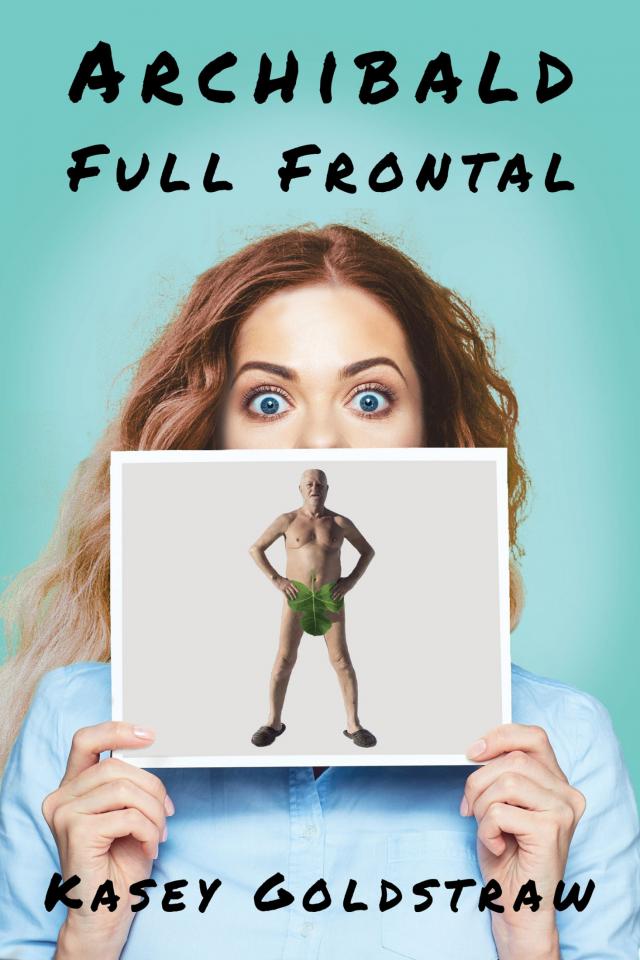
“Good evening,” I say in my most professional voice, leaning into the microphone, trying not to look at the faces that fill the cavernous auditorium. “I was compelled to come here tonight when I heard that Archibald was being honoured for his controversial work, Not a Bedtime Story. And it is quite a piece of work, isn’t it?” I swallow. “I wanted to give him something personal. Something that not only reflected how I see him, but that also conveyed what it feels like to be in my position, to be fully exposed, as his granddaughter. Archibald, this is my tribute to you. I call it Archibald, Full Frontal.”
I take a step back towards the easel and pull the black cover away in a single motion. There in full view is Archibald at his most unflattering. I have painted him emerging from shadows as he steps from the bath, bare skin a sickly greyish-white. His shoulders are hunched, his breasts rest on rolls of sagging stomach flesh, which hangs so low it partly, but not completely, conceals his shrivelled prune-sized genitals. His legs are two scrawny baseball bats beneath his wide midsection. He scowls out at the world, his eyes hollowed and sunken, with an expression of contempt on his face. I have rendered him as naked as he had rendered me. But he is not alone: the bathroom walls behind him are wallpapered with the severed heads of all the “friends” he betrayed in the novel and in life: Sam, Michael, the Deliahs, Rita, my mother, my grandmother, and me. Our eyes bulge like glazed olives, and our mouths hang open, revealing blackened tongues. In his hand, he holds a curved machete, from which bright cherry-coloured blood drips and pools around his feet. It is my most disturbing, and quite possibly my best, work. The portrait’s reveal is accompanied by a series of gasps, followed by a prolonged silence as people digest the garish image. Then the murmuring begins, growing more vociferous as it echoes through the room. Archibald, for his part, is still sitting, a frozen statue, face growing redder, until he finally lets out a raspy, explosive cough.
“Get him a glass of water,” a matronly woman seated beside him, another award recipient, urges. “I think he’s choking on an olive!” Would he fake his death in order to divert attention from the painting?
“Is this a joke?” the MC asks me, covering the microphone. “What should I do?”
Just then, Penelope swooshes onto the stage in crazed damage-control mode, like a beetle that has just had its brains bashed in. Instead of running to assist Archibald, she scoops the cover off the floor and attempts to throw it over the painting. As she passes me, I can’t resist sticking my foot out and tripping her. She stumbles madly in her heels, free arm flailing, screeching: “EEEEEEEK!” until she abruptly tips over, skirt and its crinoline layers swirling over her head like a puff pastry, and collapses in a crumpled heap. The velvet cover meanwhile has taken flight, like a magic carpet, and cascades to its final resting place in front of Archibald.
The MC, who is rushing to the still-coughing Archibald to deliver a glass of water, gets her foot caught in the velvet and skids, landing squarely in the lap of a middle-aged man seated on the other side of Archibald. The water sloshes from the glass, bathing the man, Archibald, and the MC. From my vantage spot, I can see the man underneath the MC take the opportunity to give her shapely ass a pronounced squeeze. She jumps up, takes a step back, and grinds her spike heel into his foot, all the while displaying a plastic smile for the audience’s benefit.
“Ahh!” screams the man.
“Try that again and see what I do!” she says out of the corner of her mouth. He bends over his maimed toes, moaning.
Archibald continues to cough, turning an alarming shade of puce. I watch, fascinated, as the dominoes continue to fall. The woman beside Archibald pounds him on the back. He lets out a whooping noise and spits a tiny green object out of his mouth with such force it flies into the audience.
Meanwhile, Penelope is still trying to free herself from the layers of her skirt. “What a clusterfuck!” she brays, rolling onto her knees. She tries to pull herself up by grabbing hold of the easel. “Help me, someone!” She makes it halfway up, and then the easel collapses with a crash, and the painting of Archibald slides off and lands face up on the stage. Penelope is back on her back, swearing up a storm.
The stagehand appears, talking into her headset, and attempts to help Penelope, now wrestling with the easel, off the stage floor. As she shoves him away, he shrugs. It seems she hasn’t made many friends among the staff.
The crowd’s noise intensifies. I hear laughter and shocked exclamations. “I think this wraps up the evening’s presentation,” the MC announces belatedly, once again at the podium. “Please enjoy the rest of your evening.” People begin jostling and pushing, some exiting the auditorium and others pressing towards the stage for a closer look.
A series of camera flashes blinds me momentarily as members of the press reach the bottom of the podium. Someone bends over the painting and takes a photo and then offers a furious Penelope a hand. Three security guards appear, calling nonsensical things into their walkie-talkies. I come back to reality and attempt to make my escape. Just as I reach the wings, I hear a familiar voice yell out, “Bravo! Bravo. Well done, my girl. Now this is what I call a party!” I turn to see Archibald being carried off, still in his chair, with a martini glass in his hand, held in a salute. Like the oldest prom king alive, he raises his glass higher, toasting the room, the people, the world at large, and as he does, he cackles like a man having the time of his life.
Penelope, now standing, is attempting to re-shoe herself. I have made it into the wings out of view but can’t help watching. “Where is she? That fucking cunt!” she yells shrilly. Eddie has materialized and is talking to the MC, nodding his head. The man with the maimed foot is hobbling and shaking his fist at a photographer. A stranger takes my arm and attempts to pull me back on stage. “Can we get a picture, miss?”
And then, Sam is beside me, as if on cue, holding my hand, and leading me out through a nearby door.
Out the side of the building, I exhale for what feels like the first time in minutes. I feel him panting against me. He kisses me, and it is like I am waking up from a nightmare.
“Let’s get out of here!” I urge. We rush for the jeep, and Dan pulls out into a street that is already filling with people and cars.
“That was not quite what I expected,” I say.
“It never is,” Sam says. “He never is. You were so brave.”
“I was scared shitless,” I admit, feeling a strange and thrilling sensation.
“Me too.” He touches my cheek. “But you were brilliant. You should have seen her.” Sam relates the events to Dan. In his version, I am David standing up to Goliath.
Dan says, “Poetic justice at last.”
“I don’t know about that, but it feels like closure,” I say, as Dan manoeuvres us away from the auditorium. As a plan, it had been full of flaws, but it had succeeded better than I had even imagined, hadn’t it? I look down at my hands and see they are shaking.
“It was a night he’ll never forget,” Sam adds.
But afterwards, I thought it was more like I had crashed a party that wasn’t mine. In doing so, I had confronted chaos — had stared it in the face and walked away — but even as I escaped, I felt like it had recognized me. I had brought myself to its attention and now it was watching. I could change my name and number, but it would still know how to find me. And Archibald? He had surprised me. He had laughed as he was carried away, laughed not like a victim, but like a participant in the wild turn of events.
It was as if he knew a truth I did not, could not, know. I heard his voice in my head: “Maggie, chaos claims us all in the end.”
Dan
In the months that follow, we bid the Pink Palace farewell and move to a new apartment, on the west side, close to the university where Sam is teaching full-time as an associate professor of philosophy and religious studies. I enter an art education program. The idea of being an art teacher appeals to me. It seems refreshingly free of complications.