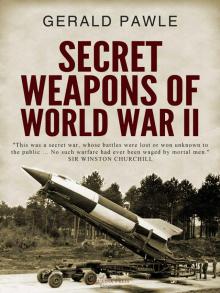
Secret Weapons of World War II, page 1
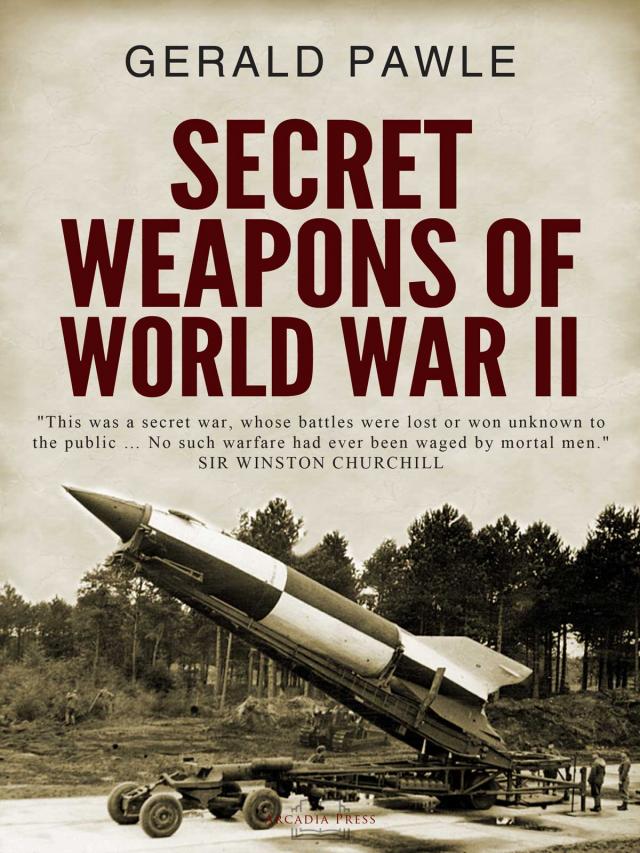


Gerald Pawle
SECRET WEAPONS
OF WORLD WAR II
With a foreword by
Nevil Shute
Copyright © Gerald Pawle
Secret Weapons of World War II
(1957)
Arcadia Press 2017
www.arcadiapress.eu
info@arcadiapress.eu
Store
www.arcadiaebookstore.eu
TABLE OF CONTENTS
COVER
TITLE
COPYRIGHT
FOREWORD
PREFACE
SECRET WEAPONSOF WORLD WAR II
PART I - THE ENEMY IN THE SKY 1 - THE CANOE LAKE
2 - A JOURNEY TO DOVER
3 - THE ROOM IN ADMIRALTY ARCH
4 - FLAME ON THE WATERS
5 - ARMOUR FOR THE BATTLE
6 - THE GUN FROM SWITZERLAND
7 - COUNTERBLAST! THE ROCKET WAR
8 - CABLES IN THE SKY
9 - THE POTATO-THROWER
10 - THE WIRE BARRAGE
PART II - THE ENEMY UNDER THE WATERS 11 - HIGHLY EXPLOSIVE!
12 - THE BIRTH OF THE HEDGEHOG
13 - HIS MAJESTY’S PIER
14 - HARRYING THE U-BOATS
15 - THE MANTLE OF ELIJAH
16 - THE TOYSHOP
PART III - KEYS TO THE FORTRESS 17 - INVASION AHEAD
18 - THE MAN IN THE GROSVENOR HOTEL
19 - SWISS ROLL AND THE LILY ISLANDS
20 - THE GREAT PANJANDRUM
21 - THE GRASSHOPPER AND THE ALLIGATOR TAKE TO THE WATER
22 - BUBBLES IN THE CHANNEL
23 - THE FLOATING WALL
24 - PREPARING FOR NEPTUNE
25 - THE MIRACULOUS PORT
This was a secret war, whose battles were lost or won unknown to the public … No such warfare had ever been waged by mortal men,
SIR WINSTON CHURCHILL,
The Second World War, Vol. II
FOREWORD
by
NEVIL SHUTE
LOOKING back over the years to the exploits of the Department of Miscellaneous Weapon Development in the Admiralty, I think it is the personalities of the people concerned that now interest me most. What sort of people were they who did the things described so excellently in this book? If any future war should come and make a similar department necessary again, what sort of people should the Admiralty seek to staff it?
Well, first of all, I do not think that such a department is likely to be created again in just that form in any future war. It was the child of Goodeve, and it was amazingly lucky for the Admiralty that Goodeve happened to fall into their lap at the commencement of the War. He was a scientist of some repute, though only thirty-five years old in 1939, but he was much more than that. He was born a Canadian, and visits to the United States in his youth had infected him with something of the vigour of their scientific and commercial enterprise; although a scientist he thought like an American project engineer, with a quick, instinctive flair for picking out of half a dozen schemes the one which could be driven through to practical success in terms of hardware. His travels between Canada, the United States, and England had given him a breadth of outlook denied to those who are constrained to spend their lives in one country, and he had immense vigour. In addition, he was passionately devoted to the Navy. From early youth his reserve service in the Navy had been practically his only recreation, his one hobby. Apart from his work and the Navy, his only relaxation lay in ice-skating. When the War came it must have been a secret joy to him; it meant that he could give his whole life to the Navy instead of just his holidays. The Admiralty would be lucky indeed if any such man fell into their hands at the right time in any future war.
Without a Goodeve the department could never have come into being. No doubt in any future war the Admiralty could make as wise a choice of a captain to command such an unusual department as they did when they appointed G.O.C. Davies. He was a burly R.N. captain with a strong sense of humour who intended to retire from the Navy anyway at the conclusion of the War, having some private means. He was therefore quite prepared to blot his copybook and to incur the disapproval of his seniors if by doing so he could advance the War effort, a fitting commander for this crowd of turbulent civilians in uniform who had no future in the Service either. Two or three times a week an R.N.V.R. lieutenant accustomed to civilian ways of doing things would return from a visit to a firm and plunge Captain Davies straight into a procedural mess. “They said they thought it would cost about three thousand pounds, sir, so I told them to go right ahead. I said we’d let them have a letter by the end of the week. They’ve put fifteen men on to it already. They’re really very keen.” To his eternal credit Captain Davies would laugh heartily before he plunged into the appalling paper-work involved in Admiralty contracts that had been started off in so unauthorized a manner.
If any one quality was a common requirement for the officers in this unusual department I would say it was imagination — the imagination to look forward and to visualize what might happen. When the Petroleum Warfare Department set up a flame barrage to prevent invading boats from landing upon beaches that consisted of a line of oil discharged from pipes under the sea, igniting on the surface to make a wall of fire twenty feet high and twenty feet wide parallel to the beach, it appeared to be an impregnable defence. It needed imagination for somebody to say, “I don’t believe that thing’s much good after all. I think the bow wave of the boat would push the oil aside. I don’t think you’d get burnt up. Let’s get a boat and try it.” We did, we weren’t, it did, and it wasn’t. This quality of imagination came into everything we touched; without it little could have been created.
Next to imagination I would say that the most useful officers were those who had a knowledge of some industry. The objective in practically every case was to produce a piece of hardware which would be of service to the fighting man, and the detailed design and manufacture had to be carried out by some firm. Knowledge of one sector of industry and personal acquaintance with the people in it were invaluable to an officer in this department, imposing a handicap upon the younger officers straight from a university or college that had to be countered by the greater energy of their youth. Technical journalists, such as that valiant little man Menhinick, were good members of the department. Their work in peace-time brought them into contact with civilian firms, they were accustomed to taking a bird’s-eye view of an industry, and they could express themselves clearly and concisely.
The Law played a surprisingly effective part in the activities of D.M.W.D. Terrell and Lochner were both barristers, though the latter had an engineering background, and these were two of the most successful officers in the department. Perhaps the ability to analyse and check evidence and to extract the truth from several conflicting stories may make it easy for a banister quickly to gain a knowledge of an industry or a technique, added to the feature of a first-class mind. However that may be, experience has shown that the legal mind can be most effective in the activities we carried on; it may be that in Patent law there lay some technical and analytical resources that we might have used but didn’t.
Pure scientists, such as Guggenheim, Penney, and Purcell, were invaluable to the department, but I think we may have had too many physical chemists straight from college. These men did first-class work, but not as physical chemists; they were very keen and very brave in trials, but they learned their job as they went along, and so made many mistakes that could have been avoided with more engineering knowledge. However, engineers are very scarce in time of war; we raked in every one that we could lay our hands on, and in that time of man-power shortage Goodeve was no doubt correct to bring in anybody technical, in any field, that he could get hold of.
Lastly we come to the men with no apparent qualifications at all for work on the design of weapons. Some of these were ineffective on creative work and drifted off to other work in other spheres of the Navy. But others, and there were quite a number of them, revealed a dormant aptitude for work on weapons to Goodeve at an interview; he had a flair for detecting this quality. Lane, the expert on tree culture, was to be the man who succoured and encouraged B. N. Wallis in his frustration, and brought him to the department and organized the trials of the weapon which resulted in the breaching of the Mohne Dam. It was Brinsmead, who made furniture in peacetime, who became our expert on shaped charges; it was Eades, the young auctioneer, who crowned his work on the development of rocket weapons with the exploitation of the rocket grapnel, and so lost his life in the invasion. And there were many others.
When I was first sent from H.M.S. King Alfred to be interviewed by Goodeve in the Admiralty I was furious. The War seemed to me, in June of 1940, to be desperately serious, and England in imminent peril of invasion. I had just abandoned technical experiment and research on gliding torpedoes to go and fight, as this book tells. Now I was threatened with a posting to a new experimental department, the king of which was interviewing me. I was not reassured. The man was young, but he had snow-white hair, very blue eyes, and a nervous, restless manner. I knew nothing of him at that time. Since he was interviewing me my opportunities for interviewing him were limited, but in my time I have met many cranks, and this man bore all the external hallmarks. Here, I thought, was a crazy inventor who had sucked in the simple admirals to the point when they were allowing him to set up a staff to mess about with graph paper and slide rules instead of fighting the Germans. If I got involved in this, I thought, I should be very safe, but other men would win or lose the war within the next three months. If I didn’t, if within the three days of joining the Navy I refused point-blank to do what the Navy wanted me to do, I might well find myself cashiered before I got my uniform.
This book shows how very, very wrong I was in every single particular.
PREFACE
The writing of this story of D.M.W.D., the Admiralty department described in Chapter I, had its genesis in an article entitled “Highly Explosive” which I contributed to The Sunday Times in 1953. Not until I began the detailed research for this book did I realize, however, the problems of giving shape and form to a record of such varied endeavour while attempting at the same time to preserve some chronological sequence.
Work on many of D.M.W.D.’s projects overlapped by considerable margins, and I have therefore aimed to introduce each new enterprise at the point of its greatest significance to the war effort.
While initiating ideas of their own, D.M.W.D. also helped to develop many weapons and devices for which they were not themselves responsible at the outset. In many instances, too, other Admiralty departments and individuals continued to contribute valuably and constantly to every phase of evolution from the drawing-board to the final production. I stress this fact because, inevitably, the story of any one particular unit engaged in such a field as research and development cannot convey an adequate impression of the part played by other organizations working in parallel.
D.M.W.D. had many successes — and many failures. But it should be emphasized that the latter were often failures only in the sense that the swift march of war removed the need for some strange and resourceful invention before its development was fully completed.
Although I have had generous co-operation from many quarters, the views expressed in the pages which follow are entirely my own. I have not sought to produce an ‘official history,’ but rather to give a picture of certain facets in the life of a unique organization now no longer in existence. At the same time every attempt has been made to ensure accuracy of fact, and my grateful thanks are due, first of all, to the many former members of D.M.W.D. — too numerous to mention individually — who submitted themselves to cross-examination at all hours of the day and night. Without their ungrudging help this book could not have been written.
Captain A. W. Clarke, C.B.E., D.S.O., R.N.(ret), Chief of Naval Information, and Mr H. G. O. Cross, M.B.E., his deputy at the Admiralty, readily placed facilities at my disposal for inspecting material in the Admiralty archives. Rear-Admiral R, M. Bellairs, C.B., C.M.G., gave me the freedom of the Admiralty’s Historical Section, and Mr G. H. Hurford, F.R.Hist.S., and Commander F. Barley, R.N.V.R., of his staff, went to much trouble to check countless details concerning the naval plans for the assault on Normandy.
From many sources unconnected with D.M.W.D. I have received valuable assistance and advice, and I should like to express my gratitude to Admiral Sir William Tennant, K.C.B., C.B.E., M.V.O., who as Flag Officer, Mulberry and Pluto, played a leading part in the events described in the closing stages of this book; Admiral of the Fleet Lord Fraser of North Cape, G.C.B., K.B.E., a former First Sea Lord, and Controller of the Navy when D.M.W.D. was formed; Admiral Sir Harold Burrough, G.C.B., K.B.E., D.S.O.; Admiral Sir Alexander Madden, K.C.B., C.B.E.; Marshal of the Royal Air Force Sir John Slessor, G.C.B., D.S.O., M.C.; Sir Steuart Mitchell, K.B.E., C.B., Controller of Guided Weapons and Electronics at the Ministry of Supply; Major-General Sir Millis Jefferis, K.B.E., M.C.; Vice-Admiral John Hughes-Hallett, C.B., D.S.O., M.P.; Surgeon Vice-Admiral Sir Alexander Ingleby Mackenzie, K.B.E., C.B., M.R.C.S., L.R.C.P.; Sir Arthur Whitaker, K.C.B.; Commander Norman Holbrook, V.C., R.N.(ret.); Mr E. G. Buhrle, head of the Werkzeugmaschinenfabrik Oerlikon of Zurich; Captain Basil Jones, D.S.O., D.S.C., R.N.(ret.); Mr A. T. Holman, O.B.E., chairman of Holman Brothers, Camborne; Mr Antoine Gazda, head of the engineering organization at Providence, Rhode Island, U.S.A., which bears his name; Mr R. E. Stubington, managing director of the Merryweather Engineering Works, Greenwich; Lieutenant-Colonel L. V. S. Blacker, O.B.E.; Commander Peter du Cane, O.B.E., R.N.(ret.); Lieutenant-Commander Peter Scott, C.B.E., D.S.C., R.N.V.R.; Mr J. M. Waldram, of the General Electric Company’s Research Staff; Mrs Ronald Hamilton; Commander J. S. Mulock, O.B.E., R.N.V.R.; Mr J. S. Herbert, M.A.; Mr C. R. Thompson, of the Schermuly Pistol Rocket Apparatus, Ltd; and Mr R.J.S. Crowe.
GERALD PAWLE
September 1956
… and, mark you, our scientists are not surpassed in any nation in the world, especially when their thought is applied to Naval matters…
SIR WINSTON CHURCHILL.
SECRET WEAPONS
OF WORLD WAR II
To
MARY
who bore so patiently with the long months of research before this book could be written
and to
J.ED.C.
In grateful memory of the Mediterranean years which
followed my service with the
“Wheezers and Dodgers”
PART I
THE ENEMY IN THE SKY
1
THE CANOE LAKE
THIS is the story of a group of naval scientists, the story of a department in the Admiralty which had no exact counterpart in the whole complex Allied machine which waged the Second World War against Germany and her confederates the story of the Wheezers and Dodgers.
The Wizard War, as Sir Winston Churchill has termed the ceaseless struggle for mastery between the Allied and enemy scientists, involved moves and counter-moves often ‘unintelligible to ordinary folk.’ And for long after the war was over a detailed description of some of those moves, which would have made them intelligible to the layman, was inadvisable on security grounds.
To-day, however, most of what was attempted and achieved by the Royal Navy’s Directorate of Miscellaneous Weapon Development — to give the Wheezers and Dodgers their official title — is no longer on the secret list. It has remained untold only, one presumes, because D.M.W.D. was essentially a clandestine organization, its triumphs and failures unknown to all but a relatively small circle of Servicemen and civilian scientists.
The Wheezers and Dodgers were a research and development team. They were formed in the shadow of defeat in Europe, and their activities reached flood tide with the Allied landings on the coast of Normandy four years later. In those four years they were destined to tackle some of the strangest tasks in the history of warfare.
On the last Sunday in May 1940 there was intense activity in the Admiralty. The British Expeditionary Force, with four of its divisions in imminent danger of encirclement outside Lille, was fighting its way back to the French coast, and Operation Dynamo was on. The first significant move in this naval plan for the evacuation from France had wisely been made a full week earlier. When the German Army broke through at Sedan an immediate request went from the Admiralty to the Ministry of Shipping for all available coasting vessels to proceed to the Downs, but as late as May 24 it was still not certain that a major evacuation would be feasible. Since then the situation had deteriorated alarmingly, and no one on the naval staff expected more than 45,000 men to be brought away from the beaches. But now the die was cast. The operation named Dynamo was to be attempted.
A severe ordeal faced the array of little ships massing in the Downs. The Germans had already reached the coast near Calais, and were shelling any vessels which tried to approach Dunkirk direct. H.M.S. Wolfhound, carrying the imperturbable Captain William Tennant and his staff to Dunkirk, where he was to act as the Navy’s Master of Ceremonies at the evacuation, had to make a sixty-mile detour to avoid a minefield, and was dive-bombed all the way, a final stick of bombs straddling her as she reached the inner harbour.
For the individual protection of the hundreds of coasting vessels now awaiting the orders of Vice-Admiral, Dover, there was little that the Admiralty could provide against the mounting air attack. The threat of enemy mines was another matter, however, and as the unceasing stream of trawlers and colliers, yachts and drifters, barges and paddle steamers, neared the assembly area they were diverted to one of three South Coast ports and shepherded through a strange ritual.