

Fire, page 1


GEORGE R. STEWART (1895–1980) was born in Pennsylvania and educated at Princeton. He received his PhD in English literature from Columbia in 1922 and joined the English faculty at the University of California, Berkeley, in 1924. He was a sociologist, toponymist, and founding member of the American Name Society, as well as the author of more than twenty books, including the highly successful novel Earth Abides and several works of American history. NYRB Classics publishes his novel Storm and a study of American place-names, Names on the Land.
EMMA ROTHSCHILD is the director of the Joint Centre for History and Economics at Magdalene College, Cambridge, and the Jeremy and Jane Knowles Professor of History at Harvard. She is the author of An Infinite History: The Story of a Family in France over Three Centuries; Economic Sentiments: Adam Smith, Condorcet, and the Enlightenment; and Paradise Lost: The Decline of the Auto-Industrial Age—among other books.
OTHER BOOKS BY GEORGE R. STEWART
PUBLISHED BY NYRB CLASSICS
Names on the Land
Introduction by Matt Weiland
Storm
Introduction by Nathaniel Rich
FIRE
GEORGE R. STEWART
Introduction by
EMMA ROTHSCHILD
NEW YORK REVIEW BOOKS
New York
THIS IS A NEW YORK REVIEW BOOK
PUBLISHED BY THE NEW YORK REVIEW OF BOOKS
207 East 32nd Street, New York, NY 10016
www.nyrb.com
Copyright © 1948 by George R. Stewart
Introduction © 2024 by Emma Rothschild
All rights reserved.
First published as a New York Review Books Classic in 2024.
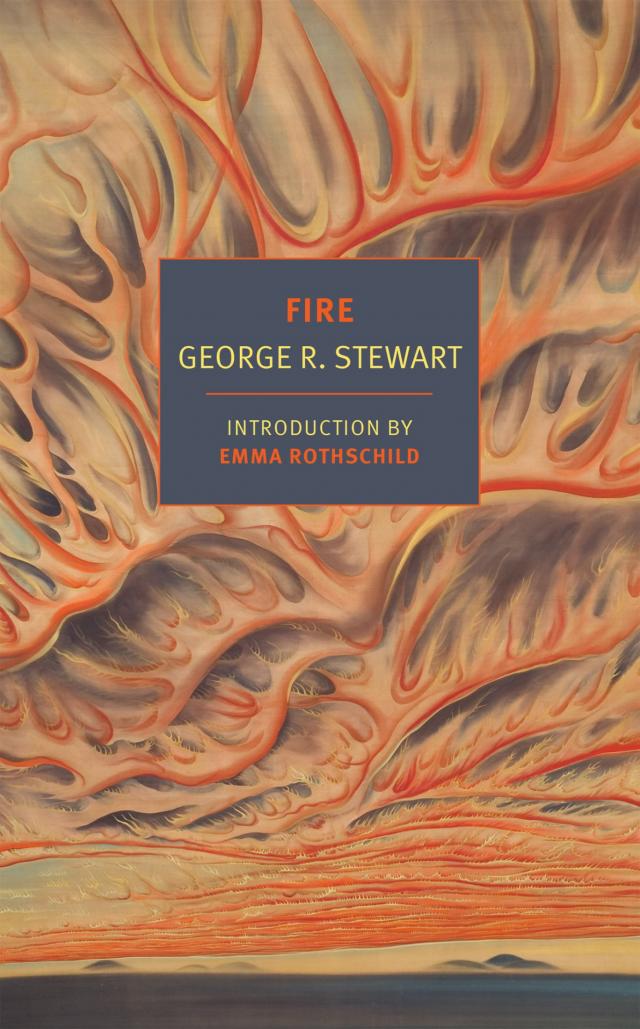
Cover image: Chiura Obata, American (born Japan), 1885–1975; Setting Sun of Sacramento Valley, 1922; hanging scroll: ink and color on silk; image: 80⅞ x 56¾ inches, scroll: 111⅝ x 72⅞ inches; Saint Louis Art Museum, Gift of Mr. and Mrs. Gyo Obata 187:2011
Cover design: Katy Homans
Library of Congress Cataloging-in-Publication Data
Names: Stewart, George R., 1895–1980, author. | Rothschild, Emma, 1948–writer of introduction.
Title: Fire / by George R. Stewart; introduction by Emma Rothschild. Description:
New York: New York Review Books, 2024. | Series: New York Review Books classics
Identifiers: LCCN 2024002136 (print) | LCCN 2024002137 (ebook) | ISBN 9781681378473 (paperback) | ISBN 9781681378480 (e-book)
Subjects: LCSH: Forest fires-Fiction. | Sierra Nevada (Calif. and Nev.)-Fiction. | LCGFT: Nature fiction. | Novels.
Classification: LCC PS3537.T48545 F5 2024 (print) | LCC PS3537.T48545 (ebook) | DDC 813/.54-dc23/eng/20240205
LC record available at https://lccn.loc.gov/2024002136
LC ebook record available at https://lccn.loc.gov/2024002137
ISBN 978-1-68137-848-0
v1.0
For a complete list of titles, visit www.nyrb.com
CONTENTS
Cover
Biographical Notes
Title Page
Copyright and More Information
Introduction
First Day
Second Day
Third Day
Fourth Day
Fifth Day
Sixth Day
Seventh Day
Eighth Day
Ninth Day
Tenth Day
Last Day
INTRODUCTION
FIRE IS a book for our times. It was first published in 1948 and acclaimed as “a gorgeous tale of adventure and danger.” A reviewer in the New York Herald Tribune wrote that “I have met no book since For Whom the Bell Tolls in which suspense is more skillfully employed.” But almost no one in the late 1940s knew about the possibility of human-induced global temperature change. More than three-quarters of a century later, Fire is still a terrific tale, and it is also a book with which to think about climate change. It takes the reader into the interior of what climate change is like.
By contemporary standards, the scale of George R. Stewart’s fictional fire is miniature. The Spitcat Fire is ignited by lightning striking a pine tree on a dry September day in the Ponderosa National Forest (a product of Stewart’s imagination). The fire lasts for ten days, and as a minor character in the book known as the Maps-and-Records man calculates, it devastates 10,032 acres.
In early 2024—in the real world of climate change—the Smoke-house Creek Fire in the Texas Panhandle burned through 1,058,452 acres. The Dixie Fire of July 2021—northeast of Sacramento, California, like the Ponderosa forest—affected 963,309 acres. Over the course of 2021 alone, there were five further fires in California, in each of which more than 100,000 acres were burned.
So it is the intimacy of Fire, not the size of the conflagration it describes, that makes it so evocative in our own times of foreboding. The story follows the fire in time and space, and as it affects various individuals, ranging from Judith, the Cerro Gordo Lookout, to Dave, a meteorologist; from the wary pine-squirrel to the burning rabbit. The perspective varies: there is the vista of the passengers in a “great four-motored plane” but also of the mice in rock crevices and of the “dark little beetles” who burrow into charred wood, “making purposefully toward the smoke.” On the seventh day, a forest ranger, Bart, and two parachute jumpers are literally in the interior of the fire, surrounded by glowing red-hot branches and “inside a little island of already burned ground.”
To the individuals in the novel the Spitcat Fire seems immense. For Bart “the very cumulative enormousness of the fire was sickening.” It seems by an “inevitable quality” to “double its area every day.” Officials try to make sense of the fire through numbers. The Maps-and-Records man finds “a little melancholy satisfaction from keeping the score.” But what are 10,032 acres like? Or 1,058,452 acres, now? Does it mean much to refer to an area “comfortably larger than Rhode Island,” as the Supervisor describes the Ponderosa Forest? Or to say that “from 1971 to 2021, human-caused climate change contributed to a +172% increase in burned areas, with a +320% increase from 1996 to 2021.” (This is from the website drought.gov.)
Even contemporary evocations of loss of life are abstract. The Australian wildfire of 2019–2020 extended across a “fire impact area” of 28 million acres and was estimated by the World Wildlife Fund to have “killed or displaced . . . nearly three billion animals.” These were the vertebrates alone; within the forests and woodlands that burned, there were 143 million mammals, 2.46 billion reptiles, 180 million birds, and 51 million frogs.
Fire, by contrast to these abstractions, is a profound work about the meaning of displacement and loss. There is the curious pine-squirrel, who in his first two years of life “had never eaten a peanut; in fact, he had never seen a man, or a fire.” There is the “panicked and burning rabbit,” the bear whimpering “at the pain of his blistered feet,” the doe looking for her fawn, the hawk who returned to a forest “full of confused and homeless little animals, easy prey.”
The limits of our understanding are part of Stewart’s story. There is a news photographer who drives up to the site of the fire, “but the pictures had not been so much, and the editor had not used any of them.” The only photograph that “made the city papers” is of a young woman waiting to be evacuated, with a vacuum cleaner and someone else’s baby. After all, “human interest thrives on women and children and household goods.”
Even Judith, the lookout, who watches the approaching fire from “high on the lonely tower,” finds herself imagining it as mere spectacle, like a marketing opportunity: “the fire lit up the sky with a violent pink, like no color she had ever seen. ‘Forest-fire pink—our latest!’ she could imagine the advertisements saying. But who would want to wear it? You thought of pinks as mild and washed-out, but this vehement glare was more dominant than scarlet or magenta.”
Within the space of a once “green and gracious forest” there was only desolation, Stewart writes at the end of the book. Who then will there be to “remember the smell of smoke in the morning, and the copper sun at noon, and the crimson glare at evening, not of sunset”?
•
Fire is a mildly optimistic book. There is an unblighted romance; not everyone dies. This sets it apart from Stewart’s other ecological novels of the 1940s: Storm, published in 1941, and written during “the grim and terrible months of Dunkirk and the fall of France,” suffused throughout with the prospect of loss, as well as its successor Earth Abides (1949), a bleak book about pestilence composed at “practically the same time” as the development of the atomic bomb. In Fire, the meteorologist and the parachute jumpers of Storm (who came from Harlem and Beale Street) reappear, back from the war to an America that is a land of many possibilities. There are women in the Forest Service, and former conscientious objectors who have returned to volunteer.
Scientific forestry is being improved: “more roads, more lookouts, better trained crews, an educated public,” with “‘wet water,’ baby cats, infra-red cameras for the scout-planes, ‘man-made rain,’ chemical bombs with proximity fuses.” There is the alarming prospect of a World Weather Control (WWC, as they would call it) “cruising in the stratosphere,” or in “a windowless air-conditioned room where he could just push buttons and not hear complaints of farmers . . . or screams of children.”
The optimism of 1948 initiated an epoch of apparently effortlessly managed burning, a combustion- and ignition-led economic expansion. It was also a new epoch of extraction and construction. In Fire, the awkward, rational Supervisor observes a “pretty-looking …youn g forest” and anticipates “a few thousand board-feet each season.” “That stuff down there is crying out to be built into houses.” This came about, and the board-feet of timber cut in National Forests increased from 3.8 billion in 1948 to 11.7 billion in 1970.
But the most dramatic expansion was in the burning of old wood or old hydrocarbon. The use of fossil fuels—coal, oil, and natural gas—by electric utilities generated 200 trillion kilowatt hours of electricity in 1948, and 1,262 trillion in 1970. US production of motor gasoline was 2.3 million barrels a day in 1948 and 5.8 million in 1970; there were $1.4 billion of contracts awarded for highway construction in 1948, and $6.5 billion in 1970.
In the long period of American economic expansion that started in the 1940s, almost everything required heat or fire; turning the ignition in passenger cars, generating the electricity for air conditioning in “coal-fired” power plants, flaring or burning natural gas. From 2022 to 2026, US federal government expenditure on “highway infrastructure” alone will amount to $379 billion.
Fire could not anticipate the global warming that began on a sustained scale in the 1970s. But it evokes the historical causes of climate change as well as anticipating what we now know to be its consequences. Fires and the place-names they left behind, like Burnt Woods, Burnt River, Bare Mountain, are part of American history, as Stewart writes: “All this too was part of the price of the taking-over of the land.”
The new infrastructure of fossil fuels that Stewart glimpsed in the 1940s was on a vaster scale. Energy, in Fire, is for the most part a figure of speech. Judith’s “permanent smokes” are the gray smudges from a “Magna Mill” and a “town dump.” A thundercloud is “like a stupendous steam-engine,” lightning has “a force equal to that of many power-houses,” and the fire burns “like the heat of a thousand furnaces.” “But it really was warm,” when the story begins, after a long summer of drought.
Droughts and heat waves are still the condition for the burning of the land. They are now the outcome of the burning of old carbon. The uses of fossil fuel are also among the immediate causes of fires. The Texas Panhandle fire of 2024 was ignited by failures of power-line equipment. Accidents involving natural gas pipelines lead to leaks of methane, explosions, and fireballs. The new green economies—the prospect of new highways and all-electric vehicles, everywhere—will bring more power lines and more battery fires.
George Stewart insisted that he was a novelist of ecology; it was not “altogether true,” he said, that he was “a chronicler of catastrophe.” But the brilliance of Fire is that it makes catastrophe real. Judith and the rabbit and the others are individuals and not “wildlife” (or victims) to be lost. The forest fire is real because of the ecology—the multiple connections between different living things—that it describes.
This is what I meant in describing Fire as a novel for our times, and as a way of thinking about climate change. Climate change is so large and so difficult to imagine that it becomes an abstraction, a virtual spectacle in forest-fire pink. But almost everyone understands things in particular, and almost everyone, too, can change particular circumstances. To read Fire is to think about what a world on fire is like and about how it could be better.
—EMMA ROTHSCHILD
FIRE
The characters of this book—including the
Spitcat—are imaginary.
To
Bob, Jack, Hutch, Frank, Mary,
George, Merv, Ray, Mac,
and the others of Region 5.
FIRST DAY
1
Suddenly ablaze with lightnings, the piled-up thundercloud swept northward across the tops of the mountains. With celestial unconcern the blasting strokes fell here or there—to splinter a snag-top fir on Donner Peak, bring down a telegraph-pole at Blue Canyon, play round a water-tank at Emigrant Gap and send a child into hysterics, flash ineffectively against bare granite on Cisco Butte, split an oak-tree by a nameless meadow and kill the buck standing beneath.
During some minutes, intermittently, the flashes pierced the dimness of the shadowed afternoon, thunder echoed along the canyons, and rain fell spottedly. Then, tensions and stresses eased by the fiery spurting, the cloud took on a milder aspect to the passive earth beneath it. The lightnings died out with a last weak stroke; the drumming showers diminished to scattered drops; the cloud-edge faded from greenish black to gentle gray, and the atmosphere grew lighter. During the outburst the cloud had seemed to rush onward by its own power; now it merely drifted with the breeze. Yet still it moved steadily toward the north—where, half hidden behind the curve of the earth, the blunt crater of Lassen Peak and the two white cones of Mount Shasta broke the far horizon-line.
2
The Lookout turned off the broadcast. All she could get in the afternoon was one Reno station. Its program was not much at best, and during the last few minutes had been interrupted by an amazing variety of squawks and roars and crackles, as if a thunderstorm must be somewhere at work.
Just after she had flipped the switch, the telephone rang. She listened—long, short, short, short—her own signal. She answered:
“Cerro Gordo Lookout speaking.”
“Hello, Judith,” said the telephone, and she recognized the deep, slightly gruff voice of the Ranger.
“Oh, hello, Bart,” she said. “Nice of you to call. I’m fine—how are the pups?”
She supposed that he had merely called as he had before, to break the monotony of her life. Being alone for twenty-four hours a day generally, a lookout might be assumed to be lonely.
“Oh, the pups are O.K.,” he said, and then went on in a tone which indicated he had not called up to gossip. “Say, there’s a lightning-storm working up on us—”
“Oh, I thought—”
“Yes, she’s working up along the range from the south—way they generally do. Hit the Sequoia Forest high country two days ago; gave the boys some trouble on the Stanislaus yesterday. From the squawks on the radio, I’d judge she was just cutting loose a little, down over the Tahoe, along U.S. 40. We and the Plumas may be next. Don’t sound too bad though. Just the same, I thought maybe a kid like you—”
“Look here now, Bart, you don’t need—”
“Sorry! Sure, I beg pardon! I know you’re twenty-one, but still that seems kind of young to me. Anyway, even Uncle Amos might get nervous if you perched him in a glass box on top of a sixty-foot steel tower, and a lightning-storm came playing around.”
“O.K., if the flashes get within a mile, I pull my switch—it’s all printed on this card tacked up here right by the phone. And then I stand on the stool that has glass things on its feet.”
“That’s fine, honey. What’s more, don’t forget you’re a lookout in the Ponderosa National Forest. If the lightning ain’t quite knocking your front teeth in, swing your alidade on every strike you see, and get us a bearing. Write the time down too. That’s all, and I’ve got to call some other look-outs.”
The girl hung up with a rising sense of excitement. She had been only two weeks on the job. Although she had seen some smokes, they had been far off, beyond the limits of her responsibility.
She went out through the screen-door to the narrow catwalk which skirted the four sides of the lookout. The storm was coming from the south, but with a child’s sense of saving the icing till the last, she looked first toward the west, and next went around the catwalk to the north and east. There was nothing unusual. Then, standing at the southeast corner, looking out level over the gently swaying tops of some pines, she gazed southward.
She was disappointed. Every afternoon she had seen fluffy white clouds build up over the endlessly stretching confusion of long forested ridges and pointed bare peaks which formed the backbone of the northern Sierra Nevada. This afternoon the clouds seemed no different.
She lifted her binoculars. The closer ridges jumped into sharp detail, but the clouds still looked much the same. She lowered the binoculars, unimpressed.


