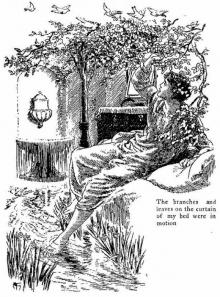
THE VICAR’S DAUGHTER, page 35


“Surely you’re not a Unitarian, Mrs. Percivale!” she said, half lifting her head, and looking at me with a dim terror in her pale eyes.
“God forbid!” I answered. “But I would that many who think they know better believed in him half as much as many Unitarians do. It is only by understanding and believing in that humanity of his, which in such pain and labor manifested his Godhead, that we can come to know it, — know that Godhead, I mean, in virtue of which alone he was a true and perfect man; that Godhead which alone can satisfy with peace and hope the poorest human soul, for it also is the offspring of God.”
I ceased, and for some moments she sat silent. Then she said feebly, —
“There’s a Bible somewhere in the room.”
I found it, and read the story of the woman who came behind him in terror, and touched the hem of his garment. I could hardly read it for the emotion it caused in myself; and when I ceased I saw her weeping silently.
A servant entered with the message that Mr. Percivale had called for me.
“I cannot see him to-day,” she sobbed.
“Of course not,” I replied. “I must leave you now; but I will come again, — come often if you like.”
“You are as kind as ever!” she returned, with a fresh burst of tears. “Will you come and be with me when — when — ?”
She could not finish for sobs.
“I will,” I said, knowing well what she meant.
This is how I imagined the change to have come about: what had seemed her faith had been, in a great measure, but her hope and imagination, occupying themselves with the forms of the religion towards which all that was highest in her nature dimly urged. The two characteristics of amicability and selfishness, not unfrequently combined, rendered it easy for her to deceive herself, or rather conspired to prevent her from undeceiving herself, as to the quality and worth of her religion. For, if she had been other than amiable, the misery following the outbreaks of temper which would have been of certain occurrence in the state of her health, would have made her aware in some degree of her moral condition; and, if her thoughts had not been centred upon herself, she would, in her care for others, have learned her own helplessness; and the devotion of her good husband, not then accepted merely as a natural homage to her worth, would have shown itself as a love beyond her deserts, and would have roused the longing to be worthy of it. She saw now that he must have imagined her far better than she was: but she had not meant to deceive him; she had but followed the impulses of a bright, shallow nature.
But that last epithet bids me pause, and remember that my father has taught me, and that I have found the lesson true, that there is no such thing as a shallow nature: every nature is infinitely deep, for the works of God are everlasting. Also, there is no nature that is not shallow to what it must become. I suspect every nature must have the subsoil ploughing of sorrow, before it can recognize either its present poverty or its possible wealth.
When her husband died, suddenly, of apoplexy, she was stunned for a time, gradually awaking to a miserable sense of unprotected loneliness, so much the more painful for her weakly condition, and the overcare to which she had been accustomed. She was an only child, and had become an orphan within a year or two after her early marriage. Left thus without shelter, like a delicate plant whose house of glass has been shattered, she speedily recognized her true condition. With no one to heed her whims, and no one capable of sympathizing with the genuine misery which supervened, her disease gathered strength rapidly, her lamp went out, and she saw no light beyond; for the smoke of that lamp had dimmed the windows at which the stars would have looked in. When life became dreary, her fancies, despoiled of the halo they had cast on the fogs of selfish comfort, ceased to interest her; and the future grew a vague darkness, an uncertainty teeming with questions to which she had no answer. Henceforth she was conscious of life only as a weakness, as the want of a deeper life to hold it up. Existence had become a during faint, and self hateful. She saw that she was poor and miserable and blind and naked, — that she had never had faith fit to support her.
But out of this darkness dawned at least a twilight, so gradual, so slow, that I cannot tell when or how the darkness began to melt. She became aware of a deeper and simpler need than hitherto she had known, — the need of life in herself, the life of the Son of God. I went to see her often. At the time when I began this history, I was going every other day, — sometimes oftener, for her end seemed to be drawing nigh. Her weakness had greatly increased: she could but just walk across the room, and was constantly restless. She had no great continuous pain, but oft-returning sharp fits of it. She looked genuinely sad, and her spirits never recovered themselves. She seldom looked out of the window; the daylight seemed to distress her: flowers were the only links between her and the outer world, — wild ones, for the scent of greenhouse-flowers, and even that of most garden ones, she could not bear. She had been very fond of music, but could no longer endure her piano: every note seemed struck on a nerve. But she was generally quiet in her mind, and often peaceful. The more her body decayed about her, the more her spirit seemed to come alive. It was the calm of a gray evening, not so lovely as a golden sunset or a silvery moonlight, but more sweet than either. She talked little of her feelings, but evidently longed after the words of our Lord. As she listened to some of them, I could see the eyes which had now grown dim with suffering, gleam with the light of holy longing and humble adoration.
For some time she often referred to her coming departure, and confessed that she “feared death; not so much what might be on the other side, as the dark way itself, — the struggle, the torture, the fainting; but by degrees her allusions to it became rarer, and at length ceased almost entirely. Once I said to her, —
“Are you afraid of death still, Eleanor?”
“No — not much,” she replied, after a brief pause. “He may do with me whatever He likes.”
Knowing so well what Marion could do to comfort and support, and therefore desirous of bringing them together, I took her one day with me. But certain that the thought of seeing a stranger would render my poor Eleanor uneasy, and that what discomposure a sudden introduction might cause would speedily vanish in Marion’s presence, I did not tell her what I was going to do. Nor in this did I mistake. Before we left, it was plain that Marion had a far more soothing influence upon her than I had myself. She looked eagerly for her next visit, and my mind was now more at peace concerning her.
One evening, after listening to some stories from Marion about her friends,
Mrs. Cromwell said, —
“Ah, Miss Clare! to think I might have done something for Him by doing it for them! Alas! I have led a useless life, and am dying out of this world without having borne any fruit! Ah, me, me!”
“You are doing a good deal for him now,” said Marion, “and hard work too!” she added; “harder far than mine.”
“I am only dying,” she returned — so sadly!
“You are enduring chastisement,” said Marion. “The Lord gives one one thing to do, and another another. We have no right to wish for other work than he gives us. It is rebellious and unchildlike, whatever it may seem. Neither have we any right to wish to be better in our way: we must wish to be better in his.”
“But I should like to do something for him; bearing is only for myself.
Surely I may wish that?”
“No: you may not. Bearing is not only for yourself. You are quite wrong in thinking you do nothing for him in enduring,” returned Marion, with that abrupt decision of hers which seemed to some like rudeness. “What is the will of God? Is it not your sanctification? And why did he make the Captain of our salvation perfect through suffering? Was it not that he might in like manner bring many sons into glory? Then, if you are enduring, you are working with God, — for the perfection through suffering of one more: you are working for God in yourself, that the will of God may be done in you; that he may have his very own way with you. It is the only work he requires of you now: do it not only willingly, then, but contentedly. To make people good is all his labor: be good, and you are a fellow-worker with God in the highest region of labor. He does not want you for other people — yet.”
At the emphasis Marion laid on the last word, Mrs. Cromwell glanced sharply up. A light broke over her face: she had understood, and with a smile was silent.
One evening, when we were both with her, it had grown very sultry and breathless.
“Isn’t it very close, dear Mrs. Percivale?” she said.
I rose to get a fan; and Marion, leaving the window as if moved by a sudden resolve, went and opened the piano. Mrs. Cromwell made a hasty motion, as if she must prevent her. But, such was my faith in my friend’s soul as well as heart, in her divine taste as well as her human faculty, that I ventured to lay my hand on Mrs. Cromwell’s. It was enough for sweetness like hers: she yielded instantly, and lay still, evidently nerving herself to suffer. But the first movement stole so “soft and soullike” on her ear, trembling as it were on the border-land between sound and silence, that she missed the pain she expected, and found only the pleasure she looked not for. Marion’s hands made the instrument sigh and sing, not merely as with a human voice, but as with a human soul. Her own voice next evolved itself from the dim uncertainty, in sweet proportions and delicate modulations, stealing its way into the heart, to set first one chord, then another, vibrating, until the whole soul was filled with responses. If I add that her articulation was as nearly perfect as the act of singing will permit, my reader may well believe that a song of hers would do what a song might.
Where she got the song she then sung, she always avoids telling me. I had told her all I knew and understood concerning Mrs. Cromwell, and have my suspicions. This is the song: —
“I fancy I hear a whisper
As of leaves in a gentle air:
Is it wrong, I wonder, to fancy
It may be the tree up there? —
The tree that heals the nations,
Growing amidst the street,
And dropping, for who will gather,
Its apples at their feet?
“I fancy I hear a rushing
As of waters down a slope:
Is it wrong, I wonder, to fancy
It may be the river of hope?
The river of crystal waters
That flows from the very throne,
And runs through the street of the city
With a softly jubilant tone?
“I fancy a twilight round me,
And a wandering of the breeze,
With a hush in that high city,
And a going in the trees.
But I know there will be no night there, —
No coming and going day;
For the holy face of the Father
Will be perfect light alway.
“I could do without the darkness,
And better without the sun;
But, oh, I should like a twilight
After the day was done!
Would he lay his hand on his forehead,
On his hair as white as wool,
And shine one hour through his fingers,
Till the shadow had made me cool?
“But the thought is very foolish:
If that face I did but see,
All else would be all forgotten, —
River and twilight and tree;
I should seek, I should care, for nothing,
Beholding his countenance;
And fear only to lose one glimmer
By one single sideway glance.
“’Tis but again a foolish fancy
To picture the countenance so.
Which is shining in all our spirits,
Making them white as snow.
Come to me, shine in me, Master,
And I care not for river or tree, —
Care for no sorrow or crying,
If only thou shine in me.
“I would lie on my bed for ages,
Looking out on the dusty street,
Where whisper nor leaves nor waters,
Nor any thing cool and sweet;
At my heart this ghastly fainting,
And this burning in my blood, —
If only I knew thou wast with me, —
Wast with me and making me good.”
When she rose from the piano, Mrs. Cromwell stretched out her hand for hers, and held it some time, unable to speak. Then she said, —
“That has done me good, I hope. I will try to be more patient, for I think
He is teaching me.”
She died, at length, in my arms. I cannot linger over that last time. She suffered a good deal, but dying people are generally patient. She went without a struggle. The last words I heard her utter were, “Yes, Lord;” after which she breathed but once. A half-smile came over her face, which froze upon it, and remained, until the coffin-lid covered it. But I shall see it, I trust, a whole smile some day.
CHAPTER XXXIX.
ANCESTRAL WISDOM.
I did think of having a chapter about children before finishing my book; but this is not going to be the kind of chapter I thought of. Like most mothers, I suppose, I think myself an authority on the subject; and, which is to me more assuring than any judgment of my own, my father says that I have been in a measure successful in bringing mine up, — only they’re not brought up very far yet. Hence arose the temptation to lay down a few practical rules I had proved and found answer. But, as soon as I began to contemplate the writing of them down, I began to imagine So-and-so and So-and-so attempting to carry them out, and saw what a dreadful muddle they would make of it, and what mischief would thence lie at my door. Only one thing can be worse than the attempt to carry out rules whose principles are not understood; and that is the neglect of those which are understood, and seen to be right. Suppose, for instance, I were to say that corporal punishment was wholesome, involving less suffering than most other punishments, more effectual in the result, and leaving no sting or sense of unkindness; whereas mental punishment, considered by many to be more refined, and therefore less degrading, was often cruel to a sensitive child, and deadening to a stubborn one: suppose I said this, and a woman like my Aunt Millicent were to take it up: her whippings would have no more effect than if her rod were made of butterflies’ feathers; they would be a mockery to her children, and bring law into contempt; while if a certain father I know were to be convinced by my arguments, he would fill his children with terror of him now, and with hatred afterwards. Of the last-mentioned result of severity, I know at least one instance. At present, the father to whom I refer disapproves of whipping even a man who has been dancing on his wife with hob-nailed shoes, because it would tend to brutalize him. But he taunts and stings, and confines in solitude for lengthened periods, high-spirited boys, and that for faults which I should consider very venial.
Then, again, if I were to lay down the rule that we must be as tender of the feelings of our children as if they were angel-babies who had to learn, alas! to understand our rough ways, how would that be taken by a certain French couple I know, who, not appearing until after the dinner to which they had accepted an invitation was over, gave as the reason, that it had been quite out of their power; for darling Désirée, their only child, had declared they shouldn’t go, and that she would cry if they did; nay, went so far as to insist on their going to bed, which they were, however reluctant, compelled to do. They had actually undressed, and pretended to retire for the night; but, as soon as she was safely asleep, rose and joined their friends, calm in the consciousness of abundant excuse.
The marvel to me is that so many children turn out so well.
After all, I think there can be no harm in mentioning a few general principles laid down by my father. They are such as to commend themselves most to the most practical.
And first for a few negative ones.
1. Never give in to disobedience; and never threaten what you are not prepared to carry out.
2. Never lose your temper. I do not say never be angry. Anger is sometimes indispensable, especially where there has been any thing mean, dishonest, or cruel. But anger is very different from loss of temper. [Footnote: My Aunt Millicent is always saying, “I am grieeeved with you.” But the announcement begets no sign of responsive grief on the face of the stolid child before her. She never whipped a child in her life. If she had, and it had but roused some positive anger in the child, instead of that undertone of complaint which is always oozing out of every one of them, I think It would have been a gain. But the poor lady is one of the whiny-piny people, and must be in preparation for a development of which I have no prevision. The only stroke of originality I thought I knew of her was this; to the register of her children’s births, baptisms, and confirmations, entered on a grandly-ornamented fly-leaf of the family Bible, she has subjoined the record of every disease each has had, with the year, month, and day (and in one case the hour), when each distemper made its appearance. After most of the main entries, you may read, “Cut his (or her) first tooth” — at such a date. But, alas for the originality! she has just told me that her maternal grandmother did the same. How strange that she and my father should have had the same father I If they had had the same mother, too, I should have been utterly bewildered.]
3. Of all things, never sneer at them; and be careful, even, how you rally them.
4. Do not try to work on their feelings. Feelings are far too delicate things to be used for tools. It is like taking the mainspring out of your watch, and notching it for a saw. It may be a wonderful saw, but how fares your watch? Especially avoid doing so in connection with religious things, for so you will assuredly deaden them to all that is finest. Let your feelings, not your efforts on theirs, affect them with a sympathy the more powerful that it is not forced upon them; and, in order to do this, avoid being too English in the hiding of your feelings. A man’s own family has a right to share in his good feelings.