SIR GIBBIE, page 1


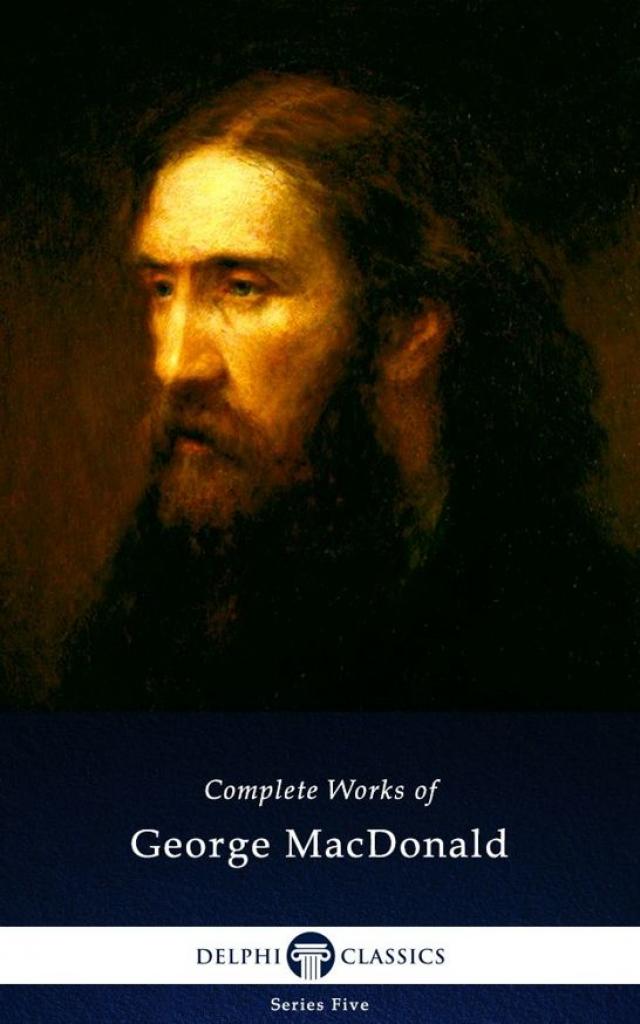
SIR GIBBIE
OR, THE BARONET’S SONG
This novel of Scottish rural life was published in 1879. Criticised by some twentieth-century writers for its overly-sentimental view of Scottish lower-class life, it has also been commended for MacDonald’s characteristic focus on the inner moral life of his characters (as opposed to realism’s more usual preoccupation with the minutiae of physical detail). Indeed, the novel was singled out for praise by noted realist author Arnold Bennett, in the second edition of his Literary Taste (1937).
The story follows a mute boy with a heart of gold who is left to fend for himself when he is abandoned by his alcoholic father.
Frontispiece to the fifth edition
CONTENTS
CHAPTER I.
CHAPTER II.
CHAPTER III.
CHAPTER IV.
CHAPTER V.
CHAPTER VI.
CHAPTER VII.
CHAPTER VIII.
CHAPTER IX.
CHAPTER X.
CHAPTER XI.
CHAPTER XII.
CHAPTER XIII.
CHAPTER XIV.
CHAPTER XV.
CHAPTER XVI.
CHAPTER XVII.
CHAPTER XVIII.
CHAPTER XIX.
CHAPTER XX.
CHAPTER XXI.
CHAPTER XXII.
CHAPTER XXIII.
CHAPTER XXIV.
CHAPTER XXV.
CHAPTER XXVI.
CHAPTER XXVII.
CHAPTER XXVIII.
CHAPTER XXIX.
CHAPTER XXX.
CHAPTER XXXI.
CHAPTER XXXII.
CHAPTER XXXIII.
CHAPTER XXXIV.
CHAPTER XXXV.
CHAPTER XXXVI.
CHAPTER XXXVII.
CHAPTER XXXVIII.
CHAPTER XXXIX.
CHAPTER XL
CHAPTER XLI.
CHAPTER XLII.
CHAPTER XLIII.
CHAPTER XLIV.
CHAPTER XLV.
CHAPTER XLVI.
CHAPTER XLVII.
CHAPTER XLVIII.
CHAPTER XLIX.
CHAPTER L
CHAPTER LI.
CHAPTER LII.
CHAPTER LIII.
CHAPTER LIV.
CHAPTER LV.
CHAPTER LVI.
CHAPTER LVII.
CHAPTER LVIII.
CHAPTER LIX.
CHAPTER LX.
CHAPTER LXI.
CHAPTER LXII.
FOOTNOTES.
Cartoon of MacDonald by William Waddy, drawn in 1872
CHAPTER I.
THE EARRING.
“Come oot o’ the gutter, ye nickum!” cried, in harsh, half-masculine voice, a woman standing on the curbstone of a short, narrow, dirty lane, at right angles to an important thoroughfare, itself none of the widest or cleanest. She was dressed in dark petticoat and print wrapper. One of her shoes was down at the heel, and discovered a great hole in her stocking. Had her black hair been brushed and displayed, it would have revealed a thready glitter of grey, but all that was now visible of it was only two or three untidy tresses that dropped from under a cap of black net and green ribbons, which looked as if she had slept in it. Her face must have been handsome when it was young and fresh; but was now beginning to look tattooed, though whether the colour was from without or from within, it would have been hard to determine. Her black eyes looked resolute, almost fierce, above her straight, well-formed nose. Yet evidently circumstance clave fast to her. She had never risen above it, and was now plainly subjected to it.
About thirty yards from her, on the farther side of the main street, and just opposite the mouth of the lane, a child, apparently about six, but in reality about eight, was down on his knees raking with both hands in the grey dirt of the kennel. At the woman’s cry he lifted his head, ceased his search, raised himself, but without getting up, and looked at her. They were notable eyes out of which he looked — of such a deep blue were they, and having such long lashes; but more notable far from their expression, the nature of which, although a certain witchery of confidence was at once discoverable, was not to be determined without the help of the whole face, whose diffused meaning seemed in them to deepen almost to speech. Whatever was at the heart of that expression, it was something that enticed question and might want investigation. The face as well as the eyes was lovely — not very clean, and not too regular for hope of a fine development, but chiefly remarkable from a general effect of something I can only call luminosity. The hair, which stuck out from his head in every direction, like a round fur cap, would have been of the red-gold kind, had it not been sunburned into a sort of human hay. An odd creature altogether the child appeared, as, shaking the gutter-drops from his little dirty hands, he gazed from his bare knees on the curbstone at the woman of rebuke. It was but for a moment. The next he was down, raking in the gutter again.
The woman looked angry, and took a step forward; but the sound of a sharp imperative little bell behind her, made her turn at once, and re-enter the shop from which she had just issued, following a man whose pushing the door wider had set the bell ringing. Above the door was a small board, nearly square, upon which was painted in lead-colour on a black ground the words, “Licensed to sell beer, spirits, and tobacco to be drunk on the premises.” There was no other sign. “Them ‘at likes my whusky ‘ill no aye be speerin’ my name,” said Mistress Croale. As the day went on she would have more and more customers, and in the evening on to midnight, her parlour would be well filled. Then she would be always at hand, and the spring of the bell would be turned aside from the impact of the opening door. Now the bell was needful to recall her from house affairs.
“The likin’ ‘at craturs his for clean dirt! He’s been at it this hale half-hoor!” she murmured to herself as she poured from a black bottle into a pewter measure a gill of whisky for the pale-faced toper who stood on the other side of the counter: far gone in consumption, he could not get through the forenoon without his morning. “I wad like,” she went on, as she replaced the bottle without having spoken a word to her customer, whose departure was now announced with the same boisterous alacrity as his arrival by the shrill-toned bell— “I wad like, for’s father’s sake, honest man! to thraw Gibbie’s lug. That likin’ for dirt I canna fathom nor bide.”
Meantime the boys attention seemed entirely absorbed in the gutter. Whatever vehicle passed before him, whatever footsteps behind, he never lifted his head, but went creeping slowly on his knees along the curb still searching down the flow of the sluggish, nearly motionless current.
It was a grey morning towards the close of autumn. The days began and ended with a fog, but often between, as golden a sunshine glorified the streets of the grey city as any that ripened purple grapes. To-day the mist had lasted longer than usual — had risen instead of dispersing; but now it was thinning, and at length, like a slow blossoming of the sky-flower, the sun came melting through the cloud. Between the gables of two houses, a ray fell upon the pavement and the gutter. It lay there a very type of purity, so pure that, rest where it might, it destroyed every shadow of defilement that sought to mingle with it. Suddenly the boy made a dart upon all fours, and pounced like a creature of prey upon something in the kennel. He had found what he had been looking for so long. He sprang to his feet and bounded with it into the sun, rubbing it as he ran upon what he had for trousers, of which there was nothing below the knees but a few streamers, and nothing above the knees but the body of the garment, which had been — I will not say made for, but last worn by a boy three times his size. His feet, of course, were bare as well as his knees and legs. But though they were dirty, red, and rough, they were nicely shaped little legs, and the feet were dainty.
The sunbeams he sought came down through the smoky air like a Jacob’s ladder, and he stood at the foot of it like a little prodigal angel that wanted to go home again, but feared it was too much inclined for him to manage the ascent in the present condition of his wings. But all he did want was to see in the light of heaven what the gutter had yielded him. He held up his find in the radiance and regarded it admiringly. It was a little earring of amethyst-coloured glass, and in the sun looked lovely. The boy was in an ecstasy over it. He rubbed it on his sleeve, sucked it to clear it from the last of the gutter, and held it up once more in the sun, where, for a few blissful moments, he contemplated it speechless. He then caused it to disappear somewhere about his garments — I will not venture to say in a pocket — and ran off, his little bare feet sounding thud, thud, thud on the pavement, and the collar of his jacket sticking halfway up the back of his head, and threatening to rub it bare as he ran. Through street after street he sped — all built of granite, all with flagged footways, and all paved with granite blocks — a hard, severe city, not beautiful or stately with its thick, grey, sparkling walls, for the houses were not high, and the windows were small, yet in the better parts, nevertheless, handsome as well as massive and strong.
To the boy the great city was but a house of many rooms, all for his use, his sport, his life. He did not know much of what lay within the houses; but that only added the joy of mystery to possession: they were jewel-closets, treasure-caves, indeed, with secret fountains of life; and every street was a channel into which they overflowed.
It was in one of quite a third-rate sort that the urchin at length ceased his trot, and drew up at the door of a baker’s shop — a divided door, opening in the middle by a latch of bright brass. But the child did not lift the latch — o nly raised himself on tiptoe by the help of its handle, to look through the upper half of the door, which was of glass, into the beautiful shop. The floor was of flags, fresh sanded; the counter was of deal, scrubbed as white almost as flour; on the shelves were heaped the loaves of the morning’s baking, along with a large store of scones and rolls and baps — the last, the best bread in the world — biscuits hard and soft, and those brown discs of delicate flaky piecrust, known as buns. And the smell that came through the very glass, it seemed to the child, was as that of the tree of life in the Paradise of which he had never heard. But most enticing of all to the eyes of the little wanderer of the street were the penny-loaves, hot smoking from the oven — which fact is our first window into the ordered nature of the child. For the main point which made them more attractive than all the rest to him was, that sometimes he did have a penny, and that a penny loaf was the largest thing that could be had for a penny in the shop. So that, lawless as he looked, the desires of the child were moderate, and his imagination wrought within the bounds of reason. But no one who has never been blessed with only a penny to spend and a mighty hunger behind it, can understand the interest with which he stood there and through the glass watched the bread, having no penny and only the hunger. There is at least one powerful bond, though it may not always awake sympathy, between mudlark and monarch — that of hunger. No one has yet written the poetry of hunger — has built up in verse its stairs of grand ascent — from such hunger as Gibbie’s for a penny-loaf up — no, no, not to an alderman’s feast; that is the way down the mouldy cellar-stair — but up the white marble scale to the hunger after righteousness whose very longings are bliss.
Behind the counter sat the baker’s wife, a stout, fresh-coloured woman, looking rather dull, but simple and honest. She was knitting, and if not dreaming, at least dozing over her work, for she never saw the forehead and eyes which, like a young ascending moon, gazed at her over the horizon of the opaque half of her door. There was no greed in those eyes — only much quiet interest. He did not want to get in; had to wait, and while waiting beguiled the time by beholding. He knew that Mysie, the baker’s daughter, was at school, and that she would be home within half an hour. He had seen her with tear-filled eyes as she went, had learned from her the cause, and had in consequence unwittingly roused Mrs. Croale’s anger, and braved it when aroused. But though he was waiting for her, such was the absorbing power of the spectacle before him that he never heard her approaching footsteps.
“Lat me in,” said Mysie, with conscious dignity and a touch of indignation at being impeded on the very threshold of her father’s shop.
The boy started and turned, but instead of moving out of the way, began searching in some mysterious receptacle hid in the recesses of his rags. A look of anxiety once appeared, but the same moment it vanished, and he held out in his hand the little drop of amethystine splendour. Mysie’s face changed, and she clutched it eagerly.
“That’s rale guid o’ ye, wee Gibbie!” she cried. “Whaur did ye get it?”
He pointed to the kennel, and drew back from the door.
“I thank ye,” she said heartily, and pressing down the thumbstall of the latch, went in.
“Wha’s that ye’re colloguin’ wi’, Mysie?” asked her mother, somewhat severely, but without lifting her eyes from her wires. “Ye maunna be speykin’ to loons i’ the street.”
“It’s only wee Gibbie, mither,” answered the girl in a tone of confidence.
“Ou weel!” returned the mother, “he’s no like the lave o’ loons.”
“But what had ye to say till him?” she resumed, as if afraid her leniency might be taken advantage of. “He’s no fit company for the likes o’ you, ‘at his a father an’ mither, an’ a chop (shop). Ye maun hae little to say to sic rintheroot laddies.”
“Gibbie has a father, though they say he never hid nae mither,” said the child.
“Troth, a fine father!” rejoined the mother, with a small scornful laugh. “Na, but he’s something to mak mention o’! Sic a father, lassie, as it wad be tellin’ him he had nane! What said ye till ‘im?”
“I bit thankit ‘im, ‘cause I tint my drop as I gaed to the schuil i’ the mornin’, an’ he fan’t till me, an’ was at the chopdoor waitin’ to gie me’t back. They say he’s aye fin’in’ things.”
“He’s a guid-hertit cratur!” said the mother,— “for ane, that is, ‘at’s been sae ill broucht up.”
She rose, took from the shelf a large piece of bread, composed of many adhering penny-loaves, detached one, and went to the door.
“Here, Gibbie!” she cried as she opened it; “here’s a fine piece to ye.”
But no Gibbie was there. Up and down the street not a child was to be seen. A sandboy with a donkey cart was the sole human arrangement in it. The baker’s wife drew back, shut the door and resumed her knitting.
CHAPTER II.
SIR GEORGE.
The sun was hot for an hour or two in the middle of the day, but even then in the shadow dwelt a cold breath — of the winter, or of death — of something that humanity felt unfriendly. To Gibbie, however, bare-legged, bare-footed, almost bare-bodied as he was, sun or shadow made small difference, except as one of the musical intervals of life that make the melody of existence. His bare feet knew the difference on the flags, and his heart recognized unconsciously the secret as it were of a meaning and a symbol, in the change from the one to the other, but he was almost as happy in the dull as in the bright day. Hardy through hardship, he knew nothing better than a constant good-humoured sparring with nature and circumstance for the privilege of being, enjoyed what came to him thoroughly, never mourned over what he had not, and, like the animals, was at peace. For the bliss of the animals lies in this, that, on their lower level, they shadow the bliss of those — few at any moment on the earth — who do not “look before and after, and pine for what is not,” but live in the holy carelessness of the eternal now. Gibbie by no means belonged to the higher order, was as yet, indeed, not much better than a very blessed little animal.
To him the city was all a show. He knew many of the people — some of them who thought no small things of themselves — better than they would have chosen he or any one else should know them. He knew all the peripatetic vendors, most of the bakers, most of the small grocers and tradespeople. Animal as he was, he was laying in a great stock for the time when he would be something more, for the time of reflection, whenever that might come. Chiefly, his experience was a wonderful provision for the future perception of character; for now he knew to a nicety how any one of his large acquaintance would behave to him in circumstances within the scope of that experience. If any such little vagabond rises in the scale of creation, he carries with him from the street an amount of material serving to the knowledge of human nature, human need, human aims, human relations in the business of life, such as hardly another can possess. Even the poet, greatly wise in virtue of his sympathy, will scarcely understand a given human condition so well as the man whose vital tentacles have been in contact with it for years.
When Gibbie was not looking in at a shop-window, or turning on one heel to take in all at a sweep, he was oftenest seen trotting. Seldom he walked. A gentle trot was one of his natural modes of being. And though this day he had been on the trot all the sunshine through, nevertheless, when the sun was going down there was wee Gibbie upon the trot in the chilling and darkening streets. He had not had much to eat. He had been very near having a penny loaf. Half a cookie, which a stormy child had thrown away to ease his temper, had done further and perhaps better service in easing Gibbie’s hunger. The green-grocer woman at the entrance of the court where his father lived, a good way down the same street in which he had found the lost earring, had given him a small yellow turnip — to Gibbie nearly as welcome as an apple. A fishwife from Finstone with a creel on her back, had given him all his hands could hold of the sea-weed called dulse, presumably not from its sweetness, although it is good eating. She had added to the gift a small crab, but that he had carried to the seashore and set free, because it was alive. These, the half-cookie, the turnip, and the dulse, with the smell of the baker’s bread, was all he had had. It had been rather one of his meagre days. But it is wonderful upon how little those rare natures capable of making the most of things will live and thrive. There is a great deal more to be got out of things than is generally got out of them, whether the thing be a chapter of the Bible or a yellow turnip, and the marvel is that those who use the most material should so often be those that show the least result in strength or character. A superstitious priest-ridden Catholic may, in the kingdom of heaven, be high beyond sight of one who counts himself the broadest of English churchmen. Truly Gibbie got no fat out of his food, but he got what was far better. What he carried — I can hardly say under or in, but along with those rags of his, was all muscle — small, but hard, and healthy, and knotting up like whipcord. There are all degrees of health in poverty as well as in riches, and Gibbie’s health was splendid. His senses also were marvellously acute. I have already hinted at his gift for finding things. His eyes were sharp, quick, and roving, and then they went near the ground, he was such a little fellow. His success, however, not all these considerations could well account for, and he was regarded as born with a special luck in finding. I doubt if sufficient weight was given to the fact that, even when he was not so turning his mind it strayed in that direction, whence, if any object cast its reflected rays on his retina, those rays never failed to reach his mind also. On one occasion he picked up the pocket-book a gentleman had just dropped, and, in mingled fun and delight, was trying to put it in its owner’s pocket unseen, when he collared him, and, had it not been for the testimony of a young woman who, coming behind, had seen the whole, would have handed him over to the police. After all, he remained in doubt, the thing seemed so incredible. He did give him a penny, however, which Gibbie at once spent upon a loaf.