Inheritance: The perfect child is now possible, page 1
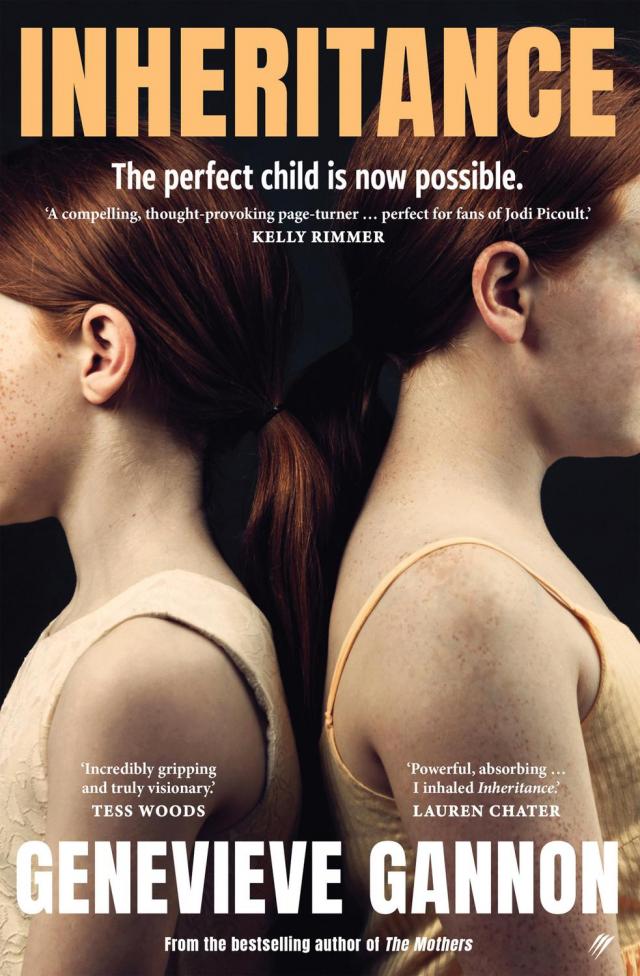


From the author of The Mothers comes a propulsive family drama that explores the possibilities and dangers of designing the perfect child.
In 2027, Emily is deciding whether to take advantage of a new health service that promises a healthier, stronger baby through gene editing. There’s plenty in her family tree that she would like to protect her unborn child against.
But not everybody loves the so-called designer baby technology.
Decades later, Adelaide is an ambitious political staffer trying to make a difference. Adelaide and her husband are working towards a goal they’ve called The Cyprus Project, but their plans risk being derailed when an unexpected threat looms.
Told across two generations, and two continents, Inheritance is about the legacies we leave our children, the bonds between mothers and daughters, and how it’s never too late to fix our mistakes.
Also by Genevieve Gannon
The Mothers
The Gifted Son
For Margaret Blair (Mum)
1
Emily
2027
Emily Monahan stood looking out the window of her red brick apartment, trying to master her fear. For the first time in her life she wished she could ask her mother for advice. She smoothed the creased flyer she had retrieved from the bin and told herself it was a coincidence it had landed in her letterbox the week of the appointment. The threatening contents were not directed at her; it was just a political flyer. Everybody on the street would have received it.
Still, it frightened her. Beady red Terminator eyes peered at her over a surgical mask. The slogan, Suffer the little children, was printed in letters that looked like they’d been cut out from a magazine, as if the flyer was a ransom note. When Emily had pulled it out of the mail slot, a chill ran through her, and she’d looked over her shoulder, unnerved by the sensation of being watched. She had crumpled up the paper and thrown it in the recycling bin, reminding herself that what she and Dougal were doing was perfectly legal. It was even subsidised by Medicare if you went through the public health system.
But she hadn’t been able to forget about it, and that night she’d gotten up in the dark to rummage through the recycling.
‘Hey.’
She jumped at the touch of a hand on her shoulder. ‘Oh God, Dougal!’
‘It’s late. What are you doing?’
She thrust the pamphlet at him. ‘I can’t stop thinking about it.’
‘Don’t let them get to you,’ he said, snaking his arms around her waist and pulling her into his protective embrace. ‘That’s what they want.’
‘Maybe they put this in our letterbox as a warning.’ She twisted out of his grasp. ‘Maybe they’ve hacked the clinic’s database and they’re coming after everyone on their books. We don’t know what they’re capable of.’
‘It’s just propaganda.’ Dougal stepped on the bin pedal, balled up the pamphlet and threw it in with the rubbish. ‘Come to bed,’ he said, steering her towards their bedroom.
But the next morning, after breakfast, Emily had opened the bin and seen the flyer sitting on top of the coffee grounds and oil-soaked paper towels. It gave her a stomach-twisting sense of impending doom. She’d fished it out and hidden it in her desk drawer.
She looked at it now, and the red, robotic eyes looked back. They were due at the clinic in half an hour and would likely be confronted by people who believed in the flyer’s message. She touched her heirloom bracelet and wished she had inherited an ounce of her mother Jean’s fearlessness. At the funeral, Emily had linked arms with her aunt Tabatha, as her mother, and all her treasures, were lowered into the ground. Being forced to bury the sapphires and diamonds seemed like a cruel, final act of control from beyond the grave, and Emily was surprised to discover she could be angry with a dead person even as she pressed her fingers against her eyes to blot her tears. At the will reading, Jean’s solicitor had passed Emily an unmarked, yellow envelope, which she tipped up so that its contents fell into her palm. The aquamarine tennis bracelet stirred up a regretful kind of sorrow for the stern woman she never really knew.
The sun was setting, taking all the colour in the sky with it. Ambers and oranges were turning indigo over their quiet street. Emily knocked on the bathroom door, rattling its rickety slats. She wanted to be inside the clinic gates before dark.
‘Dougal, come on!’
‘Coming, coming!’
She could hear the tap running. ‘I’m going to wait for you in the car.’
She slipped the pamphlet into her pocket and hurried outside, where she climbed behind the wheel of her beaten-up old Mazda. She checked her face in the rear-view mirror. Her blonde hair was lank and she could see the cords in her neck as she stretched to study her reflection. She was skinny. Far too skinny. It wasn’t that long ago when being slender was something she’d prized. Now the idea of forgoing a meal was madness. Just outside her window was a nature strip the neighbourhood had converted into a vegetable garden. Tomato vines were secured to stakes with twist ties and bits of ribbon.
Emily looked at her watch, impatient. She was about to honk the horn when the glass door of their building flew open and her husband came hurrying down the path, buttoning his jacket with one hand and straightening his glasses with the other.
‘I know, sorry,’ Dougal said as he reached the car, a little breathless. ‘Couldn’t find my specs. It’s a cruel irony that you can never find the things you need to see because you can’t see.’
She bristled as he tucked his shirt tighter into his pants. Emily had ironed it the night before, determined to make a good impression, but it hadn’t made a difference. Dougal’s clothes no longer fit him properly, lending him a perpetual dishevelment. He looked down at her as she gripped the steering wheel.
‘Are you sure you want to drive?’ he asked.
‘I don’t care who drives, I just want to get going,’ she said more tersely than she intended.
‘Shuffle over. You relax.’
‘Relax?’
‘Or your approximation of that.’ He grinned, trying to keep the mood light. ‘Go on.’
Emily hitched up her skirt and climbed over the centre console. As she dropped into the passenger seat, her skirt snagged on the gearstick with a ripping sound.
Dougal glanced at her. ‘Was that your dress?’
‘It’s fine, it’s just the lining,’ she said peevishly as she unhooked polyester-satin threads from the metal corner of the gearstick. ‘Take Nicholson Street.’
‘I was going to,’ he said. He yanked his seatbelt and clicked it into place. Emily watched as he adjusted the mirror, then his glasses.
‘Today, please.’
He started the ignition. ‘We’ve got plenty of time,’ he said.
Emily took a deep breath. ‘I’m sorry. I’ll calm down once we’re safely inside the clinic gates. Promise.’
He squeezed her knee.
As Dougal turned the car in the direction of the clinic, Emily’s nerves settled and she felt a rush of affection for her husband. He had the even temper of an ageing Clark Kent, and could absorb her bouts of anxiety the way Superman soaked up radiation. She looked at him as he watched for a break in the traffic so he could turn onto the main road, his fringe flopped over his forehead, his pale blue eyes squinting in concentration, and her feelings of tenderness swelled. He was so good-hearted, she wondered how he tolerated her, with her spikes and all-encompassing desires and her best intentions, of which she so often fell short. She would tell him how much she appreciated him later, when they were in their bed, and the unappealing task ahead had been completed. For now, she just wanted to get on the road.
They had only travelled a few blocks before they were stopped by a red light. Five men with bristly faces and tattered clothes approached with squeegees and water bottles, vying for a few dollars. Dougal waved a yes to one of them, who sloshed suds onto the glass and scraped it clean. When he was done, Dougal wound down his window and held out a five-dollar note. The man hesitated.
‘That’s generous, sir, but I don’t suppose you’d transfer it to me.’ He took an iPhone 10 with a cracked screen from his pocket. ‘It’s getting hard to find places that accept cash.’
‘Of course,’ Dougal said and tapped his watch against the man’s device.
‘Thanks. That’s decent of you.’ The man bowed his head and shuffled off as the light turned green.
The clinic was just outside the CBD. As they drove towards it, the final dying glimmers of daylight bounced off the city skyscrapers.
‘It’s eerie,’ Emily said. The scene was making her edgy.
‘Don’t worry. It’s not like he can start without us.’
‘That’s not what I’m worried about,’ she said. ‘It’s … You know … Turn off here. We’ll come at it from the back streets.’
Dougal pulled into a wide residential street, where the heritage houses were all double-fronted and had porches trimmed with iron lace and meticulously maintained hedges.
‘Do you think they’ll be there?’ Emily asked.
‘I hope not.’
‘The forums say they’re coming every night now. Why can’t they just mind their own business? This is our choice.’ She folded her arms, hugging herself. ‘We’ve wanted this for so long. It’s been hard enough, and now this … They shouldn’t be allowed to intimidate us.’
‘Even if they are there, they have to stay outside the e xclusion zone. It will be okay.’
‘Shh!’ She sat up straight, alert. ‘Can you hear that?’
‘No.’
‘Maybe I’m imagining it.’ She wound the window down a little. ‘Listen.’ In the near distance came the rolling rumble of chanting female voices. ‘It’s them. Look!’ She grabbed Dougal’s arm and pointed. ‘There they are.’
About 100 metres away was the clinic’s high bluestone fence, crowned with loops of razor wire, and around the perimeter were dozens and dozens of protestors. They were brandishing placards like pitchforks, chanting: ‘Procreation not production.’
Sunkissed wellness warriors stood shoulder to shoulder with middle-aged women in business suits and sensible shoes. Teens in university caps and activewear flanked retirees in resin necklaces and sack dresses. They were being led by a stout, thin-lipped woman in a windbreaker with a yellow trim. She wore yellow ribbons tied around her ponytail and punched the air as she shouted, ‘Procreation not production!’ An older, smaller woman with a short chestnut perm was speaking into a megaphone. Her voice droned over the chanting.
‘Interfering with the sacred creation of a human life is nothing short of evil. This will unleash changes that will reverberate for generations to come. We are here to speak for those who cannot speak for themselves.’
She was whipping up the protestors, who grew more enraged with each word. They wore yellow scarves, T-shirts and dresses in shades of mango and pineapple. Tropical fruit colours. A sign caught Emily’s eye: Human babies have human rights. Indignation surged through her.
Dougal pulled the car over and cut the engine. ‘This is worse than I expected,’ he said.
‘I told you.’
He wasn’t immersed in the forums like Emily was. The clinics all ran slick ads, but she had wanted to hear from women who had been through the process. At first, the chat rooms were helpful, cheerful places. Members offered price comparisons and ranked the doctors they’d seen. Lately, the tenor had been changing. There was fearful talk of the growing violence outside the clinics. A mother had suffered second-degree burns a few months back when someone had thrown a Molotov cocktail as she left an appointment.
The woman with the perm and the megaphone was shouting now. She wore her yellow in the form of a chiffon blouse with a fussy bow tied high and tight around her neck. ‘We will protect the pre-born!’
The crowd shouted back. The noise of the rally grew from a rumble to a roar.
‘Jesus,’ Dougal said.
‘Now we are going to be late! They say they want to protect the sanctity of human life, but what about our lives? What about our right to ensure we make the best choices for our family?’ Emily fumed but didn’t move from the passenger seat.
‘Hey.’ Dougal made her look him in the eye and touched a tender hand to her cheek. ‘I won’t let them hurt you.’
Emily nodded and undid her seatbelt. She leaned over to give Dougal a hug before she faced the horde. As she did, her elbow grazed the horn. A muffled honk escaped. Some protestors turned towards the noise, searching the dark for its source.
‘Oh no,’ Emily whispered.
One of them locked eyes with her and pointed. A cold trickle of fear ran down her spine. A smaller group of protestors splintered off from the rabble and surrounded their car, holding up gruesome pictures with angry slogans like, Messing with God’s creation is the Devil’s work!
‘We have to go,’ Dougal said.
‘How can we?’
He readied his phone’s camera. ‘If they cross the line, we’ll have evidence.’ He took hold of the car handle and wrapped his other arm around Emily. ‘Are you ready?’
She took a deep breath. ‘Yes.’
‘Keep your head down.’ Dougal pulled the handle and kicked open the door. ‘Go!’
When her foot hit the road, it was like a bomb going off. The protestors shouted and stamped their feet. The noise was deafening. Dougal kept his arm around Emily and used his body to shield her. The horde shook signs and yelled.
‘Monster!’
‘Don’t do this!’
‘Selfish!’
More protestors rushed over, teeth bared, signs up.
‘Procreation not production!’
‘PROCREATION NOT PRODUCTION!’
Dougal and Emily forced their way towards the high stone fence, crashing against bodies and the flat cardboard signs. ‘It’s okay,’ he said. ‘I’ve got you.’
Dougal held up his camera phone to ward off the mob. It was illegal for protestors to touch patients, but they shook placards at them and used their shoulders to crowd them, like a righteous, writhing roadblock. They shoved and shouted.
‘You don’t have to do this!’
‘They’ve brainwashed you!’
‘This isn’t natural!’
‘This isn’t right!’
They were pulling at Emily’s hem and her handbag, dragging her back from the gates.
‘You’re not supposed to touch me!’ she shouted at them. ‘Let me go!’
Dougal urged her forward. ‘We’re close. Just hold on a little longer.’
Guards were stationed on either side of the security gate. They were broad shouldered with thick, bulging arms and wraparound sunglasses. As Emily and Dougal inched closer, a woman with long grey hair leapt forward. Her eyes were wide as she reared and darted at Emily, like an adder, hissing and taunting, ‘This is wrong. This is wrong!’
Emily lifted her arm to protect herself and, in a flash, half a dozen phones rose to capture her, ready to spin the act of self-defence as violence. Rage ignited every nerve in Emily’s body.
‘Get out of my way!’ she yelled at the woman.
‘The most important mother is mother nature,’ the woman said blankly, holding the camera lens in Emily’s face. Then came a growl, and a slash of pain. Emily felt like she’d been cut with a serrated knife.
‘My leg!’ she cried and touched her calf, which was sticky with warm blood. Another growl came from the bowels of the mob, followed by a command: ‘Sunflower, no!’
Emily spun around and saw a bull terrier with a yellow bandana around its neck straining against its leash. Its sharp teeth gleamed. ‘Sunflower! Stop!’ the woman yelled as she held the hound back. The dog barked savagely. Its owner strained, looking as if she was about to lose her grip on his lead.
Emily held her phone up to the closest guard. It showed her appointment confirmation. ‘Help us!’ she cried.
He nodded. The automatic gate began to slide open.
Emily scrambled through with Dougal behind her. Once they were inside, the door to the clinic flew open, and a woman with long red hair came hurrying down the stairs. Her medical coat flapped as she ran, revealing long, slender legs.
‘Quickly, come inside,’ she said, helping Emily as she limped up the stairs into the waiting room, trailing blood.
Dougal followed, his hand on her back. ‘That bite looks pretty bad.’
‘It’s okay, you’re safe now,’ the woman soothed. ‘I’m Dr Osmond’s assistant, Corinne. Welcome. We’ll get you cleaned up before you go in for your appointment.’
The heavy door shut behind them, silencing the baying crowd. Emily took a deep breath. They had made it. The clinic was silent and smelled pleasantly of roses. Corinne helped Emily hobble to a seat, then knelt down to inspect her wound. ‘May I?’ She gently angled Emily’s leg to get a better view of the gash.
While Corinne studied Emily’s injury, Emily studied Corinne. She looked like a clinician as imagined by a French fashion house, in her high, impractical shoes and figure-hugging white dress under a white coat, which Emily had first thought was a medical coat, but she could now see was made from a crepe knit. Corinne’s hair was thick and glossy, her skin as flawless as latex. She was the most remarkable specimen of a woman Emily had ever encountered. An airbrushed magazine ad come to life. Emily felt herself leaning forward to get a closer look when Corinne’s eyes flicked up and met hers. Emily quickly looked away, embarrassed, but Corinne was unfazed. ‘The good news is you won’t need stitches. I’ll fetch some antiseptic cream and a dressing,’ she said, getting to her feet.
After Corinne glided out of the room, Emily whispered to her husband. ‘Did you see her? You don’t think she’s a—?’