The Most Dangerous Game, page 1


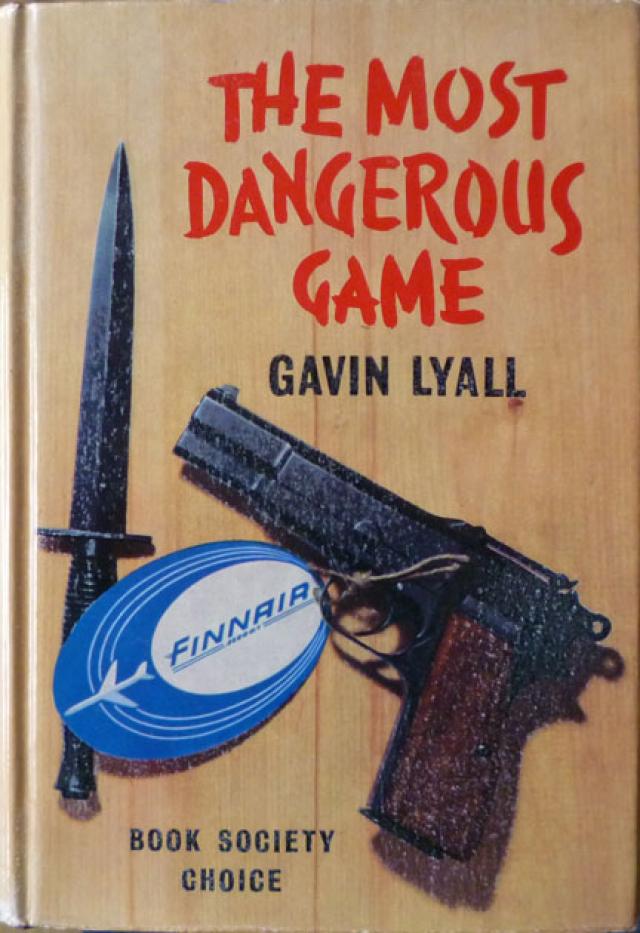
THE MOST DANGEROUS GAME
GAVIN LYALL
UNABRIDGED
PAN BOOKS LTD: LONDON
First published 1964 by Hodder & Stoughton Ltd.
This edition published 1966 by Pan Books Ltd.,
33 Tothill Street, London, S.W.1.
isbn 0 330 10487 x
2nd Printing 1966
3rd Printing 1966
4th Printing 1966
5th Printing 1966
6th Printing 1966
7th Printing 1967
8th Printing 1971
9th Printing 1973
© Gavin Lyall, 1964
Printed in Great Britain by Cox & Wyman Ltd.,
London, Reading and Fakenham
1
They were ripping up Rovaniemi airport, as they were almost every airport in Finland that summer, into big piles of rock and sandy soil. It was all part of some grand rebuilding design ready for the day when they had enough tourist traffic to justify putting the jets on to the internal air routes. In the meantime, it was just turning perfectly good airports into sand-pits.
In some rush of enthusiasm they’d even gone and torn up the area between the aircraft park and the airport building, a long low wooden affair with the control tower in one corner and the coffee baari in the middle. To reach it now, you had to walk along fifty yards of plank path laid across the muddy sand. He was waiting for me at the near end of the path.
Then, I didn’t know him from the angel Gabriel, except that he was perhaps a little short for that. I just got an impression of somebody looking smart in a light-coloured raincoat and hat and with a lot of snazzy luggage laid out neatly along the planking to keep itself dry and me wet.
The cut and colour of his clothes had marked him as not being Finnish, so I said in English: ‘You wouldn’t be offended if I broke my neck falling over your luggage, would you?’
He said:‘Mr Cary?’
I said: ‘Yes, I’m Bill Cary,’ and cranked my eyes around until I could look him over more carefully. My first idea was that he looked blurred, but then that was true of everything else I’d looked at that day.
He was shortish without being small, and slightly tubby. His raincoat was a single-breasted beltless job of that ivory white colour that looks a lot more expensive than plain soap-commercial white. And it managed to look clean and crisp without looking new. His hat was of the same material, the American golfing version of the Cockney peaked cap. He had small, brown shoes with punched patterns and a rich deep gloss in them. He looked expensive, in a quiet way, and he looked used to it.
With all this, and with standing on a torn-up airfield just inside the Arctic Circle, his face seemed off-key. It was round and smooth, with a baby-angel gentleness in his big grey eyes. But if he was a softie, at least he didn’t think he was. Among the luggage laid out on the path there were four worn gun cases.
He said: ‘Pardon me, sir - Frederick Wells Homer,’ and held out his hand. He had a watered-down American accent and he said his name as if he always said it that way, not as if he was trying to impress me.
I shook his hand. It was small and well-kept, but firm.
‘Mr Cary, sir -1 wonder if you could fly me somewhere?’
The thought landed in my brain with a soggy thud. I waved a hand at him. ‘Later - later. Say, after breakfast.’
‘Breakfast, sir? Today? You breakfast rather late.’ He raised a polite pair of eyebrows at me. The slow, controlled movement of his face gave him his age: around thirty-five. A few years younger than me and about a century younger than I felt.
He had a point there, though. It was about four in the afternoon.
‘I’ve just got in from Stockholm with a hangover,’ I said carefully. ‘I didn’t feel like eating and drinking anything before I left and to tell the truth I don’t feel like it now, either. But if I’m going to live, I’d better try at least a cup of coffee.’
The thought of coffee made him get fuzzy again. Through it came a new thought. I asked: ‘How did you know who I was?’
He smiled gently. ‘I was told to look for a tall, thin Englishman, flying a Beaver amphibian and - and dressed as you are.’ Whatever else he had, the man had manners. ‘Dressed as you are’ was a baseball-style cap, a pair of oily khaki drill trousers, a leather jacket that looked as if I’d decoked an
engine on to it (probably because I had), and American para-troop boots with a Fairbairn commando knife clipped to the right one.
I smiled knowingly more or less in his direction and said: ‘You can’t fool me. You’re Robert E. Lee, the well-known Southern Gentleman.’
He smiled gravely back. ‘I hate to disappoint you, sir. But at least we come from the same state.’
I said: ‘Virginia.’ And he nodded and I nodded, and then floundered over his luggage towards the baari.
I got my coffee, large and black and hot, and went away to fight it alone in a quiet corner. But long before I was ready for loud, close noises, somebody had rasped out the chair opposite, flopped into it, and rasped it back up to the table. Robert E. Lee would never have done that to a sick man. And in fact, he hadn’t. It was Veikko.
He said: ‘How soon can you finish the Kaaja company work?’
He said it in English, which even to me in my state, suggested he wanted something from me. When we spoke to each other, we usually spoke Swedish. Finnish is one of the toughest languages in the world and I’d never got fluent in it. But I speak Swedish all right, and most Finns have it as a second language.
But normally Veikko and I didn’t speak anything. He was Lapland’s biggest crook. I’ve nothing against talking to crooks, only against those who are well known to be crooks. Also, I didn’t know what particular crookery he was up to this year.
I said: ‘Go away. I’m busy dying.’
He leant across the table at me. ‘I have a job for you, if you finish off the Kaaja work quick. Not here. In Sweden.’
I focused on him. He didn’t look like Father Christmas. He still looked like Lapland’s biggest crook: a shortish, very solid man in a double-breasted suit of snappy green-and-black stripes that looked as appropriate to Lapland as a Tiger Lily. A good deal of flesh on his face - which isn’t untypical in a country which likes its potatoes - but very smooth and unweathered.
I took a long swallow of coffee. ‘Who’s the company on this job?’ Then I thought of a better question: ‘What’s your cut?’
He spread his hands and smiled the happy, open smile of a secondhand car salesman. ‘Just a few per cent.’
‘When does the job start?’
‘How soon can you get the Kaaja company work finished?’
I went back to my coffee. ‘I can’t. I’m contracted to them until the first snow.’
‘No.’ He smiled some more. ‘Kaaja does not give contracts like that. When can you finish?’
I swallowed more coffee. It was beginning to do its work. By now I could think out that perhaps his whole approach was some way of finding out what area I was surveying for Kaaja. You don’t know about nosiness until you’ve seen one mineral company’s interest in the areas where another company thinks there might be minerals. And Veikko would be the ideal man to hire to find out what I was up to.
Except, of course, that everybody except the reindeer knew he was a crook, and even they must be getting suspicious by now.
‘What’s the job itself?’ I asked. ‘Survey? Transport?’
‘The company will tell you. When can you start?’
‘I can’t. I’m contracted to Kaaja. Why don’t you give the job to Oskar Adler?’
He was the only other floatplane pilot working in Lapland that summer.
‘Hell,’ he spread his hands again. The work needs flying off both land and water. He doesn’t have an amphibian; you have the only aeroplane with both floats and wheels up here.’
At least that was true.
‘Sorry,’ I said. ‘I’m contracted to Kaaja.’ I went to get myself another coffee.
When I looked back, he was just getting up. He didn’t look as worried as he should have, not after missing his few per cent. Or not finding out something about the area I was surveying for Kaaja.
Perhaps I was a damn fool. My Kaaja contract didn’t last until the first snow. It was just to survey an area, and I would probably finish that in two weeks.
But Veikko still didn’t look like Father Christmas to me.
I finished my second coffee and my hands were still shaking like a battle flag. But at least I was awake enough to realize what I should have done in the first place: had a beer.
The only problem in buying a beer on a Finnish airport is that you can’t. The Finns are roughly divided into those who take it, and go on taking it, and those who leave it alone and think it would be better if everyone else did. The last bunch made the drink laws. One law is that you can’t buy a bottle in Lapland anywhere north of Rovaniemi, and can’t even buy a glass except in the half-dozen tourist hotels. This makes for plenty of illegal home distilling and a good trade in imported crates of the real stuff. I’d flown in one or two myself when I had an unloaded flight from the south.
The second law is that you can’t drink on airports. Not a bad idea for stopping pilots taking off drunk, but not much help to a pilot who knows by long experience that the only way to get a hangover roped and back in its cage is a beer. Or two.
Happily, there was a man down in the maintenance hangar who made half his living doctoring hungover pilots. I stood up to go and get some maintenance just as Frederick Wells Homer came in.
He smiled at me and came and sat down.
‘I trust you’re feeling recovered, sir?’
‘Better, anyway.’ I sat down again and lit a cigarette. At least I owed this character an apology.
I said: ‘I’m sorry about the way I behaved outside.’
‘Think nothing of it, sir. You were not a well man.’ He smiled gravely. ‘It must have been quite an achievement to fly that distance from Stockholm - I believe it’s about five hundred miles? - with such an affliction. I feel reassured in placing myself in your hands.’
I squinted at him. That should have been sarcasm, but it was said dead straight, the way he said his name.
I said: ‘I’m not sure that I follow your reasoning. If I met a pilot with a hangover like mine, I’d go by submarine.’
He just smiled again. ‘Then you think you’ll be able to transport me, sir?’
‘Depends where and when.’ I didn’t much want to take him anywhere at any time. I was contracted to the Kaaja Company and I owed them an early night. But you don’t often meet somebody with the manners of Robert E. Lee. I’d met a couple of Kaaja directors in Helsinki on my way to Stockholm and they hadn’t had the manners of Billy the Kid. I’d been flying a survey for them for over five weeks and hadn’t found a Finnmark’s worth of nickel; therefore I was loafing on the job. Flying out to Stockhohn for the weekend just proved it.
He said: ‘I was hoping you’d be able to advise me, sir, with your knowledge of the country. I’m looking for bear.’
‘Bears?’ Then I remembered the gun cases outside. Then I shook my head anyway. ‘You hardly get any bear shooting. Then mostly in the spring. I read somewhere that they only shoot forty-odd a year.’
He just nodded and waited.
I was stalling. I knew where there were bears. Flying a mineral survey means flying mostly no higher than three hundred feet, and in a single-engined aircraft that means spending the time watching the ground, looking for landing places in case the single engine gets the sleeping sickness on you. In Finland, which is mostly woodland, this doesn’t help much, but at least it means you know what’s happening on the ground. And I’d seen five bears, or the same one five times, in the last fortnight.
There were a couple of snags. One was that putting him down in the only bit of bear country I could vouch for meant putting him down in the middle of my survey area. Not a good idea if he was a rival company’s spy. Still, I didn’t really think he was.
That left just snag number two. ‘Look,’ I said. ‘I can put you down near where I’ve seen some bears recently. The trouble is, I’d be breaking the law in doing so.’
He gave his eyebrows a polite lift, and waited for me to explain.
I said: ‘It’s a prohibited area. Prohibited to aircraft, anyway. It runs up and down the Russian frontier, anything up to forty-five miles wide. It’s all Finnish territory, but they make it prohibited as a sort of peacemaker. So the Russians won’t have any excuse for complaints about somebody spying on them. And the Finns take it seriously - if they catch you in it.’
They hadn’t caught me - yet. Which was partly because their radar net isn’t complete and partly because at mineral-survey heights you’re well under most radar coverage. But it was also partly luck, because the whole of the Kaaja survey was in prohibited territory.
Kaaja had covered themselves by giving me a dummy contract for a legal area further west, and done something towards covering me - since I’d be the one to get jugged - by paying nearly double the normal rates. But I still had a better-than-usual reason for keeping my survey area secret.
But I didn’t think Homer was a Finnish government agent, either.
‘I don’t mind flying you in there,’ I said. ‘And it’s no offence for you to be there, on the ground. But I don’t want anybody to know how you got there. While you’re there I’d rather nobody else knew where you are, and when you get back I’d rather nobody knew exactly where you’d been. That means pretty well stranding you there, you understand?’
He thought about this, then nodded. ‘That’s quite agreeable to me, sir. Indeed - provided I’m not leading you into unnecessary risks - I’d prefer it that way. You’re sure you’re happy about this, sir?’
I waved a hand. ‘I’m sure. When d’you want to go?’
‘Whenever you’re ready to fly, sir.’
I looked at my watch. It was nearly five o’clock, which left us over two hours of daylight, and a long twilight after that. We were on the edge of autumn, just crawling down from the days of the midnight sun to the long, long night of the Lapland winter.
‘Okay,’ I said. ‘There’s an old cabin up near the place I’m thinking about. I don’t know what it’s like, since I’ve only flown over it, but it’s probably better than a tent. I suppose you’ve got supplies?’
‘I think I have everything, sir, including a fortnight’s food. Perhaps, after that, you could fly me in some more?’
‘No trouble.’ Then I began to wonder how long he’d reckoned it would take to shoot a bear. ‘How long were you planning to stay?’
‘I’d thought of five or six weeks - to begin with, anyhow. Were you going to be in these parts that long?’ He said it with a kindly - and honest - anxiety, as if he might accidentally detain me on the wrong side of the world.
‘I’ll stay as long as there’s work. It can be a damn long winter for a pilot.’ I must have sounded sincere, because he glanced at me quickly, then looked politely away again.
I stood up. ‘I’ll see you outside in a quarter of an hour. I’ve got a man to see down at the hangar. All right?’
‘Perfectly, sir. I’ll start loading my baggage, if your airplane’s not locked.’
I smiled at the idea. ‘Not in a long time.’ Then I nodded, which was a mistake with my head feeling as it did, and went on out, thinking of the sort of life where you can take five or six weeks off to go and shoot a bear.
The maintenance man knew me; he had a bottle in one hand and an opener in the other before I was within shouting distance.
I drank half the bottle of beer in one gulp, then started slowly on the second half.
After a time he asked: ‘How was Stockholm?’ He spoke Swedish, for my benefit.
I said: ‘Fine, as far as I can remember.’
‘What did the de Havilland’s man say?’
I’d flown over primarily to see what the manufacturer’s agent thought needed doing to the Beaver to keep it going another season.
‘He was very polite and kind. At least he didn’t laugh.’
‘Did he say you needed a new engine?’
‘He said I needed a new aeroplane.’
He nodded gloomily. ‘I could have told you that myself. Only I thought it would worry you.’
Beavers are among the toughest aircraft built these days -they were designed for the Canadian bush jobs - but even Beavers grow old. This one had grown old inside a few seconds when some Finn Air Force pilot had tried to make a long landing on a short lake. They’d picked it out of the trees and sold it off cheap - to me. I’d done what essential work I could afford, such as putting on a propeller, but one of the floats was slightly out of line, the fuselage was twisted so that none of the doors fitted properly, and the engine bearings were waggling like a film star’s bottom.
‘Did he give you a price for an engine overhaul?’
‘He said if the engine was giving full power the whole aeroplane would pull apart in the air.’
He nodded again. ‘Maybe you’ll get work this winter.’
That was always the problem. Most charter flying and all mineral survey work stops with the first snow. Up to a few years ago, I’d been able to find winter work in Norway or Germany or Austria; by now they’ve got too many aircraft of their own. Last winter I’d laid the Beaver up in Helsinki; it looked like the same this year.
But even steady winter work wouldn’t buy me a new Beaver; what I needed was to find nickel. Under the bonus clause with Kaaja, that might just do it.
I asked: ‘Mikko about?’
He nodded his head at the back of the hangar. I walked down there. Mikko was leaning against the wall, watching a man working on a piece of electronic equipment on another bench.