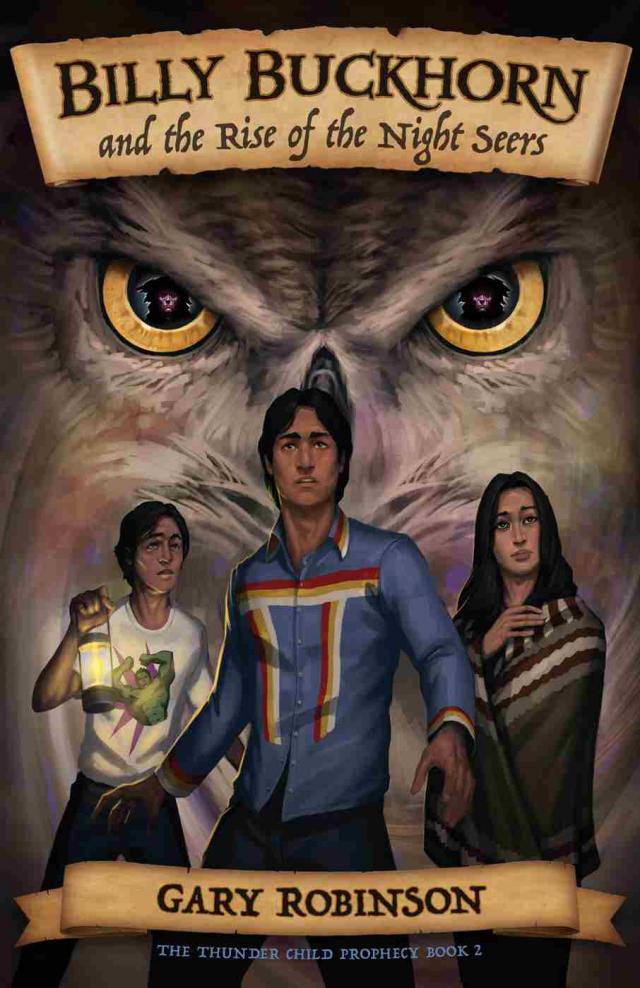
Billy Buckhorn and the Rise of the Night Seers, page 1


Library of Congress Cataloging-in-Publication Data available upon request.
© 2024 by Gary Robinson
Front cover art by Chevron Lowery, chevronlowery.artstation.com
Cover and interior design: John Wincek, aerocraftart.com
All rights reserved. No portion of this book may be reproduced by any means whatsoever, except for brief quotations in reviews, without written permission from the publisher.
7th Generation
Book Publishing Company
PO Box 99
Summertown, TN 38483
888-260-8458
bookpubco.com
nativevoicesbooks.com
Printed in the United States of America
ISBN: 978-0-9669317-5-4
eBook ISBN: 978-0-9673108-1-7
29 28 27 26 25 24 1 2 3 4 5 6 7 8 9
want to thank my best friend and significant other, Lola, for her ongoing support in all things. I couldn’t do this work without her. She has been by my side for many years, and no words printed here could ever express my true gratitude.
siyo (hello). As I noted in book one of the Thunder Child series, this is a work of fantasy fiction. Elements of Native American cultures and histories have been blended with fictional tribal cultures, religions, and histories to achieve what I hope is compelling storytelling. In these pages, reality and fantasy come together in a unique way.
To learn more about the actual Cherokee language, history, and culture, I recommend the following online resources:
The Cherokee Nation’s language website:
http://language.cherokee.org/
Cherokee Word of the Week YouTube channel:
https://www.youtube.com/watch?v=6jiK-5bJbKc
OsiyoTV YouTube channel:
https://www.youtube.com/c/OsiyoTV
Wado (thank you).
Gary Robinson
Prologue
CHAPTER 1
Tour Guide to the Dead
CHAPTER 2
The Conjurer’s Secret
CHAPTER 3
The Girl with the Spider Tattoo
CHAPTER 4
Cold Moon
CHAPTER 5
The Sorcerer’s Apprentice
CHAPTER 6
House of Bones
CHAPTER 7
Kiss of the Spider Woman
CHAPTER 8
The Buckhorn Boy and the Lookout Girl
CHAPTER 9
The Conjurer’s Complaint
CHAPTER 10
Portals to the Underworld
CHAPTER 11
The Foul Fowl
CHAPTER 12
Conflict and Confusion
CHAPTER 13
The Gathering
CHAPTER 14
Ordained by the Sun
CHAPTER 15
Billy’s Journey
CHAPTER 16
No Bones About It
CHAPTER 17
Divide and Conquer
CHAPTER 18
Secrets Revealed
CHAPTER 19
Thunder Child Speaks
CHAPTER 20
Holy Road
BIBLIOGRAPHY OF SOURCES
ABOUT THE AUTHOR
ixteen-year-old Bryan Johnson was convinced that nothing interesting would take place on this family winter vacation to the Great Smoky Mountains National Park. What makes it so great? he thought. Absolutely nothing, as far as I can see.
The weather seemed worse than usual, even for this time of year. A relentless wind howled through the trees, sounding every bit like a pack of hungry wolves. Occasionally, an odd, mechanical-sounding squawk rang out, echoing across the mountains. It all made the teen’s skin crawl.
The Johnson family had been making this annual “pilgrimage to nature,” as Bryan’s parents called it, since before he was born. Mr. Johnson had researched the family’s genealogy and discovered they had a Cherokee ancestor mixed in among the mostly German Americans in the family tree. He was proud of that little fact.
The Smokemont Campground, near the Oconaluftee River, was a favorite destination spot for countless numbers of families from Tennessee and the Carolinas during the winter school break. It was located less than ten miles north of the Eastern Cherokee reservation in North Carolina. That was one reason Bryan’s parents liked coming to these campgrounds.
Sounding much like a travel brochure, Bryan’s father often said he loved the park’s breathtaking mountain scenery, panoramic views, rushing mountain streams, and old hardwood forests that stretched to the horizon. Coincidentally, Bryan did indeed trace those exact words back to the park’s printed guide.
Bryan’s ten-year-old brother, Jessie, apparently still found the annual trip exciting and interesting, and he was having a great time. But the boy had a tendency to spend many of his waking hours entranced in some make-believe fantasy involving magic and warlocks or dungeons and dragons.
That was why it was no real big surprise to Bryan when Jessie came running into the campsite early that New Year’s Eve morning, screaming at the top of his lungs, “A giant bird just kidnapped Corky!”
The young boy was near tears and panicked out of his mind at the loss of the family pet. “Good acting,” Bryan said with a laugh. “That was an Oscar-worthy performance!”
The boys’ parents emerged from their tent.
“I’m not acting!” Jessie responded angrily. “I saw it happen with my own eyes!” He buried his face in his mother’s embrace and began sobbing.
“What kind of bird is big enough and strong enough to pick up a thirty-pound cocker spaniel?” Mr. Johnson asked as he scanned the sky.
“I don’t know what kind of bird it was,” Jessie replied, still sobbing. “But his feathers looked like they were made of metal, and his claws were big enough to pick up a cow.”
“You mean you guys are buying this story?” Bryan asked in disbelief. “He’s obviously in the middle of one of his fantasies, or he lost Corky somewhere along the trail and had to make up a story so he wouldn’t get blamed.”
Jessie let go of his mother and ran toward his older brother.
“I’m not making it up!” the boy said as he took a swing at Bryan. “You don’t know what I saw!”
Their father, who’d been scanning the woods around them, stepped in between the boys and took hold of Jessie. Squatting down, he turned the boy so they were face-to-face.
“What do you say we get on over to the ranger station?” he said. “We need to report this incident to the park authorities immediately and then do a thorough search for Corky along the trail. Maybe the bird dropped him somewhere.”
“Good idea,” Mrs. Johnson said. “Bryan can stay here and watch the camp.” She eyed her eldest son sternly.
Jessie stopped crying and nodded his approval of the plan.
So, the three Johnsons marched the two hundred yards to the Smokemont Ranger Station, which had just opened for the day. Fifty-year-old Joseph Saunooke, a Cherokee ranger who’d worked for the Great Smoky Mountains National Park the last ten years, had just finished raising the American flag on the pole next to the station when the Johnsons approached.
The Cherokee man gave them a warm welcome, noticing that the boy was quite distressed. Once they were inside Saunooke’s office, Mr. Johnson tried as best he could to describe what Jessie had reported to him without sounding too out there. It was a balancing act for sure.
“Jessie, describe the bird in as much detail as you can,” Ranger Saunooke said in a sympathetic tone.
“It was bigger than any bird I’ve ever seen!” the boy said excitedly. “Its feathers were about the same color as a penny. I could tell it was hungry because his head was moving back and forth, you know, like he was looking for something on the ground to eat.”
“What else?” the ranger asked.
“Corky started barking his head off and jerked the leash out of my hands.” The boy began to tear up again. “That’s when the thing saw him. Corky ran toward the bird, barking at it up in the sky. I heard a clanking noise coming from the wings as it began to swoop down toward my dog.”
After a pause, the boy wiped his eyes, then turned serious.
“The giant claws opened up, and Corky yelped as they closed around him.” Jessie took a deep breath and finished his story. “It flew off upriver with a loud squawking sound. I could see Corky’s leash dangling from the claw. I watched the bird turn toward some cliffs, and it looked like there was a cave near the top. The thing took Corky inside the cave, and that was the last I saw of them.”
Exhausted from recounting the event, the boy blew out a big gush of air and slumped back in his chair.
Hugging his son and winking at the ranger, Mr. Johnson said, “Quite a tale, isn’t it? Who’s ever heard of a giant bird with metallic wings?”
Joseph Saunooke, for one, had heard of such a bird all his life—the Tlanuwa, his people called it—but he wasn’t about to admit it to this family of Anglo tourists.
“I’ll file a report about the missing dog and the bird sighting today” was all he said. “Why don’t you folks go on back to your campsite, and I’ll organize a little search party for your dog. Hopefully, we’ll find him hiding out somewhere near the trail.”
Satisfied with that response, the Johnsons headed back to their campsite.
After they were gone, Joseph immediately placed a phone call to his aging uncle Bucky Wachacha. The C herokee elder and medicine man had spent a lifetime gathering the legends, songs, and cultural practices of their people. He said he was a member of some intertribal group of medicine people from different parts of the country.
Recently the old man had been carrying on about some ancient prophecy that was about to be fulfilled. The prophecy foretold of a time when the old stories would prove to be true, a time when the legends would come to life.
No one had reported seeing a Tlanuwa in two hundred years, at least. The copper-feathered creatures were known to fly up and down the Oconaluftee and Little Tennessee Rivers, grabbing goats, dogs, and even small children and taking them back to their nests inside caves located high up on cliffsides along the waterways. They’d terrorized the Eastern Cherokee for centuries.
Was today the day the prophecy came true? Joseph hoped to find out.
ince the gathering of the Intertribal Medicine Council— also known as the ITMC—on the first day of autumn last September, reports of possible “Chosen One” candidates had come to Cecil Lookout from Native American communities via phone, letter, email, text, and tweet.
However, the eighty-year-old head of the council didn’t do emails, texts, or tweets. His teenage grandson Cody, who lived with him, handled those reports. Every one of them had to be investigated and followed up on. Finding and preparing this future spirit warrior for their upcoming role was vital, not only for the sake of the Native American population but for all the people of Turtle Island.
One of those calling in to report to Cecil was his granddaughter Lisa, who told him of a Cherokee teenager, the grandson of a medicine man, she’d been reading about in newspapers from the area where she lived. The boy, Billy Buckhorn, had been struck by lightning, had miraculously saved a busload of kids from certain death, and had died himself and come back from the dead with enhanced abilities.
Last fall Lisa told her grandfather, “I plan on tracking him down so I can talk with him. Maybe you and Dad can come to Tahlequah to meet with him sometime soon.”
“It sounds like this boy might be a real contender, if the news reports are accurate,” Cecil replied. “And if the boy isn’t pulling off some kind of hoax just to get attention.”
On the most recent winter solstice, the members of the Medicine Council had gathered again to review and evaluate the most likely candidates. Three people, all from recognized families of Native healers, had been put on the short list.
The winter solstice, falling on December 21, was the seasonal turning point and beginning of the new year for traditional Native peoples. It was coincidentally also Lisa Lookout’s birthday.
During the afternoon, while the ITMC was holding its sacred winter solstice proceedings, all those in attendance felt it—the unmistakable signal that a profoundly significant supernatural event was taking place. The signal rippled through the group as the most psychically sensitive perceived it first, and then others gradually recognized it.
The point of origin of the subtle signal seemed to be southwest of their location, but only one person, Cecil, was able to narrow that information down to a specific region—somewhere in eastern Oklahoma. He could also sense that the event, whatever it was, involved the first activation of the Fire Crystal since its disappearance almost a thousand years ago. That was a significant development for sure.
From Lisa’s reports, Cecil and his son Ethan knew that eastern Oklahoma was home turf for Billy Buckhorn. Was the supernatural signal related to the boy, or was it merely a coincidence? This would have to be investigated sooner rather than later.
Cecil, Ethan, and Lisa didn’t know that at that precise moment, the Paranormal Patrol had successfully recaptured the Horned Serpent in a cave near the Oklahoma-Arkansas border.
The facetiously named Paranormal Patrol had been made up of Billy; his best friend, Chigger; Billy’s father, James; and university archaeologist Augustus Stevens. The group’s sole task had been to recapture the Horned Serpent, which had been thought of, until recently, as mere Cherokee mythology.
Now, ten days after that solstice, just after dawn on New Year’s Eve, an early morning freezing fog was interfering with Billy Buckhorn’s ability to focus. Fog and frost were both common for Oklahoma winters, but not usually at the same time.
Through years of experience in woods and wilderness, along with his grandfather’s traditional Native teachings, the Cherokee teen had become finely attuned to his natural surroundings. At the moment, he was trying to follow a set of fresh, barely visible deer tracks through dry underbrush in the woods just north of the Brushy Mountains in the Cherokee Nation of Oklahoma.
Bowhunting for deer was Billy’s favorite winter sport, following an ancient tradition of his Cherokee people. In fact, the sixteen-year-old’s well-preserved recurve bow had been handed down from his aptly nicknamed great-grandfather Bullseye Buckhorn.
Hunting deer with a bow and quiver of arrows was far more challenging than hunting with a rifle. That was why Billy liked it. And because the young man could easily imagine himself a hundred or two hundred years ago doing the same thing.
These days, a sixteen-year-old Cherokee was qualified to receive a bowhunting license good for hunting on several different tracts of land within the Cherokee Nation boundaries. And this time of year, the end of December, was among the final days of deer hunting season for archers.
Like Cherokee hunters of old, Billy had purified himself in a small temporary sweat lodge before undertaking this hunt. That ritual not only allowed for the opportunity to pray for success but also cleansed him of his human scent so as not to alert the prey to his presence.
The sudden crack of a breaking twig a hundred feet ahead caused Billy to stop dead in his tracks. The gentle rustling of leaves in a soft, cold breeze was all he heard for the next few seconds. Then he heard a second twig break in the distance. Ah, his prey was closer than ever now.
With one eye on the deer’s tracks and the other on the path ahead, Billy moved silently forward. Careful not to step on any twigs himself, the young hunter skillfully crept along. A few minutes later he saw that the deer’s trail rounded a large boulder. Using the rock for cover, Billy peered through the trees until he spotted the animal. The young buck had stopped to take a sip of water from a nearby stream.
Now’s my chance, Billy thought.
Nocking an arrow, he pulled the bowstring taut. Then, taking aim at a spot just behind the creature’s front shoulder, Billy whispered a prayer asking for the animal’s forgiveness.
At that exact moment, the deer turned his head and looked straight at Billy. The animal’s eyes locked on to the hunter’s.
“Shoot if you must,” the boy heard in his mind. “I do forgive you.”
Shocked by what he’d heard, the archer froze. Had the animal just spoken to him?
The bowstring remained taut. The arrow remained nocked. Billy’s eyes remained locked on the deer’s eyes, while the deer’s gaze remained firmly fixed on Billy.
“What’ll it be, young medicine man?”
Billy aimed the arrow up and away from the deer. Upon its release, the projectile flew harmlessly into the forest’s upper canopy. The animal motioned his approval with a nod of his head, then turned and calmly ambled away.
“What just happened?” Billy asked out loud.
He’d become more or less accustomed to strange things happening in his life, beginning with the lightning strike on Labor Day and continuing with his near-death experience over the Thanksgiving holiday. Each incident had been followed by strange phenomena, like his ability to read people’s minds, sleep on books to learn their content, predict the future, and talk to the spirits of the dead.
And thanks to the thousand-year-old spirit of the Sun Priest, Billy could now see energy fields around people and understand the Cherokee language.
Billy was also experiencing painful physical growth spurts. Not the normal bits of growth a typical teenage boy might experience. More like abnormal growth that the gigantism disorder might bring on. At first Billy thought his imagination was just running wild, but the periodic bouts of pain were undeniable. And when his mother complained about having to let the seams out of all his clothes, he knew it must be real.
And now this—he’d actually heard the thoughts of a wild animal. Sure, Cherokee legends were filled with tales of animals and people talking to one another, but those were symbolic, fanciful myths, weren’t they? Of course, he had repeatedly told Chigger that all Native legends had a core of truth based on some reality from the ancient past. Billy realized that concept had been proven with the appearance of the Raven Stalker and the discovery of the Horned Serpent, which had slithered out of the crystal cave back in November.