Do Everything in the Dark, page 1


© Gary Indiana, 2003, 2023
This edition © Semiotext(e) 2023
All rights reserved. No part of this book may be reproduced, stored in a retrieval system, or transmitted by any means, electronic, mechanical, photocopying, recording, or otherwise, without prior permission of the publisher.
Published by Semiotext(e)
PO BOX 629, South Pasadena, CA 91031
www.semiotexte.com
Special thanks to Krista Montagna
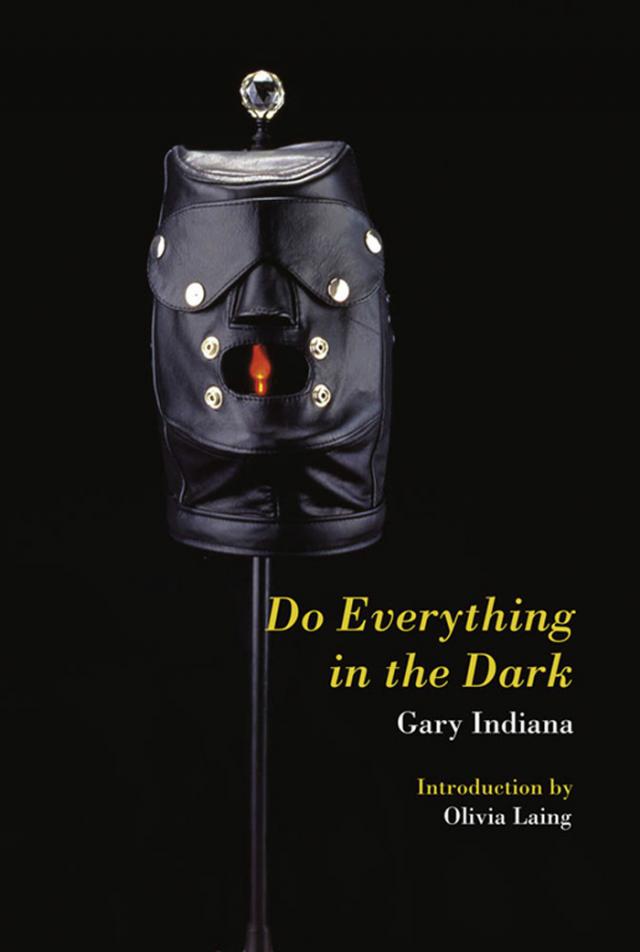
Cover Photograph: John Boskovich, Bondage Floor Lamp, (n.d.). Coutesy of David Lewis Gallery.
Design: Hedi El Kholti
ISBN: 978-1-63590-186-3
Distributed by the MIT Press, Cambridge, MA. and London, England
d_r0
Do Everything in the Dark
Gary Indiana
Introduction by Olivia Laing
semiotext(e)
Contents
Cover
Introduction by Olivia Laing
Preface to the new edition
Part One: The Debris Field 1
2
3
4
5
6
7
8
9
10
11
12
13
14
15
16
17
18
19
20
21
22
23
24
25
26
27
28
29
30
31
32
33
34
35
36
37
38
Part Two: My Recent Death 39
40
41
42
43
44
45
46
47
48
49
50
51
52
53
54
55
56
57
58
59
60
61
62
63
64
65
Part Three: The Falls 66
67
68
69
70
71
72
73
74
Introduction by Olivia Laing
Grave Goods
There is no good news. Badness ongoing, the perpetual aftermath of catastrophe, not that it's any inoculation against future damage or mishap. “I hardly need to tell you that the worst has already happened, is happening now, will happen tomorrow, and next month, and a year from Sunday,” says Do Everything in the Dark's narrator, an aging writer named Gary Indiana.
It's the summer of 2001 in New York City, a civilization long since swallowed whole by money. The layout of the city's streets might be familiar, but it's a simulacrum, the shell of a destroyed culture, wiped out by AIDS, dispossessed by rising rents and drug addiction. The new age is electronic, upbeat, ravenous in its consumerism. “People,” the narrator writes prophetically of the twenty-first century's doomed romance with technology, “were turning into things, had already turned into things.”
Indiana and his friends represent the undead: shell-shocked survivors of a 1980s demimonde, an obsolete avant-garde; play-wrights, novelists, and bit-part actors who have awoken in a millennium no longer interested in la vie de bohème except as set dressing for more effectively commercial operations. Everything is contaminated. Love is impossible, hope foreclosed years ago. Like people marooned in a shipwreck, they cling stubbornly to old habits. No coincidence that the novel is set in motion by a box of photographs or continues by way of actual paper letters, archaic modes of communication from a spent century, its ambitions and aspirations diminishing by the hour.
The season is conducted in Manhattan and its outposts. Anna sees her shrink and mutes her worries with escalating doses of heroin. Denise and Caroline have bottomed out in Santa Fe, which might as well be Mars. Jesse shifts aimlessly from Venice to Rome to Istanbul, picking up trade and worrying about being robbed, though the catastrophe, when it comes, is much closer to home. His friend Arthur writes plaintive letters from an unnamed island in the Mediterranean, where he finds himself an unwilling attendant in the court of two grotesquely wealthy married artists. No one, it is fair to say, is having much of a summer.
Do Everything in the Dark began life as a series of stories to accompany paintings of the real Gary Indiana's real friends, and retains a fragmentary, ragged, unexpectedly intimate feel. It's a novel in parts about people gone to pieces, a roman à clef, as we used to say, featuring lightly disguised satirical portraits of various downtown figures, among them Nan Goldin, David Wojnarowicz, and Rene Ricard. Cookie Mueller is the most affectionately cast, as the charismatic, lisping Millie Ferguson, while Susan Sontag is vibrantly unpleasant as fat-assed Tova Finkelstein, butch intellectual empress of unimpeachable vanity and self-regard.
But if the people are often shits, unadorned and flailing, the language is something else altogether. It's become a commonplace to speak of Indiana's sentences in terms of their lightness and sharpness, their dangerous iridescence, but what interests me more is that they exist to map a psychic realm that is neither purely private, the Freudian domain of the domestic interior, nor precisely historic, the long view of the social novel. Instead they survey the nutty cross-currents, as the very personal is assailed helplessly by the storms of time.
You can't show this effectively with a single protagonist. It requires a group to see how hidden tides move through lives, distributing havoc and accumulating debris. As the narrator says of a long-term friend, “we've breathed in and out through the same history, and seen our wishes trampled to death.” Times change and people don't always have the elasticity or appetite to change with them.
Even money is an imperfect prophylactic against chance indignity: shifts in the stock market, hopeless parents, new diseases, lightning, madness, war, air crashes, a heart attack on the cross-town bus. Jesse's trust fund permits perpetual indulgence and fails to serve as armor when it counts, while the quiddities of Anna's wealthy family have created numerous distressing glitches in her object relations, which neither sex, drugs, nor psychoanalysis can quite fix. As for Caroline, her lurid unravelling (loping naked into the desert in search of Jesus, trying to electrocute herself on the Electromagnetic Pulse Test Trestle at Kirtland Air Base, Albuquerque) can be traced unambiguously back to a rapist father. Cold comfort when the family money pays for a stint in Bellevue, after her own formidable emotional and intellectual reserves are finally exhausted.
Do everything in the dark: title and epigraph alike derive from Jonathan Swift's Directions to Servants (1745), a posthumously published satire of the eighteenth-century conduct book, in which the advice is grossly upended, so that at every turn the servant cheats and deceives his master. No one could accuse Swift of progressive intentions here. He wasn't exposing the inequities of the class system (why should one man respond to the whistle of another?) so much as poking fun at the unchanging absurdity of human nature, its venality and foolishness, in the form of servants who feign deafness to a call or blame smashed china on the cat.
In Indiana's conduct book, it's the mores of the superrich that are exhibited as monstrous comedy: their bad taste, ignorance, vulgarity, the way they generate circuses of harm for their own debased amusement. Reality is just as tiered and mannered as it was for Swift. Divisions between the powerful and powerless are permanent, no matter how palpably unjust a state that is. No one in this particular horror show, no matter how talented or altruistic, is permitted the illusion that they are unambiguously good, nor that good behavior has any indexical relationship to happiness or pleasure. As the ever-more-jaded Jesse muses, “the world has become too twined, too insalubrious with suffering, to float through it, as if one had a right to be anywhere.” And that's before they invented Twitter.
This is a book, I find myself thinking, for grown-ups. The young couldn't possibly savor such a smorgasbord of ennui and regret, nor quite gauge the value of what emerges from it: the small and stubbornly repeated instances of kindness, loyalty, affection, each accompanied by flashing billboards announcing their hopelessness and fallibility, experience having smothered any last vestiges of innocence or optimism. “I could never summon the right words, the right help. I could never save anyone,” the narrator announces, and then attempts to anyway. His tenderness and accompanying exhaustion derive inexorably from age, a consequence of lost illusions and companions, the mounting dead.
“The worst has happened,” he observes at the weirdly bathetic event that concludes proceedings, “even if ugly surprises await.” Cynicism is a way of defending against the relentlessness of this predicament, as is paranoia, but what distinguishes this book from others in the Indiana canon is that here and there a punch is pulled. I don't mean it is sentimental, but there are little chinks of unambiguous feeling. The narrator comforts Arthur, whom he loves, knowing it cannot possibly help. He mourns Miles, whom he loved; grieves for Caroline, whom he admires; sits at the hospital bed of Jesse, whom he doesn't even like. What I'm trying to say is that experience has not vanquished love, even if it has revealed love's absolute inadequacy against despair.
Cynicism, it occurs to me now, is also a way of protecting the loved object from being tarnished by those who proclaim it too easily, as well as those who trample it underfoot. The repellent machinations of the art world, the dumb, risible mechanics of socalled literary culture: these have long been Indiana's targets. Earnestness, hypocrisy, cliché are the near enemies of art, which threaten to topple it into meaninglessness: as certain an execution as defunding or censorship.
In the sour aftermath of his travels, Jesse confides in the narrator an infatuation with an artist. Leaving aside the autobiographical origins of this episode, what struck me most about it was the force with which Jesse decries the artist's ignorance and lack of curiosity in “politics, architecture, philosophy, history … He was, in fact, hostile to intellectual effort or inquiry.” There's a flash of the utopian in Indiana, the well-defended underbelly of the scabrous realist. Undeceived about reality, its ugly compromises, its endless disappointments, he also retains a dogged faith in thinking, knowledge as its own reward.
Time winds on, of course. The novel ends on September 8, 2001, on the banks of the East River. Anna has given up her apartment on Cedar Street, next to the World Trade Center. Shaken off the sense of looming catastrophe, moved into the future. No doubt more tides will pass, depositing debris at other people's doors. Life has a habit of surprising us like that.
Preface to the new edition
Do Everything in the Dark was the last of three novels I wrote while mostly living in houses in Upstate New York or at the Highland Gardens Hotel in Los Angeles. It began as a collaborative book project with a painter, my extraordinary friend Billy Sullivan: I was to write very brief stories to appear beside portraits of his friends and acquaintances, many of whom were also friends of mine. The stories would not be directly about the portrait subjects, but fictions in which some quality or characteristic of a real individual was reflected, stories about characters they might play in a film or a theater piece.
This project was never entirely certain, the prospective publisher having had an opacity comparable to that of Dr. Fu Manchu, and somewhere in the summer of 2001, Billy and I realized our book was never going to happen. By that time I had written most of what appears as the first third of this novel, though, and in this instance I had written past Kafka's “point of no return” much sooner than I normally did. (I have abandoned many more novels than I've ever published, usually realizing after fifty or sixty excited pages that they were heading nowhere I wanted to go.)
One early title I considered was Psychotic Friends Network. At the time, an unusual number of people I knew were experiencing crises in their personal or professional lives, having committed themselves to relationships and careers that, however bright and promising for years, were suddenly not working out. The binary twins, “success” and “failure,” were negligible concerns in what I was writing about, though some of my characters tended to judge themselves and others in those terms; I was far more interested in depicting how things fall apart and reconstitute themselves in the face of disappointment. My overall purpose in writing Do Everything in the Dark was to discover, if I could, what some would call paranormal ways in which a lot of monadic individuals and couples are connected to a vast number of other people, how networks of money, emotions, and wishes overlap across the shrunken geography of a globalized world. I also wanted to write a novel in which the two Greek concepts of time, chronos and kairos, were at work simultaneously, chronos being linear, consecutive, and irreversible, while kairos, “the moment in which things happen,” offers people an opportunity to employ time as a flexible medium—to write books, paint pictures, fall in love, or walk away from unfavorable situations.
When you live alone with characters you're making up, you are more alone with yourself than you realize. Rereading this book after twelve years, I see more clearly than I did then that it's a hall of mirrors. Not everyone in it is me, but I distributed my own insecurities and madness quite liberally among the figures I modeled after people I knew. And the book I thought I was writing from such a dissembling distance from real life situations turns out to be transparently about people whom a great many other people reading it could readily identify. That doesn't matter. I wasn't indicting anybody in front of a grand jury. It isn't a cruel book, or a score-settling one. In certain places, I did defend my side of a few long-recounted, wildly distorted stories people told about me, in a veiled way, but I wasn't moved by any animus about them; they were just more material when I needed some.
I wouldn't write a book like this today. A lot of it is prescient, it's written well, and most of it, I think, is darkly entertaining. But it also has the autumnal bleakness of a cosmic downer, as if a bad acid trip were being experienced by at least twenty people at the same time in different parts of the world. The world is hardly a better place than it was then, but I think it's possible that I am a better person now than the person who wrote this novel was.
At the time, I had just lost my mother, and my future prospects in the publishing “game” had been yanked out from under me. I was wobbling in and out of severe clinical depressions, which just rolled in clouds through the house at the oddest times, irradiating me with disgust at myself, and revulsion over every decision I'd ever made. I was often sunk so deep in depression that people could smell it on my skin. There was something upsettingly wrong about everything, including the house I'd impulsively bought simply because it was close to the one I'd been renting. The window frames were set wrong, a gangster contractor had installed terrible cheap wainscoting on the walls, claiming it was the only such obtainable these days, rather than the sturdy oak wainscoting found in so many old houses in the area. The original structure had been enlarged and expanded in an insensible manner, the whole layout of the place reflected some long-running cognitive disorder of its previous owners.
My cat, Lily, was terrified of the enormous basement at the bottom of a staircase off the kitchen, a maze of vast low-ceilinged chambers with the atmosphere of a horror movie. Lily never ventured a paw on those stairs.
Months after buying the house, I learned, piecemeal, from people who should have told me what they knew about that house before I signed the mortgage papers, that the sprawling white elephant I'd acquired had functioned in the middle past as a transient home for orphans and abandoned children awaiting adoption into foster care. A few years later, the house became an overflow domestic abuse shelter for women hiding from stalking husbands and boyfriends. There were even indications, in two of the basement areas, that meetings of some disreputable fraternal organization, something along the lines of Storm Front, had been held there for a while. These may also have featured a karaoke night, since besides the crumpled Confederate flags and vague neo-Nazi debris scattered in corners, there was also a truncated proscenium stage with a microphone stand and a dead amplifier on it.
My cat had infinitely better sense than I did. She knew right away that house was haunted and that I never should have bought it. In fact the house and the entire area around it, after I had stumbled through the worst confusions of my mother's death, became obviously, horrifically legible as exactly the kind of “community” I'd left home at sixteen to get away from. It even looked like the town I'd grown up in.
I finished the book before I sold the house, but not before 9/11 happened. Writing two-thirds of it after that event probably added even more plangent notes to an already melancholic saga. I don't think I considered for more than a minute whether to incorporate the disaster itself into the narrative. I decided it would be grotesquely distasteful. Everything I'd written to that point reflected in some manner an unmentioned catastrophe that had either already happened or was about to occur. But this catastrophe existed inside my characters, who were drifting on a historical current more subliminally pitched than the daily news. I didn't want to exploit something actual that had affected millions in an immediate, dramatic way, or use it as some ghastly metaphor, or wheel it onstage as a spectacular backdrop for stories that were, by their nature, comparatively trivial. It was obvious to me that many people were busy penning exactly those kinds of things within minutes after the planes crashed into the Trade Center—that's show biz. Even if literature is also show biz, I like to think it's a reflective person's show biz. So the book concludes on September 9, 2001, a day that nobody remembers, when the links between various microcosms I invented came full circle.