Echoterminus: Echogenesis Book 3, page 1


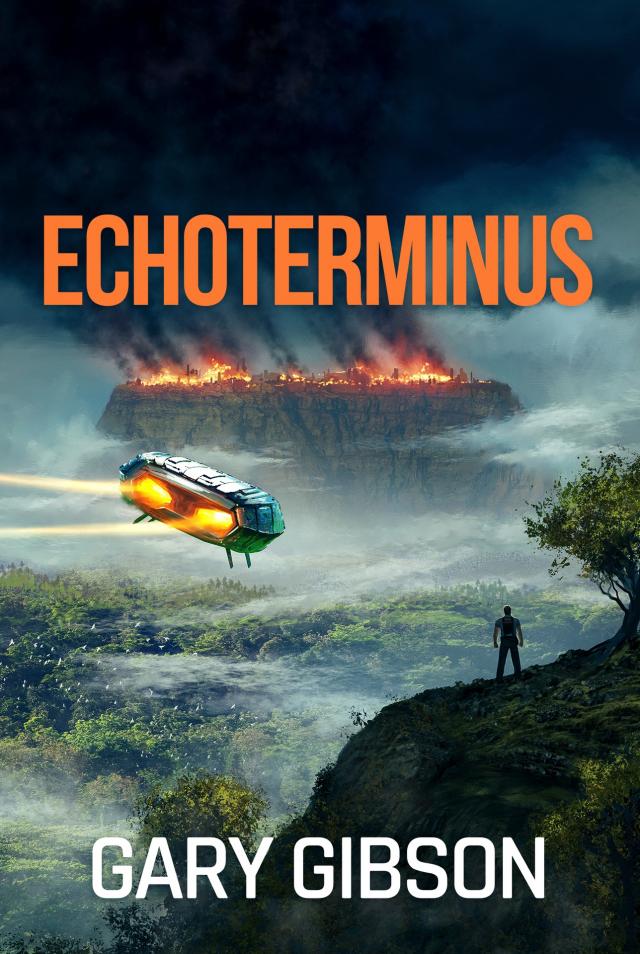
ECHOTERMINUS
ECHOGENESIS SERIES
BOOK 3
GARY GIBSON
First Published by Brain in a Jar Books, March 2026.
Copyright © 2026 by Gary Gibson.
All rights reserved.
No part of this work may be reproduced in any form or by any electronic or mechanical means, including information storage and retrieval systems, without written permission from the author, except for the use of brief quotations in a book review.
This novel is entirely a work of fiction. The names, characters and incidents portrayed are the work of the author’s imagination. Any resemblance to actual persons, living or dead, events or localities is entirely coincidental. Gary Gibson asserts the moral right to be identified as the author of this work.
First Edition.
ISBN 000-000-00-0-0 (Paperback)
ISBN 000-000-00-0-0 (Hardback)
Cover Design & Illustration © Tom Edwards Design
www.tomedwardsdesign.com
This novel uses primarily English (UK) spelling.
Formatted with Vellum
CONTENTS
Chapter 1
Chapter 2
Chapter 3
Chapter 4
Chapter 5
Chapter 6
Chapter 7
Chapter 8
Chapter 9
Chapter 10
Chapter 11
Chapter 12
Chapter 13
Chapter 14
Chapter 15
Chapter 16
Chapter 17
Chapter 18
Chapter 19
Chapter 20
EPILOGUE
About the Author
Also by Gary Gibson
ONE
GRAMM
“Hello? Dad? Come in. Anyone, come in!”
Nothing but static.
It took an effort of will for Gramm not to throw down his walkie-talkie in disgust. Ever since he had been a young boy, it had been drilled into him, again and again, that any piece of electronic equipment he made use of had to be treated with care: such things were too often irreplaceable. Even if they could be repaired, doing so risked wasting precious resources.
Such things had to be preserved, at all costs.
Above the river by which Gramm stood, a few scattered stars were still visible as the sun slowly rose above the horizon. Something darted overhead, the arc of its leap carrying it from a tree on one side of the river to another on the opposite bank.
A sense of uneasiness gripped him when he contemplated all the possible reasons why no one on the mesa was responding to his hails. Really, he should have radioed in long before now. But the walkie-talkie’s battery was an equally precious resource, and when he had stumbled across it back east, while preparing to leave the old man’s encampment, the device had looked old and rusted, and he had not even been sure it would work.
Besides, he reminded himself, the device’s range was limited: he needed to be closer to the mesa to establish a signal. He was berating himself for nothing.
It had taken a week of canoeing upriver before he’d even been able to glimpse the mesa, and that only after scaling the tallest tree he could find. The sight of it, tiny with distance and nearly lost in a haze of cloud, had filled him with longing for home. For the first time, he understood why some of the Firsters, like Ethan or Kim, talked the way they did about the things and places they remembered from their first life back on Earth.
The need for familiar faces, and for the comfort of his own bed, felt like an ache deep in his bones.
Something small and multi-legged darted past Gramm’s boot, then slid into the river with such rapidity he barely had a chance to glimpse it. Startled, his hand went to the hilt of his hunting knife, and he listened, in case something—some predator, perhaps—had disturbed the creature and sent it scurrying.
Turning, he scanned the darkened forest that lined the river’s shore, in case some threat might be hiding there.
Nothing.
Even so, Gramm felt seized by a sudden, nervous energy that told him something was nearby. The air still carried the noises of the forest, but the calls and cries of small animals and birds had taken on a muted quality, as if the forest itself was waiting for something to happen.
He shifted backward slightly, estimating how long it would take him to push his canoe away from the shore and jump back on board.
Then he saw it, still and watchful in the shadows between the trees, and less than fifteen metres from where he stood.
He saw the Cent’s eyes first. His father—or perhaps it had been one of the other Firsters—had once told him the eyes of a Cent resembled those of a cat, although Gramm, having never seen a cat, had only the vaguest notion of what this meant.
It had been standing so perfectly still that its very lack of motion rendered it almost invisible.
Gramm’s nerves thrummed with the need to flee or defend himself. Cents avoided running water, so to see one this close to the river—and after the sun had risen, no less—was more than a little unusual.
Even so, he cursed himself for having allowed the creature to get so close to him without his realising.
Now that he thought about it, though, he realised he’d never seen a Cent at such close range—at least, not in the wild. Moving slowly, he grasped his hunting knife and brought it around before him, his mouth turning gritty and dry. At first he took a careful step back toward the water and his canoe. Then he realised he would likely have a better chance of surviving this encounter if he swam to the opposite shore: dragging the canoe out into the water would take too long.
Painted stripes ran along the Cent’s flanks. It huffed, its broad nostrils flaring. In one clawed hand it held a spear, one end of which was driven into the damp soil, and it wore a broad, tanned belt above its front set of legs. From what Gramm could see, the belt held dozens of wicked-looking blades tucked into loops.
Suddenly the Cent’s gaze shifted to some point past Gramm’s shoulder, its irises dilating. Then something lit the trees from above, the shadows between the trees shifting from left to right.
At first, Gramm wondered whether burner-ticks had triggered a forest fire. Then the light grew yet brighter, as if the sun were rising a second time—and from the wrong direction.
Then he looked behind himself and saw what the Cent had seen: not the sun, but something else—something Gramm couldn’t make sense of—a minuscule black point surrounded by a blaze of light, racing across the sky from one horizon to the next.
Thunder rippled through the air, a booming crash that sent untold numbers of winged creatures spiralling up from the treetops and screeching in distress. The object passed over the mesa, turning slightly to the north.
Another lander. It could be nothing else: the same kind of craft that had brought Gramm’s parents to Aranyani...
Except…Gramm’s father had reprogrammed the Tsiolkovsky so there couldn’t be any more landers. He had done that in another life, literally so.
So how could…?
Gramm wasn’t sure what made him look around at that exact moment: it might have been the whisper of the thrown spear as it flew toward him, or something else—some uncanny premonition of danger that caused him to jerk to one side. It was fortunate that he did, for the spear missed him by scant millimetres.
With a soft, almost innocuous splash, the spear landed in the river.
The Cent roared its fury, but Gramm was already on the move. He ran as fast as he could, the air feeling dense and heavy, as if determined to slow him down long enough for the Cent to catch up. Then he dived into the river’s freezing waters, swimming hard.
Something tiny and silvery flashed through the water, narrowly missing him: probably, he thought, one of the blades stored in the Cent’s belt. But rather than investigate, Gramm kept pushing until his lungs burned and he had no choice but to surface.
He surfaced halfway across the river, spluttering and half-numbed from the cold. The Cent stood where Gramm had been moments before, venting its rage.
Something dark and sinuous slid past Gramm’s foot, making a curving ripple in the water; but he was far more afraid of the Cent than he was of anything else that might swim through those waters.
He stared forlornly at his canoe, but to retrieve it would be suicidal. He would simply have to wait and hope the Cent did not destroy it.
Sucking in air, Gramm began to pull toward the far shore, fighting against the current that threatened to carry him back downriver and further from home. Again and again his paddle dipped into the water, while he ignored the numbing cold worming its way under his skin. The Cent continued howling its rage as he dragged himself back onto dry land.
Flopping onto his back on the not-grass, he tried to make sense of what had just happened.
Cents kept their distance most, if not all, of the time. And while attacks were far from unknown, neither were they guaranteed. Why this was the case, when in the past they had laid siege to human-crewed landers soon after they touched down, was a question that remained as yet unanswered.
Perhaps it was something to do with the alien psychology of the Cents, as the Amit on the mesa had once suggested: one more piece of a complex puzzle they had never solved.
But this time was different. This time, the Cent had done nothing, merely watching him—only to attack at almost the precise moment that a lander appeared in the sky.
As if, h e thought, a trigger had been thrown.
He didn’t have time to ponder this question, however. Even out of the water, the cold continued to work its way deep into his bones. He needed to move, to warm himself up, and find shelter before he could contemplate his next move. Standing carefully, he searched the nearest trees, then selected one, studying its gnarled branches for the fastest route off the ground.
And once he had found shelter, high above the river, all he could think about was what the arrival of a new lander meant.
A few short hours later, Gramm made his way back down to the river to where he could see his canoe, still where he’d abandoned it on the opposite shore. He could see no sign of the Cent he had encountered; even so, he waited to be sure, watching the trees for signs of movement until the sun had tracked some distance across the sky.
When he was sure the threat was gone, Gramm waded back into the water and swam back across to the opposite shore. This part of the river was wide, and the waters fast-moving, and he had been lucky not to be swept away. After some hunting around, he managed to locate his backpack, which remained intact, despite being trampled in the mud.
The strips of jerky and dried fruit he’d been carrying inside the pack had mostly survived the ordeal. He chewed down the last of the strips, then carried his backpack over to the canoe to resume his journey. And when night came and he again made his bed high in the trees, the forest echoed with the sound of countless Cents howling as they prepared for war.
TWO
KEIRA
As soon as Piper had said there was another lander in the sky, Keira rushed outside the comms hut and into the early morning light.
Overhead, she saw a tiny black dot at the centre of a great mass of flames and light trailing behind it. As she watched, the lander—if that was what it was—banked hard.
A thunderous boom rolled across the mesa. At first, Keira thought it might be thunder, but the skies, while grey, were clear.
The noise had come, she realised, from the lander.
Even after the craft passed out of sight beyond the mesa, Keira remained where she was for long seconds, suddenly aware of a silence deeper than any she had ever known: no matter the time of night or day, the forest was always full of the hum and cry of wildlife—an endless cacophony of such familiarity that she felt unsettled by its sudden and unexpected absence.
Then something in the forest below the mesa broke the silence with an insistent, trilling note. Within seconds, other voices joined it, and soon enough the air was once more full of the sounds of Aranyanian life.
It felt as if nothing at all had happened: as if the whole world had not changed in an instant.
She turned at the sound of voices and saw Piper conferring hurriedly with her father at the open door of the comms hut.
“Did you see that?” Keira asked them. The question was unnecessary, of course, but she felt driven to ask regardless, as if she needed to hear someone else confirm what she had seen was real. “It is another lander, isn’t it?”
Her father, Vic Traynor, turned to look at her. “It would seem so, yes.” Then he turned to Piper and resumed talking with her in a voice that was too low for Keira to make out his words.
“So what do we do?” Keira asked, stepping back toward them.
“I’m working on that,” her father replied. He nodded across the mesa in the direction of the barn. “Go see to the two women,” he told her, referring to Angelina and Anna, whom Keira had refused to allow to be kept with the other mesa-dwellers. “And remember what I said—those two women are your responsibility now.”
“But—shouldn’t we talk about the people on that new lander? We have to rescue them! We need to find out where they’re landing, so we can get to them in time before the Cents—”
“I just gave you an order,” her father snapped. “Nobody is guarding those two women, Keira. Go now and make sure they’re not actively working to sabotage our plans.”
He turned and reentered the comms hut. Nonplussed, Keira stared at his back, unsure what to make of his sudden dismissal.
Didn’t he care?
Piper followed Traynor back inside the comms hut, then reemerged a moment later with a printed rifle. “Take it,” she told Keira, stepping over to her and handing her the weapon.
Keira’s hand shifted automatically to her hunting knife in its sheath. “I’d rather—”
“I don’t care,” said Piper. “Take it anyway. They’ll respect it a lot more than a knife.”
“We’re going to do something about that lander, aren’t we?” Keira asked.
Piper gazed at her expressionlessly. “We’ll do something, yes.”
“Connor and Lucia,” Keira asked. “I haven’t seen them. Where are they?”
“On their way,” Piper reassured her. “You’ll see them soon enough. They’re both well and looking forward to seeing their mother again.”
Once again, Piper offered Keira the rifle. Mutely, Keira accepted it, and Piper stepped back inside the hut.
For a moment Keira remained where she was, sensing something was wrong, but unable to find the words to explain why she felt that way. Then she reminded herself of the lesson her father had drilled into her ever since she was young, and increasingly so after some unknown beast had crippled her brother Sean: the need to obey instantly, and without question.
On her way to the barn, and off in the distance, Keira saw Wardell Brooks, another of her father’s people, close by the mesa’s lander. He was working on the lander’s mini-copter, which she remembered seeing parked beneath one of the lander’s wings not long after DeWitt had liberated her from the barn.
The tiny, two-person helicopter had been moved out from under the wing. As she watched, Wardell climbed aboard the machine. Soon, its rotors began to turn, lazily at first, and then with increasing speed. Then it lifted into the air, banking south and picking up speed as it flew away from the mesa.
When Keira reached the barn a few short minutes later, she saw Angelina standing just outside the barn door, staring fixedly toward the north—the same direction in which the new lander had been heading.
“Hey!” Angelina called over to her when she saw Keira approaching. She pointed excitedly toward the horizon. “Did you see that? You know what it has to be, right?”
“Another lander,” said Keira. She nodded at the open barn door. “I need you back inside.”
“It was incredible,” said Angelina. “I mean, I’ve never seen anything like it. The noise…! I guess now we know what it felt like for them.”
Keira’s brow knitted in confusion. “‘Them’?”
“The Cents,” said Angelina, as if it were obvious.
In truth, the same thought had already occurred to Keira: how it must have seemed to the Cents that their world was ending, when they first witnessed a lander’s arrival. And, in a way, it had.
No, Keira told herself, shocked at her own heresy-laden thoughts: the Cents were animals, nothing more. It was as her father always said: even back on Earth, there had been many species that exhibited similarly complex, seemingly intelligent behaviour, but which had no innate intelligence.
The Cents were no different.
To hide her anger, Keira gestured brusquely at the open barn door. “I won’t repeat myself,” she snapped.
“Or what?” Angelina regarded her with contempt. “You’ll shoot me with that rifle?”
“Or club you with it,” said Keira. “Your choice.”
Angelina’s mouth thinned to a bloodless line when she saw Keira was serious. Without another word, she turned and stepped back inside the barn.
When Keira entered behind her, she saw Anna sitting on her cot with her hands wrapped around her knees, looking much younger than she was.
“Is everyone okay?” Anna asked plaintively. “Is Ethan coming back?”
“What does it matter?” said Angelina, shooting Keira a venomous look. “Tell me, what’s the point of quarantining the two of us here, when you’re out there infecting everyone you come into contact with?”
“Ethan didn’t get sick,” Keira pointed out. “And he was here watching over us the whole time.”