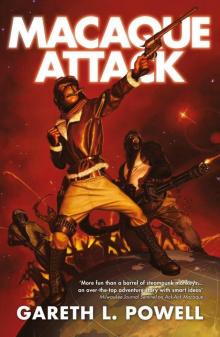
Six Lights off Green Scar, page 1


Six Lights off Green Scar a short story
by Gareth L Powell
1.
Roulette ships were dangerous and sexy. They were small and fast and tough. Their hulls were black tungsten alloy laced with smart carbon filament. They looked a bit like flint arrowheads. The media called them "roulette" ships because they were used for random jumping.
Random jumping was an extreme sport. It was the ultimate gamble. It was a pilot throwing his craft into hyperspace on a random trajectory, just to see where he'd end up.
Some discovered habitable planets, or rich mineral deposits. They became celebrities. They brought back wild tales of bizarre planetary systems, of swollen stars and uncharted asteroid belts. But the risks were huge. Roulette pilots gambled with their lives, and there were ugly rumours of ghost ships, of murder and cannibalism, and individuals dying lonely, lingering deaths in distant star systems. Those lucky enough to find their way home clustered on worlds close to the edge of familiar space, where they could stand under the clear night sky and see the unexplored frontier stretching away before them. Pik Station was one such world. It was a dirty little outpost on a half-forgotten moon. Its buildings were low and squalid, like bunkers. Down by the spaceport, drifters and tired hustlers worked its narrow streets. They huddled at its windy intersections in flapping coats, waiting for the right deal, the big score. Sal Dervish moved among them, avoiding the ebb and flow of their skinny bodies. He wore a heavy coat and a set of stained ship fatigues. His breath came in ragged clouds and his insulated boots crunched solidly on the icy ground. He was the master of the Wild Cat, an old roulette ship in storage at the port. She needed an overhaul but he couldn't afford it. Some days, he could hardly afford to eat.
The bar he was heading for was a squat, scrappy affair, built of packing crates and corrugated iron. Whenever a shuttle lifted from the port, its walls and windows shook. As he opened the door, a woman detached herself from the counter and came over.
'Captain Dervish?' She had a reedy accent and wore a smart green parka with the hood thrown back.
He squinted. 'Are you Vance?'
She took his elbow and guided him to a table near the fireplace, where two glasses and a bottle of local rot had been laid out.
'Call me Tamara,' she said. She poured the drinks and handed him one. As he sipped it, he studied her. She had hair the colour of copper, pulled back into a loose ponytail. When she spoke, it was from the side of her mouth.
'Thank you for coming,' she said, 'I know it can't have been easy.'
Sal put down his glass. 'How do you want to do this?'
She looked at him from beneath her long lashes.
'Take a seat,' she said.
When they were settled, she activated her voice recorder and leant across the filmy table.
She said, 'Let's start at the beginning.'
'The beginning?' Sal scratched his nose. They were trolling around a brown dwarf six lights off Green Scar when they found the derelict ship.
'It looked like hell,' he said. 'Like something from a sewer.'
Tamara nodded. She had her attention focused on the recorder, adjusting the sound levels.
'And this was a random jump?'
He took the bottle and refilled his glass.
'It was our fourth jump in a row,' he said. 'We were going for the record.'
'So what happened?'
'What happened?' He puffed his cheeks out; even now, he could feel the adrenalin tingling in his blood, the breath catching in his throat. He said, 'We found a derelict ship, like nothing we'd ever seen. Kate said it would be worth a fortune.'
Tamara consulted her notebook. 'She was the first aboard?'
He nodded. 'She went over with Petrov. They wanted to take some pictures, collect some samples, that sort of thing.'
'And something attacked them?'
He pushed back on his stool. 'They started screaming,' he said. 'There was something in there, taking them apart.'
'And so you turned tail and ran?' Tamara said. He clenched his fists. 'They were already dying,' he said. 'There was something in there with them, something horrible.'
He wiped a hand across his forehead.
'Are you okay?' she asked.
He took a deep breath. He said, 'I don't like talking about it.'
She looked him in the eye, her gaze long and cool, like the snow outside. She said, 'I'm paying you.'
He shifted uncomfortably.
She said, 'I've heard the stories. I know the other pilots treat you as a pariah, a jinx. They say you've lost your nerve and you'll never jump again.' She reached over and touched his wrist. Her fingertips were cold and rough, like frost. 'But you used to be a big star, back in the day. People want to find out what happened to you, how you ended up in this desolate wasteland.' She waved her hand in a gesture that encompassed the bar, the street, and the dirty snowfields beyond. He turned away. He wished he'd never agreed to meet her.
'I'm offering you a way out,' she said, 'a way to redeem yourself.'
'I don't care about that.'
She withdrew her hand. She put her glass down and pushed it away with her fingernails.
'You cared about Kate, didn't you?' she said. He dropped his gaze. 'More than you'll ever know.'
'Then come with me,' she said. 'I'm going in search of your derelict, and I want you to come along. I want to get your reactions, see the thing through your eyes.'
She tapped a painted fingernail on the plastic casing of her recorder.
'It could be a great story, Sal.'
He stood. The legs of his stool scraped loudly on the concrete floor. Around the bar, several heads turned his way.
'I've spent the last two years trying to forget,' he said. She leaned back, arms folded.
'And has it worked?'
Kate Schnitzler was an engineer. Her hands were rough and she had dirt under her nails. She wore canvas dungarees and a grease-stained t-shirt. She liked machines for their dependability and precision. She had hair the colour of sunlight and she made a point of brushing her teeth every evening, no matter how tired or drunk or lazy she felt. She liked the smell of engine grease and she liked to have her back stroked after sex. When not sharing his cabin, she slept in the cargo bay, curled in an old inflatable life raft from the ship's emergency locker. The orange distress beacon threw eerie moving shadows across the walls.
'When you're running from something, you can't trust a soul,' she once said. 'Not friends or family --they know who you are, where you go, what you do. To get away, you've got to change, got to do something unexpected.'
It took him a month to get up the courage to ask her what she was running from. They were welding a buckled hull plate at the time, in the heat and dust of a dry desert world. She pushed up her black goggles and fixed him with sad eyes.
'We're all running from something, Sal,' she said. 'People like us don't belong anywhere. Wherever we are, we've always got one eye on the exit, one foot out the door.'
She stretched her bare arms over her head. 'It's like we were given the wrong lives, you know? Like we've been running from them for so long that we can't remember what it feels like to be still.'
It was nearly midday and the hot wind blew thin fans of sand and ash across the runway's shimmering tarmac. She put her arms around his waist and her hair tickled his chin.
'We're like sharks,' she said. 'We have to keep moving, or we suffocate.'
2.
Random jumps through hyperspace were often rough, like passing through white-hot plasma. Only streamlined ships with heavy-duty heat shielding could batter their way through. Ships like the Wild Cat, for instance. They were sturdy and dependable. They were designed for abuse. You could slam one into a rocky moon at Mach Four and probably walk away from the wreckage unscathed. Even so, Tamara Vance knew that most professional "roulette" pilots wound up dead sooner or later. They just kept pushing the envelope, racking up the odds until something broke. It didn't matter how safe their ships were, or how tough; the danger was addictive, compelling. These guys just kept tempting fate until something gave. Take Sal, for instance.
As a roulette pilot, he'd seen strange and terrible things, and staked his claim on half a dozen new worlds. He'd jumped deeper into the unknown than anyone else. Where other pilots crumbled or collapsed, where they lost their nerve, he kept flying. He wasn't afraid, and that lack of feeling had given him an edge. For a short time, it had made him unbeatable. It was only when he met Kate that he appeared to let his guard down. For the first time, he became vulnerable. He started worrying about someone else.
Back in her hotel room, Tamara felt jittery, the way she always did when working on a big story. But this time, it was worse than usual. There was something about Sal Dervish that annoyed and fascinated her. He was a wreck, and she wanted to understand why. But more than that, she wanted to help him.
She stripped off and stepped into the shower. She let the warm water drum into the kinks in her shoulders. She told herself she shouldn't get involved, that she should concentrate on the story. She had her career to think about.
Random jumping was still big news back in the cities of the Assembly's comfortable inner systems. For people whose only experience of flight was a twice-daily trip on a commuter shuttle, the idea of people like Sal Dervish hurling themselves into hyperspace was a wild, almost unbearably exciting prospect: it meant they could emerge almost anywhere and find almost anything. Some random jumpers had grown wealthy and famous from their discoveries. It was a good way to get rich quick, and a good way to get killed. She rubbed shampoo into her hair. In ancient times, she thought, they'd have been shamans. They'd have been the ones dosing themselves on whatever drugs came to hand, pushing the boundaries of reality in search of answers. They'd have been out there, cavorting in the firelight while the rest of the tribe lived their trip vicariously, too scared to take the plunge themselves.
To a reporter like her, it was a goldmine. It was compulsive, must-see entertainment. And she knew she'd been incredibly lucky to track down Sal Dervish. He'd been such a high-profile burnout that no one in the random jumping community seriously expected him to jump again. After two years in the wilderness, he'd become an almost mythical figure, halfway between an urban legend and a cautionary tale.
She stepped out of the shower and pulled on a robe. If she could take him back to the scene of his downfall and make him face his fear, then this time next year, she'd be sitting behind an anchor's desk, where she belonged.
She had all her hopes pinned on this story. Too many to let her relax and wait for his call. She needed to be active. She got dressed and went out, making sure she had her phone in her pocket. It took her only a little over an hour to walk the entire length of the settlement, and she was glad of her parka. She watched condensation freeze on the giant fuel silos at the port. She read the graffiti on a row of old spherical descent modules. She saw a couple of drunken ice miners beat each other senseless in the bloody snow outside one of the crappier downtown bars.
Eventually, fed-up and alone, she found herself wandering the streets on the edge of town. Overhead, the stars burned fierce and blue. The dirty snow squeaked underfoot. The cold air bit at her nose and ears; it scoured her lungs. To someone used to the bright lights of the inner systems, Pik Station was a bitter, dismal place. In a dingy bistro off a side street, she stopped to thaw. They had an open fire, and she needed to get the chill out of her bones. She ordered a drink and took it to a table near the hearth. But no sooner had she got comfortable than a thin guy with hard bright eyes approached her.
'Miss Vance, I presume?' he said.
She was taken aback. She was used to being recognised on the streets of the inner systems but not out here, in the sticks. She was surprised anyone knew who she was.
He bowed his head and said, 'I thought as much. There aren't that many women walking these streets in hand-stitched Swiss snow boots.'
He held out a hand and she took it. He looked halfway familiar but she couldn't place him. Beneath his leather coat, he wore a white suit and leather cowboy boots. She could smell his aftershave. She said, 'Have we met?'
He smiled. He lifted her hand and brushed it with his dry lips. There were thick silver rings on his fingers.
'I suppose it's possible,' he said. He shrugged off his coat and beckoned the barkeeper.
'My name's Dieter,' he said. 'Can I buy you a drink?'
3.
When Sal got back to the Wild Cat, Laurel-Ann was waiting for him. He'd been hoping she might've got bored and left.
'Where've you been, Sal?' she said, smoothing down her vinyl skirt with pale fingers. The overhead lights glittered off her lip-gloss. He pushed past her and staggered down to his cabin. He showered and slipped into a polyester robe. There were still a few bottles of rot in the hold. He took one to his bunk. When she joined him, he ignored her. He didn't want her there, didn't even want to look at her.
'Just leave me alone,' he said.
She didn't understand. She was nineteen, with bad skin and bleached hair.
'What's the matter, baby? Have I done something wrong?' Her voice was thin and pleading and he hated the sound of it. He rolled over and pointed at the hatch.
'Just get lost,' he said.
Her face fell. For a moment, he thought he caught a glimpse of something vulnerable behind the make-up and breast implants. Then her lip curled. She sniffed, adjusted her top, and gathered her few belongings together. He closed his eyes and listened to her heels stamp across the deck. At the hatch, she paused.
'Fuck you,' she said.
When Sal was young, he was awkward and fidgety and raw. He grew up in a town near a failing seaport. It was shrouded in fog most days, and the port lights made the sky glow a hellish orange. When it wasn't foggy, it was raining, and the corrosive salt air blew in off the muddy grey mouth of the estuary, cold and sharp like rusty barbed wire.
Lowell Creek, like Pik Station, was the sort of dismal hinterland most people only passed through, on their way somewhere else. Those that stopped and stayed tended to be lost or desperate, or beyond caring. Either they were looking for trouble, or they were trying to hide from it.
He grew up in a house by the river shore, in a row of fishermen's cottages. At high tide, the lamp light from the front room window spilled out over the muddy creek water. When it rained, the lights of the houses on the far shore swam and smeared. He'd wait there, by that window, when his father was out, waiting for the lights of his little boat to appear through the gloom, listening to the pop and sizzle of the ship-to-shore radio.
Until one night, his father failed to return. It was the night the Endurance exploded. Lightning crackled through the overcast sky. Thunder growled. The waves crashed over the flood defences, smashing their spray against the shingle walls of the house. During lulls, he could hear foghorns out in the channel. His mother joined him at the window.
'It's time you were off to bed,' she said half-heartedly. He rubbed the glass where it was misting. He could see she didn't mean it, that she wanted his company.
'Just a few minutes more,' he said.
Down by the creek, he could see lights: There were kids on the Endurance.
She was a rusty old hovercraft, built to transport cargo. She lay in the mud at the back of the creek and the local teenagers used her as a hangout. They sat in her hold, drinking and smoking. When her leaky fuel tank exploded, the blast shook the windows of his house. It echoed along the street. Front doors were thrown open and people appeared, pulling coats over their pyjamas. His mother went with them.
It took most of the night to bring the blaze under control. There were kids trapped by the fire. Driving rain and intense heat hampered the rescuers. And all the while, out at sea, Sal's father was drowning. The storm had swamped his small boat. With everyone crowded around the burning Endurance, there was no one to hear his final, desperate calls. No one except Sal, listening to the radio as he clung helplessly to the window, too scared to move.
When he was fifteen, he ran away from the pain. He locked his past away, where it couldn't hurt him. He rode the freighters that dragged from world to world. He stowed away. He got his first taste of hyperspace travel. He got a tattoo. He lost his virginity behind a greasy café on a cold world whose name he could never remember. On Strauli, he was caught on the ground during a hurricane that lasted a year; and on Djatt, he spent three days wandering alone in an arctic blizzard. And yet, there was never anything to match the night the Endurance went up. There was nothing that could compare to the fear and helplessness of listening to his father die, alone. And so he became a roulette pilot because nothing could frighten him, nothing could shake him. Nothing... until he heard Kate scream. It brought back the awful, freezing dread of that distant rainy night. Alone in the Star Chamber of the Wild Cat, he'd been terrified. He'd been a boy again, lost and helpless.
And so he'd fled once more. And he hadn't stopped running until he met Tamara.
They were seated around the table in the Wild Cat's galley, playing poker.
Kate said, 'It's my brother.'
'What about him?' Sal thumbed through the cards in his hand. He had six suns and a diamond.
'That's who I'm running from.' She tossed a couple of chips into the centre of the table. Beside her, Petrov studied his own cards and frowned.
'It's not my night, I think.' He reached for the rot bottle and refilled his glass. Sal ignored him.
'Your brother?'
'My twin brother.'
Kate pushed a hand back through her hair and dropped her cards. 'I fold.'
'Me too.' Sal took the bottle from Petrov and made sure her glass was full.
'So, what did he do?'
'My brother?' She shrugged. 'It's not so much what he did, as what he does.'
'And that is what?' Petrov asked, sweeping his winnings into his lap.